

What's the difference between Orthodoxy and Catholicism?
How wide is the Divide? Wider and Deeper than you think!

<rant>
Since this is starting to become a thing that people are tying themselves into knots over.1 How was AI used in the creation of this article?
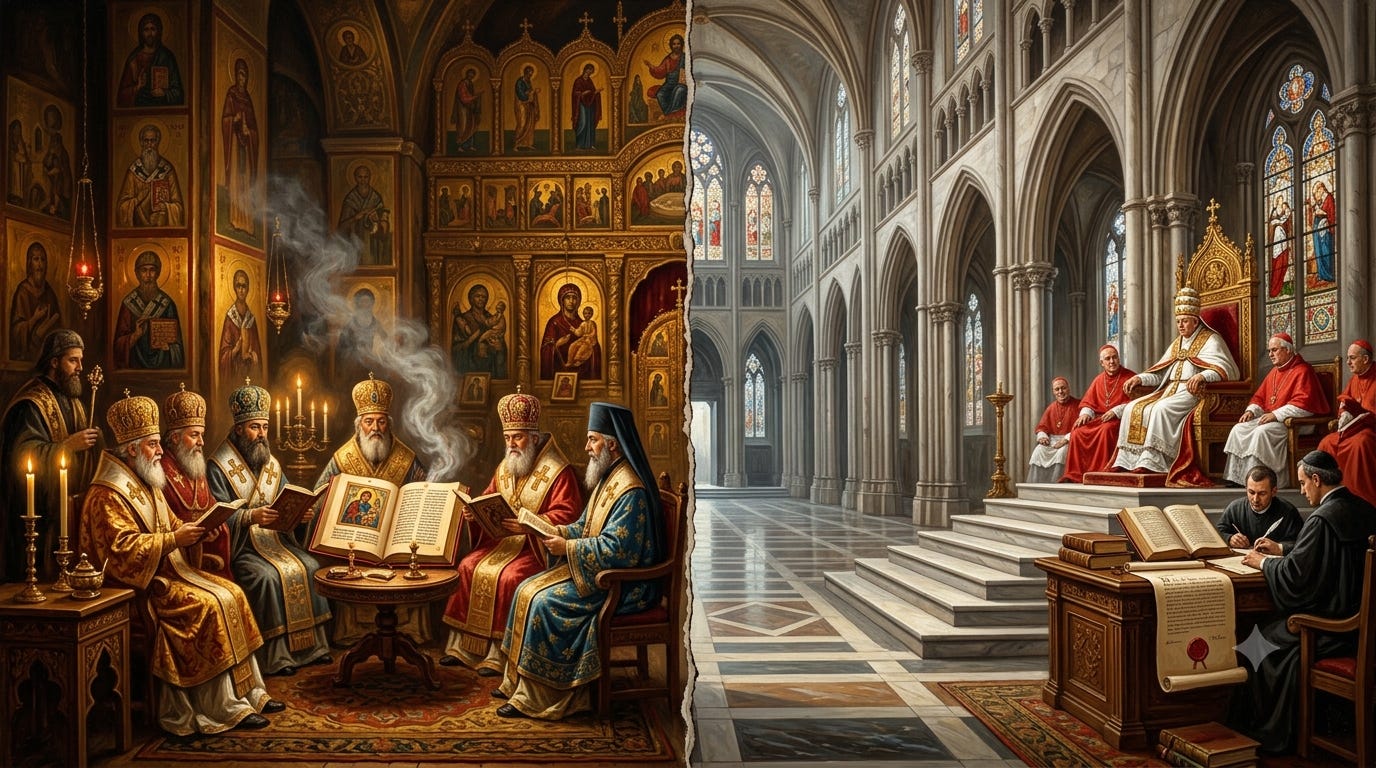
To create the illustration above.
In the writing of a couple of the footnotes, particularly the one on the NPP. I ask the AI to produce a summary of something when in a footnote I want to provide more context or information for the intellectually curious.
To fact-check my memory. Particularly post-stroke, my memory is not always reliable. Thus, sometimes I’ll write something and then cut and paste it into Google Gemini (via the Ask Gemini button in Chrome) and ask. “Is this an accurate statement?” Most of the time I’ve got it right, but it’s not uncommon for the AI to come back with nuance I may be lacking or have missed. A couple of times I have confused things, and the AI had to set me straight.
To dictate my speech. I sometimes use an AI tool called Wisper Flow that transcribes my speech so I don’t have to do as much typing. Carpal tunnel / repetitive stress injury sometimes comes back to bite me.
No REAL HUMAN WRITERS were harmed or lost their jobs in the production of this article.
Yes, yes, I’m being a smart a$$, and you can read that with sarcasm. I grew up in Canada where sarcasm is a sport.
</rant>
Ok, Serious Business now….
Over the past couple of years, many people, upon finding out that I’m Orthodox, often ask me, “How is that different from Catholicism?” (PEOPLE = “family members, mostly my roman catholic cousins, father, uncles, aunts, etc.”)
The truth? I wrote this article because I’m lazy. I don’t want to re-explain it every time. This way I can just cut and paste a URL, hand it to them, and they can read the answer for themselves.
The first question that ${PEOPLE}2 usually ask me is “Why didn’t you become Roman Catholic?” I already answered that question. Which you can read about below: (See, laziness paying off…) This article answers the inevitable follow up question about how they are different.

When ${PEOPLE} say “Catholicism” I infer that they really mean “Roman” Catholicism, because technically the name of the Orthodox Church, AFAIK, is the Orthodox Catholic Church.
Honestly, that is a difficult question to answer, in part because superficially Orthodoxy and Roman Catholicism (R.C.) might look the same (especially to a Protestant or someone Protestant-adjacent like the LDS.) The reality is that once you dig beneath the surface, the differences are stark and they go very deep.
I think it’s beneficial to pause here and provide a quick background. This is from an Orthodox perspective; So don’t get butt-hurt if you are a R.C. and don’t like my perspective. It’s my perspective from the Eastern side.
To be clear, this topic could easily fill an entire encyclopedia of books, maybe multiple encyclopedias worth, so a 5 minute overview means that I’m certainly glossing over a lot of details and nuance and making some (maybe unfair) judgements that Roman Catholics (we call them Latins- which is the term I’ll use here for the sake of brevity) would probably not agree with, but c’est la vie. If you are a Roman Catholic, please don’t take it personally; it is not meant in offense. It is just this one loser’s reading of history.
Note: When I use the word innovation in this article, concerning doctrines/beliefs, that’s not considered to be a positive thing. Orthodoxy views doctrinal innovation negatively, as we believe that we have been entrusted to preserve the Faith that has been once delivered to the saints.
"Beloved, when I gave all diligence to write unto you of the common salvation, it was needful for me to write unto you, and exhort you that ye should earnestly contend for the faith which was once delivered unto the saints."Jude 1:3
The Schism in 5 minutes or less
Preamble
Originally, way way way back in the day, the Catholic Church (the original church created by the Apostles) consisted of 5 main centers of Christianity that we call Patriarchates. The Latins call them Sees.
Rome
Constantinople
Antioch
Jerusalem
Alexandria
Each patriarchate was led/ruled by a senior Bishop called (funny enough) the Patriarch3. The Latins called their patriarch “the Pope” (basically papa.) Governance of the entire Church as a whole was done via the model laid out in Acts 15 - where the Patriarchs (and other bishops) of each Patriarchate would meet together in an ecumenical council to discuss issues and come to a consensus-based agreement.
Some Historical Background
Some time just before Christianity was legalized (see article below), the Roman Empire had grown so large that Emperor Diocletian (~280AD) decided that it was too big for one Emperor to rule by himself. So, he split the Empire into two, called the Tetrarchy; basically creating an East / West division. When Constantine comes along, he unifies the empire and decides to build a new capital in the East at Byzantium (330AD), which later became known as Constantinople.

After Constantine died, his sons divided the empire among themselves, and by 395AD the empire became permanently divided. Rome remained as the Latin center of culture and spirituality4, often administered from Milan or Ravenna for defensive reasons. The eastern portion was administered from Constantinople as a predominantly Greek center. These political and cultural differences laid the groundwork for the eventual split of the church.
As one might expect, the Roman political machine, used to ruling with absolute authority (and often an iron fist), did not take well to being stripped of its power, authority, and the control of the source of much of its wealth. This would emerge over time in the forms of resentment, envy, competition, and avarice. The fact that it took more than 600 years to lead to a total breakdown between the two parts of the empire and its church is a testament to the moderating influence of Christianity.
Each half of the empire continued on very different trajectories, and over time, the political and cultural differences between Constantinople and Rome became irreconcilable. The Western Roman Empire collapsed in the 5th century due to barbarian invasions. In the resulting power vacuum, the Pope stepped in to maintain civil order, take over local governance, and negotiate with invaders, joining religious and secular power into one “throne.” Over time, the Bishop of Rome, like Roman leaders before him, got used to exercising absolute administrative authority throughout the West, and attempted to extend that same model of governance to the East.
In the struggle for power between the East and West, the Roman Patriarchate, with ever-increasing degrees of assertiveness, attempted to extend its authority over all of the other Christian jurisdictions using the doctrine of “Petrine Primacy” as justification5. Below is the basis of reasoning behind the “Petrine Primacy” doctrine. A large part of it depends on one’s reading and interpretation of Matthew 16:18-19.
The Roman portion of the Catholic church advanced the interpretation that, according to Scripture, Peter was designated both as the leader of the apostles and “the rock” upon which Jesus was going to build his church. The name Peter means rock, so this interpretation is not without merit.
The Latins argued that because Peter was the first among the Apostles and was, according to them, the first bishop of Rome, the Roman church inherited the mantle of leadership from Peter.
Therefore, the Pope should have jurisdictional authority over all the other patriarchates and patriarchs.
The Eastern patriarchs, of course, rejected this thesis. They argued instead that:
The “rock” was Peter’s statement of Faith in Christ as the Son of God that Jesus was going to build his church on, not on the strength of any one fallible man.
They pointed out that Peter was the first bishop of Antioch before ever going to Rome. Thus, if Primacy is to be based on where Peter was the first Bishop, then by this very logic the patriarch of Antioch should hold Primacy.
Ultimate authority in the Church rested in the consensus of the Ecumenical Councils and all patriarchs acting collegially (a primacy of honor among equals), rather than absolute administrative or jurisdictional authority vested in a single bishop acting alone. This is the model demonstrated in Acts 15. Nowhere in the scriptures does Peter ever act as a ruler over the other apostles, making or overriding their decisions. They argued that this model does not have reliable biblical or historical support.
Peter did die in Rome, but the claims that Peter was the sole first Bishop of Rome and that he passed a form of absolute jurisdictional authority exclusively to the Roman Patriarchate were viewed by the East as lacking reliable biblical and historical support. The papacy produced documents at the time that they claimed supported their argument, but these documents are now universally recognized as medieval forgeries.6
The Latin arm of the church spared no opportunity in advancing their Petrine Primacy doctrine over the intervening centuries. In 1054 AD, papal legates travelled from Rome to Constantinople to discuss political, theological and jurisdictional issues. The leader of the papal party, Cardinal Humbert, brought letters with him that insisted that the patriarch of Constantinople accept the supreme jurisdictional authority of the pope over all Christian churches7. The Patriarch declined; actually, he refused to even meet with them, which enraged Humbert. So Humbert (who, by my reading of the accounts, seems to have been somewhat belligerent and arrogant) wrote up a papal bull of excommunication and, in the middle of liturgy in the Hagia Sophia, dropped it on the altar and stormed out. The patriarch responded by excommunicating all of the papal legates but not the Pope himself. (It turns out the papal bull itself had no authority, as the pope had died shortly after Humbert and his party had left Rome.)
You can read a much longer treatise on the schism in this article:
Beyond the Break: The Story of the Great Schism of 1054 and Who left Who.

I’ve had a few conversations with Roman Catholics about orthodoxy, and the first thing they always repeat is the roman catholic propaganda that the East broke off from the West. It’s so pervasive that when I saw a recent YouTube short with a Catholic Bishop repeating the same nonsense to his parishioners, I decided to write something about it. This way, the next time someone says that to me, I can hand them this article to reference.
Here is an infographic (not created by me) that basically lays out the Orthodox perspective of the historical timeline of developments in Christianity over time. The baseline red arrow is the continuity of the Orthodox Church. Latins would no doubt place the RC church as the bottom arrow. Even today, their clergy continue to propagate the lie that it was the East that left the West and not the other way around.
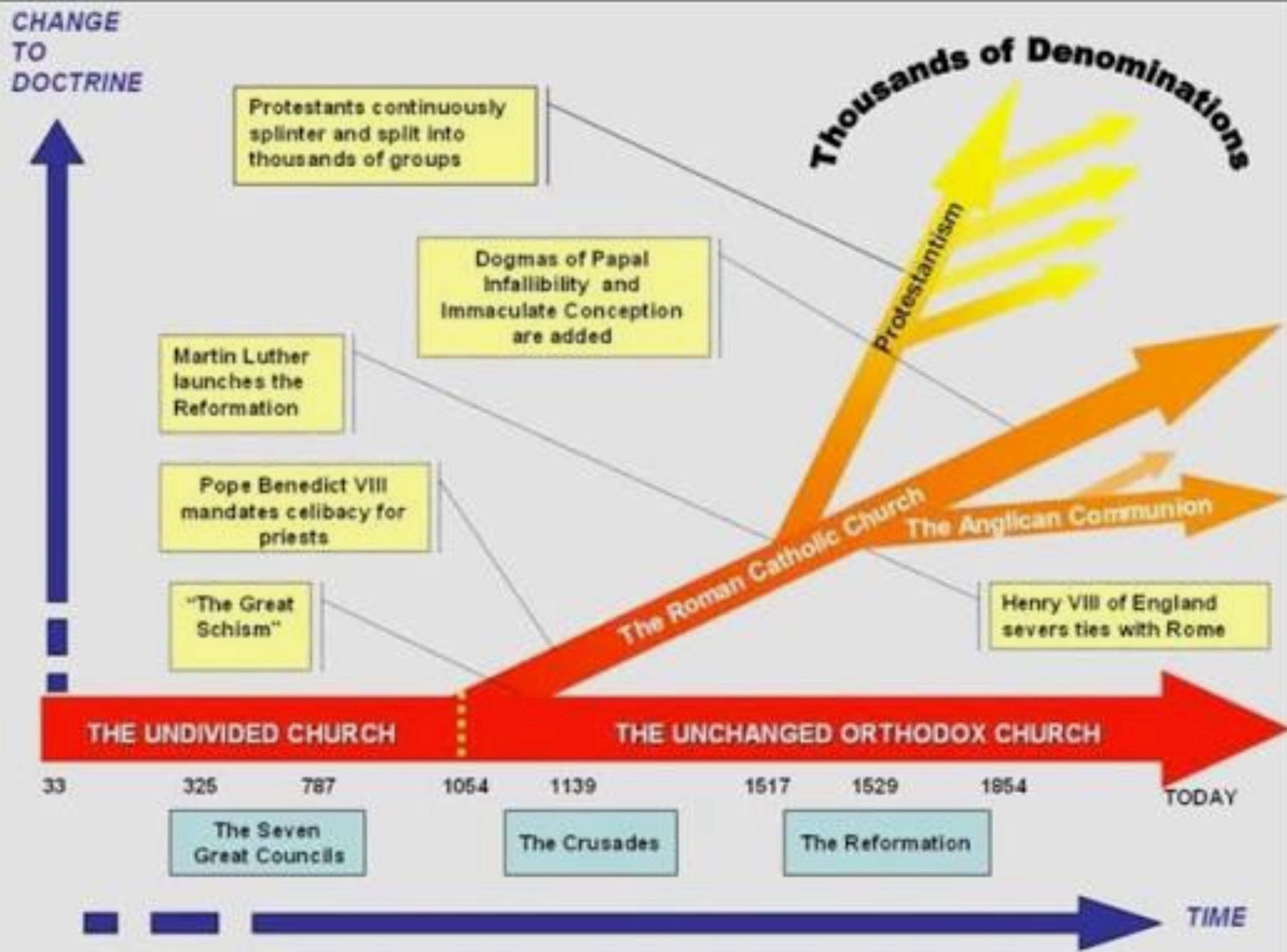
Many Scholars point to this event in 1054 as the official beginning of the split.
After the split. Rome, because they felt entitled to “rule” all of Christendom under their sole authority, went off and “innovated” on its own.
For the first 1054 years, the church had made decisions in a series of ecumenical councils following the pattern established by the apostles in Acts 15. Rome felt that it could command and direct the church on its own. It stopped hearing the rejections of other patriarchs and instead proceeded on its own to do whatever it wanted.
After the schism of 1054, the Latins introduced a series of doctrinal innovations which, in my opinion (and I don’t think I’m alone), depart from the faith held by the undivided Church of the first millennium. These changes violate the faith which had been believed everywhere always and by all, and which in Jude is described as once delivered to the Saints - which was the responsibility of the church to guard and protect against innovation. (Which is why you see the early church fight so hard against early Heresies such as the judiazers/ebionites, subordinationists/sabellianism, Marcionism, Arius/Arians, Nestorianism, the Gnostics, etc.)
Notable Western Innovations that the Orthodox do not agree with:
The Filioque - The modification of the Nicene Constantinopolitan Creed’s article 8 concerning the procession of the Holy Spirit. The Latin version of the Creed, when talking about the Holy Spirit, reads “And the Holy Spirit, the creator of Life who proceeds from the Father and the Son.” The original creed did not include “and the son” (filioque in Latin.) The Creed as finalized by the Second Ecumenical Council states that the Spirit proceeds from the Father. The Third Ecumenical Council (agreed to by all Patriarchs, including Rome) forbade any alteration of the Creed under anathema. Rome inserted the clause on its own authority and later made it obligatory. Orthodox theology holds that this distorts the monarchy of the Father as the sole unoriginate source of the Godhead and introduces a form of subordination into the Trinity.
Papal Supremacy - The claim that the bishop of Rome possesses immediate ordinary and universal jurisdiction over every local church, every Bishop, and every Christian in the world. This doctrine, initially called Petrine Primacy, is one of the driving forces of the schism, finally being dogmatized at the First Vatican Council in 1870. The Orthodox Church recognizes a primacy of honor for Rome among the ancient patriarchates but rejects any universal jurisdictional power vested in one bishop by divine right.
Papal Infallibility - Defined as dogma at the First Vatican Council in 1870. When the pope speaks ex cathedra on matters of faith or morals, his definitions are believed to be irreformable. Orthodoxy teaches that infallibility belongs to the Church as a whole, expressed through the Ecumenical Councils and the consensus of the Fathers, never to a single bishop acting alone.
Inherited guilt from Original Sin. - This comes from Augustine’s understanding of original sin as inherited guilt. Adopted into Western Latin canons in 418 AD and reframed in Thomist theology at the Council of Trent in 15468, the Roman Catholic Church distanced itself from inherited guilt in 1992 through changes to its catechism9. Orthodox reject the notion that any person born today bears the guilt of (or responsibility for) Adam’s sin. We acknowledge that we all inherit the results of the fall of Adam, but not that any person holds any responsibility or guilt due to it. We believe that people are responsible for their own sins alone and not for Adam’s transgressions. This particular innovation led to a cascade of other doctrinal changes to manage the implications of this.
The Immaculate Conception - The teaching that the Mother of God was preserved from all the stain of original sin from the first moment of her conception. This rests on the Augustinian understanding of original sin as inherited guilt. Orthodoxy rejects this and holds that the Theotokos is completely pure and ever virgin and free from personal sin, yet she shares the common human condition of ancestral mortality and corruption from which Christ alone delivers mankind.
The bodily Assumption defined as dogma - Proclaimed by Pope Pius XII in 1950. The Orthodox Church has always celebrated the Dormition (falling asleep) of the Theotokos, and we believe that she was taken body and soul into heaven; we reject the dogmatic definition and its theology because it is tied to the doctrine of Immaculate Conception, which was imposed by papal authority rather than by an Ecumenical Council.
Purgatory and the related systems of temporal punishments and indulgences: The teaching of a purifying fire or intermediate state in which the soul satisfies a remaining debt of temporal punishment after the guilt of sin has been forgiven, as formalized at the Latin Councils of Florence and Trent. We pray for the departed and believe in an intermediate state but reject the juridical framework of satisfaction, the concept of created purifying fire, and the entire apparatus of indulgences as foreign to the Fathers.
The use of unleavened bread in the Eucharist - The substitution of unleavened bread for the leavened bread that had been the universal practice.
Normalization of Baptism by pouring or sprinkling instead of triple immersion - The abandonment of the ancient form of baptism by full triple immersion in the name of the Trinity in favor of sprinkling or pouring. Orthodoxy regards triple immersion as the normative apostolic practice even if pouring or sprinkling are allowed in certain circumstances.
Mandatory celibacy of the priesthood - The requirement that all priests remain unmarried while the Orthodox Church continues the ancient discipline that allows married men to be ordained to the priesthood (bishops alone being chosen from the celibate or monastic ranks).
The scholastic doctrine of transubstantiation and created grace - The definition of the real presence of Christ in the Eucharist through Aristotelian categories of substance and accidents and the accompanying view of grace as a created quality infused into the soul. Orthodoxy confesses the real presence of the Body and Blood of Christ without philosophical speculation and teaches that the energies of God are uncreated. The latter point was clarified by St Gregory Palamas in the fourteenth century against Latin influences.
These innovations are not isolated. They form a coherent system that rests on the claim that the pope can define new dogmas binding on all Christians. The Orthodox Church continues to hold the faith of the seven Ecumenical Councils (agreed upon by all before the schism) and the consensus of the Holy Fathers without addition or subtraction.
Over time, from the schism in 1054 until today, the Latin church has also changed or introduced many unique practices; many of which happened in the Middle Ages. Things like the sale of indulgences (arguably triggering the protestant reformation), Stations of the Cross, and changes to worship. What you know as Mass also diverged over time; after the 2nd Vatican Council, it was significantly “reformed,” becoming the Novus Ordo, an extremely stripped-down (almost Protestantized) version of the traditional Latin Liturgy that has been changed to such a degree that it is almost unrecognizable. There have been struggles amongst the RC laity to preserve access to what they now call the TLM (traditional Latin Mass), but the popes since Vatican 2 have heavily restricted access to it, almost as if they are trying to stamp it out.
Once you get past the large doctrinal changes, there are deeper philosophical and anthropological differences that really change the entire pastoral approach within the Latin church. If you want to dive into the details, I, once again, recommend the podcast by Dr. Nathan Jacobs.
My Dumb Dumb Opinion
What follows under this heading is my opinion and only my own opinion. It’s not a fact-checked scholarly exposition of anything.
I think that for the Latins, over time, there seems to have been a desire to try to explain how everything works. As a result, sometimes they went a bit too far. Even creating a “systematic theology.10” We don’t have this in Orthodoxy. There are things that we recognize that we don’t, and that we probably cannot understand fully, and so we don’t attempt to explain them. We call these the Mysteries.
For example, the Latins came up with a detailed theology of how the Eucharist becomes the body and blood of Christ. This is known as Transubstantiation. We don’t use that term, or their definition. We just say that the real presence of Christ and his grace is available in the Eucharist. How does that happen? It’s a mystery.
I am of the opinion that this same impulse also got them into trouble by trying to systematize a theology of Grace, resulting in ideas like created/uncreated grace, which then resulted in things like the “Treasury of Grace / Treasure of the Church”, aka the infinite merits of “Christ / the Saints”, which ultimately led to the theology of indulgences which led to the sale of indulgences.
In this instance, it went off the rails. We don’t have any of that theology, and we don’t believe in created Grace. When talking about Grace, we have a different framework that is referred to as the Essence/Energies Model, where we participate in God’s uncreated Energies, but not His essence - which is unique to God. This model is sometimes referred to as Palamite theology because it was articulated first by St. Gregory Palamas.
Shared vs Exclusive
Speaking of Saints, I should note that after the split of 1054, Latin and Orthodox catholics each ceased to recognize Saints canonized or elevated by the other. As a result, newly glorified Saints were no longer added to the other tradition’s universal calendar. Any saints canonized by the undivided church continue to be shared by both, but any saints canonized after the split are not recognized by the other branch of the church.
Over time, the Latin church would develop a centralized and highly structured legal process involving beatification steps, miracle counts, and the Vatican’s Dicastery for the Causes of Saints (which is effectively a centralized, curial administrative bureaucracy). The Eastern process is more organic and decentralized. It is almost always a grassroots effort. Local believers recognize a holy person’s life, ask for their intercession, paint local icons, or witness uncorrupt relics or miracles at their grave. With enough groundswell, the local bishop or regional synod investigates the person’s life, teachings, and Orthodox faith to ensure there is no heresy or deception. If that checks out, a Synod of Bishops issues an official decree, adds the saint to the calendar, approves their liturgical hymns, and unveils their official icon. A special service is held where the saint’s relics (if available) are uncovered (elevation of relics) and venerated, and their memorial service is served for the very last time, transitioning immediately into prayer to the saint.
One of the things that should be standing out to you now is this theme of Decentralized vs Centralized. The East is decentralized - which can occasionally result in some limited amount of chaos/confusion whereas the West is highly centralized. I would note that this doesn’t eliminate confusion or chaos if you get into the nitty-gritty. But it does allow more streamlined and unified approaches temporally. However, it also creates a much larger bureaucracy.
Theology
I’m going to do my best here as I am not a formally educated Theologian, particularly not in Roman Catholic theology. What follows is my current understanding, but it could also be very wrong.
Latin theology is heavily influenced by Thomist theology (Which comes from Thomas Aquinas). Thomist theology is a synthesis heavily influenced by Aristotelian metaphysics and Augustinian theology, which itself is heavily influenced by Neoplatonism.
Thomism eventually became the preferred default standard of the Roman Catholic Church, declared the official philosophical system for catholic seminarian education by Pope Leo the 13th in 1879. In the East, we have no such equivalent. We have no systematic theology. Here are some differences:
The West attempts to define everything using logical formulas, metaphysics, taxonomies, and propositions. Systematic theology became very academic and led to philosophical frameworks based on the principle of Faith and Reason.
The East leans heavily on apophatic theology, where we define what we know is not the case rather than trying to define what everything is. This approach is based on the understanding that the things of God are beyond human reason.
Eastern theology does not separate theology from prayer and worship. In the Eastern mindset, a theologian is not someone who got a PhD in Theology. A theologian is “one who prays.” If you pray truly, you are a theologian, because we acknowledge that true theology is only understood and forged through true worship, by living a spiritual life and through the practice of asceticism, not relegation to mental, rational and logical abstractions.
Mindsets - Legal/Juridical vs Therapeutic
Post-Augustine and during the Reformation period, systematic frameworks often leaned heavily on rules along with legal, forensic, and judicial metaphors (original guilt, penal substitutionary atonement, double predestinations, divine satisfaction / justification, etc. are all what I could categorize as legalistic frameworks.) In my opinion, this mindset is commonly shared within Western Christianity: Roman Catholics, Protestants, and even Mormons (protestant adjacent)
In the East, we look at things through an organic and therapeutic lens.
The two mindsets result in very different approaches.
In the East, sin is seen as an illness due to corruption in human nature that needs to be healed instead of a crime that incurs a legal debt.
As a result, salvation is viewed as healing, a restoration of our nature to what God intended, and union with God instead of what I would characterize as a courtroom acquittal (justification) Any time a Latin priest or protestant pastor says you are “justified” “justified by faith” or “made right before God” or even “saved”, what I understand is a reference to a juridical model where holiness/righteousness is really understood in a framework that relies on legalistic thinking.
Martin Luther’s doctrine of salvation by Faith (Sola Fide) alone relies on this type of framework where justification is a kind of legal verdict. i.e., you were declared righteous v.s. you have been healed, and your nature has been transformed - in an ontological sense - to align with the divine reality.
To be fair, the Legalistic perspective is not without support. It didn’t just come out of nowhere. The word justified as used in the bible and can be read in different ways, which produces confusion. The Greek words translated as justified:
dikaiosis / dikaioō - mean to vindicate, to make righteous, or to set right by aligning to something that reflects true righteousness.
To declare righteous / acquit: To pronounce a favorable verdict in a judicial sense (e.g., Romans 3:28, Romans 8:33).
To vindicate / show to be right: To demonstrate or prove that something or someone is right or just (e.g., Matthew 11:19 — “Wisdom is vindicated by her deeds”; 1 Timothy 3:16 — Christ was “vindicated in the Spirit”).
To make righteous / set right: To transform or align something so that it reflects true order and righteousness (e.g., Romans 6:7 — “one who has died has been freed/justified from sin”).
When used in the New Testament as a noun (it’s used only twice by Paul in Romans), the word dikaiosis has a σισ ending which denotes that it is an action or a process that is in progress - i.e. the act of setting something right.
The Septuagint use of the Greek words translates the Hebrew word צָדַק tsadaq - which refers to faithfulness to a covenant relationship or to restore covenantal wholeness. So what is translated in English as Justified really means to be faithful to or restore a covenantal relationship.
Because these terms are central to biblical concepts of law, relationship, and moral transformation, different Christian traditions emphasize different primary senses of the word:
The Forensic / Judicial View (Roman Catholic → Protestant Reformational)
Focus: “to declare righteous” (a legal verdict).
In a courtroom context, a judge does not make a defendant morally good on the spot; the judge declares the defendant acquitted or not guilty. Therefore, when God justifies the sinner through faith, He imputes (credits) Christ’s righteousness to their account and issues a legal pardon.
The Transformative / Ontological View (Eastern Orthodox)
Focus: “to make righteous” (actual restoration/healing).
Greek patristic Fathers emphasized the factitive nature of the verb. When God speaks a word, His word is energetic and creative (e.g., “Let there be light”). When God says a person is righteous, He is not using a legal fiction—He actually infuses His grace to heal, clean, and set the human heart right (Theosis).
The Covenantal / Relational View
Focus: “to reckon as a member of the covenant.”
Modern protestant scholars (like N.T. Wright, who is part of the new perspective on Paul NPP movement - a squarely protestant movement) argue that in Paul’s letters, justification is primarily God’s public declaration of who belongs to His multi-ethnic covenant family, rather than purely an individual’s mechanism for going to heaven or a simple courtroom acquittal.11
Anti-AI sentiment on both the political left and the right, is reaching levels of irrational mass hysteria. For the Anti-AI justice warriors out there making the rounds on Substack attempting to bully people into not using AI. Here is something to consider. It’s currently fashionable to call everything produced by AI “slop”, but the reality is that humans have been writing utter rubbish - i.e., human slop - on the internet for decades before AI ever came on the scene. AND Guess what? AI is trained on the internet. If you think that AI is producing slop, it’s only because humans wrote literally (pun intended) mountains of slop for at least the last thirty years of the internet, and that’s what it’s trained on. Garbage in, garbage out. If you think AI is slop, then us humans only have ourselves to blame.
For those of you who are not programmers. This is bash shell scripting syntax for dereferencing a variable. i.e. it’s nerd shorthand.
OMG the Patriarchy!!!!!! ok feminists, settle down.
The seeds of this argument begin in the mid 3rd century by Pope Stephen in a jurisdictional dispute with St Cyprian of Carthage. It becomes more formalized in the late 4th century under Pope Damascus 1 where Rome issued a decree asserting that the Roman church’s authority is not granted by Ecumenical councils but by Christ’s promise to Peter. By the 5th Century, this doctrine is actively and aggressively being pushed onto the entire catholic church by Pope Innocent I (401-417AD) and Pope Leo 1 (440-461AD.) Innocent asserted that no major ecclesiastical decision anywhere in Christendom should be finalized without consulting the Roman See. He sent letters to Western and Eastern bishops claiming that all apostolic authority flowed through Peter and his successors in Rome. Leo I provided the final version of the doctrine of Petrine Primacy that Rome still holds onto today. This consists of: the legal concept of Vicarius Petri: Leo argued that the Pope is the plenitudo potestatis (fullness of power) and the legal heir (haeres) of St. Peter. He claimed Peter himself speaks and acts through the ruling Bishop of Rome. At the Council of Chalcedon (451 AD) Leo issued a doctrinal letter (that Peter speaks through Leo) to resolve Christological controversies (controversies about the nature of Christ - specifically at this time the Nestorian heresy.) While the council accepted Leo’s assertion that ”Peter has spoken through Leo”, they also simultaneously passed Canon 28, which elevated the See of Constantinople to equal status and rank with Rome based on its status as the imperial capital. Leo fiercely rejected Canon 28, marking a major rift between East and West over jurisdiction that was to continue until the split.
It’s still not clear to me why Peter being the first bishop of Rome makes Rome the ultimate authority over all Christian patriarchates and over all Christians. Peter was killed in Rome, there is no reliable documentation that he was the first Bishop of Rome, but he was, the first Bishop of Antioch? So, by their own logic, shouldn’t Antioch’s patriarch be the Pope over everyone? Of course that wouldn’t do or be accepted because this is about a thirst for Power, not about any kind of theological right.
This doctrine was formally elevated to dogma (binding under penalty of anathema/excommunication for all Catholics) at Vatican 1 (1870) where the Roman church accepted it unilaterally on their own authority. Vatican 1 defined two specific dogmas:
Papal Supremacy: The Pope has immediate, ordinary, and supreme jurisdictional authority over every diocese, bishop, and Christian (in the entire world.)
Papal Infallibility: When the Pope defines a doctrine concerning faith or morals ex cathedra, his definitions are irreformable of themselves.
The council affirmed that the "guilt of original sin" (reatus) is real and is remitted only through the grace of baptism.
“Sin” by Analogy (CCC 404): The Catechism clarifies that Original Sin is called “sin” only in an analogical sense. It states it is a sin that is “contracted, not committed—a state and not an act.” This kind of brings it inline with the Orthodox perspective that we don’t inherit any sin or guilt, but we have to live with the consequences of Adam’s fall.
No Personal Fault (CCC 405): The Catechism states directly: “Original sin does not have the character of a personal fault in any of Adam’s descendants. It is a deprivation of original holiness and justice...”
Systematic theology is a discipline that formulates an orderly, rational, and coherent account of Christian beliefs. It takes the truths found in Scripture and historical tradition and organizes them into logical categorical systems—such as Theology Proper (the study of God), Christology (Christ), Pneumatology (the Holy Spirit), Ecclesiology (the Church), and Soteriology (salvation). While it developed primarily within Western Christianity (both Roman Catholicism and Protestantism), its underlying methodology creates a distinct contrast with how Eastern Orthodoxy approaches theological truth.
Core Characteristics of Systematic Theology
Topical Categorization: Rather than reading Scripture chronologically or liturgically, it groups doctrines by topic to see how they fit together into a unified framework (e.g., Aquinas’s Summa Theologiae or Calvin’s Institutes of the Christian Religion).
Rational and Philosophical Precision: It leans heavily on formal logic, precise definitions, and philosophical categories, often metaphysics like Scholasticism or post-Enlightenment rationalism, to define boundaries and resolve paradoxes.
Propose-and-Prove Methodology: Typically states a dogmatic proposition, then gathers biblical proof texts, logical arguments, and historical citations to defend it.
Key Differences with Eastern Orthodox Theology
Eastern Orthodoxy does not completely reject systematic presentation, but the Orthodox approach to doing theology differs fundamentally in method, emphasis, and ultimate goal.
A. Mystery vs. Systematization (Apophatic vs. Kataphatic)
Western Systematic Theology: Tends toward kataphatic (positive) theology—defining what God is using logical formulas, categories, and propositions.
Eastern Orthodox Theology: Heavily prioritizes apophatic (negative) theology. Orthodoxy stresses that God in His essence is fundamentally incomprehensible to human reason. Theology is not meant to cleanly resolve divine mysteries, but to safeguard the mystery so that believers can encounter God directly. Paradoxes (e.g., God as both completely transcendent and immanent) are preserved rather than “solved.”
Context: Living Liturgy vs. The Academic Study
Western Systematic Theology: Historically developed as an academic, university-level discipline using rigorous philosophical frameworks separated from the liturgical setting.
Eastern Orthodox Theology: Refuses to separate theology from prayer and worship. The famous patristic maxim by Evagrius of Pontus captures this: “If you are a theologian, you will pray truly; and if you pray truly, you are a theologian.” In Orthodoxy, true theology is forged in worship (lex orandi, lex credendi), spiritual life, and asceticism—not strictly in logical abstraction.
Legal/Juridical vs. Therapeutic Frameworks
Western Systematic Theology: Systematic frameworks often lean heavily on legal, forensic, and judicial metaphors (e.g., original guilt, penal substitutionary atonement, double predestination, divine justice satisfied).
Eastern Orthodox Theology: Views theology primarily through an organic and therapeutic lens. Sin is seen as an ontological illness or corruption of human nature rather than merely a legal debt. Salvation is viewed as healing, restoration, and Theosis (deification/union with God), rather than a courtroom acquittal.
The New Perspective on Paul (NPP) originated as a Protestant movement, primarily led by Protestant scholars like E.P. Sanders (Episcopalian/Lutheran context), James D.G. Dunn (Presbyterian/Reformed), and N.T. Wright (Anglican). It developed in the late 20th century as a re-examination of 16th-century Reformation assumptions—specifically challenging Martin Luther’s reading of Paul’s letters through the lens of late-medieval Catholic legalism.
Revisiting the Reformation: NPP scholars argued that when Paul criticized “works of the law,” he wasn’t attacking a Jewish system of “earning salvation through good deeds” (which Luther mapped onto 16th-century Catholicism). Instead, Paul was addressing Jewish identity markers (circumcision, dietary laws, Sabbath) that excluded Gentiles from the covenant.
Protestant Resistance: Because the NPP challenges classic Reformation formulas regarding Sola Fide (faith alone) and imputed righteousness, it generated major pushback from traditional Protestant—especially Reformed and Lutheran—evangelical scholars (such as John Piper, D.A. Carson, and J. Fesko).
Catholic Reception of the NPP
Catholic reception has been largely favorable and supportive, with important caveats.
Support for the Critique of Luther: Catholic scholars welcomed the NPP because it undermined the traditional Protestant critique that 1st-century Judaism (and, by extension, Catholic theology) was a “religion of legalistic self-righteousness.”
Alignment on Justification as Transformation: Catholic theologians appreciate that NPP scholars view justification in close connection with actual covenantal faithfulness and Christian living, moving away from a purely forensic “legal fiction” view of imputation.
Eastern Orthodox Reception of the NPP
The NPP is viewed as a welcome step in the right direction, but still limited by its Western framing.
Correcting a misreading: The NPP is essentially Protestant scholarship finally realizing that the 16th-century Western legal/forensic framework misread 1st-century biblical texts.
Agreement on Covenant & Healing: Strongly supports the NPP’s emphasis on multi-ethnic covenantal unity and its rejection of a purely individualistic, courtroom-acquittal view of salvation.
Disagreements:
Therapeutic vs. Covenantal: While NPP focuses heavily on the covenant family badge (ecclesiology/covenantal nomism), Orthodox theology places the primary emphasis on Theosis (deification/ontological union with God) and therapeutic healing from sin and death.
Patristic Continuity: Orthodox scholars argue that the early Church Fathers never held the “Old Perspective” Luther held in the first place, making the NPP’s “discovery” feel like a rediscovery of what the early Eastern Fathers always taught.