

Why I *really* Chose Orthodoxy Over Rome
A Former Mormon Traces the Papacy Back to Its Roots — and Finds It Standing on Forgeries

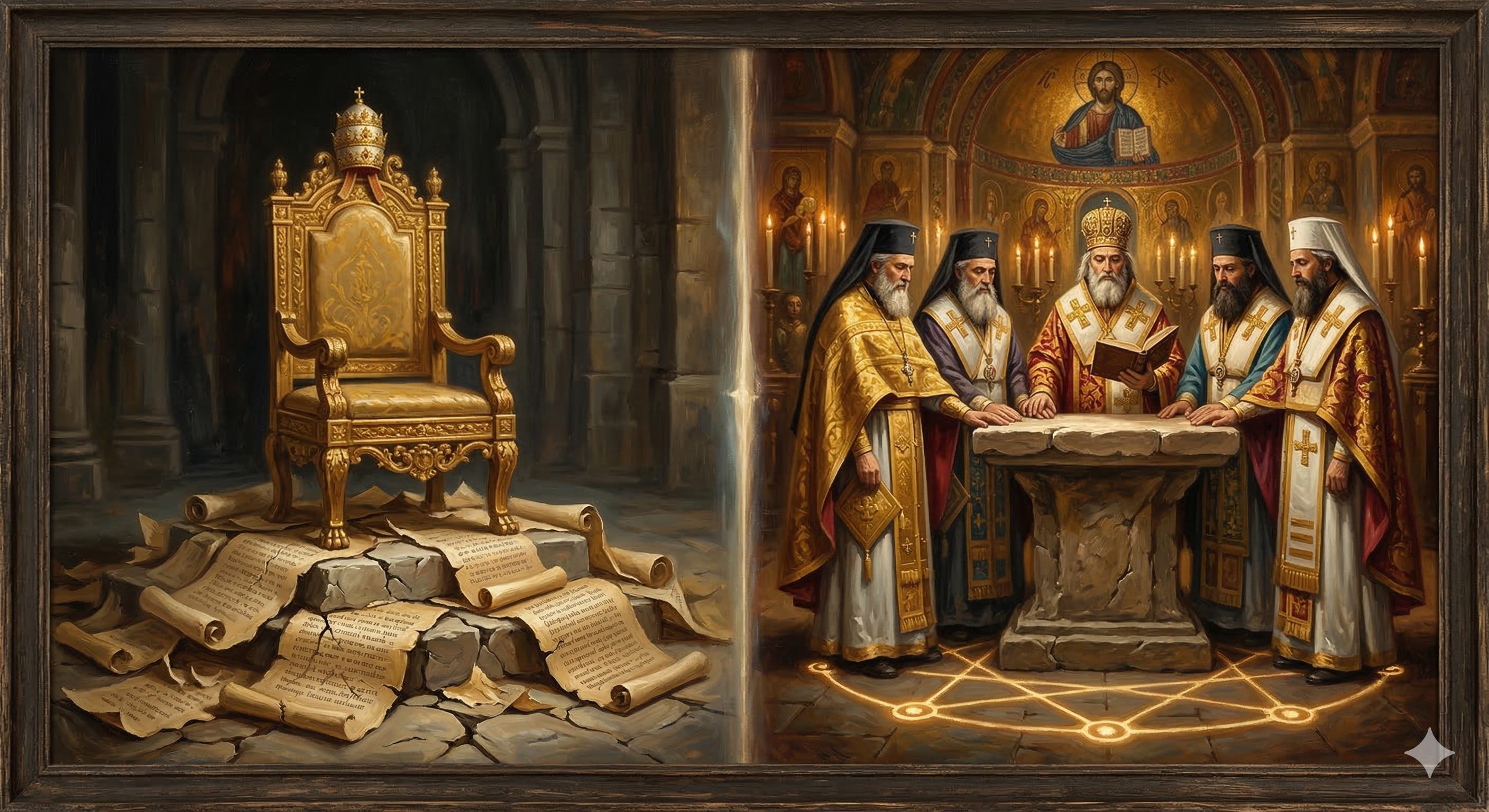
I’ve had a number of discussions over the past couple of years with friends and family who struggle to understand why I did not choose the Roman Catholic church.
When asked this question my normal answer is that I just could not get on board with the papacy. They usually take this to mean that I don’t like the current Pope and seek to reassure me that the Pope changes and one might come along that I would like better, but that’s actually not it at all. I cannot get on board with the institution of the papacy. Maybe this is just a holdover from my many years of being Mormon, where they basically have a Pope, they just call him a prophet or the president of the church. Maybe it’s a form of ecclesiastical trauma? I don’t know…
Usually this question comes from my Father and my cousins who are all Roman Catholic and seem to feel somewhat hurt that I chose Orthodoxy over Roman Catholicism. So here is a much lengthier discussion that goes into much more detail that I hope they can understand. At the very least, even if I’m missing things or my conclusions are debatable, I hope that it’s an illustration of the fact that I spent some time on this subject and put some thought into it rather than dismissing Roman Catholicism out of hand.
Hello!! McFly!! This is your Mormon Trauma Speaking! Why don’t you make like a tree and get outta here!
When I finally admitted to myself that the LDS Church was most likely not true, I became very wary of any organization that claimed authority it couldn’t fully account for. So when I set out to find the ancient Church, the one that actually stretches back to the Apostles, I had a decision to make.
Two traditions stood before me with serious historical credentials: Eastern Orthodoxy (AKA The Orthodox Catholic Church) and Roman Catholicism (The Roman Catholic Church.) Both claim apostolic succession. Both have ancient liturgies, sacramental theology, and unbroken episcopal lineages stretching back centuries. Both are serious. I don’t say that lightly. Coming from a tradition that was invented in 1830 in upstate New York, I had enormous respect for both Rome and the East.
But I chose the East. And I want to explain why in a detailed manner that I hope my friends and family can accept. Please note that this is not an anti-Catholic hit piece. Very large portions of my extended family (really all of it) are Roman Catholic, and I have deep respect and affection for many elements of the Roman tradition — the beauty of its cathedrals, the rigor of its intellectual heritage, the courage of its saints. When my father visits I take him to mass (and participate - to a degree) and I have often attended midnight mass.
But I could not, in good conscience, submit to the papacy as an institution. Not the ancient version of it. To be fair, the ancient version, pre 4th century, I probably could have lived with. The modern version, the post-Vatican 1 version, you know the one that demands you believe the Bishop of Rome has “full, supreme, and universal power” over every Christian on earth, and that when he speaks ex cathedra on faith and morals, he is infallible. That one I could not get behind. I spent 50 years in an organization led by infallible “prophets” of God and saw first hand how that goes.
The papal claims are rather specific, and when I traced it back through history, I found the entire argument, well, wanting.
The Ratzinger Admission
Let me start with a concession that comes from inside the Roman Catholic house.
Joseph Ratzinger, before he became Pope Benedict XVI, wrote something remarkable in his 1982 book Principles of Catholic Theology. He said - and I want you to sit with this, because I certainly did:
“Rome must not require more from the East with respect to the doctrine of primacy than had been formulated and was lived in the first millennium.”
So, the man who would go on to become Pope is admitting that the current form of the papacy goes beyond what the first thousand years of Christianity understood or practiced. He’s saying that if reunion with the Orthodox East is ever going to happen, Rome has to dial it back to what existed before the Great Schism of 1054.
This is not an obscure footnote. This is page 198 of a book written by one of the most brilliant Roman Catholic theologians of the 20th century. It is known in ecumenical circles as “the Ratzinger Formula” and has been cited in Catholic-Orthodox dialogue documents now for decades.
AND here is where it gets interesting. In 1997, after he had become a Cardinal and Prefect of the Congregation for the Doctrine of the Faith, Ratzinger co-signed a Pontifical Council letter that effectively walked this back. The letter stated that the doctrine on the Roman Pontiff “must be accepted in its entirety which incorporates the origins down to the present day.” i.e. never mind what I said earlier, you have to accept all of it, including the parts that didn’t exist for the first thousand years.
Notice what just happened. The same man, wearing different hats, gave two contradictory answers to the same question. As a theologian, with no skin in the papal game, he admitted the papacy overreached. As a Vatican official, he insisted you accept everything anyway. In my opinion, this is not a sign of a healthy institution. This is a sign of an institution that knows it has a problem and can’t figure out how to fix it without undermining its own authority claims. (Hmm where have I seen that before? Traumatic flashback ensues.)
And that, for me, became an issue with the papacy. It painted itself into a corner. It can’t go back to the first millennium model without admitting that Vatican I was wrong. (This is all sounding kinda familiar to me at this point. Case in point, have a gander at this article)
Reinterpreting the Restoration

When I studied religion and anthropology at university, we learned about the process of recontextualization - or reinterpretation- that happens in religions when events don’t turn out the way people expect. This is quite common in prophetic new religiou…
And the papacy can’t stay where it is without continuing to demand things from the rest of Christendom that didn’t exist for the first thousand years of the Church’s life.
Rome knows this is a problem (just like BYU scholars know the great apostasy/restoration argument is a problem.) In June 2024, the Vatican’s Dicastery for Promoting Christian Unity published (with Pope Francis’s approval) a 130-page study document titled The Bishop of Rome: Primacy and Synodality in the Ecumenical Dialogues and in the Responses to the Encyclical Ut Unum Sint. This is the first Vatican text since Vatican II to lay out the entire ecumenical debate on papal primacy in one place. The document acknowledges that ecumenical dialogues have raised serious questions about papal infallibility and universal jurisdiction. It notes that some dialogues “highlight the ambiguity” of the term “rock” in Matthew 16:18, suggesting it may refer to Peter’s faith, or even to Christ Himself, rather than to Peter as a person — and the document treats this as something to be “respected,” not corrected.
Let me repeat that so it lands. The Vatican’s own ecumenical document is now entertaining the possibility that the foundational proof-text of the entire papacy might not mean what Rome has claimed it means for the last thousand years. And they published this with the Pope’s approval.
The fact that they titled it The Bishop of Rome — not “The Vicar of Christ” or “The Supreme Pontiff” — tells you everything you need to know about which direction the wind is blowing. But here is the problem: you can soften the language all you want, but Vatican I’s Pastor Aeternus is still on the books. The dogma of papal supremacy and infallibility has not been retracted. It cannot be retracted without the entire theological system collapsing (hence my comment about painting yourself into a corner.) So what you get instead is a Vatican that talks one way to the Orthodox (first millennium, primacy of honor, synodality) and another way to its own faithful (full, supreme, and universal jurisdiction). Two scripts. Same institution.
I decided I wasn’t going to pretend that corner didn’t exist. So I started doing what a man with Autism and ADHD does, digging deeper, looking into the historical evidence.
What Did the First Millennium Actually Look Like?
If Ratzinger himself admitted that Rome should only ask of the East what was “formulated and lived in the first millennium,” then the obvious question to me was: what was formulated and lived in the first millennium?
The answer is the Pentarchy. (At least that’s the answer I accepted.)
The Pentarchy (from the Greek pente, five) was a system of church governance in which five great patriarchal sees — Rome, Constantinople, Alexandria, Antioch, and Jerusalem — shared authority over the universal Church. We discussed this a bit in a previous article:

Rome held a primacy of honor. It was recognized as “first among equals” (primus inter pares). But it did not hold the kind of unilateral, universal jurisdiction that Vatican I would later claim.
Now, I should be cautious and make sure I’m not overstating my case. The formal Pentarchy as a system wasn’t codified until the Council of Chalcedon in 451 AD. The earlier ecumenical councils at Nicaea (325) and Constantinople (381) established the basic framework by ranking the major sees — Rome first, then Constantinople, Alexandria, Antioch, and eventually Jerusalem. The point is that the governance of the early Church was conciliar and synodal (LDS should read - the church was governed through councils or, if you will, quorums) It was not monarchical. The Bishop of Rome had a primacy — nobody disputes this. But it was a primacy of honor and a court of appeal, not a primacy of universal jurisdiction. (i.e The Roman bishop could not go into another patriarchate and meddle in their affairs, e.g. he couldn’t appoint bishops or priests, etc.)
The ecumenical councils of the first millennium make this clear. Not a single one of the seven ecumenical councils recognized by both East and West defined the kind of papal supremacy that Vatican I would later dogmatize. As the Orthodox scholar Protopresbyter Gavrilo Kostelnik put it, the canons of the ecumenical councils “not only know nothing about the jurisdictional primacy of the Roman bishop based on Peter’s legacy, but in their canons, they most clearly assert that the primacy of the Roman bishop is grounded solely in custom — namely in the historical fact that Rome was the capital of the empire.”
That is a devastating observation. The highest authority of the undivided Church — the ecumenical councils — grounded Rome’s primacy in geography, not in theology. Rome was first because it was the imperial capital. When Constantinople became the new capital, Canon 28 of Chalcedon immediately elevated it to second place, using exactly the same reasoning: political importance, not Petrine succession.
The Peter Problem
Roman Catholic papal theology (as I understand it) largely hangs on some very specific claims: that Jesus, in Matthew 16:18 (”You are Peter, and on this rock I will build my Church”), established Peter as the supreme head of the Church, and that this authority passes to every subsequent Bishop of Rome in an unbroken chain.
These claims are, however, not without issue.
Issue #1: Peter was the Bishop of Antioch first (before Rome)
This is not disputed by anyone, including Rome. According to ancient tradition accepted by both Catholics and Orthodox Catholics, Peter established the Church in Antioch and served as its first bishop before he ever went to Rome. Antioch was no backwater — it was the third largest city in the Roman Empire, and it was in Antioch that the followers of Christ were first called “Christians” (Acts 11:26).
Here is a question that no Roman Catholic has ever adequately answered for me: If the Petrine succession is what gives the Bishop of Rome his supreme authority, then why doesn’t the Patriarch of Antioch have the same claim? Peter sat in Antioch before he sat in Rome (if he sat in Rome at all, which we will get to). By Rome’s own logic, Antioch should be the supreme see, because it was Peter’s first chair. To this day, the Patriarch of Antioch considers himself a successor of Peter, and in my judgment, he has just as much right to that claim as the Pope does. Maybe more, at least the people of Antioch didn’t kill him!
The Roman Catholic response is usually that Peter left Antioch for Rome, and that Rome was his final see, and that this is what matters. But this is special (logical) pleading. There is no theological principle in the New Testament or in any early Church Father that says “the last city an apostle visits gets permanent supremacy.” If that were the rule, then whatever city John the Apostle died in should have supremacy over every see that Peter founded, because John outlived Peter. The logic doesn’t hold. Not only that they narrow it so that it only matters for Peter. I understand why, but it just seems, well, convenient.
Issue #2: The earliest sources don’t call Peter the first Bishop of Rome.
This is the part that really opened my eyes.
Irenaeus of Lyon, writing around 180 AD, provides the earliest formal succession list of Roman bishops. Irenaeus is a towering figure — a student of Polycarp, who was himself a student of the Apostle John. He is as close to the apostolic generation as any writer we have outside the New Testament. And here is what he says:
“The blessed apostles, then, having founded and built up the Church, committed into the hands of Linus the office of the episcopate.”
Read that carefully. Peter and Paul founded the Church in Rome, and then they handed over the office of bishop to Linus. Irenaeus does not say Peter was the first bishop. He says Peter (and Paul — Rome always forgets about Paul) founded the Church, and then Linus became the first bishop.
This distinction matters. In the early Church, the office of Apostle and the office of Bishop were understood as two different things. An Apostle was itinerant — he traveled, planted churches, and moved on. A Bishop was sedentary — he stayed in one place to govern the local church. Peter was an Apostle. Linus was the first Bishop. These are different roles.
Eusebius of Caesarea, writing his Church History in the early 4th century, confirms the same thing: “After the martyrdom of Paul and Peter, Linus was the first to obtain the episcopate of the church at Rome.” Not Peter. Linus. After Peter died.
Now, I can already hear the (weeping, wailing and gnashing of teeth) of Catholic apologists reaching for Irenaeus’s other statement, the one where he says every church must agree with Rome “on account of its preeminent authority.” Fair enough. I am not denying that Irenaeus recognized Rome’s importance. Of course he did. Rome was the imperial capital and the site of the martyrdom of both Peter and Paul. No one in the early Church denied that Rome held a special place of honor. But a “special place of honor” is a very different thing from “universal jurisdiction and infallibility.” Irenaeus himself is the one who lists Linus, not Peter, as the first bishop. You cannot use Irenaeus to prove papal supremacy when Irenaeus himself doesn’t describe Peter as the Bishop of Rome.
Issue #3: The “Peter was the first Bishop of Rome” tradition is likely a later development
The first document to explicitly place Peter at the head of the list of Roman bishops and assign him a specific length of time in office is the Chronography of 354, also known as the Liberian Catalogue. This document, compiled roughly 30-40 years after Eusebius wrote his history, states that Peter headed the Roman church for 25 years, 1 month, and 9 days.
Twenty-five years, one month, and nine days. Down to the day, that’s awfully specific for a man whose whereabouts the New Testament deliberately conceals after Acts 12 ”he departed and went to another place”. Most historians, including Catholic historians, see this level of precision as a “pious invention” — a polite way of saying someone made it up to make the succession look more established than it actually was.
And….. it gets worse.
Pope Leo I, in the 5th century, is the one who fully develops the theological doctrine that the Pope inherits Peter’s authority in a direct, juridical sense. Leo’s Petrine Theory is the foundation upon which everything else gets built. After Leo, the Liber Pontificalis (compiled in the 6th century) takes the names from Irenaeus, the dates from the Liberian Catalogue, and adds specific decrees Peter supposedly issued, details about his burial, and a narrative that made the papacy look like an ancient, functioning government from Day One.
But, in my estimation, having seen shenanigans like this before, having run into the Forgeries see below, as well as understanding the politics of the Roman Empire at the time they weren’t discovering that Peter was the first bishop. They were constructing it, retroactively, to serve the institutional needs of a 5th and 6th century papacy that was rapidly accumulating political power. And I’m not the only one to have this view, not this isn't just my Orthodox reading of the evidence. Peter Lampe, in his landmark study From Paul to Valentinus, demonstrated that there was no monarchical bishop in Rome until the late second century, and that the succession list was "projected back into the past." Robert Eno, a Roman Catholic priest and professor at the Catholic University of America, asked the obvious question:”“If there were no bishop of Rome, then how can one speak of a Petrine Succession?" Even Eamon Duffy, a practicing Catholic historian at Cambridge, admits that the earliest evidence does not support the idea that Peter established a succession of bishops in Rome.1
The Forgeries
This brings us to the part of the story that apologists really don’t like to talk about. In the 8th and 9th centuries, the papacy produced, or at least benefited enormously from, two sets of documents that were used to justify its claims to supreme authority over all of Christendom.
The first is the Donation of Constantine (Constitutum Constantini). This document purported to be a decree from Emperor Constantine himself, granting Pope Sylvester I and his successors spiritual authority over all the churches of the East and temporal authority over the entire western Roman Empire. It was the primary legal basis for the Papal States and for the Pope’s claim to crown emperors (like Charlemagne in 800 AD). It was used for centuries as a foundational legal document of papal authority.
Unfortunately, it was a forgery. Lorenzo Valla proved this definitively in 1440, using philological analysis to show that the Latin in the document contained words and constructions that did not exist in the 4th century. The document was fabricated, almost certainly in the 8th century, to serve papal political ambitions.
The second is the Pseudo-Isidorian Decretals. This was a massive collection of approximately 100 documents, including “letters” from 1st-century Popes (like Clement and Anacletus) that described a highly centralized church hierarchy — one where bishops could appeal directly to the Pope, bypassing local archbishops, councils, and secular authorities. These forged decretals were enormously influential in shaping medieval canon law. They were used for centuries to advance the power and authority claims of the Roman bishop.
They were also forgeries. This is not disputed by anyone, including Catholic scholars. The New Catholic Encyclopedia acknowledges the Pseudo-Isidorian Decretals are fabrications.
Now, to be fair, the Roman Catholic Church did not officially commission these forgeries (at least, there is no surviving evidence that it did). And the Church has long since acknowledged that they are not authentic. But here is what matters: these forged documents were used for centuries to build up the theological, legal, and political infrastructure of papal supremacy. The papal claims that were eventually dogmatized at Vatican I in 1870 did not spring from the New Testament or the early Fathers. They were built, brick by brick, on a foundation that includes forged documents, retroactive hagiography, and theological innovations that would have been unrecognizable to the Church of the first millennium.
Let me say that again so it lands.
The doctrine of papal supremacy and infallibility, as defined at Vatican I in 1870, was the culmination of a process that leaned, at critical junctures, on documents that were fabricated. The forgeries were eventually exposed, but the doctrines (not to mention canon law and dogmas) they supported were never rolled back. The scaffolding was removed, but the building stayed.
For a former Mormon who left the LDS Church in part because of demonstrable problems with Joseph Smith’s historical claims, this left a very bad taste in my mouth. I had just walked away from one institution that demanded I accept its authority claims despite serious historical problems. I was NOT about to walk into another one.
Paul’s Silence
Here is one more piece of “evidence” that, while not earth shattering on it’s own, is one of those things that makes me go hmmm?
In Paul’s Letter to the Romans, written around 57 AD, Paul greets over two dozen individuals by name. These are people he knows personally or knows of by reputation in the Roman church. He greets Prisca and Aquila, Epaenetus, Mary, Andronicus and Junia, Ampliatus, Urbanus, Stachys, Apelles, and on and on.
He does not mention Peter. Not once. Not in passing. Not as a greeting. Not as a superior he’s deferring to.
If Peter were the reigning Bishop of Rome at this time — which is what the later tradition claims, since the Liberian Catalogue has Peter ruling in Rome from roughly 30 AD onward — this would be an enormously spectacular omission. Paul is writing a lengthy theological letter to the church in Rome. He greets everyone he can think of. But the supposed supreme head of that church? Silence. That’s not just an omission, if papal claims are true, that would be a huge slap in the face that very likely would/should have produced waves we likely would have heard about, but we never do.
The simplest explanation is the one that both Irenaeus and Eusebius support: Peter was not functioning as the Bishop of Rome in the way that later tradition would claim. He certainly visited Rome and he almost certainly died there. But the office of a monarchical bishop in Rome (i.e. and by monarchical I mean a single man governing the Roman church with supreme local authority,) did not yet exist in the way it would later develop.
Where I Planted My Flag
Ultimately, I decided that the Pentarchy — the conciliar system of five patriarchal sees governing the Church together had much more historical support, legitimacy, and justification than a monarchical papacy.
This was not a decision I made lightly. I studied the Fathers. I read (some of) the conciliar canons. I looked at the development of papal claims over time against the backdrop of roman politics and events. And what I found was a pattern: the Bishop of Rome started as first among equals, was gradually elevated by imperial politics and the prestige of martyrdom, was retroactively rewritten as the supreme ruler of the Church by 5th and 6th century papal biographers, propped up by 8th and 9th century forgeries, and was finally dogmatized in the 19th century at Vatican I. A council that many bishops opposed and that the Eastern churches have never accepted, and never will.
The Orthodox Catholic Church has never accepted any of this. Not because they were obstinate, and not because they didn’t respect Rome. They didn’t accept it because it wasn’t what the Apostles taught and it wasn’t what the Fathers practiced, and it wasn’t what the ecumenical councils defined.
And when I looked at it honestly as someone who had already learned the hard way what happens when you submit your conscience to an institution that demands unquestioning loyalty despite historical problems, I could not, in good conscience, support the institution of the papacy.
So I planted my flag on the side of the Pentarchy. On the side of the Fathers. On the side of the first millennium.
And in doing so, I became Orthodox.
A Word to My LDS Readers
You will notice some familiar themes here. An institution that claims exclusive divine executive authority resting on one man. Historical evidence that doesn’t support the claim. Later documents were produced to retroactively justify the authority. A leadership structure that demands loyalty (nay, not loyalty, fealty) despite the problems.
I’m not saying the Roman Catholic Church is the LDS Church. They are very different institutions with very different theologies. But the pattern of institutional authority claiming more than the evidence supports — that pattern, you already know. You’ve lived it. Trust that instinct. There is only one person in whom that ultimate infallible authority lies, Jesus Christ.
And if you’re looking for an ancient Church that takes history seriously, that doesn’t require you to check your brain at the door, and that worships the same God with the same liturgy that Christians have used for nearly two thousand years, look East.
The Apostles were there first.
If this article resonated with you, consider becoming a paid subscriber.
Peter Lampe — From Paul to Valentinus: Christians at Rome in the First Two Centuries (Fortress Press, 2003)
Lampe is a professor of New Testament at the University of Heidelberg. This is considered one of the definitive archaeological and sociological studies of early Roman Christianity. Lampe’s thesis is that before the second half of the second century there was no monarchical episcopacy in Rome. -Reformation500. He integrates literary, epigraphical, and archaeological evidence and concludes that early Roman Christianity was “fractionated” — a network of independent house churches, each led by its own presbyter, with no single bishop governing them all. Lampe suggests that when the succession list was created, the monarchical episcopate was “projected back into the past.” - Reformation500. He specifically argues that while the names on Irenaeus’s list were not fabricated, they were names of real Roman leaders who would not have understood themselves as monarchical bishops. The list was, in his term, a “fictive construction” from the 180s — a back-projection of the second-century situation onto the first century.
Robert B. Eno, S.S. — The Rise of the Papacy (Michael Glazier, 1990)
Eno was a Roman Catholic priest (Society of St. Sulpice) and professor of Church History at the Catholic University of America. Eno pointedly asked: “If there were no bishop of Rome, then how can one speak of a Petrine Succession?” - Reformation500. He traced the development of papal authority from the earliest period to Gregory the Great and, apparently, showed that Rome’s prestige came from being the site of Peter and Paul’s martyrdom and from its long history of orthodox teaching, but “it was never regarded as anything more than that” and “never regarded as a see having unquestioning authority over the entire church.” Goodreads
Eamon Duffy — Saints and Sinners: A History of the Popes (Yale University Press, 1997; 4th ed. 2014)
Duffy is Professor of the History of Christianity at Cambridge and himself a practicing Roman Catholic. Despite his own sympathies, he writes with remarkable candor. Duffy states that “neither Peter nor Paul founded the Church at Rome, for there were Christians in the city before either of the Apostles set foot there. Nor can we assume, as Irenaeus did, that the Apostles established there a succession of bishops to carry on their work in the city, for all the indications are that there was no single bishop” in the early period. - The Heidelblog. He also acknowledges that the stories about Peter’s life and death in Rome — the Simon Magus conflict, the Quo Vadis legend, the upside-down crucifixion — were accepted as history by great minds like Origen, Ambrose, and Augustine, but are “pious romance, not history.” A scholarly review of Duffy noted that he “candidly admits that, strictly speaking, neither the NT nor any early Christian document even hints that Peter’s special role as a leader of the disciples was or could be passed on to any single ‘successor.’” - Andrews University
Am deeply grateful to you, Lee for the p. 198 quote above.