

No, Constantine didn’t corrupt Christianity by introducing Paganism
The secret history of the “Pagan Corruption” Myth that they don't want you to know.

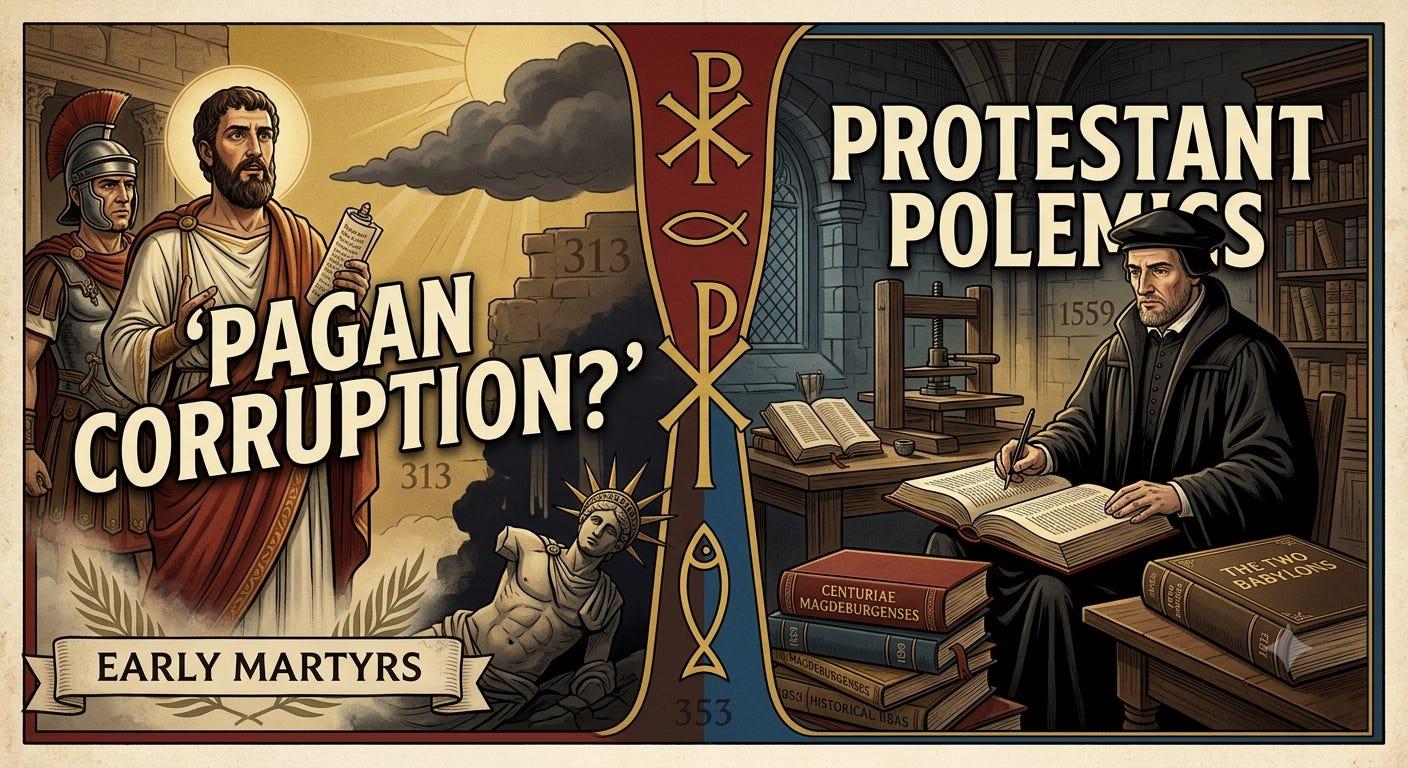
<tinfoil hat>
Gather round, friends and readers, and those who barely tolerate me, because I am about to reveal the secret history they don’t want you to know.
A pure, faithful early Church kept the Saturday Sabbath, exactly the way God intended. Then, in the fourth century, a scheming, power-hungry Roman emperor named Constantine conveniently “converted” to Christianity to glue his crumbling empire back together. In doing so, he made the empire a Christian empire and quietly fused the faith of the martyrs with paganism (sun) worship. He moved the holy day from Saturday to Sunday to flatter his favorite pagan deity, Sol Invictus, the Unconquered Sun. He rubber-stamped the whole heist at the Council of Laodicea in 364. And so the Christianity you’ve inherited is really just paganism wearing a clergy collar. Thus, the total corruption of a pure original early Christianity that worshipped in house churches just like modern protestants, proving "beyond a shadow of a doubt” that the early church was thoroughly corrupt and needed either reforming or restoring (depending on who you are hearing the story from.)
</takes off tinfoil hat>
Were you paying attention? Because almost every load-bearing claim in that paragraph is false, and we can prove it — not with vibes, not with "faith," not with another Graham Hancock series on Netflix, but with documents that any of you can pull up on your phone before you finish your coffee.
This article owes its existence to a piece by Dr. Nathan Jacobs over at Theological Letters — the same scholar whose work on the Trinity I leaned on in an earlier article (The Trinity Actually Makes Sense).
Dr. Jacobs very effectively dismantles this whole “Constantine paganized the Church” narrative, and I’d encourage you to go read and watch it for yourself.1 What I want to do here is something slightly different. Jacobs shows you the myth is false. I am interested in where the body of this myth came from, why it refuses to stay buried, and why it has a special, white-knuckle grip on the two communities I love most: my Protestant friends and my cradle faith, the Latter-day Saints.
Because here’s the thing nobody tells you. This isn’t ancient history. It’s a charter myth — and a fairly recent one. Before you read this article, I suggest reading or watching/listening to Dr. Jacob's very fine article. Links below.

and You can watch/listen to it here
Go watch it. I’ll wait. (I won’t actually wait. We both know how good I am at sticking to a plan.)
A Quick Word From My Anthropology background
I studied anthropology, so forgive me — I cannot look at a story like this and not see the machinery underneath it.
Every group that breaks away from a parent group needs an origin story. Not a history — an origin story. Anthropologists call this a charter myth2: a narrative whose real job isn’t to record what happened but to justify the present arrangement.
The charter myth explains why we are over here and they are over there, why we are pure and they are fallen, why our existence is not a rebellion but a rescue.
The “pagan corruption” narrative is a very efficient charter myth that pulls double duty:
For Protestants, it explains why the Reformation wasn’t a schism but a recovery — Rome fell into pagan darkness, and Luther and Calvin pulled the Bible back out of the rubble.
For Latter-day Saints, it’s the same story taken to it's most radical logical conclusion. If Rome merely got only partially corrupted, a reformation could fix it. But if the corruption was total — if the very priesthood authority evaporated off the face of the earth — then no human reformation could ever be enough. You’d need a restoration. From heaven. Which is, conveniently, exactly the product on offer! (funny how that works!)
I held this myth myself, for years, with all my “might, mind, and strength,” fingernails dug in when debating my roman catholic educated Father. When I sat in LDS Sunday School as a kid, I was taught that this is literally why we call this period of time the Dark Ages3 — the lights of the true gospel had gone out. The story felt like bedrock. It was load-bearing for my entire understanding of who I was.
So,, no, I’m not looking down on anyone who believes this. I’m telling you I used to be you. And then I went and scrutinized this belief. Which is really just popular culture in protestant circles these days.
The True Genesis: Post-Reformation Propaganda
James E. Talmage’s 1909 book The Great Apostasy popularized this idea inside Latter-day Saint circles, but Talmage did not invent it.4 He was a chemist and a geologist by training, not a theologian, and he had never set foot in a seminary. He went to the university library, read what was on the shelf, and what was on the shelf was three and a half centuries of Western European anti-Catholic polemic. He was drinking from a very deep, very poisoned well.
Follow the water upstream and you arrive at a group of Lutheran scholars in the mid-1500s, led by Matthias Flacius Illyricus, who produced a colossal 13-volume work known as the Magdeburg Centuries (1559–1574).
Their goal was not history. It was litigation. They combed through what they knew of the Christian past, century by century, building a case that the Roman Church was a corrupt, illegitimate institution, and that every Catholic practice they happened to dislike, from vestments to the veneration of saints, was a “pagan error” that unconverted Romans had smuggled in through the back door. It was a 13-volume indictment dressed up as a history (or better yet mythtory.)
By the 19th century the indictment had mutated into something closer to Da Vinci Code fan fiction. In 1853 a Scottish Presbyterian minister named Alexander Hislop published The Two Babylons, in which he claimed the Catholic Church was a literal continuation of ancient Babylonian mystery religion. His method was to find two words that sounded vaguely alike and declare them secretly identical. His most famous “discovery” was that “Easter” is really “Ishtar,” the Babylonian fertility goddess.
This is linguistically illiterate. It’s the same logic as insisting the English F-word and the French phoque are the same word because they sound alike when you say them fast — never mind that phoque just means “seal,” the marine animal.5 Serious historians and linguists have always treated Hislop as a crank. But cranks sell, and The Two Babylons became an underground blockbuster, seeding the “pagan corruption” myth deep into popular culture, American evangelical fundamentalism, Seventh-day Adventism, and the Jehovah’s Witnesses.
But the shenanigans didn’t end there. once the ball got rolling it just continued rolling. Baptists pick up on this, like most everyone else in those days to push that they called Baptist Successionism. Just like mormons using this mythology to justify their restorationism, baptists used this to justify their particular branch of reformationism. The idea behind Baptist Successionism is the claim that “true,” non-hierarchical, suspiciously Baptist-shaped churches had always survived underground, hunted by the evil paganized Catholic machine.. This was later codified in the immensely popular 1931 booklet The Trail of Blood by J.M. Carroll, which relied on the exact same historical narrative: that Constantine “paganized” the visible church in the 4th century, leaving only a tiny remnant of true believers. This myth still persists in protestant circles today. Same myth. Different mascot.
The Historical Reality: Do the Math
Here is where the whole thing collapses, and it collapses on a single verifiable fact:
Christians were worshiping on Sunday for nearly two centuries before Constantine was born.
Not “probably.” Not “according to one tradition.” Not “according to your interpretation of history.” We have a paper trail. Let me lay the documents out in chronological order, and pay attention to the dates, because the dates are the murder weapon. Constantine’s Sunday edict was issued on 7 March 321. Keep that number in your head.
The New Testament itself (c. 50–95 AD). Before any of the Fathers the apostolic writings already show believers gathering on “the first day of the week.” We traced this in my previous series. Luke records the church at Troas breaking bread on the first day (Acts 20:7). Paul tells the Corinthians to set aside their offering on the first day (1 Corinthians 16:2). John, exiled on Patmos, says he was “in the Spirit on the Lord’s day” (Revelation 1:10). And Paul had already told the Colossians to let no one judge them regarding sabbaths, which are “a shadow of things to come” (Colossians 2:16–17). The Sabbath question was live and being settled in the apostolic generation — roughly 250 years before Constantine supposedly touched it.
Pliny the Younger (c. 112 AD). This is my favorite, because the witness is a hostile pagan. Pliny was the Roman governor of Bithynia, and he wrote to the Emperor Trajan asking how to prosecute these troublesome Christians. In his report he describes their crime: they were in the habit of meeting on a fixed day before dawn to sing a hymn to Christ “as to a god.” That’s an enemy of the Church, with no theological axe to grind, documenting fixed-day Christian worship two hundred and nine years before the edict. You cannot get a more unimpeachable witness than the prosecutor.
The Didache (late 1st–early 2nd century). This little [priesthood manual to use LDS terminology] of church order, which some scholars date early enough to make it older than parts of the New Testament, instructs Christians to gather on the Lord’s own day to break bread and give thanks.6
St. Ignatius of Antioch (c. 108 AD). Ignatius, by tradition a disciple of the Apostle John, wrote to the Magnesians while being marched to Rome in chains to be executed. In a passage that has been argued over for centuries, he describes Christians as no longer keeping the Sabbath but “living in observance of the Lord’s Day.” 7
The Epistle of Barnabas (c. 130 AD). And here’s one that should make the heart of every reader of this Substack beat a little faster. Barnabas explicitly says: “we keep the eighth day with joyfulness, the day also on which Jesus rose again from the dead.” The eighth day (which we did a previous series about.) Sunday as the first day of the new creation, the day of Resurrection — a theology so old it’s sitting in a document from around 130 AD, nearly two centuries before Constantine could have “invented” it.
St. Justin Martyr (c. 155 AD). And then we get the smoking gun, addressed, like Pliny’s letter, but from the other side; to a Roman emperor. Justin writes to Antoninus Pius and openly describes what Christians do: “on the day called Sunday, all who live in cities or in the country gather together to one place,” for readings, a sermon, prayers, and the Eucharist. Why Sunday? Justin tells us plainly: because it is the first day of creation, and because Jesus rose from the dead on that day. Not Sol Invictus. The Resurrection.
So let’s actually do the math the myth never wants you to do.
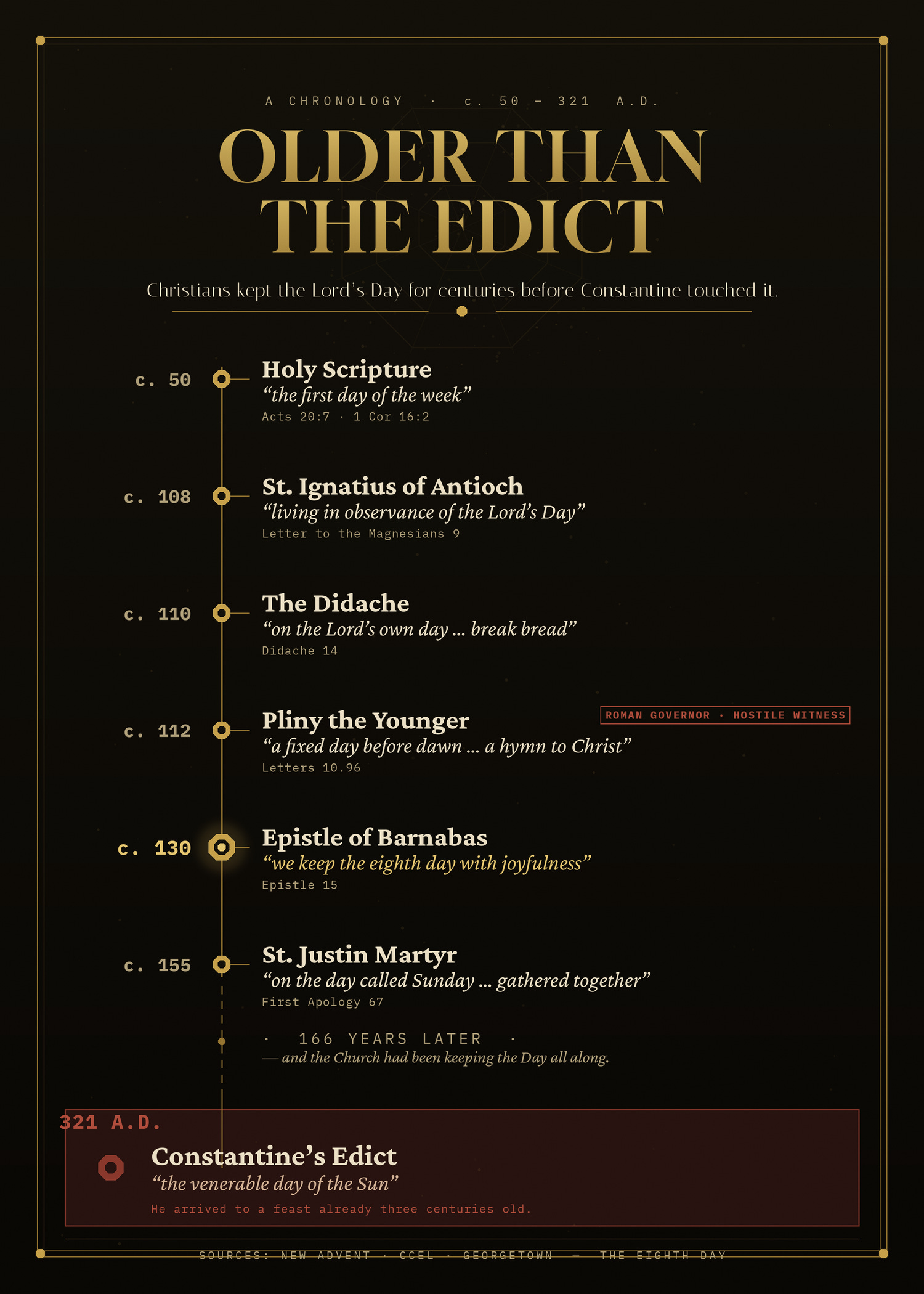
Witness Dates Centuries before Constantine’s edict:
Acts / 1 Corinthians c. 50–57 AD ~270 years
Pliny (a hostile pagan!) c. 112 AD ~210 years
Ignatius of Antioch c. 108 AD ~213 years
The Didache c. 90–120 AD ~200+ years
Epistle of Barnabas c. 130 AD ~190 years
Justin Martyr c. 155 AD ~166 years
Constantine’s Sunday edict 321 AD — (you are here)
Constantine didn’t invent Sunday worship. He showed up to a party that had already been running for almost three hundred years.
“But What About Sol Invictus?”
This is usually the moment someone says: fine, but Constantine still called it “the venerable day of the Sun,” and Sunday is obviously a sun-god day, gotcha punk, now capitulate to my ill informed “superior“ pop-culture.
Two problems.
First, the chronology runs the wrong way. The specific imperial cult of Sol Invictus — the one the myth always names — was elevated to a major state religion by the Emperor Aurelian in 274 AD.8 That is after Pliny (112), after Ignatius (108), after the Didache (90), after Barnabas (130), and after Justin (155) had already documented Christian Sunday worship as a settled fact. If anybody was borrowing a holy day from anybody, the chronology has the Christians there first. You cannot copy your homework from a kid who hasn’t shown up to school yet.
Second, the “Christians are secret sun-worshippers” charge isn’t a modern discovery. It’s a recycled second-century pagan slander, and the Fathers explicitly denied it.
Around 197 AD, the North African writer Tertullian complained that some pagans supposed “the sun is the god of the Christians, because it is a well-known fact that we pray towards the east, or because we make Sunday a day of festivity.” And then he turns it right back on them: you pagans, he says, are the ones who set aside the day of Saturn for leisure, and many of you move your lips toward the rising sun.9
Christians, Tertullian insists, face east and rejoice on Sunday for entirely different reasons — the Resurrection, the light of Christ — not because they worship the orb in the sky.
Sit with the irony. The exact accusation that Hislop and Talmage and a thousand TikTok “alternative history” accounts treat as a hidden truth they uncovered is, in fact, an ancient misunderstanding that the early Church looked at, named out loud, and rejected — eighteen hundred years ago. The myth isn’t a revelation. It’s a pagan caricature of Christianity that someone fished out of the recycling bin and spray-painted gold.
The Nature of the Edict and Didn't Constantine make the empire officially Christian with his “edict of Milan" so he could use it as a political tool?
Why did Constantine call Sunday “the venerable day of the sun” in his 321 AD decree?
Pragmatism. Rome was still a overwhelmingly pagan empire. Christianity had only been legal since the Edict of Milan in 313 AD. The Edict of Milan did not make the empire Christian (another modern misconception) it only legalized christianity and made it an accepted practise. Christians were still a minority. If an emperor (of a still largely pagan empire) wants to declare a civil day of rest across a vast, predominantly pagan empire, he cannot tell them to take “the Lord’s Day” off, that phrase would mean absolutely nothing to them. Instead, he used the civil, solar calendar terminology that his pagan subjects recognized. The edict did not command anyone to worship the sun; it simply picked a day of rest using the common language of the culture.
False premise #1: Constantine “made the empire Christian.” He didn’t. This is just factually wrong. It's not a matter of interpretation, it's a historical fact. Don't believe me? Read it for yourself.
Constantine’s actual legal act is known as the Edict of Milan in 313AD, which legalized Christianity; it granted toleration, ended the persecutions, and restored confiscated property. Toleration is not establishment.
The edict is, largely, a declaration of freedom of religion without fear of persecution, for all people, not just christians.
Here is the bulk of the text of the actual edict, edited down for relevance and brevity - (I removed some parts that seemed repetitive and replaced them with […] ) but if you don't trust me, please go read the full text at: https://earlychurchtexts.com/public/edict_of_milan.htm.
When we, Constantine and Licinius, (then co-) emperors, […] conferred together with respect to the good and security of the commonwealth, it seemed to us that, amongst those things that are profitable to mankind in general, the reverence paid to the Divinity merited our first and chief attention, and that it was proper that the Christians and all others should have liberty to follow that mode of religion which to each of them appeared best; so that that God, who is seated in heaven, might be benign and propitious to us, and to every one under our government. And therefore we judged it a salutary measure, and one highly consonant to right reason, that no man should be denied leave of attaching himself to the rites of the Christians, or to whatever other religion his mind directed him, that thus the supreme Divinity, to whose worship we freely devote ourselves, might continue to vouchsafe His favour and beneficence to us. And accordingly we give you to know that, without regard to any provisos in our former orders to you concerning the Christians, all who choose that religion are to be permitted, freely and absolutely, to remain in it, and not to be disturbed any ways, or molested. […] at the same time that the open and free exercise of their respective religions is granted to all others, as well as to the Christians. For it befits the well-ordered state and the tranquillity of our times that each individual be allowed, according to his own choice, to worship the Divinity; and we mean not to derogate aught from the honour due to any religion or its votaries. […] we formerly gave certain orders concerning the places appropriated for their religious assemblies; but now we will that all persons who have purchased such places, either from our exchequer or from any one else, do restore them to the Christians, without money demanded or price claimed, and that this be performed peremptorily and unambiguously; and we will also, that they who have obtained any right to such places by form of gift do forthwith restore them to the Christians: […] “All those places are, by your intervention, to be immediately restored to the Christians. And because it appears that, besides the places appropriated to religious worship, the Christians did possess other places, which belonged not to individuals, but to their society in general, that is, to their churches, we comprehend all such within the regulation aforesaid, and we will that you cause them all to be restored to the society or churches, and that without hesitation or controversy: […] So shall that divine favour which, in affairs of the mightiest importance, we have already experienced, continue to give success to us, and in our successes make the commonwealth happy. […]
The Roman Empire did not become officially Christian until the Edict of Thessalonica in 380, issued by Theodosius I — forty-three years after Constantine was dead.
So the claim fails before we even get to the interesting part. But let’s grant the protestants their best version and go to the real argument.
False premise #2: he did it “as a political tool to unify the empire.” This is the part that’s not just wrong but rationally backwards.
To unify something, you reach for the common denominator, the thing the most people already share. So ask the obvious question: at the moment Constantine threw in with Christ (the Battle of the Milvian Bridge, 312), what fraction of the empire was Christian? A minority. Estimates vary, but the serious ones put Christians somewhere well under a fifth of the population, and in much of the West, far less than that, heavily concentrated in eastern cities. The other 80-plus percent were pagans: the Senate, the old aristocracy, and, crucially, the army, whose officer corps was thick with devotees of Sol and Mithras.
Now run the “unification” thesis through that fact. We are asked to believe that a master political strategist surveyed a fractured empire and concluded that the way to bring everyone together was to embrace the religion of the small, distrusted minority that the other ninety percent had been feeding to lions. That is not statecraft. That is the single most divisive, idiotic, religious choice on the menu. And it’s worse than merely unpopular, because of why Romans had persecuted Christians in the first place: Christians were prosecuted as antisocial “atheists” precisely because their flat refusal to honor the pagan gods and offer the imperial sacrifice. Something that was understood as a solvent of civic unity, a threat to the pax deorum that held the state together. So the claim asks us to believe Constantine adopted, as a unifying instrument, the one faith every Roman already regarded as the great dis-unifier. It inverts the entire Roman understanding of what the religion did to a society.
Here’s where the absurdity becomes total, because the actual unification tool was sitting right there on the shelf, and he didn’t use it. If your single overriding aim is to weld a sprawling, polyglot, ninety-percent-pagan empire into one, you already have the perfect device: the imperial cult and the cult of Sol Invictus, the flexible, near-monotheistic solar ideology that the army loved, that the emperor Aurelian had elevated for exactly this purpose a generation earlier, and that offended almost no one because it could absorb everyone’s local gods. That was the off-the-shelf unifier. A cynical Constantine optimizing for unity grabs Sol Invictus with both hands and never looks back. Instead he gradually walked away from it toward the one cult that couldn’t be blended with anything. The “political tool to unify” thesis can’t explain the most basic fact about his choice: he picked the anti-unifier and left the actual unifier on the table.
It gets even worse, because Christianity in 312 wasn’t even internally unified, so it couldn’t have unified anyone else. Constantine spent his reign refereeing Christianity’s own civil wars: the Donatist schism in North Africa, the Arian controversy, which was so bitter he had to convene the Council of Nicaea in 325 just to stop the Church from tearing itself apart. He didn’t import a unifying force into imperial politics. He imported a whole new front of theological warfare. You do not reach for a religion that is publicly splitting in two as your instrument of cohesion. That’s not picking a flag everyone can salute; it’s handing everyone a different team’s jersey and hoping for peace.
Was Constantine politically calculating? Of course, he was a soldier and a Roman Emperor, not a monk. Faith and statecraft were braided together in him, as they were in every ancient ruler; it’s a both/and, not an either/or. Historians genuinely debate the depth of his personal conviction, and that’s a fair debate. But notice that the lifetime pattern, decades of church-building, Christian legislation, raising his sons in the faith, deferring baptism to his deathbed (a common practice for those who took the washing-away of sins seriously), all while absorbing real political cost from a resentful pagan establishment, fits sincere-if-savvy belief far better than pure opportunism. The cartoon version, “cynical atheist adopts Christianity purely to unify the empire,” is the least supportable reading on the evidence, not the most.
So where does the cynical story even come from? Largely Enlightenment historiography, Gibbon and his heirs10, who needed the fourth-century turn to be a political racket rather than a genuine religious shift. Which should sound familiar: it’s the secular cousin of the very pagan-corruption myth we’ve been dismantling. Both stories require the Constantinian moment to be a cynical power-grab, one says he paganized the Church, the other says he weaponized it — and both ignore the same inconvenient documents.
Boiled down, the argument asks you to believe that a brilliant politician unified a pagan empire by embracing the persecuted minority everyone else despised, declined to use the unifying cult already built for the job, and chose instead a faith that was both notorious for refusing civic unity and actively at war with itself. That’s not a strategy. That’s the setup to a joke.
The mythtory needs Constantine to be a cynical mastermind, and the actual history makes him a terrible one.
And Laodicea?
Now let’s go back and grab a thread the myth left dangling that some protestants like the Seventh Day Adventists lean heavily on, The Synod of Laodicea11, around 363–364 AD, which the conspiracy treats as the moment the swap of worship to Sunday was “formalized.” There are three problems, that get worse as you go.
Problem one: the date. Laodicea is later than Constantine’s 321 edict and decades after his death in 337. It can’t be the origin of anything Constantine supposedly started, and it certainly can’t predate two centuries of documented Sunday worship. As an “origin point,” it’s a non-starter on the calendar alone.
Problem two: read what it actually says. Canon 29 of Laodicea reads: “Christians must not judaize by resting on the Sabbath, but must work on that day, rather honouring the Lord’s Day.” Notice the logic. You do not need to pass a rule telling people to honor Sunday unless Sunday is already the established Christian day. The canon isn’t creating Sunday worship — it’s defending an existing, centuries-old Sunday norm against a minority of judiazers who were still resting on Saturday in a Jewish manner. The very existence of the rule is proof that Sunday was already the default. It’s like passing a law reminding people to drive on the right side of the road; you only bother when right-side driving is already the norm and a few folks (maybe die hard brits) keep drifting on the left.
Problem three: which should really be the nail in the coffin: the same council says, in Canon 16, that the Gospels are to be read on the Sabbath — Saturday — along with the other Scriptures.12 So the 4th-century Church that the myth says “abolished Saturday and replaced it with a pagan Sunday” was, in the same breath, still assembling on Saturday to read Scripture (as per traditional synagogue worship.) This is fatal to the myth’s clean little binary. There was no dramatic flip, no pagan substitution, no abolition. There was a Church that honored the Lord’s Day as the day of Resurrection and in many places kept a Saturday observance too exactly as the documents have shown us all along.
The “Closet Pagan” Problem
There’s one more angle Jacobs raises that I want to underline, because it’s less about documents and more about human beings, and it’s the part the conspiracy theorists never reckon with.
The myth requires you to believe that the early Christian bishops and theologians were secretly itching to keep their old pagan habits — that they were soft, syncretistic, easily bullied into compromise.
Now look at how these men actually lived and died.
Justin Martyr, the same man who wrote that calm, matter-of-fact description of Sunday worship for the emperor, was dragged before the Roman prefect Rusticus, ordered to offer a pinch of incense to the gods to save his life, and refused. He and his companions chose torture and beheading over a single nod to paganism.
Ignatius of Antioch wrote his letters in chains, on the road to his own execution, and begged his flock not to rescue him, because he wanted to be ground like wheat by the teeth of the lions and so be conformed to the suffering of Christ.
These are not the actions of men looking to soften the edges of their faith to keep the neighbors comfortable. The idea that a Church built — literally — on the blood of anti-pagan martyrs would, a few decades later, casually fold paganism into its worship to please a politician is not just historically false, it's absurd. You don’t die rather than burn one grain of incense to Caesar’s gods, and then turn around and dedicate your holiest day to the Unconquered Sun. The martyrs would have spat.
But Constantine never really converted, he kept his paganism until baptised on this death bed.
It is true that Constantine himself kept the pagan high-priestly title Pontifex Maximus his entire reign, kept the sun-god Sol Invictus on his coinage well after his supposed conversion, never closed the temples, never banned the old cults, and the triumphal Arch of Constantine that the Senate built in Rome to celebrate his victory is conspicuously not Christian. It thanks “the divinity” in vague terms and leans on traditional and solar imagery.
Surely this is proof enough that the pagan mythtory is true, right? Wrong.
Those facts are true, but they’re being asked to prove something they can’t. This only works if you let three completely different questions get blurred into one. Watch the seams:
Did the Roman state become Christian under Constantine? (No — slowly, partially, and not fully for generations.)
Did Christian worship and doctrine become pagan? (A claim about the content of the faith. Which we explored in great detail in a previous article series we began in April and is still rolling out to free subsribers. The answer is a resounding NO.)
Was Constantine personally a sincere Christian? (A claim about one man’s soul.)
The Pontifex Maximus title, the Sol coinage, the open temples, the vague Arch — every one of those facts speaks to question 1. The corruption thesis needs them to answer questions 2 and 3. They don’t, and pretending they do is a level-confusion: evidence about the state gets smuggled in as evidence about the Church’s faith and about a man’s interior life. Those are three different things.
Here’s the part that flips it. If Constantine were paganizing Christianity, you’d expect to find him importing pagan rites, gods, and theology into Christian worship. But that’s not what any of these facts show. What they show is the exact opposite: he left the pagan apparatus standing in the civic and state sphere and left Christian worship alone to be Christian. The two ran in parallel. A man paganizing the Church meddles in the liturgy; a man tolerating a still-pagan empire while favoring a Christian minority leaves both spheres alone — which is precisely the picture. So these facts, read carefully, cut against the paganization thesis rather than supporting it. “He didn’t abolish paganism in the empire” is not the same sentence as “he poured paganism into the Church.”
And each fact has a mundane explanation that has nothing to do with crypto-paganism:
Pontifex Maximus was welded into the imperial office itself — a constitutional fixture, not a personal devotional choice. Every emperor held it; it wasn’t set aside until Gratian refused the robes in the late 370s–380s, two generations later. Holding it tells you Constantine kept operating inside Roman constitutional forms. It does not tell you he was out back sacrificing to Jupiter. (There’s real debate about whether he ever performed the rites or just held the title.)
The Sol Invictus coinage was state propaganda aimed at a majority-pagan population and a sun-and-Mithras-loving army. The telling thing is the trajectory: Sol fades off his coinage through the 320s as Christian-friendly imagery and the Chi-Rho come in, and he withdrew himself from depictions of pagan sacrifice. That’s a shift over time, not a static paganism. It’s also worth knowing that Christians themselves had long called Christ the “Sun of Righteousness” (Malachi) and the Light of the world — there’s even a third-century Christ-as-Helios mosaic in the necropolis under St. Peter’s. The boundary between “the Sun” and “Christ the true Sun” was being renegotiated by Christians, not borrowed from pagans.
Not closing the temples is toleration and prudence, not allegiance. Forcibly banning the cults of ninety percent of your empire is how you start a civil war, not how you govern. Rome has many example of unpopular emperors who had been deposed. Constantine was not stupid. That he restrained himself is evidence of a careful ruler, arguably even of religious moderation, not of secret loyalty to the old gods. Restraint isn’t a confession.
The Arch of Constantine was built by the Senate, a pagan body, in their own traditional idiom, to honor him the way they honored emperors. He didn’t design it as a creedal statement. And that famously hedgy inscription, that he conquered “by the prompting of the divinity,” is actually revealing: the pagan Senate reached for weasel words precisely because everyone knew his victory was being credited to a non-traditional god they didn’t want to name. The vagueness is a fingerprint of a shift already underway, not proof of paganism.
On “he never really converted,” is just unfalsifiable heart-reading, and we simply can’t see his soul. But the behavioral record runs heavily counter to this narrative: he built the great churches (the Lateran, Old St. Peter’s, the Holy Sepulchre), legislated in Christianity’s favor, exempted and empowered the clergy, convened and funded Nicaea, wrote theological letters, sent his mother on pilgrimage, raised his sons in the faith. Even the deathbed baptism that skeptics love to cite cuts against them: deathbed baptism was a sincere and common practice then, reflecting the belief that baptism washes away sins. You don’t carefully delay a sacrament you think is meaningless. A fake Christian using baptism as a prop gets baptized early and in public for maximum effect. Delaying it for spiritual reasons is a believer’s anxiety, not a cynic’s.
But here’s the decisive point, the one that makes the whole objection collapse even if you grant it everything. Suppose, for the sake of argument, that Constantine was the most syncretistic crypto-pagan you can imagine, a man who never shed a single pagan instinct. It still wouldn’t get you to “Christian worship is paganized,” because Constantine did not write the faith. The doctrine wasn’t his to compose. At Nicaea he was the convener and the enforcer, the conference organizer, not the theologian. He didn’t even understand the Greek of the dispute (the whole homoousios fight went over his head), and the proof is what happened next: within a few years he was persuaded the other way, he recalled Arius, and exiled Athanasius, the very man defending the orthodox doctrine the corruption crowd thinks Constantine invented. He ended up on the Arian (i.e., the side the Church later condemned as heretical) end of the argument. A man who can’t follow the theology, and who lands on the losing/heretical side of it, is in no position to paganize a creed. He couldn’t steer it; the bishops did.
And those bishops were not pliant courtiers. Many of them carried the scars of the persecutions Constantine had only just ended; confessors who had been maimed for refusing to sacrifice to the gods. The notion that those men took their theology from a half-catechized emperor is exactly absurd. And the entire fourth century after Constantine is the story of bishops defying emperors: Athanasius in and out of exile five times, fighting Constantine and his Arian-leaning son Constantius II, who tried far harder than his father to bend the Church to imperial will; and totally failed. “The Church just did whatever the emperor wanted” is refuted by the most famous biography of the century.
Now, the fair concession, because there genuinely is a kernel here worth granting. The corruption crowd is pointing, clumsily, at something real: Constantine inaugurated the fusion of throne and altar. The entanglement of bishops with imperial power, the emperor convening councils, the long Byzantine experiment in “symphonia” that can tip into Caesaropapism. That’s a serious development, and Orthodox, Catholics, and Protestants all have to reckon with it; Orthodoxy in particular has its own internal critique of when the empire leaned on the Church too hard. But notice what kind of critique that is: it’s a critique of church-state politics. It is not evidence that the worship and the doctrine turned pagan. You can grant the whole problem of the Constantinian settlement and it gets you exactly nowhere toward “the Eucharist is a sun-cult ritual” Keep those two apart, the politics and the faith, and the paganization thesis has nothing to stand on.
The above facts prove that the empire stayed largely pagan, which is the opposite of the Church going pagan; the man’s personal internal sincerity is unknowable but his life points to belief. Even maximal cynicism about Constantine can’t touch the conclusion, because the faith was guarded and defined by battle-scarred bishops who routinely defied him, including over the very doctrine he’s accused of inventing. It’s the same mythical-history trick we keep meeting: real facts about a transitional age, yanked up a level to make a claim they can’t support.
How Talmage Fits Into the Puzzle
Talmage arrived at the tail end of this wave of historical revisionism. When he sat down to write The Great Apostasy, he didn’t invent the narrative; he simply went to the local university library and read these mainstream Protestant texts. He adopted their historical arguments, but he pivoted the conclusion to fit Latter-day Saint theology:
The Protestant Conclusion: The original gospel was buried under pagan traditions, but it was successfully reformed by Martin Luther, John Calvin, and others who stripped away the Catholic “pagan accretion” to get back to the Bible.
The Latter-day Saint (Talmage) Conclusion: The pagan corruption was so absolute, institutional, and complete that the very divine authority (the Priesthood) was entirely lost from the earth. Therefore, a mere “reformation” of existing structures was impossible; a total, divine restoration from heaven was required.
So, while Talmage is an important figure in defining how a specific religious movement understands the history of early Christianity, the broader pop-culture belief that early Christianity is secretly dressed-up paganism is a direct inheritance from centuries of fierce, post-Reformation Protestant propaganda (fuelled largely by wars and conflicts with Catholics.)
Why the Myth Will Not Die
So if it’s this easy to disprove, and it is; you just watched it happen with links you can click yourself , then why does it survive?13
Because, as my anthropology professors would say, the myth isn’t doing the job you think it’s doing. It was never primarily a claim about the fourth century. It’s a boundary marker. It’s the wall that keeps Protestants Protestant and Mormons Mormon, by making the alternative, the ancient, sacramental, liturgical Church, look like a pagan counterfeit you’re well rid of.
This is the narcissism of small differences at industrial scale. The closer a community actually is to the real Church, the louder it has to insist on a story that makes that Church monstrous, because if the ancient Church was simply the Church, faithful and unbroken, then the whole justification for having left it quietly evaporates and you are the heretic and the one in error. The myth has to be huge precisely because the real distance is small.
And there is something distinctly, achingly American in how this all plays out. The myth flatters the deepest instinct of the Western religious mind: the conviction that I, Me, armed with my Bible and my private judgment, can leapfrog two thousand years of saints and martyrs and councils and reconstruct pure Christianity from scratch in my own living room. That every prior generation got it wrong and I finally got it right. We dress this up as humility , “just me and my Bible,” but make no mistake, it is the most prideful claim a human being can make about the things of God. It enthrones the individual ego as the final arbiter of revelation. How American. How very much the western mind worshiping, in the end, itself.
But step out of the polemics and into the documents and the conspiracy simply evaporates. There is no fourth-century cover-up. There is no pagan switch. There is only a long, unbroken, fiercely checkable line of Christians who gathered on the first day of the week the eighth day, the day of the empty tomb, and did so not because an emperor loved the sun, but because their Lord had walked out of a grave on a Sunday morning, and they were willing to be fed to lions rather than pretend otherwise.
They didn’t borrow that day from the sun. They received it from the One who made the sun.
I encourage you, genuinely, to verify what I've written. The links are right there. Go read Justin to the emperor. Go read the prosecutor Pliny. Go count the years yourself. That’s the whole point: this faith has nothing to hide, because it was never the thing in disguise.
The disguise was the myth.
Primary Sources
Acts 20:7; 1 Corinthians 16:2; Revelation 1:10; Colossians 2:16–17 — New Testament references to “the first day of the week” / “the Lord’s day” and Paul relativizing the Sabbath. Linked above to churchofjesuschrist.org.
Pliny the Younger, Letters 10.96 (c. 112 AD) — a hostile pagan governor describing fixed-day Christian worship “before dawn.” Georgetown / J. O’Donnell
St. Ignatius of Antioch, Epistle to the Magnesians 9 (c. 108 AD) — “living in observance of the Lord’s Day.” New Advent
The Didache (late 1st–early 2nd c.) — gathering on the Lord’s day to break bread. New Advent
Epistle of Barnabas 15 (c. 130 AD) — “we keep the eighth day with joyfulness... on which Jesus rose again from the dead.” New Advent
St. Justin Martyr, First Apology 67 (c. 155 AD) — “on the day called Sunday, all... gather together to one place.” New Advent
Tertullian, Apology 16 (c. 197 AD) — rebutting the pagan charge that Christians worship the sun. New Advent
Tertullian, Ad Nationes I.13 — the same rebuttal, expanded. CCEL / Schaff, ANF03
Synod of Laodicea, Canons 16 & 29 (c. 363–364 AD) — Gospels read on the Sabbath (16); honoring the Lord’s Day over Judaizing rest (29). New Advent · CCEL / Schaff, NPNF2-14
And for a thoroughly entertaining real-time demonstration of how this kind of “alternative history” holds up under cross-examination, the Wes Huff / Billy Carson debate is a great example and can be found here:
popcorn recommended.
Once you learn to spot a charter myth, you start seeing them everywhere, including in the mirror. If this one helped you see the receipts for yourself, share it with the person in your life who still thinks Constantine moved the Sabbath and paganized the early church. They deserve to know they’ve been handed a 16th-century dan brown book and told it was history.
The term comes from the anthropologist Bronisław Malinowski, who noticed that the “myths” of a culture function less like history textbooks and more like title deeds — they exist to charter, or license, a present-day institution, ritual, or social hierarchy. Keep that lens handy. It explains why this particular myth survives every debunking: its job was never to be true. Its job was to be useful.
The phrase “Dark Ages” actually comes from Renaissance humanists like Petrarch, who were making an aesthetic and literary complaint about the centuries between Rome and themselves — not a theological claim about a lost gospel. The term has been quietly retired by most working medievalists, who got tired of explaining that the “dark” centuries gave us Hagia Sophia, the entire monastic preservation of classical literature, and, you know, the theology of the Trinity.
Talmage’s other major works — The Articles of Faith (1899) and Jesus the Christ (1915) — remain genuinely influential and are, in places, beautifully written. Articles of Faith and Jesus the Christ have been for decades required reading by LDS missionaries. The point isn’t that the man was a fraud. The point is that on this subject he was a layman repeating the consensus of hostile sources he had no specialized training to evaluate. Sola scriptura plus a public library is a powerful engine — it just isn’t a reliable historical method.
While we’re here: most of the Christian world doesn’t even call the feast “Easter.” It’s Pascha (Greek), Pâques (French), Pascua (Spanish) — straight from the Hebrew Pesach, Passover. The English and German names probably derive from an old Germanic spring month, Ēosturmōnaþ, which the Venerable Bede mentions in the 8th century. Notice the irony: the actual, near-universal name of the most important feast in Christendom is a Jewish festival, not a Babylonian one. Hislop didn’t just get the etymology wrong; he got it backwards.
We covered the didache in a previous article (The book that shouldn't exist) and will spend time with it again later in this article. It’s an extraordinary document, and the fact that most Christians have never heard of it is a tragedy. For now, just note the date: a Eucharistic gathering “on the Lord’s day” is being treated as the obvious, established norm, not a novelty.
Full honesty, because I’d rather you hear the counter-argument from me than from a hostile reader comment. Sabbatarian apologists dispute this translation, and they have a point worth examining: the Greek (katà kyriakḕn zōntes) literally says “living according to the Lord’s…” with no noun, and you have to supply the word “day.” So some render it “living according to the Lord’s way.” Fair. But three things seem to indicate this is talking about Sunday:
The immediately preceding chapter is a polemic against Judaizing, so the contrast is plainly Sabbath-versus-something-else;
Ignatius grounds the day in the Resurrection — “on which also our life rose” — which can only be the first day of the week;
The ancient Latin manuscript tradition reads secundum Dominicam viventes, and Dominica simply means Sunday. Either way, this single contested verse isn’t load-bearing. Take Ignatius out entirely and the chronology is still buried under Pliny, the Didache, Barnabas, and Justin.
Aurelian dedicated a grand temple to Sol Invictus and promoted his cult around 274 AD, and the date dies natalis Solis Invicti (Dec 25) appears in a Roman calendar from 354. None of which can be the source of a Christian Sunday practice that pagan and Christian writers alike had already been describing for over a century and a half. Causes, as a rule, precede their effects.
Tertullian makes the same move in Ad Nationes I.13, available at CCEL: he tells the pagans that if they want to mock Christians for “the sun and Sunday,” they should look at how close their own Saturn’s-day customs are. The whole exchange only makes sense if “Christians worship the sun” was a known external charge that Christians considered a slander — not a description they’d have accepted.
Edward Gibbon (1737–1794), is an English historian. He published The History of the Decline and Fall of the Roman Empire in six volumes between 1776 and 1789. It’s one of the towering works of Enlightenment historiography, still read, still quoted, and still shaping how educated people half-consciously picture late Rome.
He’s relevant to this conversation because of two scandalous chapters, 15 and 16, where he addresses the rise of Christianity. He treats it with a cool, ironic, skeptical detachment, explaining the Church’s growth through worldly “secondary causes” (zeal, the promise of immortality, miracles, Church organization) rather than divine ones; much like a modern Bart Erhman. He floats the provocative thesis that Christianity helped cause Rome’s decline by draining civic and martial energy into otherworldly concerns. On Constantine in particular, Gibbon was pointedly skeptical of the sincerity of the conversion. He leaned heavily on ambition and political calculation as the prime motivators, and was happy to dwell on the gap between the convert and the man. The skeptical, “the conversion was really about power” framing is largely what filtered down into the pop-culture mythical-history instinct that Constantine adopted Christianity as a cynical political instrument.
Two honest caveats. First, Gibbon was in general a good historian and a magnificent prose stylist; the problem isn’t that he’s not competent, it’s that his anti-clerical Enlightenment lens colored his read of the fourth-century. Second, modern scholarship has substantially revised him. Historians like Timothy Barnes, Averil Cameron, Peter Brown, and H.A. Drake have moved the consensus towards painting a picture where Constantine's conversion was real, but politically aware (the both/and again), against the older cynical picture. So citing Gibbon is about citing the headwaters of the skeptical popular mytholody.
But here is some irony: Gibbon, LDS and Protestant restorationists end up shaking hands over the same caricature of Constantine, a man who co-opted or corrupted the faith for worldly ends, from completely opposite motives. The skeptic wants Christianity to be a human power-play; the reformers want the historic church to have lost it's way but not fully apostatized, and the restorationist wants the historic Church to be a fallen counterfeit. Different destinations all the same misread of the fourth century.
The Synod of Laodicea was a small regional church council held in Laodicea in Phrygia (in what’s now western Turkey), usually dated to around 363–364 AD. It was a gathering of a couple dozen bishops from Asia Minor, and it produced around sixty short, practical canons. These weren’t grand doctrinal pronouncements about the nature of Christ. They were housekeeping: rules about clergy conduct, who can sing in church, not bathing with the opposite sex, what to do about heretics. Disciplinary plumbing for one corner of the Church.
It was emphatically not one of the great Ecumenical Councils like Nicaea. It was a local synod. Its canons only acquired wider authority much later, when the Quinisext Council (the Council in Trullo, 692) endorsed the canons of several regional synods — the Apostolic Canons, Laodicea, the Third Synod of Carthage, and others — in its second canon. So in the Eastern canonical tradition Laodicea “counts,” but it got there as ratified small print, not as a summit that reset Christian worship
You can read the full canons of Laodicea at New Advent, and Philip Schaff’s edition with commentary is at CCEL. Note the broader confusion the myth depends on: early Christians did not claim that Sunday was “the new Sabbath.” For them the Lord’s Day and the Sabbath were distinct things. The whole framing — “Constantine moved the Sabbath to Sunday” — is an anachronism that smuggles a later, Puritan, “Sunday-as-Sabbath” idea back into a period that didn’t think that way at all. The myth can’t even describe its own crime scene correctly.
I could be nasty and ask "Why does the Devil keep trying?"