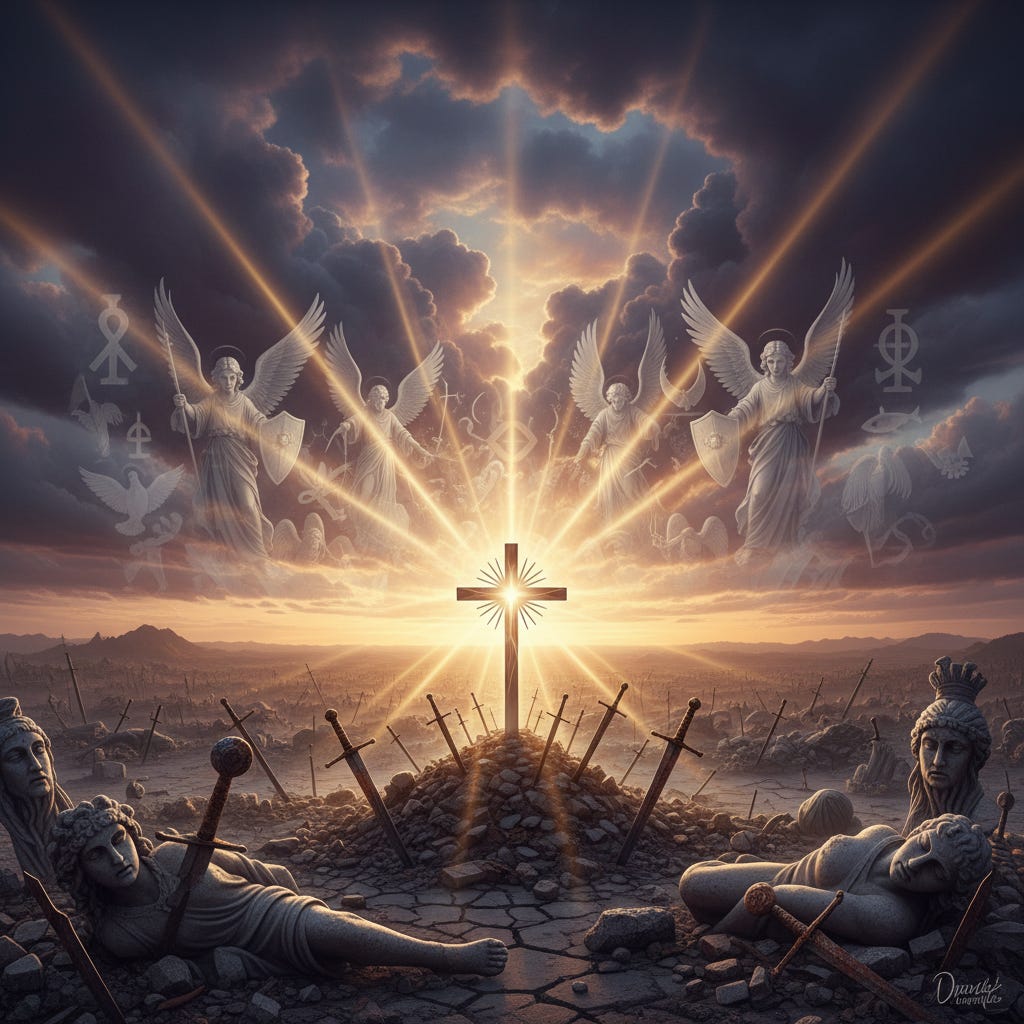
The Final Onslaught: Unveiling the Antichrist and the Triumph of Orthodoxy in the Last Days
Part 8 in The War Unseen: Exploring Orthodox Eschatology: The Antichrist's Deception, the Church's Perseverance, and the Promise of Christ's return in the Last Days.
This is Part 8, the culmination of our journey through “The War Unseen.” If you’re new, Start with Part 1! to trace the ancient battle from Eden’s gates to these last days. For convenience:
The Calm Before the Storm
The world hums with distraction. A thousand voices promise salvation through technology, ideology, and comfort—each a mirror of Eden’s whisper: “You shall be as gods.”
But behind the noise, something older stirs. The same battle that began with the serpent’s hiss now reaches its fever pitch. Prophecies multiply, rapture dates collapse1, false messiahs trend, and faith itself seems to flicker.
The sky above us is strangely quiet. The air feels charged, as if the world itself is holding its breath. You can feel it—something ancient, something terrible, something familiar.
It feels as if heaven has gone silent.
It hasn’t. The silence is a gathering of breath before the thunder.
A War Older Than Time
From the moment the Light entered the world, the darkness declared war.
Christ’s birth detonated the ancient order: “Now is the judgment of this world; now the ruler of this world will be cast out” (John 12:31).
Every age has been a campaign in that same war—empires rising, heresies blooming, idols renamed, repackaged, and resold. Rome fell. Byzantium burned. The Church endured. The Enemy adapts; the Kingdom stands.
This essay is not prophecy, nor official doctrine of the Orthodox Church (although I do not believe that I have deviated from it). It is a personal meditation on that protracted conflict and its last act: the unveiling of the Antichrist and the triumph of Orthodoxy at the end of the age.
This wasn’t meant to be the finale of this series, but with the recent “end-times rapture” flop lighting up the news, I couldn’t resist. Buckle up as we unpack Orthodox eschatology—the real deal—exposing the cracks in other millennial fantasies that keep leading souls astray.
When Prophecy Fails and Faith Wavers
Another predicted “rapture” passed last month without trumpet or cloud. Some mocked. Others despaired.
Both missed the point.
Every failed prediction reveals the danger of reading Scripture through the eyes of personal preference2, instead of through the Fathers. The apostles warned of deceivers who would “tickle the ears” of believers with secret knowledge and timelines (2 Tim 4:3). True eschatology is not a calendar—it is a call to repentance.
Orthodoxy, unlike modern millennial fantasies, teaches no secret escape from suffering. The Kingdom does not arrive by evacuation but by endurance. The Cross is not bypassed.
It is entered.
It is carried.
There is NO resurrection without the Cross
The Study of the Last Things
The Fathers called this field Eschatology—from eschatos, Greek for “last.” It asks:
What is the destiny of the world?
What awaits the soul after death?
How will history be transfigured at the coming of Christ?
The Eschaton is that final consummation itself—the world made new, the veil torn back, time folded into eternity.
To study the Last Things is not to speculate about beasts and numbers; it is to prepare the heart to meet the Bridegroom.
Biblical Promises of Christ’s Return
The Scriptures don’t whisper about the Second Coming—they roar it. From the prophets to the apostles, the Bible forms one unbroken promise: Christ will return, not as the suffering Servant, but as the conquering King.
Joel doesn’t describe a gentle spiritual refresh. He describes an eruption of divine power that engulfs the whole world:
“‘And it shall come to pass afterward, that I will pour out my Spirit on all flesh; your sons and your daughters shall prophesy… and it shall come to pass that everyone who calls on the name of the LORD shall be saved’”
Joel 2:28–32
This isn’t a kind divine sentiment.
It’s a divine invasion.
Christ Himself removes all ambiguity:
“I go to prepare a place for you… and if I go and prepare a place for you, I will come again will take you to myself”
John 14:2–3
The Savior doesn’t outsource His return. This is not symbolic or allegorical.
He comes personally. St. Paul then tightens the grip:
“For the Lord himself will descend from heaven… and the dead in Christ will rise first”
1 Thessalonians 4:16–17
A trumpet blast.
A resurrection.
A King reclaiming what is His. The demons may think they own the world, and since the incarnation, they have been fighting hard to reclaim it. When Jesus sketches the world’s unraveling—wars, diseases, earthquakes—He interrupts the panic with a hard correction:
“But the end is not yet.”
Matthew 24:6
In other words:
Don’t confuse the tremors with the quake.
He also warns of demonically inspired impostors meant to disrupt and derail:
“There will arise False Christs and false prophets… to deceive, if possible, even the elect.”
Matthew 24:24
Satan doesn’t rely on ugliness. He relies on counterfeit beauty.
But the King has commissioned us to a grand mission before this can be so:
“The gospel must first be proclaimed to all nations.”
Matthew 24:13
It seems that Christian persecution and Christian expansion advance together like two blades of the same shears. Then the Lord unveils the sky itself as a final herald:
“The sun will be darkened… the stars will fall.”
Matthew 24:29
Creation responds to its Creator. Unlike what the demons are doing to try to corrupt creation and bring it back under their control, the biblical picture is not chaos.
Every sign, every upheaval, every deception is a part of a choreographed countdown to the return of the rightful King.
Beyond the Paywall: Unveiling the Shadows of the Last Days
In the full essay below, we examine:
The patristic commentaries on the Antichrist and the “man of lawlessness.”
How Orthodox amillennialism dismantles both Protestant dispensationalism and LDS millennial literalism.
Russian Orthodox prophecies from Russian Saints, which designate Russia as an Ark of Orthodoxy and a bastion of salvation in the end times.
Why the Fathers saw martyrdom, not escape, as the mark of the last generation of saints.
The prophetic visions of modern elders who foresaw the Church as a refuge amid a moral deluge.
This article invites not curiosity alone but vigilance. The call of the hour is not panic but purification. The crown is not given to those who calculate the end but to those who endure it.
Signs of the Times
Christ told us that wars, famines, and earthquakes would come—but that these contractions are not the birth itself. The Fathers echoed Him. They warned the faithful not to become obsessed with blood moons and global crises.
Because those are the signs everyone sees.
They said the true sign—the one almost no modern Christian recognizes—is quieter, stranger, and far more dangerous. And it is this sign, not earthquakes or wars, that reveals the nearness of the true Antichrist…
It unfolds not in the sky, but in the soul.
This sign, not the wars or the quakes, reveals the nearness of the final deception.
Look around:
Truth is now treated as violence.
Faith is repackaged as a personal aesthetic.
The human body—the very temple of the Holy Spirit—is rewritten, redesigned, desecrated.
The family fractures.
Icons shatter.
Worship gives way to consumption, as if man could fill his hunger with the very dust he was formed from.
These aren’t cultural trends, they’re spiritual tremors—precursors to the great falling away the apostles warned about; and yet, in the middle of the collapse, something ancient stirs.
The Spirit gathers a remnant.
Not a political movement.
Not a utopian project.
But the Church—God’s Ark—rising quietly as the waters of confusion deepen.
The flood returns.
So does the Ark.
And only one of them saves.
The Millennium
Few passages have caused more confusion—and more bad theology—than St. John’s vision of “a thousand years.” For some, it’s a roadmap to an earthly paradise. For the Fathers, it’s something far more serious: a symbolic portrait of the age we’re living in right now.
Where many modern Christians see a future kingdom, the Fathers saw the present reign of Christ through His Church.
Not political.
Not militarized.
Not utopian.
But sacramental, spiritual, and cosmic.
St. Augustine, St. Andrew of Caesarea, and the overwhelming chorus of Orthodox commentators read the Millennium as the era between Christ’s First and Second Coming. In this age:
Christ reigns invisibly.
Satan’s power is restrained.
The saints already reign with Him in the heavenly places.
This isn’t speculation—it’s the backbone of Orthodox eschatology, and this is precisely why the Church rejects both:
Chiliasm — an earthly kingdom with Christ ruling from Jerusalem like a global emperor.
Dispensationalism — the 19th-century invention of John Nelson Darby, with its rapture charts, timelines, and a thousand-year vacation from suffering.
Both of these ideas, extremely popular with protestants and Mormons alike, are deeply problematic:
Both collapse the Kingdom of God into a political administration. - Something Christ was clear on the first time that his Kingdom wasn’t a kingdom of man, or a restoration of a Davidic kingdom (like the jews expected.)
Both promise comfort instead of repentance.
Both try to force eternity into human arithmetic.
But the church Fathers knew better. For them, “a thousand years” isn’t a countdown.
It’s a symbol—the fullness of time Christ grants before His return, the long mercy in which the Gospel spreads like fire through the nations, and then the warning:
“When the restraint is lifted,” St. John writes, Satan is loosed “for a little season.”
That small window—the brief, violent gasp of darkness before dawn—is the Antichrist’s hour. While it will be dark, we should not lose hope, its very shortness is a promise that Christ stands at the door.
Mormons and Protestants are still waiting for the Millennium to begin.
Orthodox Christians have always known—we’re already living in it.
SURPRISE!
This is called amillennialism—not “no millennium,” but no literal one. The “thousand years” is the symbolic span of the Church age, the spiritual reign of Christ amid tribulation.
The Cappadocian Fathers, St. Basil the Great and St. Gregory of Nyssa, read Revelation not as an apocalyptic itinerary, but as the unveiling of Christ’s kingship already manifest in His Church. St. Augustine in The City of God (Book 20) argued that the binding of Satan occurred at Christ’s resurrection, thereby limiting his deception so that the Gospel could conquer the world.
Origen echoes this, describing the Millennium as the heavenly rest granted to souls awaiting judgment. Eusebius and St. Jerome went further, attacking literal millennialism as materialistic—more fantasy than theology. In their view, the Church IS the Kingdom; which they insisted, is already but not yet: present in the Eucharist, blazing in the saints, crowned in the martyrs.
And so Orthodoxy gives the only consistent reading:
There is no pre-tribulation rapture.
No thousand-year utopia.
No political paradise before judgment.
We suffer with Christ now.
We reign with Christ now.
We await Christ’s return now.
The next great event in salvation history isn’t a secret escape—it’s the Return of the King, the Resurrection, the Last Judgment, and the unveiling of the eternal Kingdom.
And the proper Orthodox response? St. Ignatius Brianchaninov said it plainly:
Fix your attention not on timelines, but on inner vigilance against the Antichrist’s spirit, already at work in the world.
St. Ignatius Brianchaninov (1807-1867)
Vigilance—not speculation—has defined Christian thought regarding the second coming from Constantine’s day onward, sparing the Church from the endless failed predictions that plague modern alternatives.
The Fathers didn’t give us charts.
They gave us watchfulness.
And they were right.
Protestant Millenarianism
Protestants, emerging from the “great schism of the West,” detailed in a previous article:
Beyond the Break: The Story of the Great Schism of 1054 and Who left Who.
I’ve had a few conversations with Roman Catholics about orthodoxy, and the first thing they always repeat is the roman catholic propaganda that the East broke off from the West. It’s so pervasive that when I saw a recent YouTube short with a Catholic Bishop repeating the same nonsense to his parishioners, I decided to write something about it. This way, the next time someone says that to me, I can hand them this article to reference.
lack unity on the topic of the millennium—mirroring their fragmented schismatic bodies.
This is my best attempt at a generalized high-level overview:
Historic Premillennialism: Christ returns before a literal 1,000-year reign, following a tribulation. Early Fathers like Justin and Irenaeus held a view similar to this, but it waned after Augustine labeled it “chiliasm3” i.e., Millenarianism, which was deemed Heresy. (I'd remind readers that Millenarianism was extremely pervasive during the First and Second Great Awakenings in American history, which shaped the American religious landscape and is still pervasive in American Protestantism and all religious movements to come out of the Great Awakenings, like Mormonism, The Jehovah's Witnesses, Modern Baptist/Evangelical theology, Pentecostalism, etc.) This heresy was revived in Protestantism by figures like George Eldon Ladd.
It promises earthly glory that the Fathers rejected as carnal.
Dispensational Premillennialism: A 19th-century invention by the "daft bugger”4 John Nelson Darby (founder of one of the first non-denominational groups - the Plymouth Brethren) as part of Dispensationalism, popularized via the Scofield Reference Bible. Darby's unique eschatology adds a pre-tribulation rapture, seven-year tribulation, and Israel/church distinction—all things absent from patristic writings. Proponents, such as John Walvoord, tied it to modern events, leading to date-setting flops (e.g., Hal Lindsey’s 1980s predictions and the recent failures, including the one in September 2025). This escapist view fosters fear-mongering rather than faithful endurance.
Mormons, please take note, any time you hear someone in church talk about the "Dispensation of the Fullness of Times,” what you are hearing is an echo hearkening back to Darby's dispensationalism. Remember in the previous article where I pointed out that Mormonism is an offshoot of Protestantism, rooted in the Second Great Awakening period of US history. This is further indication of that fact. This is not a slight on Mormonism, just historical context.
Joseph Smith did not fully adopt all of Darby's dispensationalist ideas (which evolved differently over time, in parallel with LDS theological developments), but the general concept did make its way into Mormonism. Any scriptural references to dispensations would thus be considered anachronistic by outsiders, as the LDS version of this concept (and the protestant one as well), which frames history as a repetitive cycle of prophet → keys → apostasy → prophet, would have been completely foreign to both the ancient Hebrew and early Christian cultures the Book of Mormon purports to represent.
Postmillennialism: The Millennium is a golden age of Christian dominance before Christ’s return, often symbolic. Revived post-Reformation by Puritans, with proponents like Jonathan Edwards seeing it as a Gospel triumph. The optimism ignores patristic warnings of ongoing tribulation (e.g., St. Cyril of Jerusalem on end-times woes).
Amillennialism: Symbolic current age; some Reformed Protestants, like John Murray, espouse it, aligning closest to Orthodox. But even here, sola scriptura individualism leads to debates unknown in patristic consensus.
Historically, premillennialism faded after the 4th century as the Church matured beyond literalism. Protestant revival of it? A “going beyond the mark” impulse, as I argued in that article, chasing hypothetical purity but missing Tradition’s guardrails.
Mormon Millennialism
LDS eschatology modifies premillennialism with additional 19th-century ideas, centering on America as the “promised land.” Joseph Smith taught a literal millennium after calamities burn the wicked, with Christ reigning from the New Jerusalem (in Independence, Missouri - as the land of promise and location of a new earthly Zion) and old Jerusalem. The end-time gathering of the Saints is said to take place in this new Zion.
Mormons have added additional ideas that connect to the rest of their theology and sacramentology, including temple work for the dead, Satan bound by human agency and divine power, and a premillennial meeting at a place called Adam-ondi-Ahman (another location in Missouri) where Adam hands "keys” to Christ. Also, a view I have heard repeated is that in the last days, as the tribulations abound, all people and nations will try to seek refuge in/near the Salt Lake City Temple, and that there will be a time when the US Constitution will "hang by a thread” and be saved by Mormon elders.
“Christ and the resurrected Saints will reign over the earth during the thousand years. They will not probably dwell upon the earth, but will visit it when they please...” (History of the Church, 5:212). - Joseph Smith
Later leaders like Joseph Fielding Smith added that the Earth will be renewed to a state of paradisiacal glory, there will be no enmity, and children will grow up without sin.
The inclusion of America and Missouri in Eschatology is puzzling to many, which leaves them scratching their heads and wondering why and how it came about. Which leads me to this article’s…. ADHD tangent (thankfully, the only one.)
ADHD Tangent: (From the Anthropology of Religion)
Why Every Religion Puts Its Homeland in the Spotlight
Every faith story is deeply imprinted with the culture and history it sprang from—and naturally, it casts its own homeland5 as the hero in the ultimate cosmic showdown. This is no accident.
Looking at Mormonism, scholar Grant Underwood6 shows how LDS end-time stories mirror American millennialism, positioning the U.S. as the centerpiece of divine destiny. Meanwhile, Russian Orthodox saints foresee Russia playing a key role—not out of crude nationalism, but as a symbol of suffering, spiritual renewal, and God’s mercy on a persecuted Church.
The takeaway - Religions don’t emerge in a vacuum. They reflect and reinforce their people's identities. Religions are inevitably shaped by the social, historical, and cultural milieus of their origins; something often termed historical-cultural conditioning or the cultural embeddedness of religion. It’s a foundational lens in the anthropology of religion, where faiths are seen as “products of human culture” rather than floating above history completely detached from any human context.
Religion Is History Writ Large
No religion pops out of nowhere. Anthropologist Thomas Tweed calls it “crossing and dwelling,” meaning that religions carry temporal markers—such as the linear progression of salvation history in Abrahamic faiths—and spatial markers, such as sacred sites or communal gatherings. Every religion bears the historical and cultural markers of the time and place in which it arose.
Religions carry the fingerprints of their era—sacred geography, timelines, and narratives shaped by history and place. Even if you believe in divine revelation, humans in a particular time and culture are the ones nurturing those beliefs, inevitably leaving cultural imprints on the faith.
Context Is Everything
Trying to understand a religion without its cultural and historical backdrop is like reading Shakespeare without knowing Elizabethan English.
What the Great Thinkers Say
Emile Durkheim nailed it: religion is a “cultural system of symbols” reflecting society’s needs—not just divine downloads. And Franz Boas’s historical particularism shows how religions grow uniquely from their culture’s history, while religious functionalism explains their social role, like rituals that glue communities together.
It’s no wonder that ancient myths mirror their world—floods for Mesopotamians, city-state politics for Greeks. Religion reflects the human story, shaped by time and place.
What’s the Point?
We're going to explore this because it provides an excellent anthropology against which we can view, understand, contextualize, and interpret religious traditions and the veracity of their claims.
This idea is a foundational lens in the anthropology of religion, where faiths are seen mainly as “products of human culture” rather than floating above history completely detached from any human context.
Personal Aside…..
I am not saying that religions are made up, or entirely human products. If we start with the thesis that Christianity is a religion directly revealed by God, we still have to acknowledge that religions don't plant, grow and develop by themselves divorced from people, history, or reality. In every case people are doing the work of planting, growing and developing a faith, and those people live in a specific time, place and culture. As a result, they inevitably and unknowingly, bring those cultural and temporal markers (and assumptions) with them into the new religion and we can see the cultural, social and historical imprints on the religion itself.
I would argue that you cannot fully understand a religion or it's history without understanding the cultural, social and historic context of that religion. This is why the bible is so difficult to understand by uneducated individuals without also learning about not only the history of the text itself, but history and culture of the people who wrote it and are featured in it. e.g. why American evangelicals continue to misinterpret "Works” in Pauls epistles as being any effort you take verses the intended meaning of Works as “Works of the Mosaic Law” - which is how Works would have been interpreted in that day and age. All words have connotations and those connotations are highly dependent on time and place.7
Emile Durkheim has a sociological perspective that religion is a “cultural system of symbols” reflecting collective societal needs, and not pure supernatural downloads.
One last concept is Functionalism8, as developed by scholars like Bronisław Malinowski. Functionalism views religion as fulfilling cultural roles specific to its society; e.g., rituals that reinforce social bonds in that time and place.
Application to our Analysis
In Orthodoxy, we see strong Near Eastern Second-Temple Jewish influences. The following YT video is wonderfully instructive in terms of placing Orthodox worship practices within the appropriate milieu (cultural, historical and social context.) I see these echoes as strong markers of Orthodoxy's authenticity.
In Protestantism, those imprints are Enlightenment-era, born of Renaissance-era humanism and feudal unrest; it’s stamped with 16th-century European markers—sola scriptura echoing the printing press’s individualism, predestination mirroring Calvin’s Geneva politics. Luther’s 95 Theses? Fueled by German anti-Roman nationalism and by economic grievances over indulgences. As I detailed in this series, the “reformation” gave birth to new religions, not restorations of some ancient “pure and complete” faith. Something anticipated by St. John Chrysostom (4th century), who warned against schism as a form of cultural pride (Homilies on Ephesians).
In Mormonism, those markers reflect the 19th-century American frontier. Early 19th-century America was buzzing with revivalism, frontier expansion, and a sense of divine favoritism toward the “New World.” This is where “manifest destiny” comes in—the idea that God had ordained America as a promised land for His people, echoing Old Testament themes slapped onto U.S. geography.
It is not a coincidence that some LDS beliefs seem to echo these attitudes, and that Book of Mormon narratives mirror early 18th and 19th century speculations about the mound builders, and grew out of racist attitudes against Native Americans as being too unsophisticated to have built the earthworks and other material culture early European settlers were encountering. European settlers at the time speculated that these artifacts must have been built by ancient Israelites from the 10 lost tribes of Israel.
Joseph Smith’s prophecies reimagine events in a way completely detached from a first-century Near Eastern context; unsurprisingly, his ideas have no patristic support. However, they make perfect sense for him in an 18th-century American context. No ancient source supports Missouri as a millennial HQ or Adam-ondi-ahman as the location of the Garden of Eden. These are ahistorical inventions that stretch modern credulity.
When I took an LDS youth trip to Nauvoo with my LDS stake many years ago, we visited a site called Adam-ondi-Ahman, where there was a large rock that Joseph Smith prophesied was the altar Adam built to offer sacrifices after being driven out of Eden. This is 22 miles from Jackson County, Missouri. I was highly skeptical. I didn't buy it at all and felt it was both phony and fraudulent.
I apologize in advance to LDS readers as I pick at something that, while technically part of the LDS faith, is, even today, on the fringes. (Though I wasn't the only person there rolling their eyes.) This isn't frequently spoken of, and is, in modern times, rarely taught. It is an extreme example of LDS beliefs, or perhaps an example of extreme LDS beliefs. While it was taught more readily when I was young (back in the 80s), what I present below is rarely taught today. If you mention it to a younger or newer Mormon, they will most likely deny that it's actually church doctrine. So, I've put some Scripture references from their D&C (Doctrine and Covenants - canonical LDS scripture pertaining to the 19th-century restoration movement) into footnote 4 linked to Adam-ondi-ahman in the quoted passage below. (You can’t say something isn’t doctrine if it’s in the Doctrine and Covenants.)
Since adam-ondi-ahman is relevant within the scope of LDS eschatology as the End Time gathering point and arrival of all saints, Zion and even Christ himself, I felt it a valid example to use to make my academic point. Sorry! I do feel a little bit bad about doing this, but if it's in LDS scriptures, it's LDS doctrine, and hence, I'm not picking at something that is speculative mythology; I'm examining something that is part of the faith through "revelation given” to Joseph Smith. Stick with it, I throw Joseph Smith a few bones by the end of this illustration.
Abraham O. Smoot, a member of the survey team for Adam-ondi-Ahman9, is quoted as having said that Joseph Smith was not present when “Adam’s Altar” was discovered: President Smoot said that he and Alanson Ripley, while surveying at the town [i.e., Adam-ondi-Ahman], which was about 22 miles from Jackson County, Missouri, came across a stone wall in the midst of a dense forest of underbrush. The wall was 30 feet long, 3 feet thick, and 4 feet high. It was laid in mortar or cement. When Joseph visited the place and examined the wall he said it was the remains of an altar built by Father Adam and upon which he offered sacrifices after he was driven from the Garden of Eden. He said that the Garden of Eden was located in Jackson County, Missouri. The whole town of Adam-ondi-Ahman was in the midst of a thick and heavy forest of timber and the place was named in honor of Adam’s altar. The Prophet explained that “it was upon this altar where Adam blessed his sons and his posterity, prior to his death.” (BYU Studies, Vol. 13, No. 4, p.565)
“At a conference of the Sunday School children in the old Tabernacle on the 30th of March (1873), Elder Woodruff reported Brigham Young as saying, “Joseph, the Prophet, told me that the Garden of Eden was in Jackson County, Missouri. When Adam was driven out he went to the place we now call Adam-ondi-Ahman, Daviess County, Missouri. There he built an altar and offered sacrifice.” (Wilford Woodruff, p. 481) https://bookofmormonevidence.org/altars-of-stone-sacrifice/
From the LDS Church website:
Three years before he died, Adam called his righteous posterity into this valley and bestowed on them his last blessing (D&C 107:53–56). In 1838 Adam-ondi-Ahman was the location of a settlement of between 500 and 1,000 Latter-day Saints. The Saints abandoned this settlement when they were expelled from Missouri. Before Christ’s Second Coming in glory, Adam and his righteous posterity, which includes Saints of all dispensations, will again assemble in this valley to meet with the Savior (Dan. 7:9–10, 13–14; D&C 27; 107:53–57; 116).
Joseph Smith learned about Adam-ondi-Ahman through revelation and inspiration. It’s the name of a place near where Adam, the first man, lived with his wife, Eve, for at least some time. This was sometime after they were cast out of the Garden of Eden. Three years before he died, Adam gathered all his righteous descendants there and blessed them.
In the last days, Adam, as a resurrected being, will come again to the place called Adam-ondi-Ahman, located in northern Missouri, USA. There he will again gather with others, including many other resurrected beings. Prophets who have held priesthood keys will deliver their keys up to Adam, who was the first to hold such keys and is the father of the human family on earth. He will then deliver the keys to Jesus Christ. This will be an important event to help prepare for the Second Coming of Jesus Christ to all the world.
Non-Mormons typically find these pronouncements ridiculous. The very fact that the historic garden of eden of the bible could be in the USA stretches credulity to the extreme (anyone with a background in ancient history/biblical history would find it absurd) but what Joseph Smith is doing here by recontextualizing biblical history onto American frontier geography is in line with the anthropological principles we discussed previously and the attitudes of American exceptionalism and manifest destiny present in Smith's milieu. Joseph Smith isn't prophesying in a vacuum; his actions fit his historical and cultural context. This is a very strong indication that Mormonism isn't a religion of new revelation delivered from heaven, but like most religions, is a new religious movement created by a man shaped by his time and culture. It's also a good indication (at least to me) that the Christianity of Mormonism, thus having been reimagined, is an entirely new and separate religion.
Millennial Nationalism: As scholars like Grant Underwood note in The Millenarian World of Early Mormonism (1993), Mormonism emerged during the Second Great Awakening (SGA), when Americans were obsessed with the 'imminent millennium.” SGA "Prophets” like Joseph Smith weren’t just restoring the church; they were nationalizing it. Missouri as Zion fits perfectly—it’s the heart of the frontier, a place for gathering saints amid persecution, symbolizing America’s role in the Eschaton. No ancient Jew or Christian would have ever dreamed of this; it’s pure 1830s Americana; or just bible fan fiction (my sarcastic assessment.)
Recontextualizing Biblical History: Joseph Smith is overlaying Near Eastern stories onto the American landscape. The Book of Mormon does the same with its “Nephite” civilizations in the Americas. Anthropologically, this mirrors how new religious movements adapt sacred narratives to their cultural milieu10. Smith’s revelations make America the center of salvation history, boosting morale for his followers amid land disputes and mob violence in Missouri. This is also textbook historical-cultural conditioning. Born in 1830 amid America’s Second Great Awakening—a hotbed of millenarian fever and frontier individualism—Smith’s unique doctrines scream with 19th-century American frontier vibes. The Book of Mormon’s “promised land” narrative? Pure Manifest Destiny, casting America as the new Zion, with Native Americans as “Lamanites” (lost Israelites)—echoing early colonial myths of divine entitlement to the land.
But it’s all totally ahistorical: Archaeological digs at Adam-ondi-Ahman (like those by the Missouri Archaeological Society) show Native American artifacts, not ancient Hebrew ones. That “altar stone”? Likely a geological formation or ancient glacial deposit from the last ice age —nothing dating to 4000 BC.
The Functionalist Analysis
Joseph Smith's prophecies function to make the United States—specifically the American frontier—the center of all cosmic history. It links the foundational moment of human creation (Eden) and the ultimate destination of the future (Millennial Headquarters) to the same location. This imbues the American continent with unparalleled divine significance.
Social Cohesion and Identity: By designating a specific, tangible location (Missouri) as the sacred center, Joseph Smith provided his early followers (the Latter-day Saints) with a powerful collective identity and a unifying mission with unifying narratives about creation and their ultimate future. The community now had a divine mandate to gather and build Zion in that literal place.
New Dispensation/Authority: The power to definitively locate the Garden of Eden and name the altar is functional proof of Joseph Smith’s as a modern-day SGA Prophet. It demonstrates to his followers at the time that he has access to new, higher knowledge that was previously hidden. This serves to strengthen the foundation of the LDS Restorationist movement.
I have previously asked myself: If Joseph Smith’s revelations are divine (and come from God), why do they align so perfectly with early 19th-century cultural biases and sociocultural context while ignoring both the Near Eastern evidence, biblical history, and 2,000 years of Christian witness? I am certainly not the only person, by far, who has asked himself this question. Neither I nor anyone else I knew of could come up with a satisfactory faith-promoting answer. This alone produced tremendous cognitive dissonance that wouldn't go away.
Despite whatever personal opinions I might hold about Joseph Smith, the truth is that he is acting exactly as we should expect a leader in his position to act. He clearly understood the need to build a new myth, a fresh origin story, and unifying narratives for a fledgling community. He knew this was essential to inspire his followers, foster social cohesion, and equip them with the motivation and resilience to endure the turbulent times ahead. That’s not only strategic—it’s visionary leadership. There is a reason why Harold Bloom said that he had a particular religious genius. Despite my feelings about Joseph Smith, he's not an idiot, but his lack of education is on stark display. I wouldn't call him an inspired prophet, but if we are objective, we cannot deny that he occasionally has good instincts that serve him well in that time and place. Today, however, we do not live in the same cultural milieu, and as a result, this recontextualization looks out of place.
Contrast these beliefs with real biblical geography: Genesis 2:10-14 places Eden near the Tigris and Euphrates rivers, which are in Mesopotamia (modern Iraq). Even though (as I understand it) this repurposed Mormon religious history rationalizes Adam's descendants making it to the Old world via Noah's ark, biblical scholars can very clearly show the Garden of Eden story fits well within, even arguably builds upon themes and imagery arising in an ancient near eastern cultural context that would be nonexistent in Late Neolithic America. Examining similarities to Sumerian, Akkadian, and Mesopotamian myths, e.g., Enki and Ninhursag, Dilum and the Myth of Adapa, you can see common Near Eastern motifs and themes that would be entirely out of place in North America during Late Neolithic times. Which means it would have been nigh impossible for the Genesis story to have arisen organically in Neolithic America.
- End of the ADHD Tangent -
Orthodox Amillennialism
Orthodoxy escapes the protestant Millennialist traps. Its doctrines, from Nicea to the Fathers, transcend eras and are rooted in Christ’s Church. Protestant premillennialist hype sells books but leads to disillusionment when forecasted “signs” fizzle (and there have been many from 1844 to September 23rd 2025.)
Orthodoxy, rooted in the patristic Fathers (even Augustine), calls us to live eschatologically now—repenting, partaking sacraments, and preparing for judgment.
Moving beyond Millennialism, there are other periods in biblical Eschatology:
Apostasy - A falling away from the faith as deception multiplies (Mt 24:10–12; 1 Tim 4:1).
The Antichrist Revealed - The “man of lawlessness” exalts himself and demands worship (2 Thess 2:3–4; Rev 13).
Global Deception & the Mark - False wonders and a coercive system tied to commerce (Rev 13:11–18).
Persecution of the Church - The faithful are hated, martyred, and pressured to apostatize (Mt 24:9–13; Rev 13:7).
Satan’s “Little Season” - His final unleashing before the end (Rev 20:3).
The Second Coming of Christ - Public, glorious, unmistakable. The Antichrist is destroyed (2 Thess 2:8; Mt 24:27).
Resurrection & Judgment - “All who have died in Christ” rise. Christ judges the nations (Jn 5:28–29; Mt 25:31–46).
The Renewal of All Things - New heavens, new earth, and unending communion with the Trinity (Rev 21–22).
Irenaeus, a direct disciple of the apostle John, teaches that the Church’s endurance amid heresies foreshadows Christ’s final triumph; Hippolytus affirms the binding and loosing of Satan through Christ’s death. Their writings emphasize continuity: every generation’s heresy testifies to the nearness of the last days.
The Russian Ark
Where this becomes even more interesting (at least to me) is when we look at and account for prophecies from Russian Orthodox Saints about the Russian Orthodox Church and Russia serving as an “Ark of Salvation” in the last days. I only recently became aware of this via a youtube video about an orthodox family that moved from Canada to Russia because they felt Russia was a safer environment in which to raise their children and believed in these prophecies.11
Let's briefly examine these below and then line them up with the eschatological timeline listed above and see what falls out.
The concept of Russia serving as an “ark of salvation” in the last days appears primarily in prophecies from Russian Orthodox saints and elders, framed within eschatological visions. These prophecies typically depict Russia undergoing immense suffering, persecution, and spiritual trials—such as those experienced during the Soviet era—followed by a divine restoration where Russia becomes a beacon of Orthodox faith, resisting the Antichrist and contributing to the world’s salvation. "Ark of Salvation” refers to Russia as either a source of global spiritual renewal or a refuge amid apocalyptic chaos. This is somewhat different from the LDS case examined above. This does not place all of the most significant events of the Eschaton in Russia; it only highlights that Russia has an important role to play in the grander narrative. Given the anthropological principles examined above, it is to be expected that beliefs about a special role for Russia would emerge, given that the bulk of the current Orthodox membership is Russian. Also important to note is that these prophecies come from Russian Orthodox Saints.
These prophecies are rooted in 19th- and 20th-century Russian Orthodox mysticism and are popular in Russian Orthodox circles, though they are not official church doctrine, and interpretations vary. They emphasize themes of repentance, martyrdom, and the triumph of Orthodoxy. Below, we'll examine key examples from notable figures.
St. Seraphim of Sarov (1754–1833)
One of the most revered Russian saints, St. Seraphim of Sarov, is credited with prophecies that foresaw Russia’s trials and its ultimate role in opposing anti-Christian forces. He predicted that while the Antichrist would dominate most of the world, Russia would remain a stronghold of faith.
Prophecy: “Everything that bears the label of ‘Decembrists12’, ‘Reformers’ and, in a word, belongs to ‘the party for the betterment of life13’ [i.e. communism] is genuine anti-Christianity, which, in evolving, will bring about the destruction of Christianity and, in part, of Orthodoxy, upon the earth; and which finally will end with the enthronement of the Antichrist over all the nations of the world, except Russia. She will come together into a single united body with the other Slavic nations and comprise a huge ocean ‘one mighty realm, fearsome to the foes of Christ’ before which all the other tribes of the earth will quail in fear.”
This envisions Russia uniting Slavic peoples into a powerful Christian alliance, acting as a bulwark against the Antichrist’s global rule during the end times. The “ark” aspect implies Russia as a preserved vessel of true faith amid widespread apostasy.
Other accounts attribute to him the idea that “The Lord will have mercy on Russia and will elevate her to great glory through suffering.”
St. Seraphim of Vyritsa (1866–1949)
A 20th-century saint known for his ascetic life and prophetic visions, St. Seraphim of Vyritsa explicitly described Russia as assisting in a worldwide salvation.
Prophecy: “The salvation of the world is from Russia. St Petersburg will become the spiritual centre of the country. There will be more great events in Russia - the exaltation of the Cross and the ringing of bells. But when the bells ring more loudly, it will be the real sign. Know that when the bells ring loudly, it means that we are on the eve of sorrow. The storm will pass over the Russian land; the Lord will forgive the Russian people their sins. And in Divine and Holy beauty, the Cross will shine brightly above the Church of God once more. And the ringing of bells will awaken all our Holy Rus to salvation from the slumber of sin. Holy monasteries will open anew, and faith in God will unite all.”
This prophecy foresees a “storm” of end-times tribulations (including wars and spiritual decline), after which Russia experiences a revival, with St. Petersburg as its spiritual heart. Russia is positioned as the “ark” from which salvation spreads globally, restoring faith before the final judgment.
St. John of Kronstadt (1829–1908)
A prominent priest and miracle-worker, St. John emphasized Russia’s divine destiny as a foundation of faith built on suffering.
Prophecy: “I foresee the restoration of a powerful Russia, still stronger and mightier than before. On the bones of these martyrs, remember, as on a strong foundation, will the new Russia be built – according to the old model; strong in her faith in Christ God and in the Holy Trinity! And there will be, in accordance with the covenant of the holy Prince Vladimir, a single Church! Russian people have ceased to understand what Rus is: it is the footstool of the Lord’s Throne! The Russian person must understand this and thank God that he is Russian.”
St John portrays Russia rising from martyrdom (e.g., perhaps the Bolshevik persecutions) to become a unified, mighty Orthodox nation, serving as a throne for God’s presence in the last days—implying a salvific role amid global upheaval.
Elder Barnabas of Gethsemane Skete (1831–1906)
Elder Barnabas was a revered elder at the Gethsemane Skete near the Trinity-Sergius Lavra, known for his spiritual discernment and guidance to pilgrims, including future saints like St. Nektarios of Optina. Canonized by the Russian Orthodox Church in 1995, he embodied the hesychastic tradition—inner prayer and vigilance against deception. His prophecies, recorded in letters and disciple accounts before the 1917 Revolution, eerily foreshadowed Soviet atheism’s horrors.
Prophecy: “Persecutions against the faith will constantly increase. There will be unheard-of grief and darkness, and almost all the churches will be closed. But when it will seem that it is impossible to endure any longer, then deliverance will come. There will be a flowering. Churches will even begin to be built. But this will be a flowering before the end.”
Sequence of Events
Escalating Persecutions Against the Faith: Barnabas foresees intensifying attacks on Orthodoxy, building on the “spirit of Antichrist” already at work. “Persecutions against the faith will constantly increase.” This mirrors St. Cyril’s warnings of doctrinal heresies and moral decay leading to the Antichrist’s rise.
Unprecedented Grief, Darkness, and Church Closures: The crisis peaks in “hitherto unheard-of grief and darkness” where “the temples will be closed” and “almost all the churches will be closed.” Barnabas described Russia as a “prison,” urging repentance: “The whole of Russia will become a prison... One must repent of one’s sins and fear to do even the least sin.” This aligns with St. Hippolytus’s 3.5-year Antichrist reign of desecration, but Barnabas ties it to pre-Revolution omens.
The Breaking Point and Divine Liberation: When endurance seems impossible, ”when it becomes intolerable” or “when it will seem that it is impossible to endure any longer”. God intervenes with “liberation” or “deliverance.” This echoes patristic hope in divine mercy amid tribulation, like St. John’s Revelation, where God’s seals protect the faithful (Rev. 7).
A Transient Flowering and Rebuilding: Post-liberation brings revival: “The temples will be erected again. There will be a flourishing before the end.” Churches rebuilt, faith blooms—but it’s short-lived, a “flowering before the end,” not a permanent utopia. This matches Orthodox amillennialism: symbolic renewal in the Church age, per St. Augustine (City of God, Book 20). Post-Soviet Russia saw this—thousands of churches restored since 1991, yet active faith hovers at 5-10%.
The Ultimate “End” – Antichrist and Judgment: The flowering precedes the eschaton: Antichrist’s full reign, final deceptions, then Christ’s return. Barnabas doesn’t detail mechanics, but implies global chaos where Russia endures as a faithful remnant, per interconnected prophecies like St. Seraphim of Sarov’s “Russia as ark.” This culminates in resurrection and judgment, as St. Basil taught—no literal millennium, just the eternal Kingdom.
Other Related Prophecies
Anonymous or collective prophecies from Russian Orthodox sources often echo these themes. For instance, one states: “Russia will be resurrected from the dead, and the entire world will be astonished. Orthodoxy in her will be reborn and triumph.”
Some tie into broader events like the October Revolution,14 viewing it as part of Russia’s prophetic destiny of suffering leading to salvation.
These prophecies gained renewed interest during and after the Soviet era, and some Orthodox believers interpret current events (e.g., Russia’s role in global affairs) through this lens. However, they contrast with Western protestant evangelical interpretations of biblical prophecy (e.g., Ezekiel 38–39), which often cast Russia in a more antagonistic role as “Gog” or “Magog” invading Israel.
THE RUSSIAN FLARE BEFORE THE FINAL NIGHT: ELDER BARNABAS AND THE LAST FLOWERING OF ORTHODOXY
When Elder Barnabas of Gethsemane Skete spoke of an era of “unheard-of grief and darkness,” he wasn’t spinning mysticism—he was describing the exact century Russia would walk into.
His prophecy reads today like a post-mortem of the Soviet soul, because everything he warned about came to pass.
Communism didn’t just persecute the Russian Orthodox Church—it tried to erase it. During the Bolshevik Revolution, Soviet atheism campaigns resulted in the mass executions or imprisonments of clergy (e.g., over 100,000 Orthodox victims by the 1930s.
Tens of thousands of clergy executed or entombed in gulags.
Monasteries dynamited.
Icons burned.
By the late 1930s, a civilization that once rang with 50,000 church bells was reduced to a few hundred operating temples across the entire soviet union.
Barnabas said the night would deepen.
It did.
Then he said there would be a bloom.
There was.
When the Soviet Union collapsed, Orthodoxy surged back like water through a broken dam. Churches reopened by the thousands. Entire cities regained their liturgical heartbeat. Under Patriarch Alexy II, Orthodoxy once again became a pillar of national identity. Moscow alone began building churches at a pace reminiscent of Byzantium. (e.g., thousands of new or restored churches, including significant projects such as the Cathedral of Christ the Savior in Moscow).
But here’s where the prophecy turns unsettling, because the appearance of flourishing is not the same thing as spiritual health. Russia today is overwhelmingly Orthodox on paper—two-thirds of the population claim the faith. But peel away the numbers and a different picture emerges:
Only 6% attend church weekly.
Only 15% call religion “very important.”
Only 18% pray daily.
And most studies estimate only 5–10% of Russian Orthodox believers actually practice their faith with any consistency.
Barnabas spoke of a flowering before the end—a brief, brilliant resurgence before collapse. If that is the metric, the data today reads like a blinking warning light.
Trust in the Church has dipped. Younger generations drift (a global trend.)
The ROC’s global influence has fractured—Ukrainian schisms, international distancing, and canonical disputes with Constantinople. The political entanglements of the Moscow Patriarchate have only sharpened the divide.
None of this negates the revival, but it reveals what kind of revival it is.
A bloom, not a forest.
A flare of beauty before the night.
When you read Elder Barnabas’s words through the lens of modern Russia, the pattern is unmistakable:
1. A century of crushing darkness — fulfilled.
2. A surge of rebuilding and religious resurgence — fulfilled.
3. A future contraction, a global shaking, and the appearance of the Antichrist — yet to unfold.
Barnabas never gave timelines. He gave arcs. He spoke of suffering that purifies, renewal that deceives the inattentive, and a final trial that exposes the heart.
And everything in Russia today—its revival, its fractures, its nominalism, its geopolitical turmoil—fits the shape he drew over a hundred years ago.
The bloom is real, but so is the warning. Orthodoxy’s flare in Russia may not be the sunrise of a new age. It may be the lantern flickering before the final storm.
The Prophecy and the Russian ARK: The Bloom before the Blade
When Elder Barnabas wrote in 1906, he didn’t give a timeline. He didn’t offer a sequence of geopolitical events. He offered a warning:
A brief flowering - not permanent, not triumphant, but temporary, shining for a moment before the world is dragged into the final trial.
Then the end.
And Russia’s last century reads like a commentary on his words.
Barnabas’ prophecies were not meant to satisfy curiosity. They were meant to jolt the soul awake.
Orthodox eschatology — the soil in which Barnabas spoke — paints the “end” as the rise of the Antichrist, global delusion, the collapse of nations, and finally the return of Christ. Against that backdrop, here is how Elder Barnabas’s pattern unfolds.
1. The Bloom Before the Darkness
The Soviet night crushed the Church. Then, suddenly — a resurrection. Churches reopened by the thousands. Monasteries revived. Icons returned to public life. This was the flowering Barnabas foresaw — unmistakable yet fragile. He never said it would last. He said it would come before the end.
2. The Trials Resume — Open or Hidden
According to the Fathers, tribulation doesn’t always look like gulags and firing squads. The next wave may be far more refined:
spiritual sleep,
societal apostasy,
internal schisms,
moral disintegration masquerading as progress,
a Church tested not by swords, but by seductions.
In Barnabas’s framework, the bloom is the calm before the pressure rises again — a pressure designed to reveal who actually belongs to Christ.
3. The Short-Term Ripples: Subtle Signs of the Contraction
Early signs match the pattern:
Secularism increasing.
Active faith is declining despite high nominal identification.
Tensions and fractures within global Orthodoxy.
Confusion, disunity, and spiritual fatigue.
These aren’t “predictions fulfilled.” They are warnings activated.
4. The False Prosperity Phase
The Fathers warn that the next stage often masquerades as stability — a deceptive peace that lulls believers into comfort. Barnabas seems to imply it: a brief period of flourishing that disguises an approaching storm.
This is the danger:
When churches are full of gold but empty of repentance, the catacombs will soon return. Not because governments necessarily ban worship — but because compromise hollows it out.
5. Russia’s Role as the “Ark”
Barnabas’s imagery fits a larger Orthodox narrative: Russia as a spiritual ark — a nation that suffers, purifies, and at critical moments preserves the faith for the rest of the world. And historically, that’s not speculation.
Over 100,000 martyrs under Soviet rule.
Missionaries of the Russian Church planted Orthodoxy across North America, starting in Alaska in the 18th century. This planting is now flowering in America, with unprecedented growth of orthodoxy in its history.
The ROCOR (Russian Orthodox Church outside of Russia) preserves ascetic and monastic traditions throughout the diaspora.
In many ways, the “ark role” may already have been partially fulfilled. Its influence on the American Orthodox revival — especially among converts — is impossible to ignore.
6. The Time of the Antichrist
In Orthodox teaching, the “end” is not the collapse of a nation. It’s the unveiling of a deceiver:
A figure who unites the world under a banner of peace.
A leader who promises salvation without repentance.
A seducer who offers humanity everything except the Cross.
One who persecutes true believers.
One who desecrates holy things. (inspired by Revelation 13 and 2 Thessalonians 2)
One who convinces the world that he is the answer.
In many prophecies, Russia stands as one of the last spiritual outposts resisting this global enchantment — a weary but faithful remnant. Whether that role is literal, symbolic, or already unfolding is not the point.
The point is vigilance.
7. The Final Intervention
Every Orthodox prophecy — Barnabas included — ends the same way:
Christ returns.
The Antichrist collapses.
The dead rise.
The world is judged.
The faithful enter the Kingdom.
The unrepentant face the truth, they fled.
No dates.
No charts.
No countdowns.
Just a command:
Repent. Watch. Endure.
And because the prophecies seem to align with the age we are living in, it is worth asking the next question — the question Barnabas forces us to confront:
If the flowering has already happened…
What comes next?
THE RESTRAINER: THE LAST WALL BEFORE THE ANTICHRIST
St. Paul drops a riddle into 2 Thessalonians that has haunted Christian imagination for two millennia:
“And now you know what is restraining, that he may be revealed in his own time. For the mystery of lawlessness is already at work; only He who now restrains will do so until He is taken out of the way”
(2 Thess. 2:6-7, NKJV).
The Greek makes the mystery sharper. Paul uses both:
τὸ κατέχον — “what restrains” (neuter)
ὁ κατέχων — “he who restrains” (masculine)
A force and a person.
A structure and an archetype.
Both are standing between the world and the unveiling of the Antichrist.
And the Fathers spoke with an almost unanimous voice.
THE PATRISTIC CONSENSUS: THE EMPIRE THAT HELD BACK CHAOS
To the Fathers, the katechon was not mysterious. Not spiritualized. Not symbolic. It was concrete:
The Roman — later Byzantine — Empire.
A divinely permitted order, imperfect yet God-used, acting as a bulwark against global anarchy.
St. Jerome affirms it.
St. Augustine affirms it.
St. John Chrysostom says it plainly:
“When the Roman Empire is taken out of the way, then he (the Antichrist) shall come.”
Tertullian adds the punch:
“The Empire’s prayers delay the end; its fall unleashes chaos.”
(Apology, 32)
This isn’t political nostalgia. It’s the Fathers recognizing that God often restrains evil through earthly structures — even flawed ones. St. Hippolytus spells it out:
“The Antichrist emerges when monarchy collapses and anarchy spreads.”
THE FALL OF BYZANTIUM — AND THE TORCH PASSED
For 1073 years (hey look, it’s a millennium!!!), Byzantium held the line as an officially Orthodox Christian Empire (I didn’t count the years before Christianity became the official state religion). Then in 1453, Constantinople fell to muslim invaders.
The Ottoman crescent rose where the Cross once ruled. And suddenly, the Orthodox world looked north. Moscow declared itself the “Third Roman Empire,15” the last holder of Christian imperial restraint. Philotheus of Pskov prophesied:
“Two Romes have fallen.
The third stands.
A fourth will not come.”
The Tsars became the defenders of the faith — not perfect, but sacramentally anointed as restrainers16.
And then came the February Revolution of 1917.
FR. SERAPHIM ROSE & THE YEAR THE RESTRAINER FELL
Few modern voices understood the katechon as well as Hieromonk Seraphim Rose, the American ascetic of ROCOR. In his 1981 lectures (later The Orthodox Survival Course), he drew the line clearly:
The fall of Tsar Nicholas II = the removal of the restrainer.
The last Orthodox Emperor was overthrown (March 1917), imprisoned, and ultimately martyred (1918.) For the first time in over 1000 years, Russia no longer had an anointed Orthodox monarch.
Rose argued that this was not merely a political collapse, but the spiritual unsealing of St. Paul’s prophecy. What followed? “Unprecedented Grief, Darkness, and Church Closures.”
Bringing a century of:
The rise of communism, which brought with it a militant atheism
church closures
mass martyrdom
global revolutions
world wars
technological upheaval
moral disintegration
In Russia, just months later, a second revolution (the October Revolution) completely broke the country.
The Bolsheviks (Lenin’s faction) overthrew the Provisional Government in a nearly bloodless coup.
They seized Petrograd, Moscow, and key infrastructure.
This ushered in the world’s first communist regime.
And with it:
Atheism became the state ideology.
Church property was seized.
Clergy were harassed, arrested, or executed.
Monasteries were closed or repurposed.
The Orthodox Christian civilization of Russia collapsed in real time.
What followed was a bloody Civil War that lasted 6 years. The communists won, which led to the creation of the USSR (Union of Soviet Socialist Republics).
St. Theophan the Recluse warned exactly this:
“When [the] monarchy falls, and nations establish self-rule everywhere, the Antichrist will act freely.”
1917 was not just Russia’s death — it was Europe’s. World War I detonated the old world order. Empires imploded. Civilizational restraints vanished overnight.
The mystery of lawlessness began to operate with unprecedented ferocity.
THE RESTRAINER IS GONE. THE NIGHT DRAWS NEAR
The Empire has fallen. The monarchies have collapsed. The restraints on lawlessness have evaporated. And the world is rearranging itself for a final unveiling. Everything now shifts to the only question that matters:
How do we recognize the Antichrist when he appears?
The Cunning Counterfeit
If Christ is Truth incarnate, the Antichrist is the lie made flesh.
He will not appear first as a monster but as a savior.
St. Paul writes, “He will come with all power and lying wonders” (2 Thess 2:9).
Patristic writers describe him as the ultimate parody—offering peace without repentance, unity without holiness, mercy without justice. He will enthrone humanity in place of God and call it progress.
The spirit of Antichrist is not bound to one man alone but manifests wherever man enthrones himself.
The Antichrist will not look like a monster. He will look like everything modern man wants. He will look like a Savior.
Scriptural Foundation
“Little children, it is the last time: and as ye have heard that antichrist shall come, even now are there many antichrists; whereby we know that it is the last time”
1 John 2:18)
While a singular Antichrist will emerge at the end, “many antichrists” already exist as forerunners—anyone who denies Christ’s divinity or incarnation (1 John 2:22, 4:3; 2 John 1:7).
Related figures include the “man of sin” or “lawless one” in 2 Thessalonians 2:3-12, who exalts himself as God in the temple, performs signs through satanic power, and leads a great apostasy.
Orthodox exegesis also links this to the “beast” in Revelation 13, Daniel’s “little horn” (Daniel 7-8), and the “abomination of desolation” (Matthew 24:15; Daniel 9:27, 11:31).
These passages are seen as prophetic of a final deceiver who opposes Christ (”anti” meaning both “against” and “in place of”), promoting a religion that mimics Christianity but denies its core truths.
St. Hippolytus (c. 170–235) described the Antichrist as a Jewish king from the tribe of Dan who rebuilds the Jerusalem Temple, performs false miracles, and demands worship, only to be destroyed by Christ’s return.
St. Cyril’s Catechetical Lectures warn that the Antichrist will seduce through apparent virtue and signs, but true believers will recognize him by his rejection of Christ’s Incarnation.
St. John of Damascus (c. 675–749), in his Exact Exposition of the Orthodox Faith, affirms: “It should be known that the Antichrist is bound to come. Everyone, therefore, who confesses not that the Son of God came in the flesh and is perfect God and became perfect man, after being God, is Antichrist.”
Later saints like St. Ignatius Brianchaninov (1807–1867) stressed internal discernment: “Those without God’s kingdom within will fail to recognize the Antichrist and join him unwittingly.”
Orthodox theology views the “spirit of Antichrist” (1 John 4:3) as already active in heresies, persecutions, and moral decay, preparing the way for the final figure.
THE CHARACTER OF THE ANTICHRIST
1. Human Origin & Charismatic Deception
He is not a demon in flesh, but a man so captivating, so persuasive, so polished that the world will want him.
The Fathers say he will:
appear brilliant, charming, and compassionate
possibly arise from Jewish lineage
promote unity, peace, and prosperity
offer a spiritual synthesis that destroys true Christianity
perform lying wonders (2 Thess. 2:9)
imitate Christ’s miracles to seduce the world
He rules for 3½ years — short, intense, catastrophic.
2. Persecution & Apostasy
He desecrates the holy.
He demands universal loyalty.
He enforces a mark — not optional.
He tears the faithful from the comfortable and throws them into the catacombs once again.
No rapture escapes this.
Orthodox eschatology does not sugarcoat it:
The Church suffers.
Some die.
All are tested.
3. His End is Instantaneous
Christ annihilates him “with the breath of His mouth” (2 Thess. 2:8).
No battle.
No contest.
Just glory devouring darkness.
PROPHECIES AROUND THE EDGES
The Fathers, elders, and ascetics fill out the contours:
St. Nilus ties the Antichrist to moral collapse.
St. Kosmas of Aetolia links him to global wars and societal disintegration.
Some elders foresee a final Orthodox monarch — a symbolic moment of restoration before the last deception.
Others warn of ideologies, technologies, and cultural movements that prefigure him.
Orthodoxy generally forbids naming living individuals.
The danger is not in guessing his identity
The danger is being spiritually unprepared
Differences from Other Traditions
Orthodoxy stands almost alone in rejecting the entire modern architecture of end-times speculation — a secret rapture, a seven-year tribulation, an escape hatch for believers, the prophetic timelines and charts.
Why?
Because it's all a 19th-century invention, not original apostolic Christianity. These are the very “Philosophies of Men” that reformers and restorationists have been going on about for more than a century.
The Fathers saw the end times not as a sudden cosmic interruption but as the intensification of the spiritual war that began in Eden — the same war we’ve been tracing throughout this entire eight-part series. There is no “pause” in salvation history, no era in which the Church exits the battlefield. The Church suffers until the return of Christ. Period.
Orthodoxy also rejects the idea that human actions can hasten or delay the Eschaton — building a New Jerusalem, constructing a new Zion, engineering prophetic fulfillments.
God’s timeline is not programmable.
It unfolds according to His sovereignty, not our blueprints.
That said, some prophecies and Fathers connect the Antichrist to a Jewish restoration and to the rebuilding of a temple, with Israel initially accepting him as Messiah before a dramatic, nation-wide turning to Christ (Romans 11:25–26). These teachings are part of the tradition, though Orthodoxy treats them with humility rather than speculation.
A Personal Aside on Irony
If the biblical prophecies play out in the most ironic way — and history is full of God using irony as judgment — then one could imagine a scenario in which the efforts of the Modern Evangelical Right, and Mormons, in their desire to support Israel and by extension future prophetic fulfillment, inadvertently pave the road for the wrong figure.
Not because of malice.
Not because of a conspiracy.
But because the most ironic outcomes often end up being the most likely, to borrow a line from Elon Musk.
The theological irony would be staggering:
Efforts meant to aid prophetic restoration accidentally prepare the ground for the Anti-Christ.
This is not a prediction; it is simply an observation about how history and irony tend to move together.
THE ORTHODOX RESPONSE: SOBRIETY AND PREPARATION
Orthodoxy doesn’t tell us to decode headlines. It tells us to purify our hearts through:
prayer
fasting
repentance
vigilance
and a sacramental life
Because the Devil and the Antichrist do not primarily target the wicked — they’re already captured. They target the lukewarm, the self-satisfied, those who assume they cannot fall. As St. Ignatius Brianchaninov warned:
“Self-deception opens the door to the deceiver.”
Orthodoxy’s message is simple and brutal:
You won’t be tricked by the Antichrist because he is clever.
You’ll be tricked because you’re careless.
The Role of the Church in the End Times
In the final days, the Orthodox Church does not flee history — she endures it.
She does not escape tribulation — she confronts it.
She does not bargain with the Antichrist — she outlives him.
Whether Russia stands firm or collapses under the weight of its own trials, the Church herself remains the same across the ages:
the Ark that does not sink,
the Remnant that cannot be erased,
the Bride who endures until the Bridegroom returns.
St. Cyril of Jerusalem thunders this truth in his Catechetical Lectures:
“He who endures to the end shall be saved.”
(Matt. 24:13)
Not he who analyzes.
Not he who speculates.
He who endures.
For St. Cyril, the end times are not a puzzle to solve — they are a crucible that tests fidelity. The Church survives not by strategy but by martyrdom, by holding fast to the apostolic Tradition while the world dissolves around her.
St. Hippolytus, in On Christ and Antichrist, describes this moment with stark clarity:
“Now, concerning the tribulation of the persecution which is to fall upon the Church from the adversary… then, that the elect and beloved of God are to be tried, and that those may be found established in the faith, who have learned to love Christ sincerely.”
The Church becomes a shining remnant, a last-standing light against the beast’s darkness. Her sacraments, her saints, her prayers become weapons — not of aggression, but of unbreakable faith.
The mystery of lawlessness moves.
The nations rage.
The Antichrist rises.
Yet the Church does not fracture.
She tightens her grip on Christ.
This is her role in the final war:
Endure, witness, die if necessary — and thus, conquer. (Remember that there is no resurrection without the cross.)
Lessons and Exhortations for Today’s Believers
Living between the ages demands clarity, courage, and compassion.
Watchfulness and Readiness - “Therefore stay awake… for you do not know on what day your Lord is coming” (Matthew 24:42–44). Cultivate alertness through prayer and Scripture.
Holiness and Hope - “Behold, now is the favorable time… behold, now is the day of salvation” (2 Corinthians 6:2). Let eschatological hope fuel ethical renewal.
Mission and Mercy - “Go therefore and make disciples of all nations” (Matthew 28:19). Proclaim the Gospel with prophetic courage and practical compassion.
Community and Communion - The Church’s unity and sacramental life stand as signposts of the Kingdom. Through mutual exhortation and sacrificial love, believers embody the new creation in the present age.
CONCLUSION: THE FINAL WORD IN THE LONG WAR
From the moment Eden fractured, the world has been a battlefield. Every empire that rose, every deception that spread, every spiritual convulsion shaking our age — all of it is the long echo of that first division - a war we have taken a birds’-eye view of through this entire series. And yet, the outcome of the war has never been in doubt.
Christ has already won.
The end is not in doubt.
History is not drifting toward chaos — it is marching toward a throne.
When He returns:
The martyrs will be vindicated,
The faithful will be gathered from the ends of the earth,
The wounds of the ages will be healed,
And the Church’s long night of tears will finally break into unending light.
But until that moment, the command has never changed:
Stand firm.
Walk in the light.
Hold the line.
Proclaim the Kingdom that is coming like a rising storm and a rising sun.
For as Hebrews reminds us,
“He who is coming will come and will not delay.”
(Heb. 10:37)
The war rages.
The signs multiply.
The night deepens.
But the Victor is already on the move.
And His footsteps are closer than we think.
This latest “fizzle” came courtesy of Joshua Mhlakela, a South African pastor who claimed to have received a vision from Jesus and shared his prediction on TikTok. But there is a long history of protestant rapture/second coming “fizzles.” Here is a list:
October 22, 1844 - William Miller - A Baptist preacher who, along with his followers (known as Millerites), anticipated the return of Christ based on calculations from the Book of Daniel. When it did not happen, the event became known as the “Great Disappointment”. 1874, 1914, 1918, 1925 - Charles Taze Russell and Joseph Franklin Rutherford - Russell, the founder of the Watch Tower Society (which later became the Jehovah’s Witnesses), and his successors made several predictions for Christ’s return and the end of the world.
1988 - Edgar C. Whisenant - This former NASA engineer published the book 88 Reasons Why the Rapture Will Be in 1988. He sold millions of copies, but was incorrect.
1994, May 21, 2011, and October 21, 2011 - Harold Camping, A radio broadcaster, used biblical calculations to predict the rapture and the end of the world on multiple occasions, all of which failed.
September 23, 2017 - David Meade - A Christian numerologist who based his prediction on astrological and numerological theories.
AKA Sola Scriptura, a foundational Protestant thesis.
Chiliasm, also known as Millenarianism, is the theological belief that Christ will physically reign on earth for a literal thousand years before the final judgment. This idea centers on Revelation 20:1-6, which describes Satan being bound for a thousand years, during which time the righteous will reign with Christ in a period of peace and prosperity on earth.
From an Orthodox Christian perspective, chiliasm is considered a heresy because it involves a literal earthly reign of Christ before the final resurrection and judgment, implying two separate resurrections and two comings of Christ. Orthodox eschatology teaches that Christ’s kingdom is eternal and spiritual, not a temporary earthly kingdom; there will be one singular final resurrection and judgment, after which the eternal Kingdom of God is established. The Orthodox Church has historically rejected chiliasm and the idea of a thousand-year earthly utopia as a misunderstanding of the apocalyptic imagery in the Book of Revelation.
Early Christian fathers like St. Gregory the Theologian and St. Augustine strongly opposed chiliasm, seeing it as a misinterpretation of apocalyptic scripture and a deviation from the true Christian hope in the eternal Kingdom of God. The Orthodox Church emphasizes spiritual reign in the present age and the eternal life to come rather than any earthly millennial kingdom.
This is my personal assessment.
Messianic Nationalism (or national messianism) is a concept where religious eschatology fuses with national identity, positioning the faith’s origin country as the chosen savior-nation in the apocalyptic drama. Think of it as ethnocentrism on steroids, wrapped in sacred garb—religions naturally elevate their cultural cradle to cosmic importance, blending divine promises with geopolitical boosterism. This isn’t some fringe idea; it’s a staple in religious studies, drawing from anthropology (e.g., Mircea Eliade’s “sacred space” where homelands become the “axis mundi” or world-center) and sociology (like Robert Bellah’s “civil religion,” where national myths get sacralized)
Early Mormon Millenarianism: Another Look - Published on BYU’s site.
Every language, including English, is replete with word meanings and connotations that have changed over time. Here are some examples.
Here are several examples of English words whose meanings have significantly shifted over time, with dates approximating their original and current senses:
Girl - Originally a gender neuter word that referred to a young person of either sex (13th century.) Currently, this refers exclusively to a Female child or young woman (16th century)
Meat - Originally meant any kind of food or edible substance (Old English, before 1000.) Now it specifically refers to animal flesh used as food (14th century.)
Silly - Happy, fortunate, or blessed (Old English, before 1000) now often connotes behavior that is foolish or lacking good sense (15th century)
Fantastic - Existing only in imagination (16th century,) Now means very good, impressive
Gay - Joyful, carefree (14th century), now refers to Homosexuals (from 20th century)
Hussy - Housewife or mistress of a household (15th century), now refers to a Promiscuous woman (17th century)
Functionalism is a major theoretical approach in the social sciences that views society as a complex system whose parts work together to promote solidarity and stability. It examines how various social institutions, customs, and practices serve a necessary function (or purpose) in maintaining the entire social system.
The core idea is often described using the organic analogy, comparing society to a living organism in which each social structure (such as the economy, family, or religion) is an “organ” that performs an indispensable function for the survival of the “body” (society) as a whole.
In the study of religion, the functionalist approach does not focus on the truth claims of a religion (i.e., whether God exists), but rather on what religion does for the individual and society.
Functionalism in Anthropology and Sociology
Core Principles
System and Interdependence: Society is viewed as an integrated system where all parts (institutions, norms, and roles) are interconnected and mutually dependent.
Functionality: Every aspect of a society is assumed to perform a function (with a positive consequence) that contributes to the stability, cohesion, and survival of the overall system.
Emphasis on Stability: Functionalism is a macro-level theory that focuses on large-scale social structures and how they maintain social equilibrium. It is often criticized for overlooking social conflict and change.
See Mircea Eliade’s work on myth and sacred space in The Sacred and the Profane, 1957.
Whether modern Russia is safer for children is debatable, but I also recognize that we have a lot of anti-Russian propaganda that has only gotten worse since the invasion of Ukraine. I strongly suspect that not all of the propaganda is true and recognize that you cannot demonize an entire country, let alone one as large and diverse as Russia, just based on the actions of Putin. Recently, I tried to explain some of this to my youngest brother. He told me I was in a Cult and that I am brainwashed by my cults pro-Russian propaganda [I’m Greek Orthodox, not Russian so this accusation makes no sense], when I disagreed with him and pointed out that his fear of Russia was most likely due to his own countries very heavy anti-russia, pro-ukraine propaganda he called me a cunt and rage quit the conversation. Reminding me again why I don’t bother to have substantive conversations with leftists.
A Decembrist was a member of a group of Russian revolutionaries, primarily military officers and noblemen, who led an unsuccessful uprising in Saint Petersburg in December 1825 against Tsar Nicholas I. The revolt, known as the Decembrist Revolt, aimed to force political reform—most notably, a constitutional monarchy or even the abolition of the monarchy in favor of a republic—following the confusion after Emperor Alexander I’s death and during the disputed succession. The revolt was inspired by Enlightenment ideals encountered in Western Europe, particularly during the Napoleonic Wars, and the Decembrists opposed autocratic rule and advocated for the liberation of the serfs.
Historical Context
The Decembrist uprising occurred on December 14 (Old Style), 1825, as the new Tsar, Nicholas I, was about to take the throne. The Decembrists’ original plan was to prevent the army from swearing loyalty to Nicholas, using this moment of succession crisis to press for political change. However, the revolt was poorly coordinated and rapidly suppressed; its leaders were either executed or exiled to Siberia.
Impact and Legacy
Though the uprising failed, the Decembrists became symbolically important in Russian history as the first open revolutionary movement advocating European-style reforms and constitutionalism. The Decembrists’ ideals and martyrdom inspired later generations of Russian reformers and revolutionaries. Their wives and families also became notable for their enduring loyalty, many following them into exile and helping to seed educational and social change in Siberia..
The term “Decembrist” is still used to refer to these revolutionaries and their supporters, as well as to their place in Russian historical memory.
In the Russian context, “the party for the betterment of life” does not refer to a formal political group, but is a phrase used by certain Orthodox Christian saints to characterize reform movements and ideologies—such as those of the Decembrists, general Western-style reformers, and those advocating for progress or earthly improvement. This term was notably used by St. Seraphim of Sarov, who warned that any group or movement pushing for “betterment of life” from a purely humanistic or secular perspective, rather than a spiritual one, was in fact a danger to Orthodoxy and Christianity. According to such prophetic warnings, these movements—though seeking improvement—ultimately contribute to spiritual decay and pave the way for the end times, culminating in the global reign of the Antichrist.
Orthodox Critique and Eschatological Role
Saint Seraphim of Sarov specifically labeled the Decembrists, Reformers, and groups working for the “betterment of life” as representative of “genuine anti-Christianity,” signifying not just political opposition, but a spiritually adversarial position to the Orthodox faith.
These prophecies and warnings framed earthly improvement movements as spiritually suspect because they prioritized material progress or social reform over fidelity to Orthodox Christian values.
Prophetic voices claimed that such efforts could ultimately lead to the destruction of Christianity and Orthodoxy internationally, while Russia was imagined as being divinely protected and remaining faithful to traditional beliefs.
This phrase is thus deeply rooted in Orthodox spiritual critique of Westernization, secular reform, and revolutionary ideologies during periods of Russian history. It signaled suspicion and condemnation from some clerical quarters toward movements seeking political, social, or “worldly” advancement at the expense of traditional Orthodox religious life.
The October Revolution, also known as the Bolshevik Revolution, took place in Russia in October 1917 (Old Style calendar; November 1917 in the Gregorian calendar). It was the second major phase of the Russian Revolution, when the Bolshevik Party led by Vladimir Lenin overthrew the Russian Provisional Government based in Saint Petersburg, seizing power and inaugurating Soviet rule.
Key Events and Context
The October Revolution followed the earlier February Revolution of 1917, which had led to the abdication of Tsar Nicholas II and the formation of a Provisional Government.
The Provisional Government, led by Alexander Kerensky, struggled to maintain control and continued Russia’s involvement in World War I, which was widely unpopular.
On October 25, 1917 (Old Style), Bolshevik Red Guards, soldiers, and workers, under the leadership of Lenin and Leon Trotsky, staged an armed insurrection and captured key government buildings and infrastructure in St. Petersburg.
The climactic event was the storming of the Winter Palace, the seat of the Provisional Government, after which the Bolsheviks declared themselves in charge.
Immediate Outcomes
The Bolsheviks, with their allies, quickly consolidated power, dissolving the Constituent Assembly when it did not support their decrees.
The revolution marked the start of the Russian Civil War (1917–1922), as anti-Bolshevik (White) forces rose against the new regime.
The October Revolution is seen as the foundation of the first socialist state and would ultimately lead to the formation of the Soviet Union in 1922.
Significance
* The October Revolution was pivotal in global history, sparking a wave of communist movements and influencing political developments throughout the 20th century. It was the first time a Marxist party seized state power, marking the beginning of a one-party, socialist system in Russia and serving as a model for future revolutionary movements worldwide.
It took 60-70 years for them to make this declaration once they realized that Constantinople would not be restored and that the mantle of the Christian Empire had to pass somewhere.
They were anointed by the Orthodox Church—specifically by the Patriarch of Moscow (or, earlier, the Metropolitan of Moscow) with holy chrism
This chrismation was not symbolic.
It was considered:
a sacramental anointing,
a consecration to divine service,
and the transfer of the Byzantine imperial mantle after 1453.
a. In Byzantium
The Emperor was crowned and anointed by the Patriarch of Constantinople.
This anointing was seen as the continuation of the Davidic tradition of kings being set apart by God through the priesthood.
b. After Byzantium fell (1453)
Russia inherited the rite.
In 1547, Ivan IV was crowned Tsar and anointed by Metropolitan Macarius with the full Byzantine imperial rite.
This officially transferred the concept of Christian Empire to Moscow.
The Patriarchate itself was established soon after (1589), solidifying the theology.
Orthodox anointing is not merely political authority. It’s a liturgical consecration, placing the ruler under divine obligation:
defender of Orthodoxy,
supporter of monasteries,
protector of the poor,
restrainer of lawlessness.
This is why the Tsar’s fall in 1917 was seen by many Fathers (and later, Fr. Seraphim Rose) as the removal of the katechon.