

The River Remembers
The Great Blessing of the Waters and the Eighth Day's Power Over Matter, Part 3.

This is the third article in the Eighth Day series. If you are just joining us, the first two articles:

Lay the theological foundations for everything discussed here. You can find them in the archive.
Somewhere outside Moscow, on the sixth of January, a priest in gold vestments is walking across a frozen river.
He is followed by a procession of the faithful. Some carry icons. Some carry candles, the flames stuttering in the wind. Babushka's who have done this many times, carry little lanterns to protect the candles from blowing out. A deacon swings a censer, and the smoke of frankincense hangs in the air at about shin level because the cold is so severe that it refuses to rise. The temperature is well below zero. The birch trees along the bank are black against a white sky. The only color for miles is the priest’s vestments and the red and gold of the icons, and these look almost violent against so much winter.
They have come to bless the river.
At the center of the ice, someone has cut a hole in the shape of a cross. The water beneath is black and slow, and the hole is already beginning to refreeze. The priest stands at the edge of this opening and begins to chant. The prayers are long and ancient. They invoke the creation of the world, the parting of the Red Sea, the baptism of Christ in the Jordan. They command every unclean and invisible spirit to withdraw from these waters. They ask that this water become, in the language of the rite, “a fountain of incorruption, a gift of sanctification, a loosing of sins, a healing of diseases, a destruction of demons.”
Then the priest takes a large brass cross and plunges it into the black water three times, singing each time the great hymn of the Feast: When You, O Lord, were baptized in the Jordan, the worship of the Trinity was made manifest.
And then people begin to jump in. Not all of them. Not everywhere. But in Russia, in Serbia, in Greece, in Alaska, even in Florida and communities scattered across the Orthodox world, men and women young and old strip down to their undergarments and lower themselves into the blessed, often freezing, water. Some go fully under. Some gasp and immediately scramble out. Some are serene. A grandmother crosses herself and sinks to her shoulders and stays there for a moment. It's a picture that seems to belong in a different era.
In Greece, a Priest throws the cross into the newly blessed waters of the Mediterranean. As soon as it leaves his hands, faithful young men and young women dive into the sea, competing to be the first person to recover it and with it blessing for the coming year.
It can be festive, but this isn't a contest to prove how tough you are. What they are doing has been done for centuries in Christianity. They are immersing their bodies in the Eighth Day.
If you have been following this series, you know what that means. The Eighth Day is the day beyond the seventh, the day that dawned when Christ rose from the dead, the era where humanity can finally achieve its original purpose and the material world is being pulled out of its bondage to death and decay, being renewed and regenerated, just like we are in baptism. In the first article, we laid the theological foundation. In the second, we saw how Orthodox Christians extend the Eighth Day into domestic space through the blessing of houses, animals, cars, and fields.
Now we go to the source.
Because the Great Blessing of the Waters at Theophany is not one blessing among many. It is, in the Orthodox understanding, the archetype of all blessing, the annual moment in the Liturgical year when the Church reaches into the most fundamental substance on earth and reclaims it for God. And the theology behind it begins not in the Jordan River two thousand years ago but at the very first moment of the world’s existence, when there was nothing but darkness and water and the breath of God.
The Oldest Element
Before there was daylight, there was water.
This is what Genesis says. “The earth was without form, and void, and darkness was upon the face of the deep. And the Spirit of God was hovering over the face of the waters.” Before the sun existed. Before land. Before plants, animals, or human beings. Before God said “Let there be light.” There was water, and the Spirit of God was moving over it.
The Church Fathers noticed this. They noticed it with the kind of intense, sustained attention that modern readers rarely bring to any text, let alone the first three verses of the Bible. And what they saw in that image, the Spirit brooding over the primordial waters, was not the narrative imagery of the opening of a creation myth, but a revelation about the nature of matter itself.
St. Basil the Great, writing in the fourth century in his treatise On the Holy Spirit, argued that the Spirit’s presence over the waters at creation established a permanent relationship between the Spirit and the material world, with water as the first and most intimate point of contact. The Spirit did not hover over the rocks, it did not hover over fire or air, it hovered over the water. For St. Basil, this was not arbitrary. Water was the first material substance to receive the Spirit’s creative touch, and that primordial contact left a mark. Water, you might say, has a memory. It was the first element to know the breath of God, and it has never entirely forgotten.
Tertullian, a fierce North African theologian of the early third century (and the author of the oldest surviving treatise on baptism in all of Christian literature), made the point even more forcefully. In On Baptism, he wrote that water possesses a kind of “special dignity” among the elements because of its primordial encounter with the Spirit. “The Spirit of God was carried over the waters,” Tertullian wrote, before being “carried over” anything else. The waters were, in his phrase, “the first to produce that which has life.” They were the womb of creation. And this, Tertullian argued, is precisely why God chose water as the medium of baptism. Not because water is convenient or because it makes a good visual metaphor. Because water is, at the molecular level, prepared for the Spirit. It was built for this.
St. Cyril of Jerusalem, instructing his catechumens (new converts preparing for baptism) in the fourth century, made the same connection from a different angle. In his Catechetical Lectures, Cyril taught that the waters of baptism are not merely a symbol of cleansing. They are the same waters in which the Spirit moved at the beginning of time, called back to their original purpose. Baptism is not an invention. It is a recollection. The water remembers what it was made for, and the Spirit reminds it.
I want you to sit with that idea for a moment, because it is far stranger and far more beautiful than anything most Western Christians have been taught about baptism. The water is not a prop. It is a participant. It has a history with the Holy Spirit that predates the existence of the sun. And when the priest blesses it, he is not performing a magic trick. He is calling the water back to its first love and original purpose.
What Happened at the Jordan
All of this is prologue. The real event, the one that changed the nature of water forever, happened on the banks of the Jordan River when a man named Yeshua, Jesus, of Nazareth walked into the current and asked a wild eyed prophet to push him under.
Every Christian tradition acknowledges the baptism of Christ. Most treat it as the beginning of Jesus’ public ministry, a kind of inauguration ceremony. Some treat it as an act of humility, God stooping to identify with sinners. These readings are not wrong, but they are incomplete, and the early Church knew it.
The Orthodox understanding of Christ’s baptism is not primarily about Jesus demonstrating humility, setting an example, or launching his career as a rabbi. It is about the sanctification of matter and the renewal of all creation.
St. John Chrysostom, the golden tongued archbishop of Constantinople, put it with his usual directness in his Homily on the Baptism of Christ: Christ did not enter the Jordan because He was dirty. He entered the Jordan because the Jordan was dirty, because all water on earth had been caught in the same cycle of corruption and decay that trapped the rest of the material world after the Fall. The waters of the Flood had drowned humanity. The waters of the Red Sea had swallowed armies. Water, for all its primordial dignity, had become an instrument of death as often as an instrument of life. The memory of the Spirit’s first touch was still there, buried deep, but the surface had been scarred by centuries of violence and curse.
Christ walked into that scarred water and He healed it.
St. Gregory the Theologian, preaching his magnificent Oration 39 on the eve of the Theophany Feast, captured the cosmic scale of what was happening: “Christ is illumined; let us shine forth with Him. Christ is baptized; let us descend with Him, that we may also ascend with Him.” For Gregory, the baptism was not a spectacle to observe from the riverbank. It was a door. Christ descended into the waters, and by descending He opened a passage for the entire material world to follow Him back up. To me this is what the scripture really means when they say that his baptism fulfilled all righteousness. Not that it was merely setting a good example, like I was taught when I was LDS.
The Psalmista, centuries earlier, had already seen this coming. Psalm 114, which the Orthodox chant at Theophany, describes the Exodus in language that sounds unmistakably like a prophecy of baptism: “The sea looked and fled; the Jordan turned back. The mountains skipped like rams, the hills like lambs.” The whole natural world recoiling and leaping at the presence of God. And the Orthodox liturgical tradition read this Psalm as a description of what happened when Christ stepped into the Jordan: the river itself recognized Him. The water remembered its Creator. And it shuddered. “Tremble, thou earth, at the presence of the Lord, at the presence of the God of Jacob"
St. Ephrem the Syrian, the great fourth century poet and theologian, wrote about this moment in imagery so esoteric that it have been reverberating through Orthodox worship ever since. In his Hymns on the Epiphany, Ephrem described the Jordan as a kind of womb: “Fire and Spirit were in the womb that bore You; fire and Spirit were in the river in which You were baptized. Fire and Spirit are in our baptism also.” The river that received Christ’s body became pregnant with divinity. The water did not merely get wet with holiness. It conceived. It became generative. Something was planted in the water itself that day on the Jordan, and it has been growing and spreading ever since. This is the event that the Great Blessing of the Waters commemorates. Not as a memory. As a continuation.
Baptismal Regeneration - An Aside
This has me thinking about Baptism and baptismal regeneration. I recently had a discussion with a southern baptist pastor agreed that something special happened at baptism, but he couldn't say what or why and denied that it wast the act itself or the water that was special. (How Zwinglian of him, his theology is, after all anabaptist in origin and a product of Ulrich Zwingli's pre-enlightenment ideas.)
I find it interesting that as Orthodox we are one of the few in Christendom who still believe that baptism is regenerative. This helps me understand why that is, and why baptism is said (even in mormonism) to remove the ancestral curse of “original sin.” In case you are confused here is a bit of an explanation of what this means. Baptismal regeneration is the teaching that baptism is not merely symbolic or declarative but actually does something to the person being baptized. It effects a real change in our ontological status and our relationship to God. The water of baptism, through the action of the Holy Spirit, genuinely regenerates us, meaning that it brings about a new birth, a real participation in the death and resurrection of Christ, not just a public announcement that you have decided to follow Jesus.
In John 3:5 Christ tells Nicodemus: “Unless one is born of water and the Spirit, he cannot enter the kingdom of God.” Groups that hold to baptismal regeneration read this as a straightforward statement that water baptism is the instrument through which the Spirit effects new birth. Groups that reject it read “water” as metaphorical, or as referring to natural birth, or as separable from “Spirit.”
The Eastern Orthodox Church holds to the strongest version of this belief. Baptism genuinely unites a person to Christ’s death and resurrection, removes the ancestral curse of the Fall (what the West calls “original sin”), imparts the Holy Spirit (which is completed in Chrismation, which immediately follows baptism), and ontologically changes us.
You also receive the Holy Spirit. In Orthodox practice this is completed through Chrismation (anointing with holy oil), which immediately follows baptism. The Spirit is not an abstract blessing. He is the power source of the new life. Baptism and Chrismation together plant the seed of a new spiritual reality inside a body that is still running on the old biological fuel.
We are made members of the Body of Christ and temples of the Holy Spirit. We become participants in what 2 Peter 1:4 calls “the divine nature.” Not that we become God in essence (the creature always remains a creature), but that we are granted real participation in God’s energies.
St. Mark the Ascetic, a fifth century Father, put it in a way that captures the tension perfectly: baptism gives us “perfect grace,” but we must discover what we have received through the ongoing struggle of the Christian life. The gift is total. The realization of the gift is gradual.
St. Nicholas Cabasilas, the fourteenth century Byzantine theologian, wrote in his work The Life in Christ, that baptism gives us new birth, Chrismation gives us new energy (the capacity to move and act in the new life), and the Eucharist gives us new food (sustenance for the journey). The three together constitute full initiation into the Eighth Day. But initiation is not completion. We have been born into the new life, but we have not yet grown up.
Baptism is thus not a symbol of something that has already happened internally. It is the event itself. Here is one way I think about it… We, are in a way, through baptism “rebooted.” This is both similar to and different from the pre-fall state Adam was in in Eden. Similar in that we are no longer being severed from the life of God, we have the ability to choose to grow in the likeness of God like Adam was able to before that likeness was lost, and we have open to us the road to Theosis. But different in that we still have the garments of skin, we still age and our bodies still die. We still experience disordered passions and biological instincts. Yet it is also something more. Baptism doesn’t graft us onto Adam, it grafts us onto Christ, and Christ is not merely an un-fallen version of Adam. He is not the starting point Adam occupied, He is far more, and achieved what Adam was supposed to achieve.
Romans 6:3-4 “Do you not know that all of us who have been baptized into Christ Jesus were baptized into his death? We were buried therefore with him by baptism into death, in order that, just as Christ was raised from the dead by the glory of the Father, we too might walk in newness of life.”
That “newness of life” is not Adam’s pre-Fall life. It is resurrection life. It is the life of the Eighth Day planted as a seed inside the ongoing reality of the Seventh.
The Jordan Typology
There is one more layer to this that most Western readers miss entirely, and it has to do with the geography of the Jordan.
In the Old Testament, the Jordan River was considered the boundary between life and death. On one side lay the wilderness, forty years of wandering, a whole generation dying in the desert. On the other side was the Promised Land, the land flowing with milk and honey, the destination that God prepared for His people. When Joshua led the Israelites across the Jordan, the waters parted (just as the Red Sea had parted before them), and the people walked through on dry ground into their inheritance. The crossing of the Jordan was the crossing where they left exile and came home.
The Church Fathers saw in Christ’s baptism a deliberate and devastating reversal of this typology.
Joshua crossed the Jordan going into the Promised Land. Christ crossed the Jordan going out of it, into the wilderness. Or rather, He went down, into the waters themselves. He did not pass through the Jordan as Joshua did, with the waters conveniently held aside. He went under. He let the waters of death close over His head. The icons of the Theophany1 make this startlingly clear: in the traditional iconographic depiction of Christ’s baptism, the Jordan is painted as a chasm, and Christ stands inside it, the waters forming a kind of tomb around His body. The visual connection to the burial is unmistakable and intentional.
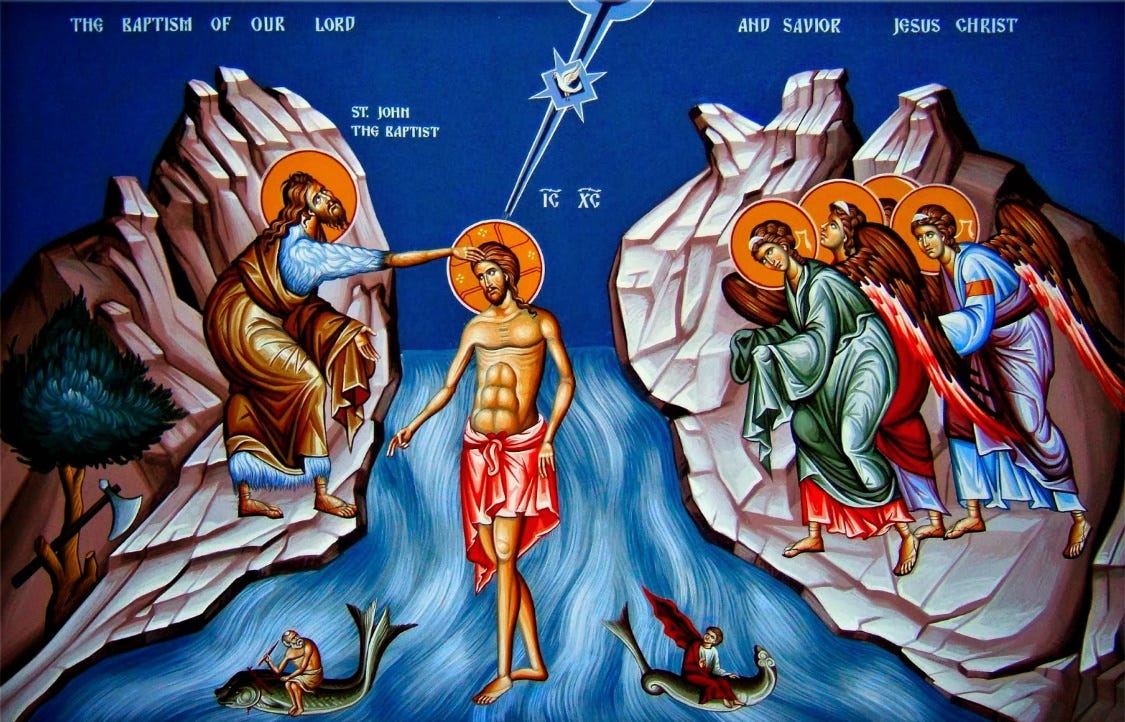
Christ entered the waters of death not to avoid death (as Joshua did by walking on dry ground) but to destroy death from within. He brought His divine life into the place where death reigned, and in doing so He poisoned death at its source. The waters that had been instruments of judgment became instruments of healing. The Jordan, which had been the boundary between death and life, became the place where death and life met and life won.
This is why Orthodox Christians do not view baptism as a symbolic reenactment. It is a real participation in what Christ did in the Jordan. And the Great Blessing of the Waters is the annual renewal of that participation on the largest possible scale.
The Rite
I want to walk you through the Great Blessing because there is something about this rite that no amount of patristic commentary can fully convey. You have to get a sense of the weight of it.
The service takes place either inside the church (where a large vessel of water is blessed) or, in many traditions, outdoors at a natural body of water: a river, a lake, a spring, or the sea. The outdoor form is the older and more dramatic of the two, and it is the one that most vividly enacts the theology.
The priest and the faithful process from the church to the water. Icons are carried. Hymns are sung. The procession itself is a liturgical statement: the Church is leaving the building. It is going out into the world. This is not an interior, private, “spiritual” event. It is an act of cosmic reclamation.
At the water’s edge, the prayers begin. They are among the most theologically rich prayers in the Orthodox liturgical tradition and they deserve to be heard slowly.
The priest begins by recounting the history of water in salvation. He recalls the Spirit hovering over the waters at creation. He recalls the Flood. He recalls the parting of the Red Sea. He recalls the Jordan. This is not a mere listing Bible stories, instead the priest is reactivating the spiritual history embedded in every molecule of water on earth. He is calling the water to remembrance.
Then the tone shifts. The prayers become exorcistic. The priest addresses the demonic powers directly, commanding every “aerial and invisible enemy” to withdraw from these waters. This is not a polite request. The language is commanding, even aggressive. And it reflects the Orthodox conviction, discussed in the first article of this series, that the fallen angelic “watchers” did not limit their corruption to human societies. They corrupted the material world itself. The waters of the earth, like the nations of the earth, were occupied territory. And they were and are being liberated.
After the exorcism comes the great invocation. The priest asks God to send the Holy Spirit upon these waters, just as the Spirit hovered over the waters at the beginning of the world. He asks that the water become “a fountain of incorruption, a gift of sanctification, a loosing of sins, a healing of diseases, a destruction of demons, unapproachable by hostile powers, filled with angelic might.” Every phrase is teaching Christian theology.
Incorruption: the reversal of entropy, the signature achievement of the Eighth Day.
Sanctification: the restoration of the water’s original purpose as a bearer of divine life.
Healing: the medicine of immortality extending beyond the Eucharist to the most basic element of physical existence.
Destruction of demons: the Great Displacement applied to the molecular level.
And then the cross goes into the water 3 times. Each time accompanied by the singing of the Theophany troparion: When You, O Lord, were baptized in the Jordan, the worship of the Trinity was made manifest; for the voice of the Father bore witness to You, calling You His beloved Son, and the Spirit in the form of a dove confirmed the truthfulness of His word.
In Genesis 1:2, the Spirit of God is portrayed as a bird. The word used in Hebrew to describe his movement over the waters, usually translated in English as ‘hovering’ or ‘brooding’ is a word used to describe a mother bird brooding over her young. The presence of the Holy Spirit over the waters as a dove is a deliberate recalling of the original creation of the world. The first creation culminates, at its climax, in the creation of Adam (Gen 1:27). The new creation follows the reverse order and begins with the re-creation of man through the incarnation of Christ. This is the first main liturgical theme of Theophany: the re-creation and setting free of Adam by Christ in the waters of the Jordan. It should be remembered that the celebration of Theophany in the East preceded the celebration of the Feast of the Nativity by nearly three centuries and it was Theophany which functioned as the celebration of the incarnation of Christ.
Theophany and River Gods: What Are the Strange Figures on the Theophany Icon? - January 6, 2020 / Fr. Stephen De Young
Three immersions. Just as in baptism. Because this is a baptism. Not of a person, but of the water itself.
When the cross emerges the third time, the water is changed. Not chemically (though Chrysostom made an observation in the fourth century that has been repeated by the faithful ever since: Theophany water, properly stored, does not spoil; it remains pure and uncorrupted for months, even years, in a way that unblessed water does not). The change is ontological, a word we have been using throughout this series to mean a change in the mode of being itself. The water has been recalled to its primordial purpose. The Spirit that hovered over it before the creation of the sun is hovering over it again. It has been pulled out of the Seventh Day and into the Eighth.
LDS Tangent 1
(don't worry it's nice)
To use LDS language for a moment, when I talk about the Eight Day, that it's coming and how elements of it are being pulled into our current reality, you could say that this is part of the process by which the earth is being celestialized. Not at some later event 1000 years into the future after a 3rd or 4th coming of Christ, but ongoing since the Incarnation and in the Here and Now as we are in and approach The Last Days (to me the phrase The Last Days now takes on a new meaning. It's not the Last Days as in the end of all life on Earth in some apocalyptic sense, it's the Last Days as in the end of the 7 Day creation, and moving to an 8th and truly Last day.)
The Capillary System
What happens next is, to my mind, one of the most quietly radical things in all of Christian practice. The first time I experienced this I found it very strange. Because I didn't understand it it seemed almost like almost superstitious or magical thinking. The faithful line up. They drink the water. They fill bottles and jars and thermoses and whatever vessels they have brought with them. And then they take the water home.
They sprinkle it in their houses. They give it to the sick. They anoint their children with it. They sprinkle it on their gardens, their animals, their cars. In rural Orthodox communities, the priest will walk through village fields with the Theophany water, blessing the soil before planting season. In coastal towns, he will bless the boats in the harbor. In cities, people keep a bottle of Theophany water on their icon shelf all year and use it whenever illness strikes, whenever anxiety descends, whenever something in the household feels wrong in a way that is hard to name but impossible to ignore.
This is what I'm calling the "capillary system” of redemption.
Think about how blood works in the body. The heart pumps. The great arteries carry the blood outward. But it is the capillaries, the microscopic vessels that reach into every tissue, that actually deliver the oxygen to the cells. Without capillaries, the heart’s work would be pointless. The blood would never reach the places that need it.
The Great Blessing of the Waters is the heart pumping. Christ’s baptism in the Jordan is the event that oxygenated the blood. But the bottles of holy water carried home to apartments in Queens, farmhouses in Romania, Ranches in Texas, and fishing villages in Crete: those are the capillaries. They are how the Eighth Day reaches the ordinary tissues of every day life. The cosmic event becomes domestic. The river becomes the kitchen table. The Jordan reaches your doorstep.
Fr. Alexander Schmemann, in his Of Water and the Spirit, described blessed water as the “matter of the new creation.” He meant this with full ontological seriousness. Just as the bread and wine of the Eucharist become, through the Holy Spirit, the Body and Blood of Christ (the ultimate union of the material and the divine), the water of the Great Blessing becomes a fragment of the world to come. When you drink it, you are taking the Eighth Day into your body. When you sprinkle it on your home, you are extending the Jordan into your hallway. When you pour it on the soil, you are doing, in miniature and by grace, exactly what Adam was supposed to do with the entire cosmos: pulling the material world back toward its Creator.
St. Paisios of Mount Athos, the beloved twentieth century Greek elder whose counsel was sought by thousands, used to tell his visitors to use holy water with faith, not as a charm. He insisted that the water’s power was not mechanical but relational. It worked because it was a vehicle of the Holy Spirit, and the Spirit responds to the faith of the one who receives Him. “The water is holy,” Paisios would say, “but your heart must also be open.” The capillary system works only if the tissues are alive enough to receive the blood.
What the Protestants and Mormons Are Missing (and What They Already Have)
I want to pause here and speak directly to the two audiences who make up most of this publications readership, because I know that what I have described so far either resonates deeply or sounds like baptized paganism, and there is probably not much middle ground.
If you come from the LDS tradition, you already believe in the sacredness of water. Baptism by immersion is essential to salvation. You believe the physical act matters, that the water matters, that the authority of the one performing the baptism matters. You are closer to the Orthodox understanding of the Great Blessing than you might think. Where the divergence comes is in the scope of the claim. In the LDS framework, water is sacred when it is used for a specific ordinance by a specific priesthood holder for a specific person. In Orthodoxy, the claim is wider. All water is sacred, or rather, all water is meant to be sacred, and the Great Blessing is the Church’s annual act of reminding the water (and the world) of this fact. The priesthood is not conferring a status that the water does not naturally possess. It is restoring a status that water has always possessed but that has been obscured. The river does not become holy at Theophany. It remembers that it was holy all along.
If you come from a Protestant tradition, I suspect the Great Blessing sounds like exactly the kind of thing the Reformation was supposed to correct. Superstition, mythology. Works based righteousness. Magical thinking masquerading as faith. I understand the instinct. But I would first ask you to consider two things:
First: the Christians who wrote these prayers, who developed these rites, who believed that blessed water could heal diseases and drive out demons, were not medieval peasants fumbling in the dark. They were the same men who gave you the Nicene Creed, the scriptures of the New Testament, the canon of the Bible (and hence the Bible itself as a compiled canon,) and the doctrine of the Trinity. St. Basil, St. Gregory, St. Chrysostom. If you trust them on the nature of Christ, why would you dismiss them on the nature of water?
Second: the Protestant suspicion of material holiness rests on an assumption that the Reformers inherited from late medieval nominalism, not from the early Church. That assumption is that the spiritual and the material are fundamentally separate categories, and that God acts on the soul directly, without needing the “middleman” of physical matter. But this is an almost gnostic (heretical) idea and precisely the assumption that the Incarnation shattered. Let's think this through shall we. God did not save the world through an idea, a sermon, or a feeling. He saved the world by entering into it and becoming flesh (physical matter.) By eating fish. By sweating blood. By dying on wood and being buried in stone. And by walking out of a tomb with a body that could be touched. The material world is not a middleman between you and God. It is the place where God chose to meet you. And the Great Blessing of the Waters is the Church’s insistence, year after year, century after century, that His entering into physical/material creation was the greatest event in the history of mankind, and that God has not stopped choosing.
The Water Does Not Spoil
One more detail before we close, and it is the sort of thing that makes rationalists uncomfortable and makes the faithful go quiet.
St. John Chrysostom, in his Homily on the Baptism of Christ, made an observation about the Theophany water that has been repeated by Orthodox Christians for sixteen centuries: “It does not decay over the course of time, but the water drawn today remains whole and fresh for a year, and often for two or three years, and after a great passage of time, it rivals the waters just drawn from the springs.”
This is not a medieval legend. This is a claim made by one of the most brilliant and empirically minded teachers in the history of the Church, and it has been tested, informally but persistently, by Orthodox Christians ever since. Bottles of Theophany water stored on icon shelves, unsealed, exposed to air and dust, and yet remaining clear and odorless and free of algae or decay for periods that far exceed what ordinary water would endure under the same conditions.
I am not going to tell you this is a scientifically verified miracle. I am not going to tell you it is not. What I will say is that if the theology outlined in this series is true, if water really does have a logos that orients it towards incorruption, if the Great Blessing really does recall water to its primordial purpose as a bearer of the Spirit, then incorruptibility is not a strange side effect. It is a signature. It is what happens to Saints and it is what the water was always supposed to do. Decay is a feature of the Seventh Day. The Eighth Day does not decay, for in Christ, there is no death.
"I am the resurrection and the life. Whoever believes in me, though he die, yet shall he live, and everyone who lives and believes in me shall never die."
John 11:25-26 is Christ’s own statement. And it doesn't just apply to us, it applies to all of creation.
LDS aside 2 (also nice)
This is not only an Orthodox Christian belief, it is also, if you think about it, an LDS belief. It is the work of Christ that celestializes the earth. The Doctrine and Covenants teaches that the earth itself will die and be “quickened again” through the same redemptive power that raises human bodies (D&C 88:25-26). “Not one hair, neither mote, shall be lost, for it is the workmanship of mine hands” (D&C 29:25). It is the work of Christ that celestializes the earth. Not a different program running alongside salvation. The same program, applied to everything He made.
“The earth abideth the law of a celestial kingdom, for it filleth the measure of its creation, and transgresseth not the law — Wherefore, it shall be sanctified; yea, notwithstanding it shall die, it shall be quickened again, and shall abide the power by which it is quickened, and the righteous shall inherit it.” D&C 88:25-262
Now pay attention, the earth dies and is quickened again. That’s resurrectional language being applied to the planet itself. And the mechanism is the same mechanism that quickens human bodies: the power of Christ. Verses 14-16 of the same section make the connection explicit: “Now, verily I say unto you, that through the redemption which is made for you is brought to pass the resurrection from the dead. And the spirit and the body are the soul of man. And the resurrection from the dead is the redemption of the soul.” Then verses 17-20 immediately apply this to the earth: “And the redemption of the soul is through him that quickeneth all things... Therefore, it must needs be sanctified from all unrighteousness, that it may be prepared for the celestial glory; for after it hath filled the measure of its creation, it shall be crowned with glory, even with the presence of God the Father.”
The earth’s celestialization and humanity’s resurrection are presented as the same act of redemption operating at different scales. It is not two separate programs. It is one work of Christ.
D&C 29:22-25 extends this beyond the earth to all living things. “And the end shall come, and the heaven and the earth shall be consumed and pass away, and there shall be a new heaven and a new earth... and all old things shall pass away, and all things shall become new, even the heaven and the earth, and all the fulness thereof, both men and beasts, the fowls of the air, and the fishes of the sea; and not one hair, neither mote, shall be lost, for it is the workmanship of mine hands.”
The reason nothing is lost is not that matter is indestructible, it’s that creation is God’s workmanship, and He doesn’t abandon what He makes. That’s the same theological logic Orthodox theology uses when Irenaeus says “God is not so poor” as to need a whole new creation.
Joseph Fielding Smith made this connection explicit in his 1928 General Conference address: “The Lord intends to save, not only the earth and the heavens, not only man who dwells upon the earth, but all things which he has created. The animals, the fishes of the sea, the fowls of the air, as well as man, are to be recreated, or renewed, through the resurrection, for they too are living souls.” He’s drawing on D&C 29 and 88 together, and the phrase “through the resurrection” is doing heavy lifting. It is the resurrection power of Christ that renews all creation. Not a separate act. The same act.
D&C 77:1-2 adds the detail that in its celestialized state, the earth will be like “a sea of glass and fire,” and that the animals seen in John’s Revelation are real creatures: “They are in the likeness of that which is in the heaven of God... beasts, and creeping things, and fowls of the air; that which is spiritual being in the likeness of that which is temporal; and that which is temporal in the likeness of that which is spiritual.” Animals aren’t metaphors they are participants in the glorification.
D&C 130:9 adds that “this earth, in its sanctified and immortal state, will be made like unto crystal and will be a Urim and Thummim to the inhabitants who dwell thereon.” Translation, the earth doesn’t get replaced. It gets transfigured. Same matter, new glory.
Protestants, make of this what you will. The water does not seem to care whether you believe it or not.
The River Keeps Flowing
I started this article with the image of a priest standing on a frozen river in Russia. Let me end it by widening the frame.
On the same day, in the same hours, the same rite is being performed across the Orthodox world. In Thessaloniki, a priest throws the cross into the Aegean and young men dive after it in a tradition that goes back centuries. In Tarpon Springs, Florida, the largest Theophany celebration in the Western Hemisphere draws tens of thousands to the bayou. In Ethiopia, the ancient Orthodox community gathers at rivers and lakes in a celebration called Timkat that preserves some of the oldest forms of the rite in existence. In Bucharest, in Tbilisi, in Beirut, in Anchorage, in a hundred small parishes in a hundred small towns where nobody is watching and nobody is filming and the priest is standing on the ice with five parishioners and a thermos, the cross goes into the water, the troparion is sung and the Eighth Day breaks through.
The Great Blessing is not performed in one place. It is performed everywhere. And in Orthodox theology, the blessing of any water is the blessing of all water, because all water is connected. The ocean that receives the cross in Thessaloniki is the same ocean that laps at the shore in Jakarta. The river blessed outside Moscow feeds into tributaries that eventually reach the sea. The theology is not sentimental. It is hydrological. Water moves. It circulates. It evaporates and falls as rain. And wherever it goes, it carries the Eighth Day with it.
This is what Adam was supposed to do with the whole material world. Take it. Bless it. Offer it to God. Receive it back, sanctified, and distribute it to every corner of creation. The Great Blessing of the Waters is the Church doing Adam’s job. Taking the most fundamental, most ancient, most intimate element of the physical world and lifting it to God, and receiving it back charged with the life that the world was always meant to carry.
The Priest of Creation is back at his altar. And the river remembers.
The final article in this series, “No Rapture, No Escape: Orthodox Eschatology and the Eighth Day’s Final Dawn,” will be published for paid subscribers only. It is the article where all four threads of the series converge: creation, the fall, the redemption of matter, and the ultimate fate of the cosmos. If you have read this far and the Eighth Day framework has begun to reshape how you see the world, that last article is where the full picture comes into focus.
It is also, frankly, the article I am most looking forward to writing because Orthodox eschatology, the teaching about how this all ends, is the most hopeful, most beautiful, and most terrifyingly ambitious claim in the history of Christian thought. And almost nobody in the Western world has ever heard it.
Paid subscribers make this work possible. Become one.
The Eighth Day is not coming. It is already here. The question is whether or not you can see it yet.
"The Orthodox Church has always taught that the background against which the scriptures and scriptural events are rightly understood is preserved within Holy Tradition. Holy Tradition is the life of the Holy Spirit within the church, but how precisely this functions is often misunderstood. Sometimes it is thought to be some sort of secret additional knowledge, beyond the scriptures or the public proclamation of the church passed down orally. This sort of idea, however, is roundly condemned by the Fathers in their contest against Gnosticism. What separates Christianity from Gnosticism, they argue, is that Christianity has always publicly proclaimed the same faith delivered once and for all to the saints. A prime example of how tradition ‘works’ can be seen in the icon and related liturgics for the Feast of Holy Theophany.” For more information please read the full article that explains this icon by Fr. Stephen Dr Young.
https://www.churchofjesuschrist.org/study/scriptures/dc-testament/dc/88?lang=eng