
Forget Salvation, You Were Never Meant to Be Saved. You Were Meant to Be Finished.
The ancient Christian teaching that rewrites everything you thought you knew about the “plan of salvation.”
What if I told you that the earliest Christians didn’t believe you needed to be “saved” in the way you’ve been taught? They didn’t go around trying to get you to be saved or say a sinner’s prayer.
Neither were they concerned with rescuing you from a divine courtroom, nor with being acquitted by a celestial judge focused on justice and handing out punishment. Nor were they overly concerned with being whisked away to some disembodied heaven where you float on clouds and sing hymns forever.
What if the original Christian vision was far stranger, far more ambitious, and far more beautiful than any of that? What if these things: plain, precious, and basic, have been lost in the Christian traditions of the West but are just as valid today, maybe even more important, than they were 2000 years ago?
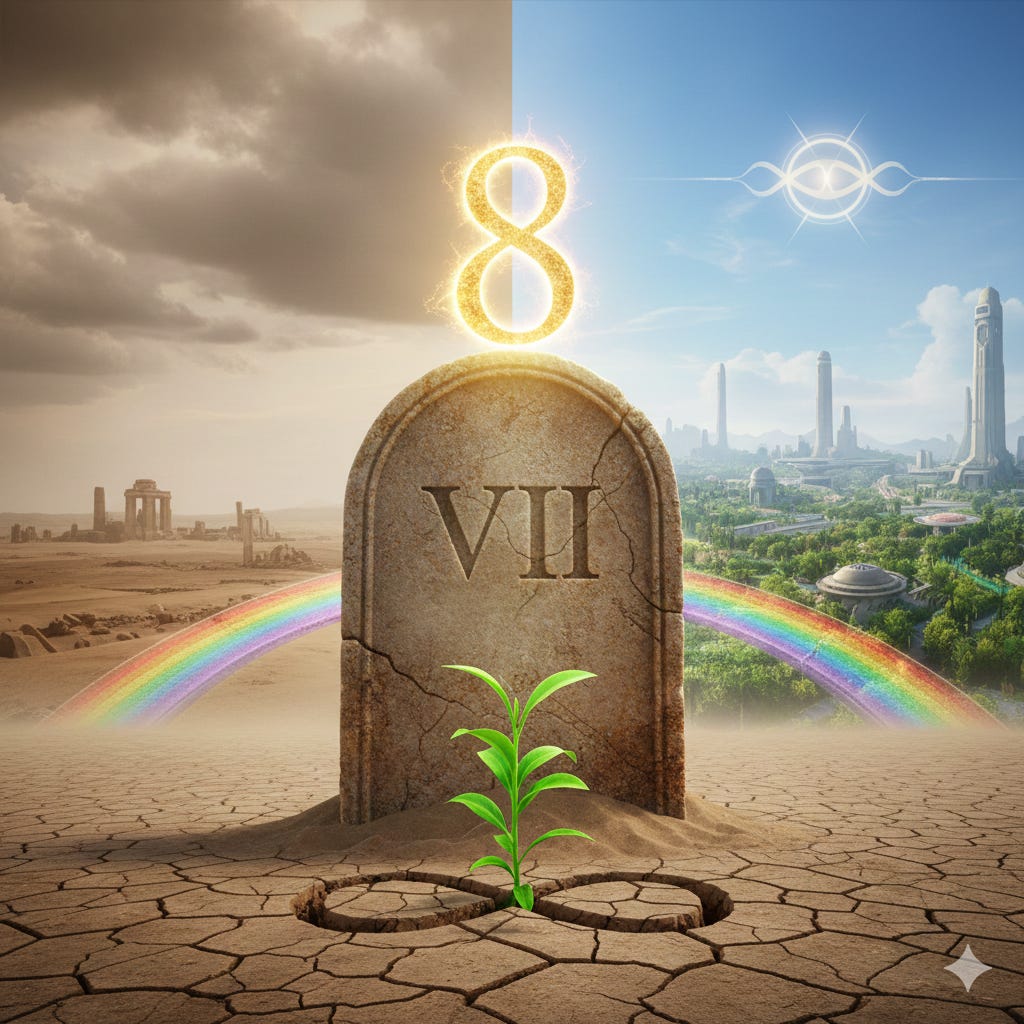
What if the whole point of the Gospel, the actual, ancient, pre-denominational point, was that you are an unfinished creature, and that, in the words of Saint Athanasius, “God became human so that humans could become God?“
I know. That sentence probably made half of you lean forward (LDS readers likely heard in this an echo of the (in)famous Lorenzo Snow couplet) and the other half reach for the “unsubscribe” button. Stay with me. What I’m about to lay out for you is not some fringe theory. It is the beating heart of the oldest continuous Christian tradition on earth. And it will reframe everything you think you know about the plan of salvation, creation, the fall, redemption, and the end of the world.
It all starts with a day that doesn’t exist on your calendar.
This is the first part of a series on the Eighth Day. In upcoming posts for paid subscribers only, we’ll explore how Orthodox Christians “hallow” physical space through blessings and holy water—and why they bless not just houses and churches, but cars, animals, fields, and rivers. We’ll look at the specific prayers of the Great Blessing of the Waters at Theophany and what they reveal about the Eighth Day’s power over the material world. And we’ll go deep into the Orthodox understanding of the “end times”—an eschatology so different from Left Behind that it will feel like discovering a new religion.
This is the kind of theology that doesn’t get written about in most places, and your support makes it possible to keep going deeper.
The Day After the End of the World
Every culture on earth has a seven-day week. It’s baked into the bones of civilization; inherited from the Genesis account of creation. Six days of labor, one day of rest. The cycle repeats. Monday follows Sunday. January follows December. We are born, we work, we age, we die. Our children repeat the process.
This is what the early Church Fathers called “the Seven Days,” and they didn’t mean it as a metaphor. They meant it as a diagnosis.
The Seven Days is the way the world works after the Fall. It is the closed loop of biological existence. You eat to survive. You reproduce to continue the species. You build to stave off entropy. And then you return to the dust. The sun rises, the sun sets. Vanity of vanities, said the Preacher. All is vanity.
If you grew up Mormon, you know this rhythm well. Earthly life is a “probationary state,” a test. If you grew up Protestant, you know it too. We’re sinners in need of a savior. The world is fallen. The goal is to get out, to heaven, to the celestial kingdom, nirvana, or whatever version of the afterlife your tradition promises.
But the ancient Christians saw something different. They didn’t see the Seven Days as a test to pass or a prison to escape. They saw it as a chrysalis, an unfinished stage of development for a creature that was always designed to become something more.
And they had a name for what comes next.
They called it the Eighth Day.
Perfect but Not Finished
Here’s where things get interesting, and where the Orthodox tradition parts ways with almost every Western understanding of biblical history and the “plan of salvation.”
In most Protestant and Mormon theology, Adam and Eve were created in a state of completion. They were “perfect.” Then they sinned, and everything broke. The rest of the Bible is the story of God fixing what went wrong.
Orthodoxy tells a radically different story.
In Orthodox theology, Adam and Eve were created perfect but unfinished. Think of a newborn child. A newborn is perfect. Every finger, every toe, every cell is exactly as it should be. But no one would say a newborn is a completed human being. A newborn is designed to grow. To learn. To mature. To become something far greater than what it is in the cradle.
That’s what Adam and Eve were. Spiritual newborns. Icons of God, bearing His image but not yet having grown into His likeness. And that distinction, the one between image and likeness, is one of the most important ideas in all of Christian theology, even though most Western Christians have never heard of it.
The Image of God (tselem in Hebrew, eikon in Greek) is what you are by nature. It’s the structural blueprint—rationality, free will, creativity, the capacity for love. Every human being has this, and nothing can destroy it. Not sin. Not death. Not even hell.
The Likeness of God (demut in Hebrew, homoiosis in Greek) is what you are called to become. It’s the destination. The full maturation. The point where the creature so perfectly reflects the Creator that the distinction between them becomes almost—almost—invisible.
The Church Fathers had a word for reaching that destination: Theosis. It means deification. Becoming by grace what God is by nature. And before you recoil, this is not the popular (within LDS circles) Mormon idea of “becoming gods” in the sense of achieving independent, sovereign godhood over your own planet. It’s not polytheism. It’s something stranger and more intimate. It is participation. It is union. It is the creature being so saturated with the life of the Creator that it radiates divine light without ever ceasing to be a creature.
St. Athanasius, writing in the fourth century, put it into simple, understandable words that still echo across the centuries: “God became man so that man might become God.”
This was the plan from the beginning. Not a backup plan. Not a response to the Fall. The original design. Adam was meant to walk from perfection into completion—from the image into the likeness, from the Seven Days into the Eighth Day.
He never made it.
How We Got Stuck
The Fall, in Orthodox understanding, is not primarily a legal problem. It’s not that Adam broke a rule and now God is angry and needs to have a debt, created by sin, paid off. That framework—the courtroom model, where God is the judge, humanity is the defendant, and Jesus is the attorney who takes our punishment—is a later Western medieval Roman Catholic innovation that forever changed the Western understanding of the “Atonement.” Leading to erroneous ideas in protestantism and, by extension, Mormonism. It’s not wrong in every respect, but it misses the deeper architecture.
You see, above everything else, The Fall is an ontological catastrophe. That word—ontological—just means it has to do with the nature of being itself. What happened in Eden wasn’t just a broken law. It was a broken humanity.
Picture this: Adam was created as the Microcosm—the “little universe.” He was the only creature in all of existence who was simultaneously both 100% material and 100% spiritual. He had a body like the animals and a soul (nous, the spiritual intellect) oriented toward God. He was the living bridge between heaven and earth, the link between the created cosmos and the uncreated God.
His job, his cosmic vocation, was to act as the Priest of Creation. He was supposed to take the material world, with all its beauty and wildness, and offer it back to God. To pull the physical universe upward into the divine. To be the hinge on which everything turned towards its Maker.
But instead of the spirit leading the body up towards God, Adam let the body lead the spirit down towards the world. That’s what we call the Fall. He didn’t just eat a piece of fruit. He reversed the hierarchy of his own being. He chose the stomach over the soul. He chose biological impulse over spiritual vocation. He chose the Seven Days over the Eighth.
And the consequences were catastrophic—not because God was punishing him, but because that reversal changed *what* he was.
The Church Fathers, particularly St. Gregory of Nyssa, describe what happened next with a haunting image. After the Fall, God clothed Adam and Eve in “garments of skin.” On the surface, it sounds like God made them leather clothes. In the LDS understanding, this is clothing meant to cover their nakedness, as they now could understand that they were naked.
But the early church Fathers (you know, those crusty old dudes who studied at the feet of the apostles) read it as something far more profound. The “garments of skin” represent our current biological condition—mortality, the dominance of animal instinct, the desperate cycle of hunger, reproduction, and death. We didn’t receive a punishment; by Adam’s choice, we became something diminished. The image of God remained—buried, tarnished, but indestructible. But the likeness? That was lost. The trajectory toward Theosis was severed.
And we got stuck.
Stuck in the loop of the Seven Days. Born, fed, frightened, hungry, reproducing, dying. The samsara wheel of suffering turning and turning and turning, with no exit in sight.1
And It Wasn’t Just Us
Here’s something that almost no Western theology talks about, but Orthodoxy insists on: when humanity fell, the whole world fell with us.
Because Adam was the Priest of Creation, the link between the cosmos and God, when the priest collapsed, the parish suffered. St. Paul says it explicitly in Romans 8: “The whole creation groans and labors with birth pangs.” Nature didn’t sin. Animals didn’t rebel against God. But they were bound to the one creature who did2. When man stopped channeling divine life into the material world, the material world began to devour itself. Here, the LDS idea that separation from God naturally brings death is spot on.
This is why nature is “red in tooth and claw.” Not because God designed it that way. Not because predation and suffering are part of some eternal plan. But because the conduit was broken. The animals became subject to the same cycle of futility—the same Seven Day loop of survival and death—because the one creature meant to bridge them into eternity abandoned his post.
Orthodox theology holds this truth with real grief. Animals suffer not because of their own sin, but because of ours. The tragedy of the natural world is a mirror of the tragedy of the human soul. We were supposed to be their voice, their priest, their bridge to the divine. We failed. And they paid the price.
If that doesn’t change the way you look at a suffering animal, I don’t know what will.
The Second Adam and the Three Temptations
So, where does that leave us? Humanity is stuck. The Microcosm is shattered. The Priest of Creation has abandoned his altar. The Seven Days spin on and on, a closed loop of birth and death with no door to the Eighth.
And then God does the unthinkable.
He enters the loop.
The Incarnation. What we call God becoming human in the person of Jesus Christ; Is not primarily about God coming to pay a debt. It is about God entering the broken Microcosm to repair it from the inside. Christ takes on the “garments of skin.” He takes on hunger, exhaustion, thirst, and grief. He takes on the full weight of the Seven Days. But He does it differently than Adam did.
And this is what the Temptation in the Wilderness is all about.
This event, which most Christians treat as a dramatic but relatively straightforward moral test, is something far more important and precise. It is the Anthropological Correction, the exact moment where the Second Adam (Jesus Christ) undoes, point by point, the failure of the First Adam.
Let’s look at the structure.
The First Temptation: Stones to Bread. Satan says to Jesus, “If you are the Son of God, command these stones to become bread.” This is the temptation of biological necessity—the stomach. It is exactly the same category as the fruit in Eden. Adam saw food, desired food, and let the desire for food override his orientation toward God. Christ, starving after forty days in the desert, refuses. He subordinates the body to the spirit. “Man does not live by bread alone, but by every word that proceeds from the mouth of God.” The hierarchy is restored. The spirit leads.
The Second Temptation: The Leap from the Temple. Satan takes Jesus to the pinnacle of the temple and says, “Throw yourself down, for the angels will catch you.” This is the temptation of self-preservation—the ego. It is the instinct to use divine power for personal safety, to make God a servant of your survival. Adam chose self-preservation over trust. Christ refuses. He will not test the Father. He will not make his own safety the ultimate value.
The Third Temptation: The Kingdoms of the World. Satan shows Jesus all the kingdoms of the earth and says, “All this I will give you, if you will fall down and worship me.” This is the temptation of dominion—power, advanced knowledge, territory, force. It is a Seventh-Day kingdom built on the animal “law of the jungle.” Laws of hierarchy, aggression, and control. Christ refuses it entirely. He will not rule by the logic of the beast. His kingdom operates by a different law—sacrificial love, self-emptying, the inversion of worldly power.
Three temptations. Three failures of the First Adam. Three corrections by the Second.
And then the Gospel of Mark adds a detail that most readers skim past, but that the Orthodox Fathers seized on with fierce attention. After the temptations, Mark 1:13 says that Jesus “was with the wild beasts, and the angels ministered to him.”
He was with the wild beasts.
Why in heaven’s name does Mark mention this? It seems like a very random thing to say, but it’s not. It’s the sign of the Restoration of creation. When Christ subdued His animal nature. When He re-established the proper hierarchy of spirit over body, the animals recognized Him. They were at peace with Him. Not because He magically tamed them, but because He was what Adam was supposed to be. The True Man. The Priest of Creation, finally back at His altar. The link between the wild creatures and their Creator was restored.
It is a glimpse of the Eighth Day, leaking through into the Seventh.
Breaking the Loop
The Temptation was the preparation. The Resurrection was the explosion.
When Christ rose from the dead on the day after the Sabbath. On what we now call Sunday, the early Christians understood something that most modern believers have lost. They didn’t see it as merely a miracle, or even as proof of Jesus’ divinity. They saw it as a cosmological event. The Seven Days had been running since the creation of the world. Six days of work, one day of rest. Repeat forever. A closed system.
And on Sunday morning, the tomb was empty. The loop was broken. A new day had dawned. A day that had no precedent and no sequel. Not the first day of a new 7-day week, but the Eighth Day of creation. The day that was always supposed to come but had been delayed by the Fall.
Christ is what St. Paul calls “the Firstborn of the New Creation.” Not the first person to go to heaven. The first instance of a new kind of human being—one no longer trapped in the biological cycle, no longer bound by the “garments of skin,” no longer a slave to hunger and fear and death. His resurrected body was physical—He ate fish, He was touched, He walked through doors. But it was a transfigured physicality. A body animated not by biology but by the Holy Spirit. What Paul calls a soma pneumatikon—a “spiritual body.”
And here is the critical claim of Orthodoxy, the one that changes everything: this is what you were made for.
Not just Jesus. You. Every human being. The Resurrection is not just something that happened to Christ. It is something that is happening to humanity. The Eighth Day has dawned. And every person who enters into it through faith, through baptism, through the sacramental life of the Church—they are already, in some real but incomplete way, participating in the new creation.
The Fathers called this the “already/not yet.” Your body is still in the Seventh Day. You still get hungry. You still age. You will still die. But your person—if you are being drawn into Theosis—is already tasting the Eighth Day. Already being transfigured. Already becoming what Adam was always meant to become.
Why Everything Is Shaped Like an Octagon
If you’ve ever walked into an Orthodox church and wondered why the baptismal font is eight-sided, now you know.
The octagon is not a decorative choice. It is a theological statement. When a person is baptized, they are not simply “accepting Jesus” or “joining a church.” They are being born again into the Eighth Day. They are dying to the Seven Day cycle—the old humanity of survival and death—and rising into the new humanity of Christ as a new creation. The eight sides of the font proclaim the destination.
You’ll find the number eight everywhere in Orthodox architecture and iconography once you know to look for it. The eight-pointed star that appears in icons of Christ and the Virgin Mary is called the Star of the Unwaning Day—the light that never sets, because it belongs to a Day that has no evening. The domes of Byzantine churches are often octagonal. The earliest Christian baptisteries were octagonal. The symbolism is relentless and deliberate.
Orthodoxy is not a religion of abstract ideas. It is a religion of architecture, light, sound, and bread. Every physical element is meant to pull the material world back toward its Creator—to do, in miniature, what Adam was supposed to do with the entire cosmos.
The Liturgy: The Eighth Day Bleeds Into the Seventh
This brings us to the part that most outsiders find either bewildering or intoxicating: the Orthodox Divine Liturgy.
If you walk into an Orthodox service expecting a sermon with some songs before and after, you will be disoriented. The Liturgy is not a lecture. It is not a concert. It is not a pep rally for Jesus. It is not a revivalist tent meeting.
It is the Eighth Day breaking through into the present.
When the faithful gather for the Liturgy, they believe they are stepping out of ordinary time. The incense is not ambiance, it represents the prayers of the saints rising to heaven, and it is meant to “baptize” the sense of smell, training even the body’s most primal faculties to recognize the presence of God. The icons are not paintings—they are windows into the Eighth Day, depicting the saints and Christ not as they appeared in historical time, but as they appear in the timeless light of the Resurrection. The chanting is not performance—it is the sound of creation being offered back to its Maker.
And at the center of it all is the Eucharist.
St. Ignatius of Antioch, writing in the early second century, a man who personally knew the Apostles and was discipled at the feet of Peter, called the Eucharist the “Medicine of Immortality.” Not a metaphor. Not a symbol. Medicine. As in: something that acts on the body. Something that heals the garments of skin from the inside. Something that feeds the spirit so that it can resume its proper authority over the flesh.
When you take the bread and wine in the Orthodox Liturgy, you are not “remembering” Jesus in the way you remember a dead friend. It’s not something early Christians did just as a memorial. You are eating the Eighth Day. You are taking the life of the New Creation into the cells of the Old. This is why we believe that the bread and wine have “the true presence of Christ” within them. Not that it actually necessarily transubstantiates into flesh and blood, but that the essence of Christ, his Grace and energies are in it, and by consuming it, you are experiencing true communion. The result is that you are, at the molecular level, beginning the healing and transfiguration of your animal nature from the inside out, and this this, is what the Atonement is actually all about, not some penal substitutionary atonement theory cooked up by a medieval roman catholic monk and further refined by Martin Luther, but the victory of Christ in remaking and healing all creation, including us.
This is why we Orthodox call the Liturgy “heaven on earth.” Not as a compliment. As a location.
The Priest of Creation, Restored
Now we need to go bigger. Because the Eighth Day is not just about individual salvation. It is about the fate of the cosmos.
Remember: the Fall was not just a human problem. When the Priest of Creation fell, all of creation fell with him. The animals. The mountains. The rivers. The very structure of the material world. All of it groaning under the weight of the Seven Day cycle, waiting—as Paul says—for the revealing of the sons of God.
The Eighth Day is that revealing.
In Orthodox eschatology (the theology of the “last things”), the end of history is not a rapture. It is not an evacuation plan where the righteous are beamed up and the earth is left to burn. It is the full and final saturation of the material world with the presence of God. The General Resurrection—when all the dead are raised—is the moment when the Eighth Day stops being “already/not yet” and becomes simply and completely now.
And when that happens, Man resumes his role as the Priest of Creation. The Microcosm is healed. The bridge between heaven and earth is rebuilt. And through that bridge, the whole of the material world—every animal, every atom, every star—is liberated from the cycle of the 7-day decay and drawn into the life of God.
Paul’s “groaning of creation” is finally answered. Not by the destruction of nature, but by its transfiguration. The animal kingdom, so long trapped in the violence and futility caused by the Fall, is freed—not because the animals achieve some kind of independent salvation, but because the creature who was supposed to be their bridge to salvation has finally, at last, become what he was always meant to be.3
This is the end of the story. Not escape from the world. The healing of the world.
The Cosmic Displacement: Saints, Demons, and the Geography of the Eighth Day
But there’s still one more layer—and it’s the one that tends to stop people in their tracks.
In discussions among scholars like Fr. Stephen De Young and Dr. Nathan Jacobs, the Eighth Day narrative expands from the internal healing of the human person to the external reclamation of the cosmos. It moves from psychology to geography. From the soul to the nations.
To understand this, you need to know about Deuteronomy 32.
In the Septuagint, the Greek Old Testament used by the early Church (and still used by the orthodox as scripture preserved without the loss of plain and precious things at the hands of well-meaning but misguided Latin monks and reformers), Deuteronomy 32:8 contains a reading that most English Bibles obscure. It says that when God divided the nations at the Tower of Babel, He “set their boundaries according to the number of the angels of God.” (Some manuscripts say “sons of God.”) The idea is breathtaking: God assigned angelic beings—members of His heavenly council—to oversee and guide the nations of the earth.
But they rebelled.
Instead of shepherding the nations toward God, these angelic “watchers” accepted worship for themselves. They became the “gods” of the pagan world—the Baals and Molochs, the Zeuses and Marses. They fed on human passions. They demanded sacrifice. They turned the nations into spiritual fiefdoms, enslaving people not only to their animal instincts but to spiritual tyrants who exploited those instincts for their own purposes.
This is the Orthodox understanding of paganism. The “gods” of the ancient world were not purely imaginary. They were real spiritual beings who had abandoned their divine commission and set themselves up as petty despots over the territories of the earth.
And this is where the Eighth Day becomes not just personal but political in the deepest sense.
When Christ rose from the dead, He didn’t just break the power of biological death. He reclaimed authority over all the earth. And one of the most startling consequences of that reclamation is what Orthodox tradition calls the Great Displacement.
As the demonic “watchers” are cast down—stripped of their illegitimate authority over the nations—their seats are vacated. And in Orthodox theology, it is the Saints who fill those seats.
Think about what this means. A territory that was once “ruled” by a demon of war, or a local pagan deity who demanded blood sacrifice, is reclaimed by a Saint. St. George replaces Ares. St. Elijah replaces Baal. The patron saint of a city or a nation is not a quaint cultural tradition or evidence of Christian appropriation meant to aid conversion from paganism to Christianity. It is a statement of cosmic regime change. The old guard has been overthrown. The new guardians do not demand sacrifice—they offer intercession. They do not enslave—they pray on behalf of.
And here is where it circles back to the animals, to creation, to the healing of the whole world.
Under the old regime—the demonic order of the Seven Days—the material world was either worshipped as a god (paganism) or exploited as a slave (secular materialism). Neither approach reflects the truth. But under the Saints—the Eighth Day humans, the ones who have achieved Theosis or are well on their way—the material world is shepherded towards healing.
This is why Orthodox hagiography (the lives of the saints) is saturated with stories of saints and animals. St. Gerasimos healed a lion that came to live with him in the desert. St. Seraphim of Sarov fed a wild bear from his hand. St. Kevin of Glendalough held still for so long in prayer that a blackbird built a nest in his outstretched palm, and he remained motionless until the eggs hatched.
These are not fairy tales. They are evidence of the Displacement. When a human being is restored to the proper ordering—spirit leading body, soul oriented toward God—the animals recognize it. The fear dissipates. The violence subsides. The ancient peace of Eden returns, if only for a moment, in the presence of one who has entered the Eighth Day.
What This Means for You (aka, my 2 cents)
So….. let me bring this home.
If you come from a Mormon background, you already have a sense that humanity has a divine destiny—that we are meant to become something greater than what we currently are. That instinct is correct. But as an Orthodox christian I would say the mechanism is different. It is not about progressing through stages of independent godhood. It is about union. Being so saturated with the life of the one true God that you radiate His presence while remaining fully, beautifully, eternally a creature. The cup overflows, but the cup is still a cup.
If you come from a Protestant background, you already know that the cross is central—that redemption required the ultimate sacrifice. That is also correct. But Orthodoxy would say the purpose of that sacrifice is larger than you’ve been told. Christ didn’t just die to satisfy a legal requirement. He died and rose again to open the Eighth Day—to make Theosis possible, to restore the broken Microcosm, to reopen the path from the image of God to the likeness of God. Salvation is not a verdict or a legal designation. It is a metamorphosis.
And for everyone—Mormon, Protestant, Catholic, searching, skeptical, or just plain curious—the Eighth Day offers an answer to a question that haunts every human being who has ever watched a loved one die, or stood over the grave of a pet, or looked at the evening news and wondered if there was any hope at all for this bleeding, burning world:
Is this all there is?
No. This is the Seventh Day. The Seventh Day is real, but it is not final. There is a Day coming—a Day that has already begun—where the loop breaks, the cycle ends, and everything that was meant to be beautiful and whole and alive is finally, irrevocably, and eternally finished.
Not finished as in “over.”
Finished as in complete.
I see in this the perspective of a context for understanding Matthew 22:30, “at the resurrection people will neither marry nor be given in marriage; they will be like the angels in heaven.” Jesus doesn’t say that if you are already married, you will no longer be married. In fact, the Orthodox wedding sacrament service never says “till death do you part.” We don’t say “for time and all eternity” either, but we do believe that the marriage relationship persists in the afterlife. (unto the ages of ages.) However, in the afterlife, for an Orthodox Christian, the nature of that relationship is different. It’s not like you think of marriage on earth because we will have been ontologically changed. LDS women who may be afraid of or complain about becoming eternal baby factories can rest easy. In the heavens, the concerns of the 7th-day man (hunger, access to resources, sex, child rearing, and death) are no longer the concerns of the 8th-day man.
Also makes sense to me as we still believe that Man was given dominion (err stewardship) over all the earth.
This makes scriptures like Revelation 5:5-6, 2 Nephi 21:6-7 and D&C 77:2 make a lot more sense - at least to me. The lamb and the lion or the wolf and the lamb can lie down together in the eschaton, not because of some kind of divine pacification brought about by the 2nd coming, but because creation itself has been renewed and animals, man, and God can enjoy a communion together. It’s not because an enmity was placed on the earth by God as a kind of curse and then removed, but because the fallen world created by man’s fall, has finally been renewed and completed.


