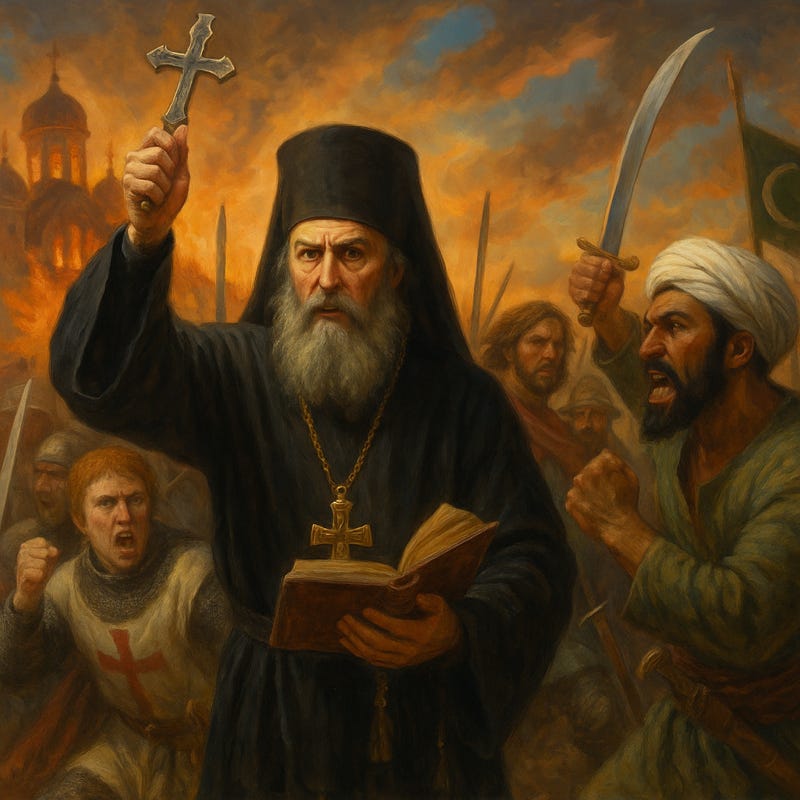
The Last Battles: Modern Fronts of the War
Part 6 in The War Unseen: The Long Battle Against Christ and His Church
This article is Part 6 in a series. Be sure to start with Part 1!
This article is Part 6 in a series. After Part 1, be sure to read Part 2!
This article is Part 6 in a series. After Part 2, be sure to read Part 3!
This article is Part 6 in a series. After Part 3, be sure to read Part 4!
This article is Part 6 in a series. After Part 4, be sure to read Part 5!
Author's Note: What follows is a personal hypothesis. While I am a devoted member of the Orthodox Church, this work does not reflect the official position of the Orthodox Church nor does it speak on behalf of it.
Rather, it represents my own synthesis and reflection on the long historical arc of spiritual warfare I believe has been waged against God, Christ, and His Church from the moment of the Incarnation until now. Ideas and concepts articulated within this article come from my own understanding of early church and reformation history, orthodox and roman catholic podcasts, and some evangelical sources. (Where these types of views tend to be the most prevalent.)
After the Paywall
The devil’s new arsenal: how algorithms, porn economies, and addictive UX replicate ancient idols—and why they’re spiritually designed to break prayer.
Secularism’s “neutrality” myth: why it functions as a rival religion with its own priesthood, liturgy, and dogmas.
Postmodernism’s core trick: how “my truth” dethrones The Truth—and how to answer it without sounding shrill.
From sola scriptura to solo meo: the causal chain from Reformation fragmentation to today’s theological collapse in mainline churches.
The war on the body and family: precise ways the sexual revolution and gender ideology invert Christian anthropology—and what the Fathers would say.
Global persecution now: the hard numbers behind martyrdom today—why swords became laws, forms, and “soft” coercion.
Are we in Satan’s “little season”? Patristic readings of Revelation 20 applied to our moment—sober, not sensational.
Field manual for resistance: baptismal renunciations in daily life, domestic-church habits that heal attention, and a practical rule to unhook from the machine.
Subscribe to unlock the complete analysis, sources, and the step-by-step plan to stand fast without becoming fearful—or fashionable.
Introduction
The war that began in the Garden of Eden, revealed itself fully at the Incarnation, and has raged across the centuries through the blood of martyrs and the smoke of heretical movements, is not over. If anything, it has intensified. Where once Christians faced lions in Roman arenas or Islamic scimitars at the gates of Constantinople, today they confront something far more insidious: a coordinated assault on the very foundations of reality itself, waged not with swords and fire, but through screens and seductions, ideologies and institutions.
Picture a world where glowing screens have replaced graven idols, where moral relativism masquerades as tolerance, where the family—that smallest church St. John Chrysostom described—lies in ruins beneath the banner of liberation, and where the very categories of male and female, parent and child, truth and falsehood, are dissolving into the mist of postmodern confusion. The devil has not abandoned his ancient strategies; he has merely adapted them to an age intoxicated with technology and seduced by the lie that each individual can become their own god.
This is the battlefield of our generation: not gladiatorial arenas, but university classrooms; not imperial edicts, but social media algorithms; not physical persecution alone, but the systematic deconstruction of the Christian worldview through a thousand cuts of cultural Marxism, sexual revolution, and spiritual confusion. The enemy has learned that it is often more effective to corrupt souls through comfort and convenience than through violence and terror.
From Swords to Screens: The Devil's New Weapons
The persecution of early Christians by Roman emperors was brutal but straightforward: confess Caesar as Lord or face the lions. Today's spiritual warfare operates through far more subtle mechanisms of control and corruption. Where the ancient world offered Christians the clean choice between Christ and Caesar, the modern world drowns believers in a flood of distractions, addictions, and moral compromises that slowly erode their spiritual foundation12.
The New Arsenal of Spiritual Warfare
The devil's weaponry has evolved dramatically from the crude instruments of imperial persecution. Today's arsenal includes digital pornography that enslaves minds through biochemical addiction3, with studies showing that 13% of the global population suffers from pornography addiction and that 67% of American men view online pornography annually4. Social media platforms design their interfaces using the same psychological principles that make gambling addictive, with over 210 million people worldwide suffering from social media and internet addiction5.
These platforms don't just waste time—they rewire the brain's reward pathways, creating dopamine dependencies that make genuine prayer and contemplation increasingly difficult6. The constant stream of notifications and infinite scroll features is deliberately engineered to capture and fragment human attention, making it nearly impossible to sustain the focus required for spiritual growth.
The proliferation of entertainment and consumer goods creates what the early Church Fathers would recognize as a form of spiritual gluttony—an endless appetite for material satisfaction that leaves the soul permanently malnourished. Where ancient Christians fasted to discipline their desires, modern believers often overindulge in digital stimulation and material consumption, weakening their capacity for spiritual discernment.
Scripture and the Battle for the Mind
As St. Paul warned, "We are not ignorant of his devices" (2 Corinthians 2:11), yet many Christians today seem remarkably unaware of how their minds are being shaped by forces hostile to the Gospel. The enemy's strategy remains fundamentally unchanged: to enslave souls and sever them from Christ. What has changed is the sophistication of the delivery mechanism.
The ancient world's idols were carved from wood and stone; today's idols are crafted from pixels and algorithms, designed to be irresistible to fallen human nature. The goal is identical: to replace worship of the true God with worship of created things, whether that be one's own image carefully curated on social media, the accumulation of material possessions, or the satisfaction of sexual desires through digital fantasy.
The Ideologies of Darkness
While the devil perfects his technological weapons, he simultaneously advances through ideological warfare—spreading systems of thought that systematically undermine Christian truth while presenting themselves as enlightened progress.
Secularism: The Lie of Neutrality
Modern secularism presents itself as religiously neutral, but it is actually a competing religious system that demands the exclusion of Christian truth from public life7. This ideology insists that questions of ultimate meaning, moral authority, and human purpose can be resolved through purely rational, scientific means—effectively making human reason into a false god.
Secularism's supposed neutrality is exposed as fraudulent when it consistently privileges materialistic explanations over Christian ones, not because they are better supported by evidence, but because they conform to predetermined metaphysical commitments. The secular educational establishment, media institutions, and government bureaucracies function as the priesthood of this false religion, zealously guarding their doctrines against Christian influence.
Postmodernism and Relativism: The Assault on Truth Itself
Perhaps no philosophical movement has done more to prepare the ground for anti-Christian ideologies than postmodernism, with its core doctrine that there is no objective truth89. By claiming that all truth claims are merely expressions of power or cultural conditioning, postmodernism attempts to relativize Christian truth into just one opinion among many.
Research indicates that this relativistic worldview has gained significant traction in American culture, with studies showing that increasing numbers of Americans reject the concept of absolute truth10. When Jesus Christ's claim to be "the way, the truth, and the life" (John 14:6) is reduced to merely one perspective among many, the Gospel itself becomes unintelligible.
This relativism creates a paradox: while claiming that no one can know absolute truth, postmodernists absolutely insist on their own doctrine of relativism. The result is a culture where traditional Christian moral teaching is dismissed as outdated while radical ideologies are accepted uncritically.
Identity Politics: The Enthronement of the Self as God
Modern identity politics represents perhaps the most refined version of the original Satanic temptation: "You shall be as gods" (Genesis 3:5). This ideology teaches that each person's subjective experience of their own identity is beyond question or critique, effectively making individual feeling the ultimate source of truth1112.
Under this system, biological reality, historical truth, and moral reasoning must all bow to the altar of personal identity. The phrase "my truth" becomes a conversation-ending trump card that places the individual ego above God, Scripture, reason, and community. This represents a complete inversion of Christian anthropology, which teaches that human beings find their true identity through relationship with God, not through self-assertion against Him.
Wokeism: Neo-Paganism with Religious Zeal
What has emerged under the banner of "social justice" often functions as a secular religion complete with original sin (white privilege, heteronormativity), clergy (diversity consultants, academic theorists), rituals (struggle sessions, land acknowledgments), and salvation (allyship, consciousness-raising). This neo-pagan system demands conformity with religious intensity while claiming to be secular and rational13.
False Ecumenism: The Temptation to Dissolve Truth in Unity
Within Christianity itself, the devil works through false ecumenism—the idea that unity can be achieved by downplaying or abandoning doctrinal differences1415. This movement pressures Orthodox and conservative Protestant churches to compromise essential truths for the sake of superficial harmony with institutions that have already abandoned historic Christianity.
True Christian unity comes through common confession of apostolic truth, not through the lowest common denominator of therapeutic moralism. When "unity" requires abandoning the doctrine of the Trinity, the authority of Scripture, or the uniqueness of Christ, it ceases to be Christian unity and becomes apostasy disguised as virtue.
Fragmentation's Consequences
The Protestant Reformation's principle of sola scriptura, while intended to reform the Church, inadvertently created the intellectual framework for modern individualism. When Scripture alone is interpreted by the individual alone, the result is not the recovery of apostolic Christianity but the multiplication of competing authorities—ultimately making each person their own pope.
This fragmentation created an environment where mainline Protestant denominations have proven especially vulnerable to cultural pressure. Statistics show devastating decline: the Presbyterian Church (USA) has lost 58% of its membership since 1990, the United Church of Christ has lost 52%, and the Evangelical Lutheran Church in America has lost 41%16. Many of these denominations now ordain practicing homosexual clergy, deny biblical miracles, or reduce Christian worship to social activism17.
The same principle of individual interpretation that Luther used against the Catholic Church now operates to dissolve biblical authority itself. What began as "Scripture alone" has led to "my interpretation alone," which becomes indistinguishable from the modern principle of "my truth alone."
III. The War on the Body and Family
The assault on Christian civilization becomes most visible in the systematic attack on marriage, family, and human sexuality. This represents a direct assault on the image of God in humanity, since "God created man in his own image... male and female he created them" (Genesis 1:27).
The Sexual Revolution: New Slavery Masquerading as Liberation
The sexual revolution of the 1960s promised freedom but delivered unprecedented levels of sexual dysfunction, family breakdown, and psychological damage. Since the 1970s, divorce rates have nearly doubled, with 40-50% of marriages ending in divorce18. Single-parent households have tripled, creating environments where children lack the stability necessary for healthy development1920.
The statistics reveal the true cost of sexual "liberation": rates of sexually transmitted infections have reached all-time highs with nearly 20 million new infections each year in the United States alone[20]. Depression, anxiety, and suicide rates have increased dramatically, particularly among young people who have grown up in this post-sexual revolution world.
The Pornography Pandemic
Perhaps no single development illustrates the demonic character of the sexual revolution more clearly than the explosion of pornography consumption. With over 4 million websites offering pornographic content—roughly 12% of all websites on the internet—an entire generation is being systematically trained to view human sexuality as disconnected from love, marriage, and procreation21.
Current statistics show that 67% of American men and 41% of American women view online pornography annually. Among younger demographics, the numbers are even more alarming, with many children being exposed to hardcore pornography before they reach adolescence. Pornhub alone reported more than 2 billion visits in a single month in 2023.
This represents more than personal moral failure—it constitutes a systematic rewiring of human sexuality away from the complementarity and self-sacrifice that marriage requires. The resulting pornography addiction affects an estimated 13% of the global population, creating patterns of compulsive behavior that mirror drug addiction.
Abortion and Euthanasia: The Mockery of the Image of God
The normalization of abortion and euthanasia represents a direct assault on the biblical teaching that human beings are created in the image of God. When society accepts the principle that some human lives are disposable—whether because they are inconvenient (abortion) or suffering (euthanasia)—it abandons the foundation of Christian civilization.
Since Roe v. Wade in 1973, over 60 million children have been killed through legal abortion in the United States alone. The euthanasia movement, while smaller in scope, represents the same fundamental denial of human dignity and the sovereignty of God over life and death.
Gender Ideology: The Direct Assault on Creation Itself
Perhaps the most brazen attack on God's creative order is the modern transgender movement, which claims that biological sex is merely a social construct and that individuals can change their gender through willpower and medical intervention. This represents a direct contradiction of Jesus's teaching that "from the beginning of creation, God made them male and female" (Mark 10:6)22.
Current statistics show that roughly 3.3% of high school students identify as transgender, with an additional 2.2% questioning their gender identity23. These numbers represent a dramatic increase from earlier surveys, suggesting that social contagion plays a significant role in the spread of gender confusion.
Research indicates that 16 states have explicitly incorporated gender ideology into their public school curricula, affecting roughly 37% of American students. Children as young as kindergarten are being taught that the most basic distinction they observe—between boys and girls—has no basis in reality.
The Breakdown of the Family: Shattering the Smallest Church
St. John Chrysostom taught that the family is a "little church" where children first learn to love and serve God242526. He emphasized that "let the household be a church consisting of men and women," where prayer and Scripture study form the center of family life.
The statistics reveal the devastating success of the attack on this institution. In 1970, 83% of women ages 30-34 were married; by 2010, that number had fallen to 57%27. From 1960 to 2007, the percentage of American women who were married fell from 66% to 51%, and the percentage of men who were married fell from 69% to 55%.
This family breakdown has profound spiritual consequences. Children who grow up without stable two-parent households are significantly less likely to become practicing Christians, more likely to struggle with addiction and mental health issues, and less capable of forming stable marriages themselves. The destruction of the family thus becomes self-perpetuating across generations.
The Vulnerability Created by Fragmentation
Protestant denominations that abandoned sacramental marriage, downplayed ascetic practices like fasting, or reduced sexuality to a matter of private choice created a theological vacuum that cultural ideologies rushed to fill. When churches no longer teach that marriage is a divinely instituted sacrament reflecting the relationship between Christ and the Church, they have little basis for resisting cultural redefinition of marriage and family.
The same churches that embraced divorce and remarriage in the 20th century found themselves unable to articulate coherent opposition to same-sex marriage in the 21st century. Having already accepted the principle that marriage is primarily about adult fulfillment rather than divine covenant, they had no theological foundation for maintaining traditional sexual ethics.
IV. The Global Assault on the Church
While the devil wages war through cultural transformation in the West, he continues his ancient strategy of direct persecution in other parts of the world, often using the very movements—like Islam—that he helped establish centuries earlier.
Overt Persecution: The Continuing Martyrdom
Despite proclamations about the modern world's tolerance and human rights, Christian persecution has reached unprecedented levels. According to the latest World Watch List, more than 365 million Christians face persecution each year—equivalent to one in seven believers worldwide282930. This represents an increase from previous years, not a decrease.
In 2023 alone, nearly 5,000 Christians were murdered for their faith, with over 80% of these killings taking place in Nigeria at the hands of Islamic extremist groups like Boko Haram31. More than 295,000 Christians were displaced from their homes, and over 14,766 churches and Christian properties were attacked—a seven-fold increase from the previous year.
The statistics reveal that the same demonic powers that inspired the creation of Islam in the 7th century continue to use it to accomplish their work today. Between November 2022 and November 2024, nearly 10,000 Christians were killed, primarily by Islamic extremist groups. The "epicenter of militant Islamist violence has shifted from the Middle East to Africa," indicating a coordinated strategy of persecution across the continent.
Communist Suppression: The War Against Orthodox Christianity
The communist persecution of Orthodox Christianity represents one of the most systematic attempts to destroy the Church in history. Under Stalin's regime alone, over 600 bishops, 40,000 priests, and 120,000 monks and nuns were killed3233. The number of functioning Orthodox churches was reduced from around 55,000 to about 500, and the number of monasteries was reduced from 1,025 to zero.
In China today, authorities have arrested or sentenced at least 1,559 Christians over the past two years, primarily from unregistered churches. Over 10,000 churches were closed in China in 2023 alone. This represents a continuation of the same anti-Christian agenda that has characterized communist regimes since the Bolshevik Revolution.
The persecution in communist countries specifically targeted the Orthodox Church because of its theological emphasis on theosis—the doctrine that humans can participate in the divine life through Christ. This doctrine represents the ultimate threat to totalitarian ideology because it places human dignity and destiny beyond the reach of political power.
Subtle Persecution in the West: Legal and Cultural Pressure
In Western nations, persecution takes more subtle forms through legal harassment, professional discrimination, and cultural marginalization. Christian business owners face lawsuits for refusing to participate in same-sex wedding ceremonies. Medical professionals are pressured to perform abortions or facilitate gender transitions against their conscience. Teachers and professors risk termination for expressing traditional Christian views on sexuality and marriage.
This "soft persecution" is often more effective than violent oppression because it maintains the appearance of tolerance while systematically excluding Christian influence from public life. The result is the creation of a secular monoculture that presents itself as neutral while being actively hostile to Christian truth.
The Vulnerability of Divided Christianity
The devil's strategy of division and conquest becomes apparent when examining which Christian communities have best resisted cultural pressure. Churches that maintained apostolic succession, sacramental theology, and conciliar authority—primarily Eastern Orthodox and traditional Catholic communities—have proven more resilient than Protestant denominations that embraced individualistic interpretation of Scripture.
Many Protestant churches that once stood firmly on biblical truth have now ordained openly practicing homosexual clergy, denied the historicity of miracles, or reduced worship to social activism. This collapse occurred not through external persecution but through internal capitulation to cultural pressure, enabled by the lack of authoritative structures to resist doctrinal innovation.
The pattern reveals the wisdom of the early Church's emphasis on apostolic succession and conciliar authority. Where these structures remained intact, churches maintained orthodox teaching even under severe pressure. Where they were abandoned in favor of democratic or individualistic approaches, theological collapse often followed within one or two generations.
Eschatological Frame: The Devil's Last Stand
The intensity and coordination of modern spiritual warfare suggests that we may be witnessing what Revelation 20 describes as Satan being "loosed for a little while" after the thousand-year period of his binding.
Patristic Interpretation of the Present Age
Many Church Fathers interpreted the "thousand years" of Revelation 20 not as a literal future millennium, but as the period between Christ's first and second comings during which Satan's power to "deceive the nations" is restrained343536. According to this view, we are currently living in the millennium, but approaching its end when Satan will be "released for a little while" to wage final war against the saints37.
The binding of Satan does not mean he is inactive, but that the spread of Christian truth38 has limited his power to systematically deceive entire nations. The current global coordination of anti-Christian ideologies—from Islamic extremism to cultural Marxism to transgender ideology—may represent the "short time" when this restraint is removed.
Several factors suggest we may be approaching this eschatological moment: the systematic nature of the assault on Christian civilization, the coordinated global persecution of believers, the rise of ideologies that explicitly seek to replace Christian truth with alternative systems, and the falling away of large portions of the visible church from apostolic faith.
The Great Deception
Revelation warns of a "great deception" in the last days that will be so convincing that "if possible, even the elect would be deceived" (Matthew 24:24). The modern combination of technological sophistication, AI-generated videos and deep fakes, philosophical relativism, and counterfeit spirituality creates unprecedented opportunities for deception.
Unlike the crude persecution of ancient Rome, which clearly distinguished between Christians and their enemies, modern spiritual warfare operates through sophisticated systems that mimic virtue while promoting vice. Environmental activism becomes a substitute religion, social justice becomes a false gospel, and psychological therapy becomes a counterfeit sacrament of confession and absolution.
The "deep fakes" enabled by artificial intelligence, the manipulation of information through social media algorithms, and the systematic rewriting of history in educational institutions create a context where distinguishing truth from falsehood becomes increasingly difficult for those without a firm grounding in apostolic tradition.
The Certainty of Victory
Despite the sophistication of modern spiritual warfare, Scripture assures believers that Satan's final rebellion will be decisively defeated. Revelation 20:9-10 describes fire coming down from heaven to consume the enemies of God's people, followed by the devil being "thrown into the lake of fire and sulfur where the beast and the false prophet were, and they will be tormented day and night forever and ever"39
Christ's victory was won definitively at the Cross and Resurrection. The current intense spiritual warfare represents not Satan's strength but his desperation, knowing that "his time is short" (Revelation 12:12). The coordination and intensity of the assault on Christian civilization paradoxically confirms the nearness of Christ's final victory.
Lessons for Christians Today
Understanding the true nature of modern spiritual warfare equips believers to respond with appropriate strategies drawn from the Church's centuries of experience with demonic opposition.
Baptismal Warfare: Daily Renunciation of Satan
Every Orthodox Christian makes a threefold renunciation of Satan at baptism: "I renounce Satan and all his works and all his worship and all his angels." This is not a one-time event but a daily discipline that must be renewed in the face of constant temptation and assault.
Modern Christians must learn to recognize and renounce the specific manifestations of demonic influence in contemporary culture: the idolatry of technology, the worship of sexual pleasure, the pride of identity politics, and the despair of nihilistic philosophy. This requires both theological understanding and practical discernment.
Ordinary Faithfulness: The Disciplines That Build Resistance
The Church's traditional disciplines of prayer, fasting, Scripture study, and sacramental participation are not arbitrary traditions but proven methods for building spiritual resistance to demonic influence. Just as physical exercise builds bodily health, these spiritual exercises build the capacity to discern and resist evil.
Fasting trains the will to resist immediate gratification in favor of higher goods—a skill essential for resisting pornography, consumer addiction, and other forms of spiritual bondage. Regular prayer creates habits of attention and reverence that counteract the fragmentation and distraction imposed by digital technology. Sacramental participation provides objective grace that does not depend on subjective feelings or cultural fashion.
The Church as Fortress and Family
The devil's strategy has always been to isolate believers from the community of faith, making them vulnerable to deception and despair. Modern technology amplifies this isolation by creating the illusion of connection while actually fragmenting authentic community.
The Church provides the interpretive framework necessary for understanding both Scripture and contemporary events. Individual believers attempting to navigate modern spiritual warfare without the guidance and support of the apostolic community are like soldiers trying to fight a coordinated enemy without communication or supply lines.
St. John Chrysostom's vision of the family as a "little church" becomes especially important in an age when Christian formation cannot be assumed from the broader culture. Parents must take active responsibility for creating domestic churches where children learn to recognize and resist the demonic influences that surround them.
Discernment: Recognizing Ancient Heresies in Modern Forms
The theological education provided by studying Church history and patristic writings enables believers to recognize how ancient heresies reappear in contemporary forms. The Gnostic hatred of the material world appears in environmentalist ideologies that view human beings as a cancer on the earth. Arian subordinationism appears in New Age spiritualities that reduce Jesus to one teacher among many. Marcionite rejection of the Old Testament appears in progressive Christianity that discards biblical teaching on sexuality and social order.
Understanding these patterns helps believers avoid being deceived by the novelty of contemporary error. There is, as Solomon observed, "nothing new under the sun" (Ecclesiastes 1:9)—only ancient deceptions dressed in modern clothing.
Hope: Fighting from Victory, Not for Victory
Perhaps most importantly, Christians must remember that they fight from victory, not for victory. Christ has already "disarmed the rulers and authorities and put them to open shame, by triumphing over them" (Colossians 2:15). The intense spiritual warfare of our time represents Satan's final desperate rebellion against a victory already won.
This confidence enables believers to engage contemporary challenges with courage rather than fear, wisdom rather than panic, and love rather than hatred. The Church has survived the persecution of emperors, the deceptions of heretics, the violence of barbarians, and the seductions of false religions. She will survive the challenges of modernity as well, because she belongs not to this world but to the Kingdom of Heaven.
The War Continues, The Victory Is Certain
From the Garden of Eden to the digital age, the same war has raged between the kingdom of light and the kingdom of darkness. The weapons have evolved from fruit and serpents to algorithms and ideologies, but the fundamental conflict remains unchanged: will human beings worship their Creator or attempt to become their own gods?
Today's battlefield is no less real and no less demonic than the arenas of Rome or the battlefields of medieval Europe. The screens that surround us are not neutral technologies but spiritual battlegrounds where souls are won and lost. The ideologies that shape our universities and government institutions are not merely political theories but theological systems that demand allegiance to false gods.
The assault on marriage and family represents an attack on the image of God in humanity. The persecution of Christians worldwide reveals the same demonic hatred that nailed Christ to the Cross. The fragmentation of Christianity into competing denominations has created vulnerabilities that the enemy has been quick to exploit.
Yet for all the sophistication of modern spiritual warfare, the outcome remains certain. Christ has already bound the strong man and plundered his goods (Matthew 12:29). The gates of Hell will not prevail against the Church that Christ built (Matthew 16:18). The devil's time is short, and his defeat is sure.
The call to Christians today is the same as it has always been: "Be sober-minded; be watchful. Your adversary, the devil, prowls around like a roaring lion, seeking someone to devour. Resist him, firm in your faith, knowing that the same kinds of suffering are being experienced by your brotherhood throughout the world" (1 Peter 5:8-9).
Stand firm. Confess Christ. Endure to the end. The King is coming, the war will end, the martyrs will be vindicated, and the Kingdom of Heaven will be all in all. Even so, come Lord Jesus.