

Older Than the Gospels
Why the Liturgy Matters Before We Even Start, and Why Most Christians Have Never Been Shown the Evidence

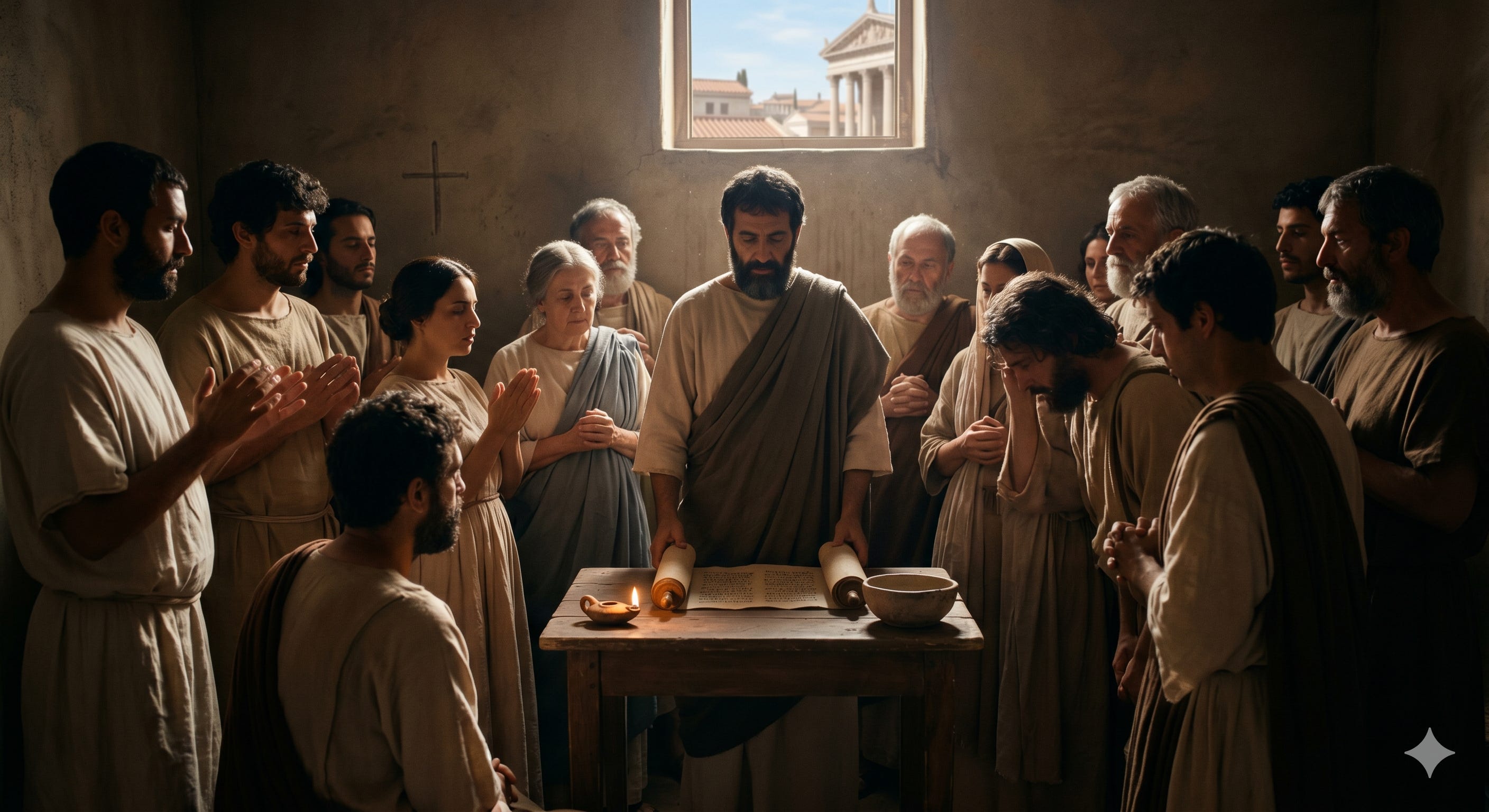
Close your eyes and picture this….
Its fifty years ago on a small country farm, Johnny McMasters Place, and its Friday Night… You've just finished ten hot days of back breakin' labor,… and the hay... the hay is finally in. You're sitting around the kitchen table, under the dim light of the kerosene lantern. Everyone is laughing, and joking, and telling storiessssss...about their neighbours. You're half way through a bottle of.…. uh….. moonshine
err STOP, SORRY, wrong article! (ADD brain ran away with me!) I almost gotcha’ though! Were you paying attention? That song is one of my all time favorites, go check it out.
<shifts gears> Ok, Seriously now…..
Close your eyes and picture this in your mind’s eye.
You are sitting in a living room somewhere in the Roman Empire. The year is 155 AD. The Apostle John has been dead for just over fifty years. The Apostle Peter has been dead for just under a hundred. You cannot get a copy of the New Testament, because the New Testament has not yet been formally assembled into a book — the canon will not be settled for another two centuries. But the writings are there. They are circulating. People are copying them and passing them around.
It’s Sunday morning. And because you are curious, because you want to know what the grandchildren of the Apostles are actually doing, you follow a group of people through the streets of Rome, past the temples of Jupiter and Mars, past the shops and the bakeries, and into a private house. The door closes behind you. You have been invited to a Christian worship service.
What do you see?
Most Christians would probably give an answer that sounds like a slightly older version of whatever tradition they grew up with. If they grew up in a low-church Protestant tradition, they picture a sermon with some hymns, maybe some extemporaneous prayer, maybe a shared meal. If they grew up in an Evangelical tradition, they likely picture something loose and informal, a gathering of fellow christians, some teaching, perhaps some singing, perhaps someone sharing a prophecy or a word of encouragement.
Almost nobody pictures an altar.
Almost nobody pictures incense.
Almost nobody pictures vestments.
Almost nobody pictures anything that looks even remotely like Orthodoxy.
And here is the thing! We do not have to guess!
We have a letter. A letter from that exact decade. A letter written by a Christian philosopher named Justin, later called Justin Martyr, because he was martyred, addressed to the Roman Emperor Antoninus Pius himself.
The letter is an appeal. Justin is trying to explain to the Emperor what Christians actually do on Sunday morning. Why would he need to do that? Because at this time roman pagans are circulating ugly rumors that Christians engage in cannibalism and incest1. Rumors designed to justify the persecution that was busy turning Christians into lion food all over the Empire. Justin writes to the Emperor and says, in effect: *let me tell you what we actually do. Send someone to check if you want. Here is the truth.*
And the description he gives is devastating because the service Justin Martyr describes — written fifty-five years after the death of the last Apostle, to a pagan Emperor who could have had the entire claim verified by a single centurion with a notebook — is not the service that most Western Christians have been shown as the “early Church.”
It is not a sermon with some hymns. It is not an informal gathering. It is something much older, much more structured, much more deliberate, and much more familiar to about three hundred million people living in the world today. Just not the three hundred million you might think.
This series is my attempt to walk you through that evidence. Patiently, carefully, and with as much documentation as I can carry. By the time we are done, my hope is that you will not be able to unsee what I cannot unsee.
Let’s begin.
Why Worship Is Never Just “Style”
Before we get to Justin Martyr’s letter, I need to establish a principle that is going to do some of the heavy lifting for this entire series. It comes from a fifth-century theologian named Prosper of Aquitaine, who was a disciple of Augustine. Prosper coined a Latin phrase that has been the inheritance of serious theology ever since:
Lex orandi, lex credendi2 - loosely translated the way you worship is the way you believe.
Sit with that for a minute. Because it sounds too simple to be important, but it is actually hugely consequential. Here is what Prosper is saying. The way a church worships is not decoration. It is not aesthetic. It is not a style preference that can be swapped out the way you swap out the upholstery on a couch. The way a church worships is the load-bearing structure of what that church actually believes. Worship is doctrine in action. Worship is theology made visible, audible, tangible, incarnate.
Let’s make this concrete.
If you pray directly to the Son of God, you believe the Son of God is God. If you pray directly to the Holy Spirit, you believe the Holy Spirit is God. If you do not do these things, you probably don’t believe these things — or at the very least, you haven’t actualized them in your spiritual life. The doctrine of the Trinity I laid out in an earlier article of this series is not something the Fathers defined at Nicaea and then shelved.

The trinity is something that gets prayed every Sunday in an Orthodox church, dozens of times, with specific addresses to specific hypostases. If you never pray that way, you will eventually drift from believing that way.
If you ask the Saints to pray for you, you believe the communion of the Body of Christ extends across the boundary of physical death. You believe the saints are alive. You believe they can hear you. You believe the bond of love between you and them, the bond of the body of Christ is stronger than demonic forces and the grave. If you do not ask them to pray for you, you probably do not believe those things — or at least, you have not let yourself believe them enough to act on them.
If your worship centers on a pulpit and a sermon, you believe the primary act of Christian gathering is the proclamation of the Word. If your worship centers on an altar and the Eucharist, you believe the primary act of Christian gathering is the offering of the Body and Blood of Christ. Neither of these is a neutral architectural decision. They are theological claims built into the “furniture” of the edifice, so to speak.
Now, let’s run the principle in reverse, because this is where it comes home.
If a church’s worship is radically different from the worship of the ancient undivided Church, then by the same principle of lex orandi, lex credendi that church’s beliefs are probably radically different from the beliefs of the ancient undivided Church. Not maybe, probably, because you cannot worship one way for generations and believe the other way for generations. The worship always wins.
Let that sit, because it is the diagnostic framework for everything that follows.
We are not going to spend the next six articles being antiquarians. We are not going to dig up old Greek texts because old Greek texts are cool. We are going to dig up old Greek texts because if lex orandi, lex credendi is true, then the shape of the worship of the first Christians is evidence, hard, documentary, unfalsifiable evidence, of what the first Christians actually believed. And if their worship has been preserved somewhere, intact, across twenty centuries, then their belief has been preserved with it.
That is a claim worth testing. Let’s Gggggggggooooooooooooooo.
The Question Nobody Asks
This is something that has always struck me as strange. There is an anthropological principle (in the academic discipline of anthropology) called the Narcissism of Small Differences. It describes the phenomenon where communities with adjacent territories and close cultural relationships engage in constant feuds and ridicule because of the hypersensitivity caused by their similarities and small differences.3 i.e. the closer groups of people are in identity, values, norms, the less any disagreement or difference is tolerated. Hence the bitter enmity between Sunni’s and Shiites, between Catholics and Protestants, rivalries between neighboring countries like Canada and the USA, political purity tests within political parties, rivalries between competing technologies due to consumer tribalism (Apple vs Android) sports rivalries, even between teams from the same city (i.e. Manchester City vs. Manchester United or Inter Milan vs. AC Milan.) And as the saying goes, "Academic politics are so vicious because the stakes are so small." You could say that this entire publication is in some way motivated by this principle.
This is in nowhere on better display than in Christianity. Christians have a long history of fighting about doctrine (reference all the years since the reformation.) We argue about the canon of Scripture; which books belong and why. We argue about predestination. We argue about sacraments. We argue about eschatology, i.e. the end times. We argue about baptism (how much water, how old, administered by whom). We argue about whether women can be ordained, whether priests can marry, whether the elements of the Eucharist are really the Body and Blood or just a symbol, whether the Pope has universal jurisdiction; I had quite a bit to say about that one in *Why I really Chose Orthodoxy Over Rome* — go read it if you haven’t!)
We argue about all of it. Vigorously. Sometimes bitterly, for centuries.
But here is the question that almost never comes up, and that almost nobody asks with any seriousness: how did the Apostles actually worship?
Isn’t that strange?
When it comes to every other Christian question, we demand evidence. We demand sources. We demand texts and translations and historical context and early witnesses. But when it comes to the question of how we are supposed to worship — how we are supposed to gather as the people of God on the first day of the week and offer to Him the thing He has asked us to offer — the question mostly doesn’t get asked, and when it does, the answer is often some version of: “well, we don’t really know, and anyway the New Testament doesn’t prescribe a liturgy, so probably it doesn’t matter.” and probably the very worst one “it’s a matter of individual choice” Why do I say this is the worst one? because it basically says that worship is whatever I want it to be, whatever I am comfortable, in essence re-orienting worship of Christ and subjugating it to the self, and the ego (the western mind’s true God.) How prideful, and yet, how American!
I want to push back hard on the thought that “we don’t really know, and anyway the New Testament doesn’t prescribe a liturgy, so probably it doesn’t matter.”
The claim that “we don’t really know” how the Apostles worshiped is not true. We know a great deal. The claim that “the New Testament doesn’t prescribe a liturgy” is a claim that needs examining, because the New Testament presupposes a liturgical context so completely that you almost don’t notice it until someone points it out. And the claim that “it doesn’t matter” is, by the principle we just laid out, isn’t just wrong, it’s catastrophically wrong. In fact, it matters more than almost anything else.
Let’s rewind and consider what we actually know so we can set the stage.
Christ Himself worshiped. Luke tells us that He went to the synagogue in Nazareth “as was his custom” on the Sabbath day (Luke 4:16). He did not improvise. He did not go to some new start-up mega-synagogue with a laser light show, a cool new Jewish band and a hip new preacher. He went to the established places of public worship of Israel where he participated in the reading of the Law, the chanting of the Psalms, the fixed prayers that had been prayed for centuries, because that was the worship His Father had given to His people. He sang the Hallel4 psalms (Psalms 113–118) with His disciples at the Last Supper, as every observant Jew did at Passover. He went up to the Temple in Jerusalem for the appointed feast days. He prayed the Psalter, which is why so many of His words from the Cross are quotations from it.
The Apostles worshiped. The book of Acts describes Peter and John going up to the Temple “at the hour of prayer, the ninth hour” (Acts 3:1). That is not a casual reference. That is a technical reference to one of the fixed hours of Jewish daily prayer, what the Temple called the hour of the afternoon sacrifice, and what the Christian Church would eventually call the Ninth Hour. Acts describes the early Christians “breaking bread” on the first day of the week (Acts 20:7) This is in face Eucharistic language that every ancient reader would have recognized. Paul preaches so long at one such gathering that a young man named Eutychus falls asleep in a window, falls out, and has to be miraculously raised. This is, incidentally, the patron story of every parish that runs long.
The early Christians worshiped. A Roman governor named Pliny the Younger, writing to the Emperor Trajan around 112 AD, about a decade after the Apostle John died, describes the Christians in his province as gathering on a fixed day before dawn to sing hymns to Christ “as to a god.” Pliny is a pagan magistrate writing an administrative report to his Emperor. He has no reason to embellish. He is describing what he found when he interrogated Christians who were about to be executed. Don’t just take my word for it though, go read this Epistula (Letter 10.96) for yourself. It’s on the internet (see the 4th paragraph.)
So we have testimony. We have texts. We have sources, pagan sources, Christian sources, apostolic sources, patristic sources. The materials for answering the question are available. They have been available for nearly two thousand years.
The question is not whether the Apostles worshiped, or whether we can know how. The question is why has nobody been showing you the evidence?
Let me show you (keep the narcissism of small differences in mind as we go.)
The Letter to the Emperor
Let’s set the scene properly, because the context matters.
Rome. The middle of the second century. The Emperor is Antoninus Pius, one of the so-called “Five Good Emperors,” the golden age of imperial Rome, the world that Edward Gibbon would later call the happiest period in the history of the human race (a claim that depends very much on not being a Christian at the time.) Christians are being executed sporadically throughout the provinces. The charges vary. Atheism, because they refuse to sacrifice to the gods of Rome. Cannibalism, because the pagan rumor mill has been working overtime on the whole eat my body, drink my blood language and producing the lurid conclusion that Christians devour infants in their secret meetings. Incest, because Christians call one another “brother” and “sister” and then give each other the kiss of peace, and pagan observers could not think of any other explanation.
Into this maelstrom walks a man named Justin. A Gentile. A convert from paganism. A philosopher by training, he had gone from school to school, studying Stoicism and Platonism, before a conversation on a beach with an old man (he never names him) had turned him toward the prophets of Israel and, through them, to Christ. Justin now lives in Rome. He has a school. He teaches philosophy in the open air. And he writes.
Around 155 AD, Justin writes what we now call his First Apology. An apology in the ancient sense is not a “I‘m sorry about that,” it is a formal defense in the form of a reasoned argument addressed to a specific audience. Justin’s audience is the Emperor himself. He is writing over the heads of the provincial magistrates directly to the throne. He is saying: stop killing us. At least understand what we actually do before you kill us.
This is why the First Apology is one of the most valuable documents we have for understanding early Christian worship. Link with Pliny’s letter, you don’t have to believe what I’m telling you about it, you can go read it for yourself (ref Chapters 65-67.)
Let’s think about the context a little bit. Justin is writing to a pagan Emperor. He has every reason to describe Christian practice accurately. If he embellishes, if he exaggerates, if he invents rituals that don’t actually happen, the document is worse than useless. It is dangerous. A Christian caught lying to the Emperor about Christian practice would be handing Rome an excuse to multiply the persecutions tenfold. So Justin is careful. He is precise. He is describing what he has seen with his own eyes, what he has participated in, what every Christian in Rome and across the Empire was doing on Sunday morning. He is writing for a pagan magistrate who could, and Justin knows this, send a centurion with a notebook to the nearest Christian assembly to verify every word.
And he is not writing long after the Apostolic generation. The Apostle John died around 100 AD. Justin is writing just fifty-five years later. He is writing in a world where the grandfathers of his neighbors could have shaken the of the Twelve.
Now. Let me walk you through what he describes.
In chapters sixty-five through sixty-seven of the First Apology, Justin gives a sequential description of the Sunday gathering. I am going to paraphrase, because Justin’s Greek is far more elegant than my English and because copyright law gets iffy about long quotations, but the structure is exactly what he says. And if you have an doubt in your mind at all about my accurate representation of the text, please go read it! (in fact I encourage you to verify what I am saying.) Here is the shape of Christian worship on a Sunday morning in the middle of the second century.
First, on the day called Sunday, Justin’s word is literally hēmera tou hēliou, “the day of the Sun,” which is the pagan name for the day, which he uses so that the Emperor will understand which day he means, all Christians who live in the cities or the countryside gather together in one place.
Then, the memoirs of the Apostles, which is Justin’s term for what we now call the Gospels, are read aloud, along with the writings of the prophets, for as long as time permits.
When the reader has finished, the one who presides over the gathering, a bishop or a presbyter, stands up and delivers a discourse, exhorting the people to imitate what they have just heard. A homily. A sermon, if you like, but bound to the text.
Then all of the people rise together and offer prayers.5 (Today we call this portion of the services the Liturgy of the Word, or the Liturgy of the Catechumen’s, those who are being instructed in preparation for baptism. This portion of the liturgy will be the most familiar to western protestants and LDS.)
When the prayers are finished, bread and wine mixed with water are brought forward to the one who presides. This begins the liturgy of the faithful, which you can also read online.
The one who presides then offers up prayers and thanksgivings to the best of his ability this is a technical phrase, and it indicates that the exact wording of the Eucharistic Prayer was not yet rigidly fixed in every detail, though the structure was, and when he has finished, the whole congregation responds with the single word Amen, which Justin takes the time to explain to the Emperor is a Hebrew word meaning “so be it.”
After the Amen, the deacons distribute the consecrated bread and wine-and-water to everyone present. And, they carry portions to those who are absent. The sick. The imprisoned. Those who could not make it.
Finally, a collection is taken up for those in need: widows, orphans, the sick, those in prison, strangers who have come through the city, anyone for whom the community is responsible.
That is Justin’s description. That is what Christians were doing on a Sunday morning in 155 AD according to a man who had every reason to describe it accurately and no reason to embellish.
Now let’s take a pause and look at that list again.
Scripture readings from the Gospels and the prophets.
A homily.
Intercessory prayers offered standing.
Bread and wine brought forward.
A Eucharistic Prayer.
The people’s Amen.
Communion distributed by deacons.
Communion carried to those absent.
A collection for the poor.
Every single one of those elements is present, in exactly that order, in the Orthodox Divine Liturgy celebrated this past Sunday morning in a parish near you.
Not a suggestion of it. Not an embryonic form of it. Not a primitive first draft. Not just selectively chosen parts of it. It, the entire thing.
The readings from the Epistle and the Gospel. The homily delivered from the bishop’s chair or the ambo. The Litany of Fervent Supplication. The Great Entrance bringing bread and wine to the altar. The Anaphora, the great Eucharistic Prayer, which we will explore in detail in Article Five of this series, followed by the congregational Amen that has been shouted in every ancient liturgy on earth for two thousand years. Communion distributed by the deacon. Communion carried to the sick and the home-bound, which Orthodox priests and deacons still do to this day, every week, with a small portable communion set designed for exactly that purpose. And the collection box by the door for the poor.
Justin Martyr, writing in 155 AD, describes the service that happened in my parish three days ago.
This is a lot to take in. I acknowledge that. When I first attended an Orthodox Liturgy - after months of diligent, detailed research into the history and the theology -6 I felt as though I had been transported to another world entirely. One ancient, and firmly rooted in the milieu of the Near East, not the American frontier.7 I was more than a little overwhelmed. I understood almost nothing of what was going on. I was totally lost. But it was so compelling that I did my best to follow along8 — to sing the hymns, to join in the responses with the faithful around me. I left feeling as though I had been drawn into a higher realm, as though I had participated in something ancient and otherworldly and, if I am honest, even a little bit alien. Heavenly love and power, mixed with a slight discomfort because it felt so foreign that I wasn’t sure I belonged there. But, I showed up again the next Sunday, and this time, instead of trying to process everything intellectually, I just followed the cantors and the other parishioners as best I could, learning from them as I went. I had spent months digging into history trying to validate the truth claims of Orthodoxy. Now I was confronted with an experience of worship totally alien to me, and one of my impulses was to do the same thing — to validate and verify the things that had initially felt so foreign. They no longer feel alien. They feel like home. They feel like heaven. And that is the moment I started to ask where all of this came from.
Two Roots, Both Ancient
Justin Martyr describes a Christian Liturgy that is already fully formed by 155 AD. Fully formed. Not developing. Not experimental. Not regional. The service he describes is not “what we tried last Sunday and liked.” It is the pattern. It is what is done. It is what has been done for as long as he and his readers can remember.
Which raises the obvious question: where did this pattern come from?
It did not appear out of nowhere. The Apostles didn’t just sit around in the Upper Room on Pentecost and make something up on a whim because it seemed good to them. They didn’t invent Christian worship from a blank page. That’s not how these things work. They had been worshiping the God of Israel their entire lives. Christ didn’t come and teach them a completely different religion, like Buddhism or Hinduism, he came to fulfill what they have already lived, what they already knew and were promised. They had been raised in the liturgical world of Second Temple Judaism; the world of the Temple in Jerusalem, the world of the synagogues of the Diaspora, the world of fixed hours of prayer, the world of chanted Psalms, Feast Days, holy incense, orders of priesthood, priestly vestments, eastward orientation and the reading of the Law. When they gathered to break bread in the name of the risen Christ, they were not starting from scratch. They were taking everything they already knew about how the people of God are supposed to worship and filling it with Him.
This is the thesis of the entire series. I want to state it as plainly as I can.
The Orthodox Divine Liturgy has two roots. Both are ancient. Both are provable. Both are older than most people have ever been told.
Second Temple Judaism. The worship of Israel as it was practiced in the Temple in Jerusalem and in the synagogues of the Diaspora when Jesus Christ walked the earth. The worship the Christ himself participated in. Every element of Orthodox worship that an LDS or Protestant visitor finds “foreign,” the incense, the altar, the priesthood, the vestments, the eastward orientation, the chanted Psalter, the fixed hours of prayer, the architectural screen between the holy place and the most holy place, every one of these is an inheritance from the worship of Israel.
None of them was invented by medieval Byzantines. None of them was invented at all. They were received.
Apostolic institution. The Eucharist itself, the center of gravity of all Christian worship, the Body and Blood of Christ given for the life of the world, was instituted by Christ at the Last Supper, handed down by the Apostles to their disciples, and preserved in documents that are older than parts of the New Testament canon. The shape of the Eucharistic Prayer. The words of institution. The calling down of the Holy Spirit upon the gifts. The mixing of water with the wine, which Justin explicitly mentions and which every ancient liturgy retains. All of this bears apostolic fingerprints that we can still read.
The Anaphora - an Aside
Let me take an aside to introduce one technical term here, because we will need it later. The word is anaphora.
Anaphora is Greek, and it means “offering up” or “carrying up” — from the verb anapherō, to bring up or to lift up. The anaphora is the Great Eucharistic Prayer that sits at the heart of every ancient Christian liturgy, and by that I mean; Every one. Eastern and Western. Byzantine and Coptic. Syrian and Armenian and Ethiopian. They all have an anaphora and despite the fact that these liturgies were separated from each other by centuries and by the collapse of empires and by theological schisms that broke communion between them, their anaphoras all share the same essential architecture. They all go back to a common apostolic root. When we get to Article Five of this series, we are going to take that root apart and look at it piece by piece. For now, just remember the word. Anaphora. The prayer that carries the offering up to God. (LDS would know this as the sacramental blessing.)
The rest of this series is going to walk through these two roots, one element at a time, and show you exactly where the fingerprints are.
Here is what I am planning to cover. (We know how good I am at sticking to a plan. I say 6 articles total, but it could easily end up more.)
In Article Two, we are going to walk into the Temple in Jerusalem. Not the Temple as it is imagined in most Christian sermons, but the Temple as it actually was: its architecture, its furniture, its priesthood, its sacrifices, its veil. And I am going to show you that every Orthodox church on earth is a deliberate, conscious architectural memory of what stood on Mount Zion. The iconostasis is the veil. The altar is the altar. The sanctuary is the Holy of Holies. Again, and I can’t emphasize this enough, it’s not an analogy, it’s an inheritance.
In Article Three, we are going to sit down in a first-century synagogue and discover that the first half of every Divine Liturgy, what we called above the Liturgy of the Word, or the Liturgy of the Catechumens, is something that Jesus Christ Himself would have recognized from Nazareth. The readings, the Psalter, the intercessions, the standing posture, the eastward orientation, all of it.
In Article Four, we are going to dive deeper into the documents. Justin Martyr is not the earliest source we have. He is the earliest pagan-facing source. There is an even older document, called the Didache (for LDS readers, think of this as an early priesthood manual) that some scholars date as early as the middle of the first century, which would make it older than parts of the New Testament itself. The Didache gives us a Eucharistic Prayer. We will read it together.
In Article Five, we will examine the anaphora itself and show you why every ancient Christian liturgy sings the song that the prophet Isaiah heard the Seraphim singing in the Temple in the year that King Uzziah died.
In Article Six, we will meet two men: John Chrysostom and Basil the Great, two of the greatest bishops and theologians of the fourth century. And I will show you that neither of them invented the liturgies that bear their names. They were editors. The liturgies were older than they were.
And in Article Seven, we will walk through a single Orthodox Sunday Divine Liturgy together, from the first prayer to the last, and I will attempt to name the pedigree of every movement. This is Temple. This is synagogue. This is Apostle. This is Didache. This is Isaiah. This is Basil. This is Chrysostom. When we are finished, I do not think you will ever sit through a Divine Liturgy the same way again. And I do not think you will ever look at non-liturgical worship the same way either.
What We Are Really Asking
The question that runs underneath this entire series is not really a question about liturgy. It is a question about legitimacy.
When Christ ascended to the right hand of the Father, He did not leave His Church without instructions. He left the Apostles. He left the Holy Spirit. He left the Eucharist. He left the pattern of worship that they had already been taught in Israel and that He had fulfilled with His own Body and Blood the night before He died. And He commanded them to go and teach and baptize and do this in remembrance of Him.
They did. And they taught their disciples to do it. And those disciples taught their disciples to do it, and so forth. And the pattern was handed down, century after century, in an unbroken chain of bishops and presbyters and deacons and faithful people, through persecution and peace, through the fall of empires and the rise of new ones, through schisms and councils, languages, peoples, cultures and continents. The pattern was translated. The pattern absorbed local music and local architecture and local genius. But the pattern did not break.
And the pattern that did not break is still being prayed, every Sunday morning, in every Orthodox parish in the world. It is being prayed in Greek, in Slavonic, in Arabic, in English, in Spanish, in Swahili and in a hundred other tongues. It is being prayed in cathedrals with gold domes and in storefronts with folding chairs. It is being prayed by people who have no idea how ancient it is and by people who know exactly how ancient it is. It does not matter. The pattern holds.
The question I want you to sit with, as we begin this series, is not whether the Apostles worshiped. They did. The question is not whether we can know how. We can. The question is only this:
When we finally see what they did — with our own eyes, from the documents they left behind, in the form that has never stopped being prayed — are we willing to go there ourselves?
Lex orandi, lex credendi. The law of prayer is the law of belief.
Find out how the first Christians prayed. You will find out what they believed. And you will find out what “the Church” truly is.
Next week, we are going to walk into the Temple in Jerusalem. Not the version you were shown on a Sunday school flannel-graph. The real one. The one the Apostles knew. And I am going to show you — from the architecture of Solomon’s Temple itself, from the Old Testament, from the testimony of Josephus, and from the witness of the Fathers — that the great icon-covered screen at the front of every Orthodox church is not a medieval Byzantine innovation. It is the veil of the Temple. The same veil that tore in two at the moment of the crucifixion is the veil we still pass through every Sunday.
If you want to read that article when it drops, become a paid subscriber now. The series only works as a whole. The Apostles were there first. It is time we caught up.
Primary Sources
Every claim in this article can be verified against the documents themselves. Don’t take my word for any of it. Go read them!
Justin Martyr, First Apology (c. 155 AD), chapters 65–67: The full text of Justin’s description of the Sunday Liturgy, in the standard Ante-Nicene Fathers English translation, hosted by New Advent:
https://www.newadvent.org/fathers/0126.htm Scroll to chapters 65, 66, and 67 for the specific passages on the Eucharist and the weekly worship of Christians.Pliny the Younger, Letter to Trajan (Epistle 10.96, c. 112 AD): Pliny’s administrative report to the Emperor, describing what he found when he interrogated Christians in Bithynia. Hosted by Georgetown University’s Jod Project: https://faculty.georgetown.edu/jod/texts/pliny.html
For readers who want to see the original Latin alongside the English, Early Church Texts presents both: https://earlychurchtexts.com/public/pliny_letter_to_trajan_about_christians.htmScripture citations: Luke 4:16, Acts 3:1, Acts 20:7. Any reliable translation. If you don’t already have one in reach, Bible Gateway https://www.biblegateway.com has them all. LDS readers know where to find their standard works.
A general resource for the curious: If this series sets you off on a longer journey through the primary sources of the early Church https://earlychurchtexts.com) is one of the best-curated free libraries available online. The New Advent’s Fathers of the Church library is even larger, hosting the complete Ante-Nicene Fathers and Nicene and Post-Nicene Fathers collections in English. Neither is an Orthodox site. Both host the texts I will be citing throughout this series. The evidence is not in hiding. It never has been.
In his book, First Apology, Justin himself speculates that the rumors originated with the Gnostic sects, particularly followers of Simon, Menander, and Marcion, whom he suggests actually did some of these things in their secret rituals, and whose practices pagans then attributed to all Christians indiscriminately. Justin himself, in his Dialogue with Trypho, also accuses Jewish authorities of cursing Christians in their synagogues and of sending emissaries throughout the Empire to spread hostile reports about Christianity.
Lex orandi, lex credendi is a Latin phrase meaning “the law of prayer [is] the law of belief”. It signifies that worship (liturgy) and doctrine (belief) are inherently connected, suggesting that the way Christians pray shapes what they believe. This ancient principle implies that liturgy serves as a foundational source for theology and that prayer forms the heart and mind.
This seems, on the surface, to be counter-intuitive. Why fight so much about small differences? Well because those differences usually cut to the heart of:
Identity Protection: Groups that are very similar often feel a greater need to emphasize minor distinctions to maintain a unique identity.
In-Group/Out-Group Dynamics: We are often more threatened by someone who is “almost like us but not quite” than by someone who is completely different, as the slight variation feels like a corruption of our own norms and illustrates that it is possible to think/live and believe differently than what we are comfortable with.
Because the differences are so small, the arguments often become more bitter and intense, as seen in historical rivalries between neighboring towns, related religious sects and political factions.
The Hallel Psalms (Psalms 113–118) are a collection of six Hebrew hymns, often called the “Egyptian Hallel,” recited in Jewish tradition to express praise and thanksgiving on major festivals. The word “Hallel” means “praise,” and these psalms were historically sung during the Passover Seder, including by Jesus and his disciples.
The Six Hallel Psalms (113–118)
These psalms focus on themes of deliverance and God’s saving power:
Psalm 113: God’s glory and care for the needy.
Psalm 114: God’s power shown during the Exodus.
Psalm 115: Praise to God rather than idols.
Psalm 116: A hymn of thanksgiving for salvation.
Psalm 117: The shortest chapter in the Bible, calling all nations to praise.
Psalm 118: A song of victory and gratitude.
Usage and Significance
Passover Seder: These psalms are central to the Passover Seder (the “Egyptian Hallel”).
Holidays: Recited on major holidays like Pesach (Pascha/Passover), Shavuot, Sukkot, and Hanukkah.
Hallelujah: The word “Hallelujah” (Praise the Lord) comes from this collection, as many of these psalms begin or end with this shout of praise.
“Great Hallel”: Sometimes “The Hallel” refers specifically to Ps. 113-118, while Psalm 136 is called the “Great Hallel” (Hallel ha-Gadol)
We call this portion of the services, the liturgy of the Word, or the Liturgy of the Catechumens (those receiving instruction in preparation for baptism.)
No, This is NOT AI, this is me. I just happen to really like using dashes. Why? Because while I’m writing something my ADHD brain is busy wandering down 100 different tangential paths and the use of dashes give me the ability to insert an in-line aside that is coming from one of those other paths my brain has already gone down.
I remember writing a journal entry after a 2 1/2 week long visit with my very roman catholic family in the Dominican republic during holy week and Easter. They have their own Easter traditions which involve visiting a lot of roman catholic church’s in their area during certain days, along with a long procession around the city (this was in Santiago.) When I returned home to Canada and attended my LDS ward the following Sunday I was struck by a sense of how “American Frontier” LDS “sacrament” service felt to me after having been wholly immersed in a roman catholic environment for weeks. Not only did it feel American Frontier, i had distinct feelings of Little House on the Prairie (which I used to watch on TV as a small child in the early 80’s - because nothing else was on.)
Admittedly there is a little anthropologist in me curious to experience the world from different perspectives. So, while it was indeed compelling to me, this was also augmented by the little anthropology nerd that took up residence in my brain since my college days.