

The Trinity Actually Makes Sense - Here’s How
What the Early Church Actually Taught About Father, Son, and Holy Spirit — and Why Most of Us Were Never Told

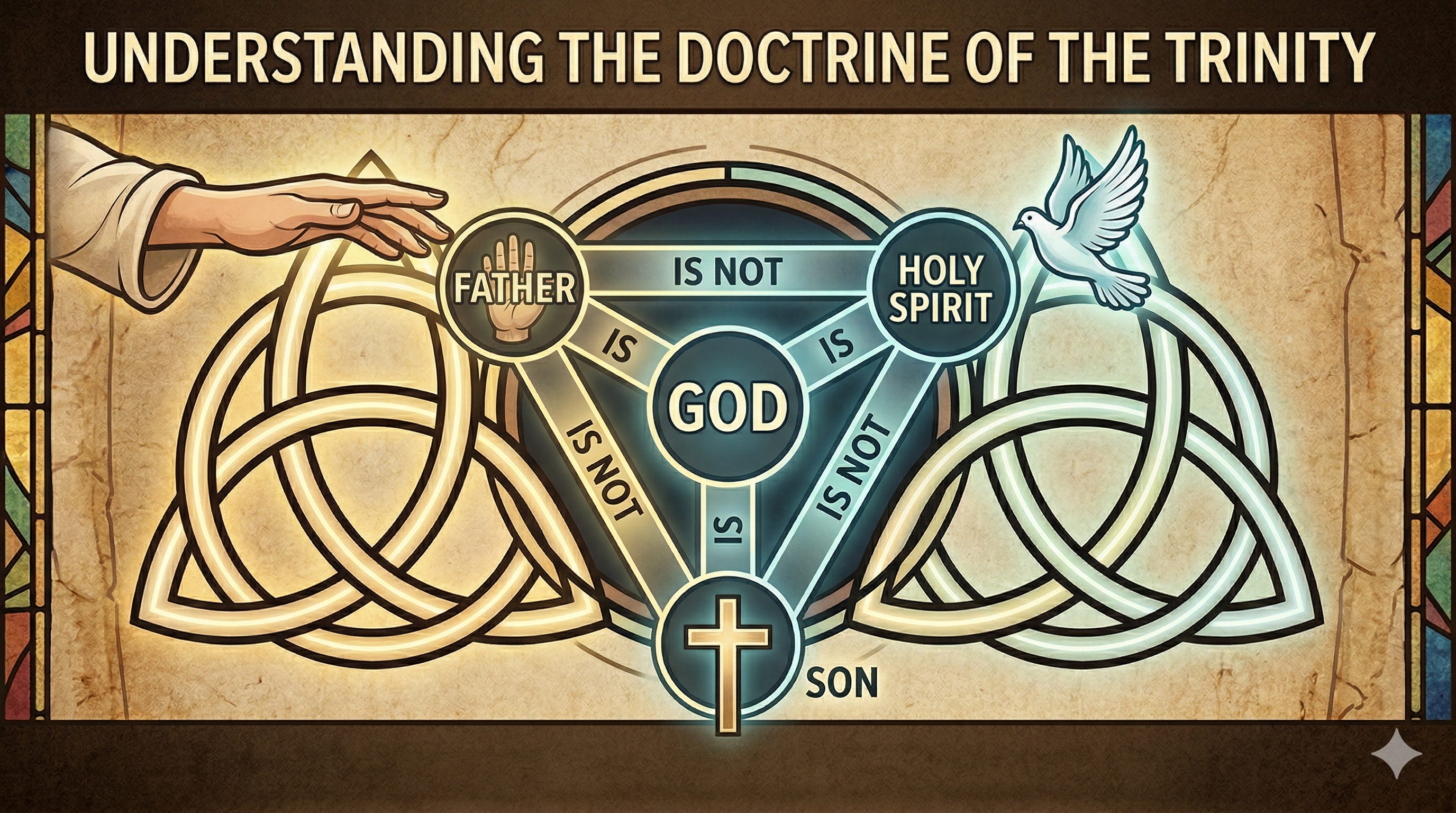
Attribution
Preamble, this article owes most of it’s content to Dr. Nathan Jacobs and his podcast episode on this same topic. Before listening to his lectures I didn’t fully understand the Trinity in detail. I had some understanding but it was still clouded by western confusion. Hopefully, I’ve boiled this down into something understandable and digestible. If you are interested in this stuff I highly suggest that you listen to his most excellent podcast (which can be found HERE) and this episode specifically, which can be found at the link provided at the end of this article.
Dr. Jacobs is a scholar of philosophy and religion, the host of The Nathan Jacobs Podcast, and writer/co-Executive Producer of the Amazon Original series House of David. His academic work on the Trinity, particularly his 2008 paper “On ‘Not Three Gods’ — Again” in Modern Theology, is essential reading for anyone who wants to go deeper. You can find his SubStack at Theological Letters.
Personally I find that Dr. Jacobs is the Orthodox Christian version of Dr. Jordan Peterson.
In this article we are going to examine the fundamental concepts of the Trinity and how they should be understood in the context of the Begetting of the Son, the procession of the Spirit, how the doctrine is monotheistic and how the Latin understanding of Augustine created a whole lot of confusion that led to todays present situation of misunderstanding.
Understanding the Trinity
There are a great many myths and misconceptions about what happened at Nicae and how the doctrine of the Trinity came into being. I’ve heard everything from “Constantine made it up”, to “Platonic philosophy infected and destroyed Christianity,” which was a Mormon favorite when I was young, with the doctrine of the Trinity being held up as the chief evidence of a Great Apostasy. This correlates with the LDS church’s Temple Endowment ritual in which Satan, on multiple occasions, asserts that he’s going to teach Adam and Adam’s posterity, the Philosopies of Men, mingled with scripture. (Which is still in the Endownment presentation today AFAIK.)
Is any of this true? Oh heavens NO! I don’t know how many times I have to repeat this but real history is not a Dan Brown book, and if you still choose to believe the Dan Brown version of history, well, then, as we say in the South, “Bless Your Heart!”
The doctrine of the Trinity comes from a very close/careful reading of the Bible. This is nowhere on better display (for a modern video centric audience) than this video where Sam Shamoun (a Roman Catholic apologist) dismantels the anti-trinitarian arguments and objections of Jacob Hansen (a popular YouTube LDS apologist.)
Ultimately the Trinity is an articulation of not only what is in the Bible, but also what Christians had always believed up until that time. The articulation of the Trinity and the “Nicaean Creed” began at Nicaea as a way to combat a heresy called Arianism1, but it was not completed or fully worked out until after Nicaea. There were questions that needed to be answered which were worked out after the council largely by three men we call The Cappadocian fathers (Gregory of Nyssa, Gregory of Nazianzus and Basil of Caesarea) (aka the Fathers of Orthodoxy.) We still have their writings today, many are even translated into English, meaning that we can all go back and read their writings on the subject to see the issues/challenges they were working through and the conclusions they came to. That’s real history, not some made up pop culture conspiracy theory mumbo-jumbo.
Few understand the Trinity, nor can they communicate it.
Discussions of the Trinity invariably get rolling with someone asking, “Okay, so what is it? What does it mean? How does it work?” And the answer usually comes back like: “Well, it’s three persons. Father, Son, and Holy Spirit. And they’re one God. One essence. Something like that.” And then the follow-up question lands: “But what does that actually mean?”, “If they are three persons, how can they be ONE God of ONE essence?”
And that is where the wheels usually come off. Because the next thing you hear, almost without fail (according to Dr. Jacobs), is some version of: “It’s a mystery. You can’t really explain it. If you try to explain it, you’ll fall into heresy. Best to just affirm it and move on.”
In my experience growing up Mormon many LDS leaders described the Nicene / classical doctrine of the Trinity in explicitly negative, even mocking, terms, often linking it to “apostasy” and “false doctrine.”2 This misunderstanding of the Trinity has led to some pretty extreme views and conspiracy theory type hypotheses, which in my opinion, at one time or another were all on stark display within Mormonism. Here is a quick summary of only some statements from LDS leaders regarding the trinity (suffice it to say, Mormons, like Jehovah’s Witnesses, are decidedly not Trinitarian. Anti-Catholic and Anti-Trinitarian sentiments were all the rage during the Second Great Awakening period, so this should be no surprise as the LDS Church and the Jehovah’s Witnesses were both born in this period of American history.)
Joseph Smith reported that in his “First Vision” that the existing Christian “creeds” were an “abomination in [God’s] sight” and that their “professors were all corrupt,” which early LDS writers explicitly connected to post‑Nicene theology about God.3 (We’ll see this opinion pop up again from later LDS leaders like McConkie..)
Later LDS apologists and historians (including James E. Talmage, LDS apostle and author of the book “The Great Apostasy”) accepted this language and used it as a framework for criticizing Nicene Trinitarianism as a corruption of primitive Christianity.
Talmage framed Nicene Trinitarianism inside a sweeping indictment of post‑biblical Christianity.
A contemporary summary of his work notes that Talmage defends Joseph Smith’s declaration that the creeds of Christendom are an “abomination” and that their “professors were all corrupt,” and then argues that later “corruptions of Christendom” (with particular emphasis on Catholicism) “perverted” primitive doctrine.
In his rhetoric about the “long night of apostasy,” Talmage depicts the dominant historic church as “thoroughly apostate and utterly corrupt,” which in context includes its conciliar, Trinitarian theology.
Bruce R. McConkie (LDS apostle and known blowhard) was one of the most forceful LDS voices against the traditional Trinity. He described the Nicene/Athanasian/Apostles’ creed view of God as “a three‑in‑one nothingness, a spirit essence filling immensity, an incorporeal and uncreated being incapable of definition or mortal comprehension,” and then added that “by a clergy chosen definition” this would “rule [Mormons] out of the fold of Christ.” (correct-a-mundo dude!)
The first edition of McConkie’s book Mormon Doctrine (which is now out of print as the LDS church has halted reproduction of this work due to it’s highly bigoted nature.) took passages in 1 Nephi (from the Book of Mormon) about the “great and abominable church” and applied them to the Roman Catholic Church, calling it a “satanic organization” that “took away from the gospel of the Lamb many covenants and many plain and precious parts” and “perverted the right ways of the Lord.” 4
This same framework is used in LDS discourse to locate Nicene and later Trinitarian creeds within a larger system of corrupt post‑apostolic theology that God supposedly rejected and had to restore in the latter days.
In a BYU devotional he said that the “adoption of this false doctrine about God effectively destroyed true worship among men and ushered in the age of universal apostasy.”
In another address he caricatured the Trinity as “a god who neither hears, nor speaks, nor appears, as did the one worshiped by the ancients,” and lumped traditional attributes such as omnipresence together with “legends of sectarianism.”5
More recent LDS leaders usually avoid the harshest language but still explicitly reject the Nicene formulation.
In their bi-annual general conference, LDS apostles have said that “the Father, the Son, and the Holy Ghost are separate persons, three divine beings,” in contrast to “the holy trinity as defined and set forth in the Nicene, Athanasian, and Apostles creeds.”6
Contemporary LDS apologists underscore that the Church “does not hold the contemporary Christian view of God, Jesus, and the Holy Ghost” and that Latter‑day Saints “break with post‑New Testament Christian history” in order to return to what they claim is the doctrine taught by Jesus.
I think that one good summary of the LDS view of the Trinity can be found at the LDS apologetic site “FAIR Latter-day Saints” https://www.fairlatterdaysaints.org/answers/Criticism_of_Mormonism/Books/Do_Christians_Believe_in_Three_Gods/Origins_of_Nicene_Trinitarianism
In one section of the FAIR document on the Trinity they have:
What were early Christian beliefs about God?
If Nicene trinitarianism was not Biblical and not part of the early Christian message, what did early Christians believe about God?
We do know that Christian orthodoxy before Nicaea was not the trinitarian creeds now popular:
LDS apologists are essentially asserting that the heresy of subordinationsim was the common belief of all Christians before Nicaea. Interesting. If that’s true then we have a problem with history (that’s a reoccurring LDS issue.) You see, the council of Nicaea was called to deal with the teachings of a priest named Arius who was teaching a subordinationist view of Christ that was causing a lot of uproar within the Christian world. If the pre-Nicean orthodoxy was subordinationism, how come 316 of the 318 bishops in attendance at Nicaea condemned Arius and his subordinationist views and 314 signed anathemas against him? Only 2 bishops, both from Arius’s home province dissented. Arius and the two dissenting bishops were both deposed, excommunicated and exiled to Illyricum.
To put a further point on it, Constantine later on allowed Arius and his supporters to return from exile and Arianism spreads for a time. At one point Athenasius (his main opponent at Nicaea) is even unseated from his episcopal seat in Alexandria and Emperor Constantius II appointed an Arian bishop in his place. You’d think that if subordinationism was pre-Nicean Orthodoxy that the common people who (according to LDS apologists - believed in a subordinationist view of Christ,) would have appreciated a subordinationist bishop, and not a trinitarian one. But this was not the case. In fact, the people of Alexandria viewed him as a heretic. He was hated and the common christian people of Alexandria later rose up and murdered him 5 years later.
St. Athanasius (De Decretis 3) wrote “the whole Church had always worshiped the Son as true God; Arius was the innovator.” If subordinationism was really ‘pre-Nicene orthodoxy,’ why did the overwhelming majority of bishops — including men who had known the apostles’ own disciples — immediately reject it?
The apologists view does not align with history, but you know what it does align with? The LDS view of the God Head. I have long maintained that LDS apologetic is not about fending off external attacks as much as it is about keeping believers in the faith, and I think that’s well illustrated here. In the LDS view of what they call the GodHead, The Father, Son and Holy Spirit are three separate beings of different natures and substances. The spirit body of the Son is considered to have been created by the father in a “pre-existence” and his physical body at the annunciation, but the belief implies that there was a time when the Son as we think of him, was not. (That’s not totally technically true, an LDS person will object that his Intelligence (basically his consciousness) - would have been co-eternal with the Father as is everyone’s, but that does not make them of a similar nature or substance.) But to translate this back to christian language, in the LDS view, the Son is a creature that is subordinate to the father and is not co-eternal with the father in the way that Christians would normally profess. On some level, Mormons end up having more in common with Arianism than Trinitarianism; and McConkie is thus correct, from a Trinitarian perspective, it essentially rules Mormons out of the fold of Christianity.
Ironically, when it comes to the Creed itself, LDS would affirm MUCH of The Nicene Creed. A discussion of this can be seen in the following video. I suppose we are going to see much more of this as the LDS church continues it’s efforts to be seen as Christian despite denying the fundamental beliefs that define traditional Christianity.
For most of my life, I heard all of the Mormon arguments against the Trinity. Most of this opinion came from my Mother (who was a Jehovah’s Witness before she became Mormon, quel suprise.)
And then I encountered the work of Dr. Nathan Jacobs, a scholar of philosophy and historical theology at Vanderbilt, and a man who has spent nearly two decades in deep research of the Greek Church Fathers. I discovered that the early Church not only explained the Trinity, they explained it clearly, precisely, and in a way that makes sense once you understand what the words actually mean and some of the reasoning behind the concepts.
My hope is, in this article to pass on a much better understanding of this doctrine.
First, Let’s Kill the Bad Analogies
Most attempts to explain the Trinity begin with bad analogies. Every Christian has heard at least one of these:
The water analogy. H2O can be a solid, a liquid, or a gas — but it’s still H2O! Three forms, one substance! That’s the Trinity!
The egg analogy. An egg has a yolk, a white, and a shell — but it’s still one egg! Three parts, one thing! (Just like the Shamrock analogy)
The man-with-three-roles analogy. A man can be a husband to his wife, a father to his children, and a son to his parents — all at the same time! One guy, three roles!
Here is the bad news. Every single one of these is an ancient heresy.
The water analogy is Sabellianism (also called Modalism). That is the heresy that says God is one person who shows up wearing three different masks. Sometimes he’s playing the Father. Sometimes he’s playing the Son. Sometimes he’s playing the Spirit. But there’s only one guy behind the masks. The early Church condemned this, repeatedly.
The egg analogy is a form of compositionism — the idea that God has parts. Nobody in the ancient Church believed that God, being incorporeal, was made up of separable components the way an egg is. The closest historical parallel is a heresy from John Philoponus involving a lump of clay cut into three pieces. Not flattering company.
The man-with-three-roles analogy is just Sabellianism again with a different outfit. One person, multiple job titles. The Church condemned this too.
When pointed out in conversation, people often laugh and say, “Well, of course they’re all heresies because the Trinity can’t be explained. It’s a mystery.”
That response sounds humble. It sounds pious. But it is actually a philosophical disaster that not only leads to confusion, it leads to heresy.
LDS Aside: Joseph Smith Didn’t Understand the Trinity Either
Here is the great irony. The Book of Mormon contains one of the clearest examples of Sabellianism/Modalism in all of Christian literature. In Mosiah 15, the prophet Abinadi declares: “God himself shall come down among the children of men, and shall redeem his people. And because he dwelleth in flesh he shall be called the Son of God... being the Father and the Son. The Father, because he was conceived by the power of God; and the Son, because of the flesh; thus becoming the Father and Son. And they are one God, yea, the very Eternal Father of heaven and of earth.”
Read that carefully. Abinadi is not describing two distinct subjects who share a common nature. He is describing one subject who plays two roles — Father when considered as spirit, Father and Son when considered as flesh. That is textbook Sabellianism/Modalism. One God wearing two masks depending on the angle you view him from. The early Church condemned this exact theology when Sabellius taught it in the third century.9 LDS apologists have spent decades trying to reconcile Mosiah 15 with the later Nauvoo-era King Follet theology of separate, embodied beings, but the text says what it says: “they are one God, yea, the very Eternal Father of heaven and of earth.” Joseph Smith, when he dictated the Book of Mormon in 1829, clearly did not understand the Trinity. What he understood was the most common misunderstanding of it at that time; the one that collapses three subjects into one subject with multiple roles. Later on, in his “First Vision” published in 1832 he rejected what he thought was the Trinity. What he actually rejected was Sabellianism, after writing it into his own scripture.10
The Two Greek Words You Need to Know
The entire doctrine of the Trinity hangs on two Greek terms. Once you understand them, the rest of the doctrine unfolds with remarkable clarity.
The terms are ousia and hypostasis.
Ousia is the common nature identified by a general noun. When I look at this room and I say “Tom is human, Richard is human, Harry is human” — “human” is the ousia. It is the species term. The type of thing something is. This is an ontological term (i.e. it’s concerned with what type of being you are.)
Hypostasis is the subject identified by name (LDS would likely say Personage.) Tom. Richard. Harry. Each one of them is a hypostasis — an existing subject who has a certain nature.
That is it. That is the basic distinction. Ousia answers the question “what is it?” Hypostasis answers the question “who is it?”
So when the Nicene Creed says there are three hypostases and one ousia, it is saying: there are three separate subjects (Father, Son, and Holy Spirit) who share one common nature (God). Just like Tom, Richard, and Harry are three subjects who share one common nature (Human).
Now I know what you are thinking. “That sounds like three Gods.” LDS are thinking, that sounds just like the Mormon version of the GodHead I heard in Sunday School. And in each case thinking that would be understandable, but it’s not necessarily the case.
But… you are not the first person to think this! A man named Ablabius asked Gregory of Nyssa exactly that question in the fourth century, and Gregory wrote a famous letter called “On Not Three Gods” to address it. We will come back to Gregory’s answer. But the important thing to understand right now is that Ablabius asked that question because he understood what the terms meant. He understood correctly that ousia means the common nature and hypostasis means the individual subject. And the fact that the question made sense to him is a strong indication that we are on the right track.
Why “Person” Is a Misleading Translation
Let’s pause here and explain why Dr. Jacobs uses the term “subject” instead of “person” or even “personage” The English word “person” is a commonly used translation of hypostasis, but Dr. Jacobs argues (and I agree) that it is misleading for two reasons.
First, the closer Greek equivalent to the English word “person” is actually prosopon — and that is the word the Sabellians used. Prosopon literally means “face” or “mask,” which is why the Sabellians loved it. It fit perfectly with their heresy that God was one subject wearing three masks. The Fathers deliberately chose hypostasis over prosopon precisely to avoid that implication.
Second, when modern people hear the word “person,” they immediately think of a center of consciousness and a notion of self-hood centered on Human ontological understandings of what it means to be a “person” - invariably this mixes up concepts of person / identity and being (nature.) This is not what hypostasis means. A hypostasis is broader than that. Anything that exists and has a certain nature is a hypostasis. A chair is a hypostasis. A blade of grass is a hypostasis.
The specific qualities of any given hypostasis; whether it is rational, whether it is relational or whether it is conscious, are determined by its nature (its ousia), not by the fact that it is a hypostasis. Humans are rational because human nature is rational. Dogs are not rational because dog nature is not rational. But both are hypostases — existing subjects with a certain nature.
For those LDS who are thinking the philosophies of men mingled with scripture, or those still clinging to a Dan Brown version of Nicaea where the Trinity is a product of Greek philosophy, you should know that this is actually a uniquely Christian contribution to philosophy. The pagan Greeks never figured out what makes an individual an individual. Aristotle basically shrugged and said, “I guess it’s where we run out of general nouns.” The Stoics guessed maybe it was some idiosyncratic property like Plato’s snub nose. The Christians, because of the doctrine of the Trinity and then Christology, were the first to insist that the individual subject is its own existing reality that gives concrete stability and existence to the underlying nature. Saint Maximus the Confessor also identifies this as a distinctly Christian doctrine.
Nicaea was a fight, what was it all about?
As mentioned above in the section on Mormon objections to the Trinity, the Council of Nicaea in 325 AD was convened because of a dispute with a priest named Arius who has been spreading the heresy of subordinationism. Ultimately Nicaea ends up as a contest between Athanasius of Alexandria (who was a deacon at that time and later goes on to become the patriarch) and a priest named Arius.
The question they were trying to answer was deceptively simple: Is the Son of the same nature as the Father?
Athanasius said yes. Homoousios — same nature.
Arius said no. Homoiousios — similar nature. Very godlike. But not the same type of thing as the Father.
The philosophical framework underneath this dispute is something called realism. Realism is the position that the general nouns we use — “human,” “dog,” “circle,” “square” — refer to real structures in the world. When you take a child to a zoo and they ask “What is that?” they are asking a realist question. They want to know what type of thing it is. Realism says the mind does this because that is how the world actually is. Things really do have natures.
So when Athanasius says the Father and the Son are homoousios, he is making a realist claim. He is saying: the Father and the Son are the same type of thing. They share the same nature. Just like Tom and Richard are the same type of thing — they are both human. The Father is God. The Son is God. Same nature. Different subjects.
He is not saying they are the same person. He is saying they are the same type of thing.
Nicaean Fallout
After Nicaea, a massive confusion erupted. The primary reason was linguistic. At the time of Nicaea, the Greek words ousia and hypostasis were functioning in common every day usage as synonyms. Both could mean either “individual” or “nature” depending on context. Aristotle had the same problem — he had to distinguish “primary substance” (the individual) from “secondary substance” (the nature) just to make clear which meaning he intended.
This created chaos. Some people were walking around talking about “one ousia” and some were talking about “three ousiai.” Some were talking about “one hypostasis” and some about “three hypostases.” Nobody knew what anyone was talking about.
To make matters worse, Nicaea focused on the nature of Jesus Christ, the Son, it didn’t address the Holy Spirit and it didn’t anticipate some of the questions that would later arise. The question of the Holy Spirit wasn’t cleared up until another council in Constantinople - which is why what people call the Nicaean Creed is really the Nicene-Constantinopolitan Creed.
But, there were three church Fathers who went to work to resolve the confusion and the issues created or left unaddressed at Nicaea. These three men were Saint Basil of Caesarea, Saint Gregory of Nyssa and Saint Gregory of Nazianzus; these three are also known as the Cappadocian Fathers. (because they were from Cappadocia, in modern-day Turkey.)
Basil of Caesarea fixed the linguistic confusion. He wrote a letter that basically said: from now on, we only use ousia for the nature and hypostasis for the subject. No more interchangeable usage. And that is the terminology that stuck. When we say “three hypostases, one ousia,” we are using the language Basil standardized.
While Nicaea provided the foundation, it was Gregory of Nazianzus and Gregory of Nyssa who ultimately resolved lingering ambiguities and objections that threatened to tear the post-Nicene Church apart. Gregory of Nazianzus, often called “The Theologian,” tackled the “missing link” of the Council of Nicaea: the full divinity of the Holy Spirit. At this time he is combating another heresy that began to rear it’s ugly head and would trigger the next council at Constantinople. He was fighting the Pneumatomachians (i.e. the “Spirit-fighters”), who accepted the divinity of the Son but denied it to the Holy Spirit. Gregory argued forcefully that if the Spirit was not truly God, the entire process of human sanctification was invalid. Meanwhile, Gregory of Nyssa provided the philosophical rigor needed to distinguish between substance (ousia) and personhood (hypostasis) and dealt with accusations of polytheism. By defining God as one single “what” (essence) existing in three distinct “whos” (persons), they solved the logical riddle of the Trinity. The combined efforts of the Cappadocian Fathers ensured that the divinity of the Spirit was formally recognized at the Council of Constantinople in 381 AD, effectively refining the Nicene Creed into the definitive statement of faith used by millions of Christians today.
Begetting Requires Continuity of Nature
One of the arguments Athanasius and the pro-Nicene Fathers made against Arius was based on the word “begotten.” The scriptures and the creed call Christ “the only-begotten of the Father.” And begetting always involves continuity of nature.
What is amazing to me is that the apostle John in writing the New Testament seems to foresee this issue and uses language that would guide future church leaders to the right answer. e.g. John 3:16, John 1:14, John 1:18, John 3:18, 1 John 4:9.
Somewhat ironically, the language of the “only begotten” is used even more frequently in LDS scriptures than in the New Testament. It shows up in the Book of Mormon, the Doctrine and Covenants and the Pearl of Great Price.
Abraham begot Isaac. Isaac begot Jacob. Jacob begot his twelve sons. Humans beget humans. Dogs beget dogs. Cats beget cats. If your friend announces that his wife is pregnant and you ask “What is it?” he would take that as a question about the child’s sex because he implicitly knows his wife is pregnant with a human child. If he says “I’m hoping for a horse, but it’s going to be a rough birth” you know that something with your friend has gone horribly wrong. Because begetting always produces the same type of thing.
That is why the Creed insists on the word “begotten.” If the Son is truly begotten of the Father, then the Son must have the same nature as the Father. The Father is God. Therefore the Son is God. Not a godlike creature. God. Same nature, different subject.
And this is the critical distinction between the Son and every other being the Bible calls a “son of God.” The angels are called sons of God. Believers are called sons of God. But those are adoptive or analogical sonships. Christ alone is the only-begotten — the one who is generated from the very nature of the Father.
The Eternal Begetting
But wait. If the Father begets the Son, was there a time when the Son didn’t exist?
This was Arius’s trump card. He famously declared: “There was a time when the Son was not.” And it sounds devastating — until you understand the distinction between two types of causation.
Per accidens (accidental) causation is sequential. You roll a billiard ball, it strikes another ball, and the second ball keeps rolling even if you destroy the first one. The cause and effect are separable in time. Eric has children. There was a time when he did not. If Eric dies, his children continue to exist. That is per accidens causation.
Per se (essential) causation is ongoing. If I hold up a ball, the suspension of that ball in the air is coterminous with my holding it. The effect is not separable from the cause. The moment I stop holding it up, it falls.
Human begetting is per accidens. Abraham begat Isaac, then Abraham died, and Isaac continued to exist.
Divine begetting is per se. The Father is always begetting the Son. It is an eternal, ongoing, co-terminous causal relationship. There was never a “time when the Son was not,” because the begetting has no beginning and no end. It is not a sequential event. It is an eternal reality. Here is a helpful analogy (courtesy of St. Athanasius’ Contra Arianos II32-33) Let’s Imagine that the sun has always existed — no beginning, stretching back infinitely. If that were the case, you would also have to imagine that its light and its heat also stretch back infinitely. No matter how far back you go, you would find the sun generating light and heat. The sun’s light and heat are causally dependent on the existence of the sun. So, there was never a moment when the sun existed without its light or the warmth it provides. It also makes no sense to say that there is sunlight and radiation from the Sun, without the Sun existing. That is per se causation. And that is what the eternal begetting of the Son is like.
What Makes the Three Distinct?
If the Father, Son, and Holy Spirit all share the same divine nature, how do you tell them apart? Well, Tom, Richard and Harry all share a human nature, how can we tell them apart?
With human beings, you differentiate by what are called “accidental” traits — location, size, color, beard (or lack thereof). But when you are talking about three invisible, immaterial, omnipresent spirits, no physical markers are available.
The answer is found in their names and each name is a relational identity.
The Father is the one who begets. That is what makes him the Father.
The Son is the one who is begotten. That is what makes him the Son.
The Holy Spirit is the one who is “outbreathed” or proceeds from the Father. The Greek word for spirit, pneuma, is connected to breath and wind. The language of procession or “spiration” literally means “breathing out” from which we get the English word Spirit (via the Latin Spirare which means “to breathe.”
These are not arbitrary labels. They are causal descriptions. The Father causes the Son by begetting. The Father causes the Spirit by out breathing. Two different modes of causation. And the Father himself is uncaused.
Distinct But Not Separate
This is where we begin to get into the territory that has cause so many misunderstandings about the trinity being One God. One of the most important qualifications the Fathers add is this: the three hypostases are distinct but not separate.
This can get a bit confusing because with human beings, we are both distinct and separate. I know where Tom ends and Richard begins. We are material bodies with boundary lines. The Greek word for this is perigraphos — you can draw a line around Tom. You can circumscribe him.
God is aperigraphos — you cannot draw a line around God. He has no boundary. And if you cannot draw a line around the Father, and you cannot draw a line around the Son, and you cannot draw a line around the Spirit, then you cannot separate them the way you separate material bodies.
Gregory of Nazianzus uses a stunning image. Imagine three suns in the sky. Three distinct hypostases, one common nature (sun). But if you looked up, you would be so blinded by the intermingling glory of the three celestial bodies that you could not tell where one ends and the other begins. That, he says, is something like the Trinity — three who are absolutely distinct, but so interpenetrating that they cannot be divided.
This is what the tradition calls perichoresis — a mutual indwelling, sometimes described as a divine dance where each makes room for the other.
But the Fathers are equally insistent on the other side of the coin. The three are unconfused. They do not get mashed together into one subject.
“The three are one in Godhead, and the one is three in hypostases.” - St. Gregory Nazianzen (Oration 31.14)
Some people are so anxious to affirm monotheism that they collapse the three persons back into one — and that is just Sabellianism returning through the back door. The hymns of the Church address the Father. They address the Son. They address the Spirit. Distinctly. Because they are distinct.
One Will — But Not a Hive Mind
The three share a common will. But this does not mean what most people think it means.
Will is a faculty of the nature. Just like reason is a faculty of human nature. Every human has a rational faculty (because that is part of what it means to be human.) Similarly, every possessor of the divine nature has a divine will (because that is part of what it means to be God.)
So the Father has the divine will. The Son has the divine will. The Spirit has the divine will. One type of will, because one nature.
But how they use that will is idiosyncratic — that is, specific to each hypostasis. The Son uses the divine will to obey the Father. Two different subjects using the same faculty differently. But they always operate in perfect harmony. The Son delights in doing the will of the Father. Not because he is forced to, but because they are perfect. This makes these scriptures make more sense. “For I have come down from heaven, not to do my own will but the will of him who sent me” - John 6:38 and John 10:30 “I and the Father are one.”
This, by the way, is why we pray “Thy will be done, on earth as it is in heaven.” In heaven, perfect beings operate harmoniously in accord with the will of God. On earth, we don’t.
What Monotheism Actually Means (and Doesn’t)
This is where Dr. Jacobs drops what I consider the most important bomb in the entire lecture. And it is a point that will unsettle Protestants and fascinate Mormons in equal measure.
The modern concept of monotheism; the idea that there is one “optimal being” and anyone who believes in that being is a monotheist; is not how the early Church understood the term.
In modernity, this concept of monotheism emerged from what is called “perfect being theology.” The idea is: God is a being greater than which none can be conceived. He is the optimal being: omniscient, omnipotent, omnipresent. And once you define God that way you create a framework where Jews, Christians, Muslims, and Deists are all supposedly talking about the same thing. They just disagree about what he has done.
That is the modern concept of monotheism. And it is not what the Eastern Church Fathers meant.
When Basil of Caesarea and Gregory of Nyssa said they were monotheists, they meant something very specific. We believe there is only one nature worthy of the name God. Not a genus. Not a category of types of beings. Not the pantheon of “immortals.” One divine nature. Saint Basil said - “We confess one God not in number but in nature.” And that is what distinguishes Christianity from the polytheism of the pagans, who believed divinity was a broad category containing many different types of beings.
But, and this is crucial, Gregory of Nyssa also says that in contending with the polytheists and denying a multiplicity of divinities, “we do not sink to the level of the Jew who denies that God has a Son.”
Let me repeat that so it lands. Gregory is saying: monotheism means there is one divine nature. It does not mean there is only one divine subject. There are three subjects who have that one nature. And if your version of monotheism requires you to deny that God has a Son, you have left Christianity for something else.
Sounds like you believe in Three Gods
Ironically, this is a common objection that Mormons hear all the time when they explain their version of what they call, the “God Head.” This is also an objection that the early Christian church had to deal with after Nicaea. Ironically, misunderstanding the answer to this objection is probably what Joseph Smith and other protestants of his day also objected to, leading him to reformulate his own articulation of the GodHead from his own understanding of scripture that brought him full circle, but still without a satisfactory answer to this objection.
Gregory of Nyssa recognizes the gravity of this objection and deals with it head on. This objection was initially brought to him by a man named Ablabius. He responds in an epistle of Ablabius titled on “Not Three Gods.”
“In truth, the question you propound to us is no small one, nor such that but small harm will follow if it meets with insufficient treatment. For by the force of the question, we are at first sight compelled to accept one or other of two erroneous opinions, and either to say there are three Gods, which is unlawful, or not to acknowledge the Godhead of the Son and the Holy Spirit, which is impious and absurd.” - on “Not Three Gods” St. Gregory of Nyssa
Here is how Gregory handles the “three gods” objection. Tom, Richard, and Harry are not “three humans” in the sense that there is one human nature. They are three subjects of that nature. So too the Father, Son, and Holy Spirit are not “three gods.” There is one divine nature. They are three subjects of that nature.
If we were to say to Gregory “You know, I see Tom, Richard and Harry, but what I really see are three humans.” Gregory would say, “I know you do, but you really shouldn’t [say that.] That’s a very sloppy and imprecise way of speaking. I know you’re not a metaphysician and that happens with non-metaphysicians, but it’s not true that that’s what you see here; because human is a species term and there’s only one type of thing. You see three human singular persons plural. The number of subjects having that nature is not the same as three different natures. To speak that way is a common abuse of language.”
What Went Differently in the West - And how the Three Persons, one Essence/Substance confusion came to be
I want to touch on this briefly because it explains why most Western Christians — both Catholic and Protestant — have such a hard time understanding and explaining the Trinity. The difficulty is not inherent to the doctrine. The difficulty is inherited from Augustine.
Augustine of Hippo wrote a treatise on the Trinity. In the english translation there is an introductory essay by WIlliam G.T. Shedd, and within it he mentions the following:
The treatise of Augustin’s Upon the Trinity, which is here made accessible to the English reader, is one of the ablest produced in the patristic age. The author devoted nearly thirty years of his matured life to its composition (A.D. 400 to 428). He was continually touching and retouching it, and would have delayed its publication longer than he did, had a copy not been obtained surreptitiously [it was apparently stolen by those who were very excited to read it] and published. He seems to have derived little assistance from others; for although the great Greek Trinitarians — Athanasius, the two Gregories, and Basil — had published their treatises, yet he informs us that his knowledge of Greek, though sufficient for understanding the exegetical and practical writings of his brethren of the Greek Church, was not adequate to the best use of their dialectical and metaphysical compositions. Accordingly, there is no trace in this work of the writings of the Greek Trinitarians, though a substantial agreement with them.
Dr, Jacobs paraphrases the situation in what he sees as a remarkable admission:
“the Greek writers probably have the answer to every question you might ask about the Trinity, but most of us in the Latin-speaking West don’t read Greek well enough to know what they’re talking about. So I am going to have to rely on God and work this out myself.”
And when he gets to the term hypostasis, he is lost. The proof is in Chapter 8 of book one. The heading title is:
CHAP. 8.—WHATEVER IS SPOKEN OF GOD ACCORDING TO SUBSTANCE, AS SPOKEN OF EACH PERSON SEVERALLY, AND TOGETHER OF THE TRINITY ITSELF. ONE ESSENCE IN GOD, AND THREE, IN GREEK, HYPOSTASES, IN LATIN, PERSONS.”11 (See footnote for link to referenced document.)
At the end of this chapter, just before chapter 9, he admits that he is confused by the difference between Ousia and Hypostasis.
For inasmuch as to God it is not one thing to be, and another thing to be great, but to Him it is the same thing to be, as it is to be great; therefore, as we do not say three essences, so we do not say three greatnesses, but one essence and one greatness. I say essence, which in Greek is called οὐσία (Ousia), and which we call more usually substance.
10. They indeed use also the word hypostasis; but they intend to put a difference, I know not what, between οὐσία(Ousia) and hypostasis: so that most of ourselves who treat these things in the Greek language, are accustomed to say, μίαν, οὐσίαν, τρεῖς, ὑποστάσεις, or, in Latin, one essence, three substances.
He admits he does not really know what it means. He eventually decides that what the Latin West has been calling persona is something like a relational identity — the way he is a teacher to his students and a student to his mentor. And from there he develops a view where the Trinity is basically the divine essence relating to itself: it relates to itself paternally (producing the identity of “Father”), it relates to itself filially (producing the identity of “Son”), and it loves itself (producing the identity of “Spirit” — the love between Father and Son).
The relational identities part is correct — the Fathers do say the persons are identified by their relations. But Augustine goes further and says a hypostasis is a relation. And that is not what the Eastern Fathers taught. A hypostasis is an existing subject. The relation tells you which subject you are talking about. Those are different claims.
This, combined with Augustine’s commitment to a Platonist doctrine of divine simplicity (the idea that God’s essence and existence are identical, and all of God’s attributes collapse into one simple thing -see the quote above that mentions gods greatness and being great), created a fundamentally different starting point. For the East, the Father is the ground of the Trinity — he exists, has the divine nature, and gives it to the Son and Spirit. For the West, the divine nature itself is the ground — it exists, and the persons are relational identities layered on top of it. That difference is the seed from which the filioque controversy, and ultimately the Great Schism of 1054, would grow.
For LDS Readers
Some of this will feel strangely familiar to you. The idea that the Father, Son, and Holy Spirit are three distinct subjects — not one subject wearing three masks — is something that, today, Latter-day Saints insist on. And on that specific point, you are closer to the Eastern Church Fathers than some Protestants.
But here is where it diverges. In LDS theology, the Father and the Son are two separate beings with two separate bodies. In the Nicene understanding, they are distinct but not separate — they share one divine nature, they interpenetrate one another, and there is no separation between them because God is not a material body. And because they are perfect, have one will, and interpenetrate one another (remember the analogy of three suns above.) You could say, and the ancient Greek fathers would agree, that they are united in purpose.
And in LDS theology, there is a plurality of gods — an entire cosmology of exalted beings. In the Nicene understanding, there is one divine nature, and exactly three subjects possess it. Not a pantheon. Not an open set. Three. And the reason there are three and only three is because the Father has only one Son and outbreathes only one Spirit. The number is determined by the Father’s eternal action, not by an ongoing process of exaltation that evolves one into the divine nature.
If you were to distill the LDS view of the GodHead down to it’s most simplistic and superficial articulation of “three persons united in purpose.” (Which is something we taught when I was an LDS missionary.) It’s not wrong. Where it goes off the rails is when you drill down to talk about the nature of those three persons. Then the limitations of this overly simplistic viewpoint become apparent, and you realize that it is incomplete and has a confused understanding of divine nature. In my opinion this confusion has very much to do with trying to apply human concepts about categories like what a person is or what a being is, and the assumptions that come with each, e.g that each different person must be a different being. These are human ontological categories and understandings. We cannot project this onto God as God has already told us in the scriptures that he is beyond our understanding (Isaiah 55:8-9, Job 11:7-9, Job 36:26, Romans 11:33-36, 1 Corinthains 2:16)
Then in discussions with exaltation the LDS version of the God Head goes too far in ways that would have been considered deeply heretical to the early original church. In review it seems to me that what Joseph Smith and other Mormon leaders were really against, was the confused Latin/Western understanding of the Trinity, not the actual doctrine of the Trinity as rightly understood.
So the Trinity is neither a 19th century Protestant collapse of three into one (which always trends toward Sabellianism) nor the LDS expansion of three “persons” into three individual natures, (which the Fathers would call paganism).
ADD Tangent
As I write this, the ADD part of my brain is going on a tanget that seeks to apply McConkie’s logic back on him12 (and I know most people ignore McConkie these days so don’t be offended just take this as a thought exercise. Those who know me know that I really strongly dislike McConkie. I think his book Mormon Doctrine was atrocious.) He says, the “adoption of this false doctrine about God effectively destroyed true worship among men and ushered in the age of universal apostasy.”
Now I completely agree with the principle of the argument that a false doctrine about God will destroy true worship and makes Theosis (salvation) extremely difficult if not impossible. (How can you align your likeness to God’s if your understanding of who and what God is, is distorted? That would be like trying to shoot an archery target with a bow at 60+ yards while wearing dirty glasses of the wrong prescription.) Different areas of theology are not separate and disconnected from each other. Each naturally has implications/consequences for other areas of belief. So, if you get the fundamentals wrong, the rest go quickly awry.
Holding to McConkie’s principle above, what does it mean for the LDS faith if the LDS understanding about God also happens to be false doctrine? (at least in the perspective that it is incomplete, confused about divine nature, and limited?)
McConkie taught that the Trinity ‘effectively destroyed true worship among men and ushered in the age of universal apostasy.’ But the actual Fathers who fought the real heresies saw it the other way around. St. Irenaeus warned that every false doctrine about God — every invention of another God or a subordinate Creator — renders its followers ‘apostates from Him who made them’ and ‘wounds men unto death.’
Aside to the Aside: Why should we pay any attention to Irenaeus? Irenaeus was the spiritual grandson of the apostle John. He was a disciple of Polycarp who was a direct disciple of the apostle John. St. Polycarp didn’t just know John in passing — he sat under his teaching for 10-15 years. Irenaeus, who knew Polycarp personally, recalls him vividly recounting ‘his familiar intercourse with John’ and the words of those who had seen the Lord. That’s not a lost apostolic faith, that’s a direct transmission, one generation removed from the eyewitnesses.
St. Vincent of Lérins, writing centuries later, watched the same pattern repeat with Arian novelties and declared: ‘Shun profane novelties… if novelty is profane, antiquity is sacred.’ The Nicene doctrine didn’t cause apostasy. It was the ancient bulwark against it. The real innovation — the one that actually shipwrecks the faith — is the one that turns the eternal Trinity into a committee of exalted beings with separate bodies and natures and an open path to godhood. That’s not restoration, that’s polytheism. That’s exactly what the Saints said would make a shipwreck of the faith.
A Word to My Protestant Readers
If you have always found the Trinity confusing, the confusion is not your fault. You inherited a theological framework from the Roman Catholic (Latin) church, ultimately derived from Augustine, that made the doctrine of the Trinity confusing; Largely b/c Augustine wasn’t totally clear on it himself.
The Eastern Fathers explained the Trinity with remarkable clarity using the tools of moderate realism: a common nature and three subjects who possess it, distinguished by their eternal causal relations, indivisible because they are immaterial and omnipresent, harmonious because they are perfect. It is not a contradiction. It is not a paradox. It is not a mystery in the modern sense of “I don’t know what this means.”
If you want to dig deeper to understand the Trinity, do not start with Augustine. Start with Basil. Start with the two Gregory’s (Saint Gregory of Nyssa and Gregory of Nazianzus.) Start with Athanasius. Start with the people who actually wrote the Creed and formulated this articulation of revealed truth.
Conclusion
Joseph Smith didn’t restore an original christian view of the God-Head, he rejected a flawed 19th century protestant misunderstanding of it (derived from a confused Roman Catholic misunderstanding, and replaced it with something the Cappadocian Fathers would have called paganism with extra steps. The real restoration happened at Nicaea and Constantinople, when the Church simply articulated, with rigor, what it had always believed.
Regardless of who you are, your religious background, or current affiliation you hopefully have a much clearer understanding of the Trinity. Hopefully, now, if someone tells you the Trinity cannot be understood; that all analogies fail, that it is beyond explanation, that you just have to affirm it and move on. You now know that the Church Fathers who defined the doctrine would have disagreed with every word of that sentence and that there is a way to communicate and understand it; you just need to know a little Greek…
(I find that in understanding Christianity, there are innumerable benefits to being in a Greek church!)
As mentioned above, This article draws heavily on a lecture by Dr. Nathan Jacobs on Nicene Trinitarianism. Dr. Jacobs is a scholar of philosophy and religion, the host of The Nathan Jacobs Podcast, and writer/co-Executive Producer of the Amazon Original series House of David. His academic work on the Trinity, particularly his 2008 paper “On ‘Not Three Gods’ — Again” in Modern Theology, is essential reading for anyone who wants to go deeper. You can find his Substack at Theological Letters. A recording of this episode can be found on YouTube HERE.
If this article resonated with you, consider becoming a paid subscriber.
I document more about Arianism in this article:
Swords from Without, Cracks from Within

This article is Part 3 in a series. Be sure to start with Part 1!
What Have Mormon Leaders Said About the Trinity? https://mrm.org/trinity-in-their-own-words
Talmage - The Great Apostasy - An LDS Soul https://ldssoul.com/wp-content/uploads/2015/04/Talmage-The-Great-Apostasy.pdf
Why Catholics Reject the Mormon “Great Apostasy” Theory https://patrickmadrid.substack.com/p/why-catholics-reject-the-mormon-great
The Mystery of Godliness - Bruce R. McConkie - BYU Speeches https://speeches.byu.edu/talks/bruce-r-mcconkie/mystery-godliness/
The Only True God and Jesus Christ Whom He Hath Sent https://www.churchofjesuschrist.org/study/general-conference/2007/10/the-only-true-god-and-jesus-christ-whom-he-hath-sent?lang=eng
Do LDS members believe in a ‘somewhat trinitarian view’ of God? https://www.reddit.com/r/latterdaysaints/comments/davu2m/do_lds_members_believe_in_a_somewhat_trinitarian/
Subordinationism is the view that the Father is superior and the Son is subordinate to the father. The son may be higher than normal creatures (he’s a creature created by God) but he is not “True God.” He is not only subordinate in his role, he’s subordinate in his nature as a created being who is not co-eternal with the Father. Thus there was a time when the Son did not exist.
This conclusion was developed by Henry Scowcroft Bettenson. According to wikipedia Henry Bettenson (1908, Bolton, Lancashire – 1979) was an English Classical scholar, translator and author. Educated at Bristol University and Oriel College, Oxford; after some years in parish work, he taught Classics for 25 years at Charterhouse, then afterward rector of Purleigh in Essex. Notable works include a translation of Augustine‘s City of God and Livy‘s Rome and the Mediterranean.[2] His collection of Early Christian documents, written from an Anglican perspective (hence the emphasis on early councils and on seventeenth century Church of England documents), and history of the Latin fathers remain in print.
This heresy was condemned in 220AD.
Mormons will object to my saying this, because in their belief “J.S. translated the book of mormon, he didn’t write. it.” I’m saying wrote it because if the book of mormon prophets Mosiah and Abinidai were actually prophets, they would have known better. Interestingly by Book of Mormon chronology Abinidai supposedly lived around 150B.C whereas Sabellius was formally condemned around 220AD, but modalist ideas begin to emerge around 190 AD. So Abinadi is preaching Modalism/Sabellianism some 370 years before it was invented. Prophetic indeed! Still wrong, but prophetic, and just a tad bit anachronistic. Say nothing of the fact that modalism was a very common understanding of the trinity in Joseph Smith’s day. But hey, the Book of Mormon says it so maybe the original* long lost plain and precious doctrine about God is not the Trinity or the modern accepted LDS version of the God Head, but instead Modalism?!
This is probably a good indication for you that I didn’t use AI to write this article!
That section on begetting is so pinnacle to understanding the eternal nature of Christ. Your example of the difference in distinction between humans and God on the topic of accidental properties was also peak. You explain it so well!