

Holy Ground Everywhere
Why Orthodox Christians Bless Their Houses, Their Cars, and Their Cats

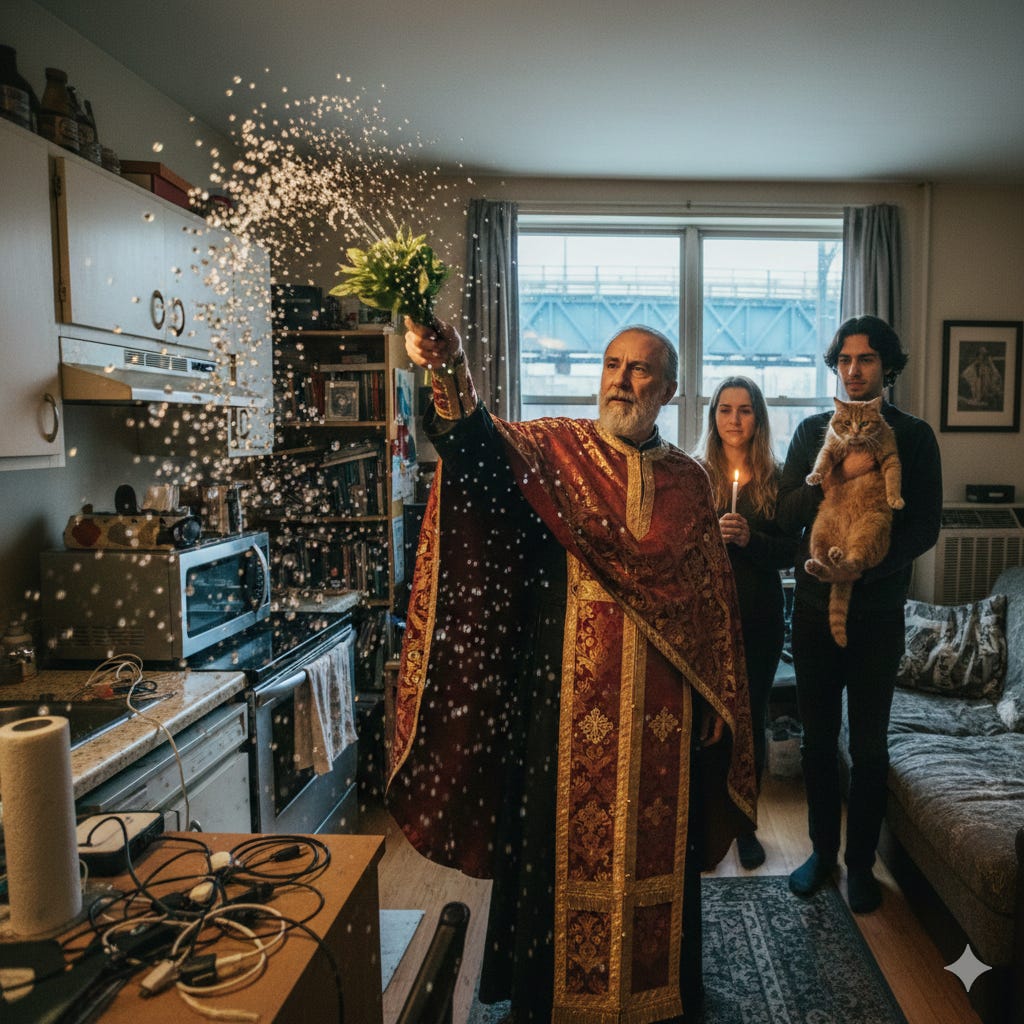
Father Dimitri is standing in a one-bedroom apartment in Astoria, Queens. He is wearing full vestments. He is holding a bundle of basil stalks in one hand and a brass bowl of holy water in the other. Behind him, a young couple stands, hands folded. The wife is holding a candle. The husband is holding their cat, who looks bewildered.
Father Dimitri dips the basil into the water and flings it across the kitchen, chanting in Greek. He sprinkles the refrigerator. He sprinkles the stove. He walks into the bathroom and sprinkles the shower. He opens the closets and sprinkles the coats. He makes his way to the bedroom, to the bookshelf, to the desk with its tangle of charging cables. He pauses at the living room window, which looks out over the elevated train tracks and sprinkles that too.
The cat receives a direct hit… and does not appreciate it.
When it is over, Father Dimitri turns to the couple and says a final prayer. He asks that the Lord send His angel of peace to guard this dwelling and all who live in it, that every evil spirit would withdraw, and that the grace of the Holy Spirit would fill this place.
Then he leaves. He has three more apartments to bless before lunch.
If you have never seen this before, your first reaction is probably somewhere between charmed and confused. Sprinkling holy water on a microwave? On a closet? On a cat? It looks like superstition wearing a cassock. It looks like something out of the Middle Ages that somehow survived into an era of smartphones and subway lines.
But there is something going on behind that brass bowl of water that goes all the way back to Genesis. And if you read the first article in this series, you already know the outline: the Eighth Day, the unfinished destiny of the human race, the Priest of Creation who was supposed to pull the material world into the life of God and failed. The whole framework of creation, fall, and redemption is built around the idea that the physical universe is not a backdrop to the spiritual drama but a participant in it.
The house blessing is where that theology gets concrete. Literally concrete, drywall, tile, plumbing, etc.
To understand why an Orthodox priest would bless an apartment in Queens, or a home in Texas, you need to understand something that most of Western Christianity has quietly forgotten: the ancient Christian conviction that space is not neutral.
There Is No “Middle Secular Ground”
In most modern Protestant thinking, and in a fair amount of Mormon thinking too, the physical world is essentially a stage. It is where the action happens, but it is not itself part of the action. The real drama is spiritual: your soul, your faith, your relationship with God. The material world is either a testing ground (the LDS perspective) or a passing shadow (the Evangelical frame). Either way, it is not the point. The point is somewhere else. Up. Out. Beyond.
We reject this completely.
In Orthodox theology, the material world is not evil or merely a stage. It is a character in the story. Every rock, every river, every room in your house has what St. Maximus the Confessor called a logos, an inner principle, a divine intention built into its very existence by the Creator. The word logos here is deliberately chosen. It is the same word used in the Gospel of John: “In the beginning was the Logos, and the Logos was with God, and the Logos was God.” Every created thing carries within it a tiny echo of the Word who spoke it into being. Every atom has an orientation, a direction, a purpose that points back toward its Maker. LDS people recognize this idea as the Light of Christ, and it applies here, too.
Maximus, writing in the seventh century, described the entire cosmos as a kind of liturgy. Not metaphorically. The sun, the rain, the turning of the seasons, the growth of a seed into a tree: all of these are the material world doing what it was designed to do, which is to move toward God and reflect His glory. The problem is not that the world has stopped doing this. The problem is that the one creature who was supposed to lead this cosmic procession abandoned his post.
That creature is you. (Well, to be fair, Adam started it.)
This is the Priest of Creation concept from the first article. Humanity was created as the Microcosm, the living link between the spiritual and the material. Our job was to take the world’s natural worship (the logos in every created thing) and consciously offer it back to God. We were the voice of the voiceless. The bridge between the wordless praise of the mountains and the articulate praise of the angels.
And when the priest fell, the parish (i.e., creation) suffered.
St. John of Damascus, the great eighth century theologian who defended the veneration of icons and physical matter against those who wanted to spiritualize Christianity into pure abstraction1, put it bluntly: “I do not worship matter, but I worship the Creator of matter, who became matter for my sake, who willed to take His abode in matter, and who through matter accomplished my salvation.” For John, the Incarnation itself was proof that the material world is sacred. If God Himself took on flesh, then flesh (and by extension all physical reality) is capable of bearing the divine presence. Matter is not opposed to spirit. Matter is waiting for spirit. The whole physical world is like a house with the lights off, waiting for someone to come home and turn them on.
The Fall turned the lights off. A Blessing turns them back on.
The World Between Orders
To grasp what a blessing actually does, you need to understand what happened to the material world at the Fall. And here is where things get both more precise and more strange than what most Western Christians expect.
The material world did not become evil at the Fall. Orthodoxy is very insistent on this point. The Gnostics (the ancient heretics who believed matter was inherently corrupt) got it wrong, but the idea seems to persist, even in modern Christian circles. The Puritans, with their suspicion of beauty and the body, got it wrong in a different way. The modern secular materialists, who believe matter is “just stuff” with no spiritual dimension at all, have it perhaps the most wrong of all.
What happened at the Fall was not that matter became evil. It’s that it became disordered.
Remember the “garments of skin” from the first article. After Adam and Eve fell, God clothed them in these garments. St. Gregory of Nyssa, one of the brilliant Cappadocian Fathers of the fourth century, read this not as a story about leather clothing but as a description of the human condition after the Fall: mortality, animal instinct unmoored from spiritual direction, the body’s desires and passions running ahead of the soul’s wisdom, the whole apparatus of biological survival (hunger, fear, aggression, reproduction driven by survival instincts rather than love) that now defines our experience of physical life.
But the garments of skin are not limited to the human body. Because humanity is the Microcosm, the link between heaven and earth, when the human person became disordered, the environment became disordered too. The logoi (those inner principles that orient every created thing toward God) didn’t disappear. But they became, so to speak, muffled. The world’s natural movement toward its Creator was disrupted. Things still exist according to their design, but they no longer know they do. The signal is jammed. The connection is frayed.
St. Symeon the New Theologian, writing in the eleventh century, took this further. He taught that the material world participates in the spiritual state of the human beings who inhabit it. This seems mystical, but it is not mysticism or mythology. Symeon makes an ontological statement about the nature of reality itself. A home where prayer is offered becomes, over time, a different kind of place than a home where prayer is absent. The walls, the air, the quality of silence in the room: all of it is affected. This is not because the drywall has feelings, but because the material world is porous to spiritual realities2. It always has been and always will be. After all, that is what it was designed for.
Unfortunately, this goes both ways. If you’ve ever listened to the Exorcist Files podcast, one of my personal favorites, this just makes sense. Think about if you’ve ever gone into a place and either felt light and love, or oppression and heaviness.
If sustained prayer and love can gradually reorient the material environment toward God (which is what the logoi were always trying to do), then sustained sin and spiritual disorder can push the environment in the other direction. We take very seriously the idea that places can become spiritually “heavy,” saturated with the residue of violence, despair, or demonic activity.
lol, I can see Zwingli over in the corner making a sour face. Chillax, Ulrich. This is not superstition. It is the logical consequence of taking the Microcosm seriously. If humanity is the bridge between the spiritual and the material, then what flows through the bridge flows into the environment on both sides.
This is why a blessing is not a meaningless ritual meant to just satisfy human emotions. It’s not performative or decorative. It is medicinal. Spend time around Orthodox folks, and you'll hear a lot of that kind of talk. Talk about healing, medicine, and the great physician. I mentioned a bit in the last article how our view of salvation and the Atonement is not about legal or juridical ideas, but instead about healing. Salvation, if viewed through the lens of Theosis, must by necessity be about healing. You will, at some point, inevitably hear an orthodox priest describe the Church as a Hospital for sinners. If you get squeamish about everyone in the communion line using the same spoon, you’ll hear an explanation that the eucharist (body and blood of Christ) is healing and cannot possibly make you sick.
<ADHD tangent> In fact, there were priests in Canada during COVID who used separate spoons for each person. It caused a bit of a stir, not only b/c it was mandated by the government, which has no business poking its head into how sacraments are administered (especially far left marxist secular liberals), but also because bending to this type of thing implies that you think the body and blood of Christ could in some way harm you, or you are tacitly admitting that the bread and wine does not have the real presence of Christ within it. Either way, that’s just straight-up heresy and blasphemy of the worst sort!
On the flip side of this, I have seen an 80-year-old priest at the end of every liturgy, consume every last drop of bread and wine left in the chalice week over week for years, and I swear, he’s the healthiest, spryest 80-year-old I’ve ever seen in my life. I get sick more often than he does, he has more energy than I do, and I’m approximately 30 years his junior! </ADHD tangent>
What the Priest Is Actually Doing
Let’s go back to Father Dimitri and look at what is happening when he walks through that apartment with his basil and his holy water.
The Orthodox house blessing, especially in the form used after the Feast of Theophany (which we will explore in depth in the next article), is not a ritual of good luck or a “positive energy cleanse.” The priest is holding basil, not sweetgrass or sage. It is a precise liturgical act with a specific theological purpose: to reconnect a piece of the material world to its Creator by reestablishing the link that the Fall severed.
The prayers of the blessing, drawn from the Euchologion (the priest’s service book, one of the oldest collections of liturgical texts in Christian history), are remarkably specific.
First, they exorcise. The prayers explicitly instruct that every evil and unclean spirit withdraw from the place. The Orthodox understanding, rooted in the Deuteronomy 32 worldview discussed in the first article, holds that the fallen spiritual powers (the rebellious “watchers” who accepted worship as pagan gods) do not confine their activity to temples and battlefields. They operate in the ordinary spaces of daily life, exploiting the disorder of the garments of skin, amplifying fear, anger, and despair wherever they find a foothold. The blessing is a formal notice of eviction. The space being blessed is being reclaimed.
Second, they invoke. The priest asks God to send His angel of peace to guard the dwelling and all who live in it. Angelic guardianship is not a fairy tale idea about cute little fairies sitting on your shoulder. It is a continuation of the Divine Council framework. Just as the Saints replace the demonic watchers over nations and territories, the angel of peace replaces whatever disordered spiritual influence may have taken root in the home. A new regime is installed. A new guardian takes his post.
Third, they sanctify. The holy water that the priest sprinkles is not symbolic (still listening Ulrich?3) It is water that has been blessed in the name of the Trinity and has received, through the prayers of the Church, a participation in the grace of Christ’s own baptism in the Jordan (more on this in the next article). When this water touches the walls, the floors, the furniture, and, yes, the cat, it pulls the reality of the Eighth Day forward into the Seventh. It is applying the medicine of the new creation to the corrupted surfaces of the old.
St. John Chrysostom, the great fourth-century bishop of Constantinople, urged his congregations to make their homes into “little churches.” He did not mean this only in the sense of moral behavior, of being kind to your spouse and praying before meals (though he meant that too). He meant it architecturally, ontologically. The home should be a space where the Eighth Day is breaking through. Where the garments of skin are being gradually loosened. Where the logoi of every material thing in the household are being gently turned back toward their Creator.
The house blessing is the liturgical kick start of that process.
Blessing Cars, Animals, Fields, and Rivers
Once you see the logic of the house blessing, the rest of the practice of blessings stops looking strange and starts looking inevitable.
Orthodox Christians bless their cars. The prayer for the blessing of a vehicle asks specifically for the safety of all who travel in it, invoking the journey of the Holy Family into Egypt as the archetype of sacred travel. The car is not just a machine. It is a space in which human life unfolds. It is part of the material world that the Priest of Creation is called to offer back to God. Leaving it unblessed would be like leaving one room of your house in darkness while the rest is filled with light.
Orthodox Christians bless their animals. And this connects directly to the deepest layer of the Eighth Day theology. Remember: the animals suffer not because of their own sin but because the one creature meant to help bridge them into eternity failed in his vocation. When a priest blesses a dog, a cat, a horse, or a flock of sheep, he is exercising the priesthood that Adam abandoned. He is, in that moment, doing what humanity was always supposed to do: standing between the animal kingdom and its Creator, lifting the voiceless into the presence of the One who made them. The stories of the saints and their animals (St. Gerasimos and his lion, St. Seraphim and his bear, St. Kevin and the blackbird nesting in his open palm) are not fairy tales or pious exaggerations. They are previews of the Eighth Day, moments when a human being so fully recovered his original vocation that the animals recognized him as their priest and were at peace.
Orthodox Christians bless fields and crops. In the agrarian traditions of Greece, Russia, Serbia, and the broader Orthodox world, the blessing of the land before planting and after harvest is not a superstitious act of magic dressed up as religion. It is the Priest of Creation doing his job. The earth itself has a logos, a divine intention, an orientation toward God that the Fall disrupted. The blessing is the reassertion of that orientation. It is the Church saying to the soil, “You were made for more than this. You were made to participate in the life of God. And through this water, through this prayer, the Eighth Day reaches you.”
Orthodox Christians bless water. Rivers, lakes, springs, the ocean itself. This is the most dramatic form of the blessing, and it happens once a year at the Feast of Theophany, when the Church commemorates Christ’s baptism in the Jordan. We will dedicate the entire next article to this event, because it is the moment when everything we have been discussing becomes visible on the largest possible scale. But for now, note the pattern: house, car, animal, field, river. The scope keeps expanding. The Eighth Day does not stay confined to a church building. It radiates outward. It claims more and more of the material world, pulling the Seventh Day toward its intended destination.
Fr. Alexander Schmemann, one of the most influential Orthodox theologians of the twentieth century, argued in his masterwork For the Life of the World that the fundamental sin of secularism is not atheism. It is the belief that the material world is “just stuff.” That bread is only calories. That water is only molecules. That your apartment is only square footage. Secularism does not deny God so much as it denies the sacramentality of creation. It insists that the physical world is closed, self-contained, and spiritually inert. It is the final and most complete victory of the garments of skin: a humanity so deeply trapped in the biological mode of existence that it can no longer even imagine the material world as a vehicle of the divine.
The brass bowl of holy water in Father Dimitri’s hand is the Church’s answer to that lie.
The Displacement in Miniature
Now let me connect this back to the larger arc of the series, because this is where the house blessing becomes not just a lovely tradition but a battle strategy in an ongoing spiritual war.
In the first article, we discussed the Great Displacement: the cosmic process by which the rebellious angelic “watchers” who enslaved the nations under the old order (the Seventh Day system) are being replaced by the Saints, the friends of God, the Eighth Day humans who take their seats in the Divine Council. We talked about how a territory once ruled by a demon of war or a local pagan deity is reclaimed by a patron saint who offers intercession instead of demanding sacrifice.
The house blessing is the Displacement in miniature.
Every home, every apartment, every room exists within the material world that became disordered at the Fall. The air itself is, in the Orthodox understanding, a contested space. St. Paul calls Satan “the prince of the power of the air” (Ephesians 2:2), and the Orthodox Fathers took this with real seriousness. The atmosphere of ordinary life, the invisible spiritual environment in which we go about our daily business, is not empty. It is inhabited.
When a priest enters your apartment, he is not performing a quaint ceremony. He is executing a change of governance. The old spiritual disorder, whatever form it takes in that particular place (residual grief, habitual conflict, ambient anxiety, or more overt demonic oppression), is formally addressed and told to depart. The angel of peace is installed. The holy water carries the grace of Christ’s baptism into every corner. The space is no longer contested. It has been claimed.
St. Basil the Great, writing in the fourth century in his treatise On the Holy Spirit, taught that it is the Holy Spirit who “perfects” creation, bringing to completion what the Father initiates and the Son accomplishes. In every blessed space, the Spirit is doing exactly this: completing the work of the Eighth Day in one specific location. Making one more room in the cosmic house livable. Turning the lights on in one more corner of the darkened world.
And this is where St. Seraphim of Sarov, the beloved nineteenth-century Russian saint, comes in. Seraphim’s most famous teaching is this: “Acquire the Spirit of peace, and thousands around you will be saved.” The logic is staggering in its simplicity. A person who has been internally healed, whose own garments of skin are being transfigured by the Holy Spirit, whose inner hierarchy (spirit over body, soul oriented toward God) has been restored, does not merely benefit himself. He transforms his environment. The material world around him begins to reorient. The logoi of the trees, the animals, the very air begin to turn back toward God, because the priest is finally back at his altar.
This is why Seraphim could feed a wild bear from his hand. Not because he had a gift for animal training. Because his presence was a walking house blessing. The Eighth Day radiated from his person into the material world, and the bear responded to it. The ancient peace of Eden returned, if only in a clearing in the Russian forest, if only for a moment, because one man had become what Adam was always meant to be.
The house blessing is the liturgical extension of this principle. Most of us are not St. Seraphim. Most of us are still very much wearing the garments of skin, still struggling with the animal instincts, still caught in the loop of the Seventh Day. But the Church, in her mercy, provides a way for the Eighth Day to enter our spaces even when it has not yet fully entered our persons. The priest comes. The water is sprinkled. The prayers are chanted. And the apartment in Astoria becomes, in some real but perhaps still incomplete way, a colony of the world to come.
What This Means for You
If you grew up Mormon, you already have a powerful sense of consecrated space. The temple is, for you, the place where heaven and earth meet, where sacred ordinances connect the living and the dead, where the material world (altars, water, oil, clothing) is charged with spiritual significance. That instinct is correct. Where Orthodoxy differs is in the scope of the claim. The apostolic church’s vision is that the entire world is meant to become a temple. Not just one building in Salt Lake City or one in each major city, but every house, every field, every river, every square inch of the material cosmos. The house blessing is the Church’s way of extending the temple’s logic to the whole of creation, because that is what the Eighth Day demands. LDS also have a view of this in their eschatology. So if you are LDS/Mormon, you should have heard that in the last days, at the end of time, after the “second coming,” that the earth will be Celestialized. You could call that, in a way, a similar concept to the 8th Day. We are not waiting for some far-off future time for that to happen; we are starting that process now.
If you grew up Protestant, especially in the Reformed or Evangelical traditions, you may have been taught that the physical world is spiritually neutral. That what matters is your heart, your faith, your personal relationship with Jesus. The material stuff, the buildings, the water, the bread, are just a delivery mechanism. Props for the real show, which is entirely interior. I would say, with great respect, that this is precisely the lie the garments of skin want you to believe. The whole point of the Fall was to convince humanity that the material world doesn’t matter, that the body is a prison, that “spiritual” means “nonphysical.” But the Incarnation destroyed that lie. God took on matter. He sanctified water. He multiplied bread. He rose in a body. And He sent His Church into the world to continue the work of pulling the material universe back into the life of God, one apartment, one car, one bewildered cat at a time.
The Scope Keeps Expanding
There is a pattern in the Orthodox life of blessing, and it moves in one direction: outward. It begins with the person: baptism, chrismation (anointing with holy oil), the Eucharist. The individual is claimed for the Eighth Day.
It moves to the home: the house blessing. The person’s immediate environment is reclaimed.
It extends to the means of daily life: the car, the animals, the tools of one’s labor, the food on the table. The ordinary infrastructure of the Seventh Day is gradually re-sanctified.
And then, once a year, it explodes outward to the most elemental level of the material world itself: water. On the Feast of Theophany, the Orthodox Church does not bless a baptismal font or a bowl or a pitcher. It blesses a river. It plunges the cross into the living water and claims the most fundamental substance on earth for the Kingdom of God. And through that river, the blessing radiates to every body of water on the planet, because all water is connected, and the Eighth Day does not recognize the boundaries that the Seventh Day imposes.
That event, the Great Blessing of the Waters, is the subject of the next article. It is the most dramatic, the most beautiful, and the most theologically audacious act of blessing in all of Christendom. It is the moment when the Priest of Creation does not just bless a room or an animal but reaches down into the molecular structure of the world itself and says: This too belongs to God. This too is being made new. This too is entering the Eighth Day.
If Father Dimitri splashing holy water on a cat in Astoria seemed strange, wait until you see what happens when the Church blesses the ocean.
Conclusion and looking forward
This is the second article in the Eighth Day series. The first article, “You Were Never Meant to Be Saved. You Were Meant to Be Finished,” is available to all subscribers. The next article, “The River Remembers: The Great Blessing of the Waters and the Eighth Day’s Power Over Matter,” will be available only to paid subscribers.
If this series is opening doors you did not know existed, your paid subscription is what makes it possible to keep walking through them. Every article in this series requires hours of research, engagement with patristic sources, liturgical texts, and the theological tradition of the oldest Church in the world. Your support is not charity. It is a partnership in the work of making this ancient faith accessible to a world that has largely forgotten it exists.
The Eighth Day is still dawning. Come further in.
This is still an impulse we see in protestantism today, and to me it smacks of gnosticism, an early heresy that imported ideas from Greek Platonic thought that the material world is somehow evil.
Crazy aside, a mechanism for how you can have haunted places. If physical material can be affected by spiritual realities, this makes a lot of sense and is, in a way, a kind of first principle of our reality.
Yes, I’m spending a lot of time mocking Ulrich Zwingli, one of the early Protestant reformers and the originator of the idea of Memorialism. I’m picking on Zwingli b/c he, in his infinite wisdom, stripped, in his theology, any form of spiritual power from all sacraments. It’s his view of Christianity that has been inherited into modern American evangelical Protestantism (particularly Baptists) and also into Mormonism. I really don’t like him; I think he was a tyrant and a not-so-nice person, so I’m having a bit of sport at his expense.