

The Temple in Your Parish
How Every Orthodox Church on Earth Is Built From a Blueprint God Delivered Around 1500 BC - And Why That Should Wreck You a Little

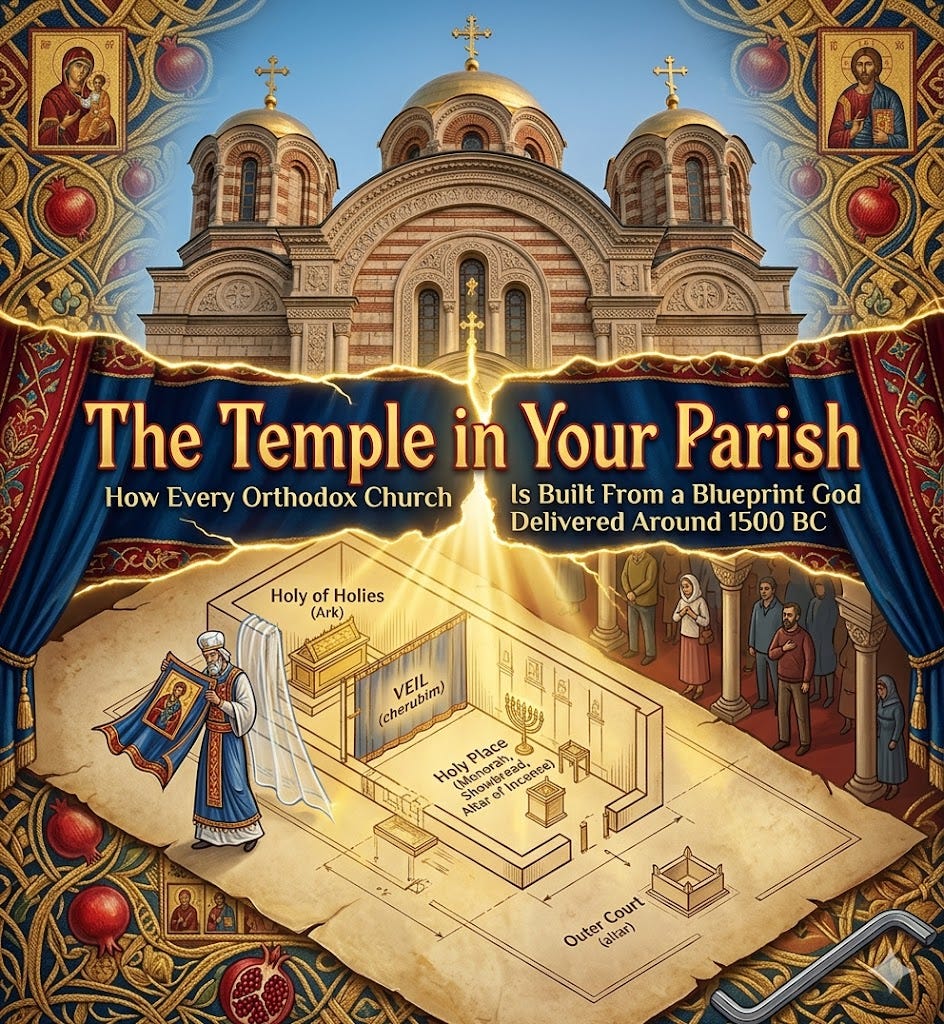
You’re trying to assemble an IKEA bookshelf.
You have the instructions. You have the little paper bag of dowels and the plastic cam-lock fasteners. You have that weird L-shaped Allen wrench that is somehow always the exact tool required and is also somehow always going to be lost by next Tuesday. You have Piece A and Piece B and Piece 47-C, which you were told was “not needed for most configurations” but which is apparently critical for this one.
You are going to follow those instructions exactly, because if you don’t, if you put the back panel on backwards, or skip the step about pre-drilling the little cam holes, or tighten the bolts out of order, the whole thing is going to wobble. Or lean. Or not fit together properly and you’ll just end up having to take it all apart and put it back together properly.
You will obey the instructions. Meticulously. For a bookshelf.
Have you ever wondered why we spend 3 hours following the blueprint for a piece of Swedish particle board to the exact millimeter, but the minute someone suggests that God’s instructions for how to build His house might actually matter we collectively shrug and go “well, it’s the thought that counts” and throw up a pole barn with some folding chairs and a projector screen?
Because…. (and this isn’t going to make me popular):
God actually did give instructions for how to build His house. Very specific instructions. He dictated the dimensions. He specified the materials. He designed the furniture. He designed the decorations, images and visuals, he prescribed the vestments of the priests down to the color of the thread and the arrangement of the pomegranates on the hem. (Yes, pomegranates. Fruit embroidery. On the priest’s robe. We’ll get there.) He did this on Mount Sinai, to Moses, in a conversation that covers roughly seven chapters of the Book of Exodus. And when He was done giving the instructions, he said this:
“See that thou make all things according to the pattern shown to thee on the mount.”
Read that again. Pattern. Not suggestion. Not general concept. Not “vibe.” Pattern. The Greek Septuagint uses typos - the word from which we get “type” and “typology.” God gave Moses a type, a pattern, a blueprint. And Moses was to make things according to that pattern.
And here is the question this entire article exists to answer:
What if somebody actually did?
What if, after the resurrection, after the tearing of the veil, after Pentecost and the sending out of the Apostles - somebody took God’s blueprint, held it up against the new reality of the risen Christ, and built Him a house on purpose? What if that house is still being built today, in every country on earth, by people who learned how to build it from people who learned how to build it from people who learned how to build it from the Apostles themselves?
What if the blueprint never went away?
Giddy up and let’s Ggggggoooooooooooooo.
Architecture Is Theology
In the first article of this series, I established a principle that is going to do a lot of the heavy lifting for this whole project: lex orandi, lex credendi. The law of prayer is the law of belief. How a church worships is how a church actually believes.
There is a sister principle, but I don’t think it has a Latin phrase and I’m not going to just make one up, because I don’t have to. The Fathers have already said it. Repeatedly. At length. For centuries. To paraphrase it basically boils down to is this:
What you build to worship in is what you believe about worship.
Eusebius of Caesarea, around 315 AD - just after the persecution of Diocletian ended and Christians could finally build publicly again - delivered a dedicatory oration at the consecration of the rebuilt basilica at Tyre. The oration is preserved in full in Book 10 of his Church History (read it here.) He calls the bishop Paulinus “a new Beseleel, the architect of a divine tabernacle, or Solomon, king of a new and much better Jerusalem, or also a new Zerubabel, who added a much greater glory than the former to the temple of God.” Eusebius is not treating the Christian basilica as something new. He is treating it as the direct lineal descendant of the Tabernacle that Moses built, the Temple that Solomon built, and the Second Temple that Zerubbabel built. The fourth-century Christian church is, in Eusebius’s own mouth, the continuation of that same architectural tradition - fulfilled, transfigured, but unmistakably the same lineage.
And Eusebius is not inventing this interpretation at Tyre. He is reporting it. He is giving voice to a theology of sacred architecture that the Church had already cultivated for generations before him.1
Three centuries later, St. Maximus the Confessor writes a work called the Mystagogia, literally “the teaching of the mysteries.” In which he lays out, in systematic theological detail, what the various parts of a church building mean. The nave is the world of the faithful. The sanctuary is the kingdom of heaven. The screen that divides them is the threshold between the two ages. The whole building, taken together, is an image of the cosmos, of the human person, and of the Kingdom of God. This is not metaphor. This is not syntactic sugar. This is theology rendered in stone and wood and screen and lamp, and Maximus spells it out explicitly because, for him, the building teaches. The building forms the faithful who stand in it. It is a catechesis2 you can walk into.
A century after Maximus, St. Germanus of Constantinople - the Ecumenical Patriarch who defended the veneration of icons against the iconoclast emperors - begins his commentary On the Divine Liturgy with this:
“The Church is the temple of God, a sacred space, a house of prayer, the convocation of people, the Body of Christ... She is heaven on earth, where the transcendent God dwells as if in his own home and passes through.”
Heaven on earth. Where the transcendent God dwells as if in his own home. That is not hyperbole, and it’s not a quaint eighth-century turn of phrase. That is the working definition of what an Orthodox church building is, preserved and prayed in Orthodox parishes to this day. Germanus’s commentary became the somewhat official explanation of the Divine Liturgy in the Byzantine world for the next six hundred years. What he says about the church building is what the Church said. It is what the Church continues to say.
So when I tell you that sacred architecture is not decoration - that it is not optional, that it is not “whatever works for your community,” that it is theology made of stone and wood and glass and paint - I am not giving you my personal opinion. I am reporting what Eusebius reported, what Maximus systematized, and what Germanus prayed. For the Fathers, sacred architecture is doctrine you can walk into. It is belief with a roof on it.
This is not a uniquely Christian idea. Every religious tradition on earth has understood this. The Greeks built temples to specific gods in specific shapes for specific reasons. The Egyptians laid out their tombs according to cosmic principles. The Muslims built the Dome of the Rock on the exact spot where they believe Muhammad ascended to heaven. The Buddhists orient their stupas to the cardinal directions. Everyone knows that what you build to worship in matters.
Everyone, apparently, except modern Western Christianity - which, unmoored from the tradition of the roman catholic church, decided that it didn’t really matter. The specific shape of the building became an afterthought. That one could worship God in a gothic cathedral, a converted warehouse, a storefront, a strip mall, or (I am not making this up) a repurposed Hooters in Johnson City, Tennessee.3 That sacred space is a concept, not a place. That God will meet you anywhere, so why bother with anywhere in particular?
I want to push back on that, because God Himself, on Mount Sinai, in front of Moses, did not say “build me a worship experience that reflects your local cultural context.” He said make all things according to the pattern shown to thee on the mount.
He had a pattern. He gave it to us. Let’s look at what it was.
The Blueprint God Delivered
Open your Bible to Exodus chapter 25.
What you are about to read is one of the most detailed construction specification documents in the ancient world. It runs from Exodus 25 through Exodus 31, with a repeat-performance in Exodus 35 through 40. (God dictates the plans. Then Moses repeats them back. Then they get built. Seven full chapters of detailed architectural instructions, delivered twice.) This is not casual. This is the most serious thing in the entire Torah besides the Ten Commandments themselves, and in fact, the Ten Commandments get stored inside the edifice these chapters describe.
This is the Tabernacle, the portable sanctuary that Israel carried through the wilderness for forty years. Later, under Solomon, the Tabernacle’s design was executed in stone and gold as the permanent Temple in Jerusalem. The Temple was destroyed, rebuilt after the Exile, and then magnificently expanded by Herod the Great just before the birth of Christ. It is this Herodian Temple, structurally identical in its essentials to the Tabernacle blueprint, that Jesus walked into, that He drove the money-changers out of, that His disciples admired for its massive stones. And it is this Temple whose veil tore in two at the moment of His death.
The shape of the Tabernacle, the First Temple, and the Herodian Temple was the same. The materials changed. The scale changed. The essentials did not. Because God gave the pattern once, and that pattern was the pattern.
Here is what the pattern looks like.
Three zones. Concentric. Each one holier than the last.
Zone One: The Outer Court. The largest area, also know as a preparation area, the one any worshiping Israelite could enter. In the Tabernacle, it was the open-air courtyard surrounded by a curtained wall. In the Temple, it became the Court of the Women and the Court of Israel. Later, under Herod, an outer Court of the Gentiles was added - but the original design was just “the court where the people stood.” This is where a great altar stood - the altar of burnt offering, where animal sacrifices were made. This is the place of preparation. The place where purification happened. The place where the worshiper came with his offering.
Zone Two: The Holy Place. You entered through a curtain. This was the interior of the sanctuary proper. Only priests could enter. Inside were three furnishings, and you will want to remember all three of them, because they are all going to come back:
The Menorah - the seven-branched golden lampstand, which burned perpetually from evening until morning. (Exodus 25:31-40)
The Table of Showbread - on which twelve loaves of bread were placed fresh every Sabbath, one for each tribe of Israel (Exodus 25:23-30)
The Altar of Incense - which stood directly before the veil, and on which incense was burned (Exodus 30:1-10) The Altar of Incense was a stationary piece of furniture, a small golden altar that stood directly in front of the veil, inside the Holy Place. Morning and evening, the priest burned the prescribed incense on it. Once a year, on Yom Kippur, the High Priest carried coals from this altar into the Holy of Holies in a portable censer (machtah in Hebrew.)
Perpetual light. Continually renewed offering bread. Regular incense. Continually offered in perpetual liturgical patterns. The Holy Place was not a place where stuff happened occasionally or casually. It was a place where the fundamental furniture of worship was always active according to prescribed patterns of worship.
Zone Three: The Holy of Holies. The innermost chamber. The place where God Himself dwelt, between the cherubim on the Mercy Seat of the Ark of the Covenant.
Only one person on earth could enter the Holy of Holies.
The High Priest.
And he could only enter on one day of the year.
Yom Kippur. The Day of Atonement.
And before the Holy of Holies hung the most important piece of fabric in the ancient world.
The Veil.
The Veil
Exodus 26:31-33 (read it):
The veil was made of blue, purple, and scarlet threads, woven with fine twisted linen. It was embroidered with cherubim - the angelic guardians of God’s presence. It hung on four pillars of acacia wood overlaid with gold, set in four silver sockets. It separated the Holy Place from the Holy of Holies. It was, according to Josephus (the Jewish historian writing at the end of the first century AD, and you can read him yourself here), approximately sixty feet tall in the Herodian Temple. Sixty feet. Sixty feet of embroidered linen separating the holy from the most holy.
Amazing, God’s instructions for His house included a sixty-foot wall of fabric, hand-embroidered with angels, woven with blue and purple and scarlet threads, hanging between the worshiper and the presence of God.
The veil did a very specific theological job. It said: you cannot come in here. Not because God is cruel. Not because God doesn’t want you. But because you are not yet ready, and until you are, approaching Him directly will kill you. The Law of Moses records the story of Uzzah, who touched the Ark of the Covenant to steady it when the oxen stumbled, and dropped dead on the spot (2 Samuel 6:6-7). God is not safe. The veil was a mercy. The veil was the thing that let you stand near without being consumed.
And the High Priest, once a year, on Yom Kippur, passed through the veil with the blood of the sacrifice, and sprinkled it on the Mercy Seat, and thereby atoned for the sins of the entire nation.
One priest. One day. One passage through the veil.
Until Good Friday.
On the ninth hour, at the moment Christ died on the Cross, three separate Gospel writers - Matthew, Mark, and Luke - record the same event: the veil of the Temple was torn in two from the top to the bottom (Matthew 27:51, Mark 15:38, Luke 23:45)4 From the top. Which is to say, from God’s side down. Not from man reaching up, but from God reaching down, and ripping the fabric in half.
Most of my Protestant readers know that this happened. Most of them have been told what it means. Most of them have been told wrong.
The standard Protestant reading is that the tearing of the veil abolished the Temple. That the veil tearing means sacred space is over. That we no longer need altars, priests, incense, vestments, or any of the rest of it, because Christ is the only priest we need and He already did the one sacrifice that mattered. There is a partial truth here. Christ is the only High Priest. His sacrifice is the one that matters. But the conclusion - therefore, we don’t do any of the rest of it - does not follow. Certainly this is not what the earliest Christians understood, the ones who lived while the Temple was still standing, the ones who saw the tearing happen - they didn’t draw that conclusion.
They did something else instead.
And the question is: what?
Walking Into an Orthodox Church
Come with me.
We’re going to walk into an Orthodox parish on a Sunday morning. Any of them. Doesn’t matter where. A cathedral in Moscow. A storefront in Boise. A Greek parish in Astoria, Queens. A mission in rural Alabama where the priest converted from being a Baptist pastor eight years ago and the congregation of thirty people meets in what used to be a beauty salon. Every single one of them is built on the same floor plan.
Because every single one of them is built on the floor plan.
You enter the church. Before you walk into the worship space proper, you pass through a kind of vestibule or entry area. In a larger church this is an entire room. In a smaller one it might just be a small area just inside the doors. This space is called the Narthex. Historically, and in many parishes still today, this is the place where catechumens (those preparing for baptism) stood during portions of the Liturgy from which they were dismissed before the Eucharist. It is also traditionally the place where penitents, those under discipline, those not yet fully received into the Church, could stand and participate in the outer parts of the service.
Hold that thought. Remember the three zones of the Temple. Remember that the outermost zone was the place of preparation, the place where the non-priest worshiper came. Hold that thought.
You pass from the Narthex through a set of doors into the main body of the church. This is called the Nave. (The word is from the Latin navis, meaning “ship,” because the early Church understood the Nave as the ark of salvation carrying the faithful through the flood of the world. Which is a beautiful image but not the one I need you to hold right now. Hold the Temple image. Hold the second zone.)
The Nave is where the faithful stand, and in traditional Orthodox practice, we do stand, for most of the service, because we are in the presence of the King.5 Around you, you will see:
Oil lamps, burning perpetually before the icons. Not electric. Not fake. Real oil, real flames, kept lit. Some of them have been burning in certain monasteries for over a thousand years. (The monks take turns making sure the flame never goes out.) Perpetual light.
Incense, which the deacon or priest will bring through multiple times as prescribed during the service, swinging the censer on its chains, filling the nave with a specific smoke from specific recipes that haven’t meaningfully changed since antiquity. Regular incense.6
Prosphora - offering bread - which is brought forward by the faithful on a weekly basis, stamped with a specific seal and which will be consecrated and distributed later in the service. Continually renewed offering bread.
Perpetual light. Continually renewed offering bread. Regular incense. Continually offered in perpetual liturgical patterns. The three furnishings of the Holy Place of the Temple, still burning and still offered.
The Hebrew Bible has a word for this kind of worship: tamid. It is usually translated “continual” or “perpetual,” but it does not mean “literally burning every second.” It means unceasing in pattern - offered at the appointed times, without interruption, generation after generation, never abandoned. The Menorah was lit every evening and tended every morning. That was tamid. The Showbread was replaced every Sabbath. That was tamid. The incense was offered morning and evening, morning and evening, century after century. That was tamid.
And this is what an Orthodox parish is doing, right now, today. The lamps are tended. The bread is offered. The incense rises. Not literally every second - but in the unbroken liturgical pattern that Israel kept for fifteen hundred years, and that the Church has kept for two thousand more. Light. Bread. Incense. The three furnishings of the Holy Place of the Temple, still kept in their appointed times, in a parish eight thousand miles away from Jerusalem and twenty centuries after the Temple was destroyed.
Now look toward the front of the church.
You will see a wall.
It is covered in icons. Large ones of Christ and the Theotokos (the Mother of God), smaller ones of various saints, and above them, often, a row of icons depicting the major feasts of the Church year. The wall has three doors in it. The center door is the largest and most ornate, and it has a specific name: it is called the Royal Doors, or in some traditions the Holy Doors, or the Beautiful Gates. This wall is called the iconostasis - from the Greek words for “image” (eikon) and “to stand” (stasis). Literally, “a place where images stand.”
You cannot easily see what is behind this wall.
Occasionally, during certain parts of the service, the Royal Doors will open, and you will catch a glimpse. There is a space behind there. In it is an altar table, covered in cloth, bearing specific objects whose names you probably don’t know yet. (We will get there in Article 5, when we look into the anaphora.) Only one class of person enters that space during the service.
men who have been blessed or ordained for liturgical service. This can include:
Bishops, priests, and deacons (the three orders of major clergy)
Subdeacons (the highest of the minor orders, formally tonsured and blessed)
Readers (minor order, tonsured)
Altar servers / acolytes (often boys or young men, blessed by the bishop or priest to serve, but not ordained to any order)
Women do not enter except for specific, limited purposes (nuns cleaning in a convent church, for example). Laymen off the street do not enter. The altar is not off-limits as a matter of exclusion - it is set apart, for those set apart.
If that sounds familiar, it should. The Jerusalem Temple worked the same way. Graduated access. The High Priest alone entered the Holy of Holies, and only once a year. The priests (the sons of Aaron) entered the Holy Place daily to tend the lamps, the bread, and the incense. The Levites assisted in supporting roles - music, gatekeeping, carrying the sacred vessels. Israelite men could stand in their court, Israelite women in theirs, Gentiles in the outer court. It was not one wall between priests and everyone else. It was a series of thresholds, each one marking a deeper level of consecration and a greater proximity to the Presence of God.
An Orthodox church preserves that graduated structure, in modified New Covenant form. The Holy of Holies behind the iconostasis is entered by those whom the Church has set apart for altar service. The nave is the place of the faithful - the baptized, the communing members of the Body. The narthex is the place of preparation, of catechumens and penitents. Three zones, graduated access, thresholds that matter.
And now I want you to stop.
I want you to look around the church you are standing in, and I want you to count zones.
Zone one: the Narthex. The place of preparation. The place where those not yet fully initiated stood. The outer court.
Zone two: the Nave. The place of the faithful. The place of perpetual light, continually renewed offering bread and Regular incense. The Holy Place, the place where the lamps are tended, the incense rises, and the offering bread is brought forward - kept in tamid pattern.
Zone three: behind the iconostasis. The sanctuary proper. The place where those who have been blessed or ordained for liturgical service enter, where the sacrifice is offered, where the Presence dwells. The Holy of Holies.
And between the Holy Place and the Holy of Holies, there is a wall.
There is a wall with a specific architectural function of separating the holy from the most holy. There is a wall that has a door in the middle of it that opens only at specific moments. There is a wall decorated with the figures of saints and angels - the christian equivalent of the cherubim embroidered on the ancient veil.
The Iconostasis Is the Veil
This is not an analogy. This is not a clever comparison. This is not “oh, how interesting, it’s metaphorically similar.”7
This is a direct inheritance: architectural, theological, and liturgical.
The iconostasis of every Orthodox church on earth is the veil of the Temple. It is the veil performing its original theological function in the New Covenant context. It is the same architectural object, given a new name and a new artistic vocabulary, doing the same work.
“But wait,” I hear you say. “Didn’t the veil tear at the crucifixion?”
Yes. It did.
“Doesn’t that mean the veil is gone?”
No. It means the veil has been opened.
This is a critical distinction.
When Christ died, the veil tore. From top to bottom. From heaven’s side down. That tearing accomplished something specific: it made the way into the Holy of Holies accessible through Christ. The book of Hebrews - possibly the most liturgically sophisticated book in the entire New Testament - spells this out. In Hebrews 10:19-20, the author tells us that we have boldness to enter the holiest “by a new and living way, which he hath consecrated for us, through the veil, that is to say, his flesh.”
Through the veil. Not around the veil. Not past an abolished veil. Through.
The veil is NOT gone. The veil has been identified with the Body of Christ8. Which means the veil has not been destroyed but transfigured. It is now the means of access to the Holy of Holies rather than the barrier to it. And this is why, in Orthodox worship, the Royal Doors of the iconostasis open and close at specific points during the Liturgy. Because the way is now open in Christ. The High Priest has passed through. He has opened the way. And He beckons us to follow.
The Orthodox iconostasis does something that the Temple veil could not do: it opens. It opens at specific moments. It opens so that the Eucharist can come out to the faithful. It opens at the Great Entrance, when the gifts are carried from the Table of Preparation to the Altar. It opens when the priest emerges to preach or to bless or to commune the faithful. The Temple veil was a barrier. The Orthodox veil is a threshold. Because in Christ, the Holy of Holies is no longer off-limits. It is where the faithful are being drawn.
And here is the thing that should absolutely wreck you.
The Apostles saw the veil tear. They were in Jerusalem when it happened. They walked past the torn Temple veil for the next forty years, until Rome destroyed the Temple in 70 AD. They could have concluded, “well, sacred space is over, let’s just meet in whatever building is available and call it good.” They did not conclude that. Instead, they took the principle of the Temple and built it into every Christian worship space they planted. Three zones. A veil. Incense. Priesthood. Vestments. Perpetual light. Continually renewed offering bread. Regular incense. Continually offered in perpetual liturgical patterns.
They didn’t abolish the blueprint. They fulfilled it.
Because that is what Christ does. He does not destroy. He fulfills.9
The Other Inheritances
The three zones and the veil are the big ones. But once you start looking, you cannot stop finding the Temple inside every Orthodox church. Let me give you a rapid-fire review tour.
The Priesthood. Under the Law of Moses, God established a specific order of priesthood: the sons of Aaron, from the tribe of Levi, ordained by the laying on of hands, vested in specific garments, offering specific sacrifices (Exodus 28). This Aaronic priesthood did not die with the Temple. It was fulfilled in Christ - the true High Priest “after the order of Melchizedek,” as the book of Hebrews works out in elaborate detail. And the Apostles, to whom Christ gave the authority to forgive sins and to offer the Eucharist, ordained successors by the laying on of hands. Those successors ordained further successors. That unbroken chain has never been broken in the Orthodox Church. The priest standing behind your iconostasis this Sunday was ordained by a bishop who was ordained by a bishop who was ordained by a bishop, in a direct chain back to the Apostles.10
The Vestments. Exodus 28 describes in exhaustive detail what the Aaronic priest wore. A linen tunic. An outer robe with pomegranates and bells on the hem (the bells made sound so that the priest could be heard moving in the sanctuary; the pomegranates were a symbol of abundance). A breastplate with twelve stones. A sash around the waist. A turban. Now look at what an Orthodox priest wears at the Divine Liturgy: the sticharion (a long linen tunic), the epitrachelion (a stole that hangs down the chest, equivalent to the ephod), the zone (a sash), the epimanikia (cuffs), the phelonion (an outer robe), and, for a bishop, the mitre (a crown-like headdress that is directly derived from the High Priest’s turban). It is not a coincidence. It is not a made up costume. It is a continuity. The vestments of an Orthodox priest are a conscious, deliberate, theological continuation of the vestments God specified on Mount Sinai, adapted to the New Covenant reality, but in unbroken descent.
The Incense. Psalm 141:2: ”Let my prayer be set forth before thee as incense, and the lifting up of my hands as the evening sacrifice.” In the Temple, incense was offered on a dedicated altar - the Altar of Incense - which stood directly in front of the veil. Morning and evening, every day, the priest offered it. Orthodox worship preserves the offering but moves it from a fixed altar to a portable vessel: the censer, a small bowl on chains that the deacon or priest swings throughout the service, censing the altar, the icons, the Gospel book, the clergy, and the people. The tamid offering of incense is not gone. It has been taken up and carried throughout the whole house of God. Which is fitting, because in Christ, the whole Church has become the Holy Place.
The Lamps. The Menorah in the Temple was tended daily by the priests - lit every evening, cleaned and trimmed every morning, oil refilled before it failed. The Orthodox Church keeps lamps in the same tamid pattern. A sanctuary lamp burns before the altar of every Orthodox church I know, kept lit and refilled as a matter of standing liturgical practice. Additional lamps burn before the major icons. The faithful light candles when they enter. In many monasteries, the sanctuary lamp has been tended in unbroken succession for centuries. It is not magical never-extinguishing fire. It is faithful, patterned, never-abandoned fire. Which is exactly what God commanded.
The Bread. The Table of Showbread held twelve loaves of unleavened bread, one for each tribe of Israel, replaced fresh every Sabbath, with the old loaves eaten by the priests in a holy place. The Bread of the Presence sat before the face of God all week long, never absent from the Table, renewed weekly in unbroken pattern for fifteen hundred years. When the Orthodox priest prepares the bread for the Eucharist - a service called the Proskomedia, which takes place before the Liturgy itself - he cuts commemorative particles out of specific loaves for the Mother of God, the saints, the departed, and the living. The single loaf that becomes the Body of Christ is placed at the center, with the other particles arranged around it. When the Eucharist is complete, the priest places all those particles into the chalice with the Body and Blood, saying words that mean, roughly, “let the Lord remember all of these.” Twelve loaves, made one Body, containing all the faithful. The showbread is not gone. It has been fulfilled.
Eastward Orientation. Every synagogue from the time of Christ onward faces Jerusalem - for diaspora Jews, this almost always means east. Orthodox churches are built with the altar on the eastern wall, so that when the priest offers the Eucharist, he faces east with the people, toward the rising sun, toward Paradise (which Genesis 2:8 places “in the east”), toward the direction from which Christ is expected to return Matthew 24:27. The architectural orientation is not cultural. It is eschatological. It is theology made of compass points.11
But Didn’t Jesus Abolish All This?
This is the question that many Protestant readers have been holding in the back of their minds since about the fourth paragraph, and I want to address it head-on.
The argument goes like this. Jesus’s whole ministry was in some sense a critique of Temple religion. He drove out the money-changers. He predicted the Temple’s destruction. He said “destroy this temple and in three days I will raise it up,” referring to His own Body (John 2:19). The book of Hebrews spends eight chapters arguing that the Levitical priesthood has been superseded by Christ. Paul says the middle wall of partition has been broken down (Ephesians 2:14). Doesn’t all of this add up to “the Temple is over, sacred space is over, priesthood is over, ritual is over”?
No. It adds up to “the Temple has been fulfilled.”
And there is a crucial difference between “abolished” and “fulfilled,” and the New Testament is ruthlessly consistent about which one Christ is doing.
Christ himself said: “Think not that I am come to destroy the law, or the prophets: I am not come to destroy, but to fulfil” Matthew 5:17). The Greek word is plerosai - to fill up, to complete, to bring to its intended end. Christ is not the eraser of the Old Covenant. He is its completion. The Temple is not abolished by Christ; it is the blueprint that Christ came to embody and perpetuate in His Body, the Church.
So when the veil tore, it was not an act of demolition. It was an act of opening. When the Temple was destroyed in 70 AD, the blueprint did not die - it had already been transplanted into the architecture of every Christian church being planted across the Roman Empire by the Apostles and their successors. The Jewish priesthood did not end; it was taken up into the priesthood of Christ and extended through the laying on of hands to the Apostolic succession. The sacrifices did not end; they were fulfilled in the one sacrifice of Christ, which is re-presented (not re-performed, re-presented) in every Divine Liturgy.
The pattern did not go away. The pattern was filled with Christ.
And here is what I want my Protestant readers to sit with, honestly and without defensiveness. If your tradition has stripped the continuous lamps out of the sanctuary, removed the incense, thrown out the vestments, torn down the iconostasis, abolished the priesthood, and replaced the altar with a stage, then - by the same principle Eusebius and Maximus and Germanus articulated, that what you build to worship in is what you believe about worship - your tradition has, at some point in its history, stopped believing that the Temple blueprint matters. It has concluded, somewhere along the way, that God’s seven chapters of instructions to Moses were a temporary arrangement that Christ made obsolete. And the architectural evidence in your worship space is evidence of that belief.
I am not saying this to condemn. I am saying this to invite you to ask the question.
If God Himself specified a pattern, and the Apostles Themselves preserved it, and unbroken Christian practice has continued it for two thousand years in the oldest continuous Christian tradition on earth, why does your worship space not contain it? And if it does not, what does that mean?
Those are questions worth sitting with.
What Article Three Will Cover
We have walked through the Temple. We have walked into an Orthodox church. We have seen that the architecture of the second is a direct, deliberate, theological continuation of the first.
But architecture is only half of the Jewish inheritance.
Next week, we are going to sit down in a first-century synagogue, not the Temple but the synagogue, because by the time of Christ most Jews no longer lived near Jerusalem, and Jewish worship had developed an entire secondary form for Sabbath mornings in a thousand towns across the Empire. The synagogue had Scripture readings. It had chanted psalms. It had fixed prayers. It had a specific posture of standing, a specific orientation facing east, a specific weekly cycle of readings. And it had all of this before the Temple was destroyed, which means Christ Himself attended synagogue services, as did Peter, James, John, and Paul. They prayed these prayers. They sang these psalms.
And the first half of every Divine Liturgy - the part called the Liturgy of the Word, or the Liturgy of the Catechumens - is structurally that synagogue service, baptized into Christ.
If you thought the Temple connection was uncomfortable, wait until we sit down next to Jesus in Nazareth and watch Him open the scroll of Isaiah.
Lex orandi, lex credendi
You have now seen the building. Next week, we listen to the service inside it. The pattern is there. It has always been there.
Subscribe, so you don’t miss it. And if this article resonated with you, share it with somebody who still thinks sacred space is a style preference.
The Apostles were there first. It is time we caught up.
Primary Sources
Every claim in this article can be verified against the following documents themselves. Disagree with something? Go read them.
Eusebius of Caesarea, Church History, Book 10 (c. 315-325 AD) - The oration Eusebius delivered at the dedication of the rebuilt basilica at Tyre, the earliest surviving extended Christian theology of sacred architecture. He calls the bishop Paulinus a new Beseleel, a new Solomon, and a new Zerubbabel - explicitly positioning the Christian church as the continuation of the Tabernacle-Temple lineage. Read it here.
St. Maximus the Confessor, Mystagogia (c. 630 AD) - The seventh-century systematic theological commentary on the meaning of the church building and the Divine Liturgy. The nave, the sanctuary, the screen between them - each part carries doctrinal weight. Standard English translation is by George Berthold in the Paulist Press *Classics of Western Spirituality* series; portions are also available online at various patristic archives.
St. Germanus of Constantinople, On the Divine Liturgy (c. 730 AD) - Originally titled Ecclesiastical History and Mystical Contemplation, this eighth-century commentary became the quasi-official explanation of the Divine Liturgy in the Byzantine world for the next six hundred years. The opening line “The Church is heaven on earth where the transcendent God dwells as if in his own home” is the working definition of what an Orthodox church is. Published in English by SVS Press in the Popular Patristics series.
The Tabernacle and Temple Blueprint (Exodus 25-31, 35-40) - The original construction specifications. Start with Exodus 25 on Bible Gateway and read through chapter 31. Then read 35-40 for the execution. This is where the entire blueprint is.
The Vestments of the Priesthood (Exodus 28) - The full specification for the Aaronic priestly garments. Read it here
The Veil of the Temple (Exodus 26:31-33) - The specification. And for the tearing: Matthew 27:51, Mark 15:38, Luke 23:45
The Theology of the Veil in Christ (Hebrews 9-10) - The New Testament’s fullest theological treatment of what the Temple meant and what its fulfillment in Christ looks like. Read Hebrews 9 and Hebrews 10
Josephus, Wars of the Jews, Book 5, Chapter 5 - The most detailed first-century eyewitness description of the Herodian Temple in existence. Josephus was a Jewish priest and historian who saw the Temple with his own eyes before Rome destroyed it in 70 AD. Read it here.
St. John Chrysostom, Homilies on Hebrews - The greatest preacher of the fourth century working systematically through the book of Hebrews, which is the New Testament’s sustained argument about the Temple, the priesthood, and Christ. Read the homilies here.
A general resource for the curious: New Advent’s Fathers of the Church library hosts the complete Ante-Nicene Fathers and Nicene and Post-Nicene Fathers in English. Early Church Texts provides further primary sources with Greek and Latin originals for readers who want to verify at the textual level. Neither is an Orthodox site. Both host the sources I am citing throughout this series.
This is critical to understand. Eusebius is often dismissed by Protestant readers as a “Constantinian innovator” - the theologian who supposedly invented the imperial church and its architectural formalism. But as the architect Steven Schloeder observes, “Eusebius is not inventing this language of ecclesial architecture... he has a fully formed theology of architecture that I don’t think came to him all of a sudden, but he is expressing what the Church had already cultivated.” The theology of sacred architecture that Eusebius preaches at Tyre in 315 AD is older than his sermon. He is the earliest surviving extended witness, but he is a witness, not an inventor.
Catechesis is the systematic instruction and formation in the Christian faith, aiming to echo Christ’s teachings and bring believers into intimate communion with Jesus. It involves teaching doctrine, scripture, prayer, and morality, grounded in four pillars: the Creed, Sacraments, Christian living, and Prayer.
This actually happened. The “Buffalo Wild Wings Church” situation of the 2010s, where struggling restaurants were being converted into low-rent evangelical worship spaces, was a real thing. I am not citing it to mock. I am citing it as empirical proof of the point: when a tradition no longer believes that sacred space matters, the architectural evidence shows up immediately. If sacred space is a concept, then a converted sports bar is functionally equivalent to a cathedral. The fact that this strikes most people as absurd is evidence that in our bones we still know sacred space is a real thing - even when we have been catechized to deny it.
John does not record the veil tearing, which is interesting. John records almost nothing about the Temple destruction or the tearing of the veil because he is writing much later and because he takes it for granted that his readers already know. His Gospel is much more concerned with Christ Himself as the new Temple (John 2:19-21). Three evangelists tell us the veil tore; the fourth tells us why it tore.
I know, I know. Orthodox services are long. If you visit an Orthodox parish for the first time and you need to sit during the service, please sit. Nobody is going to judge you. We are happy you are there. Stand when you feel called to stand. Sit when you need to sit. Protestant visitors are often baffled that there are no pews (or very few pews, set along the side walls for the elderly and the sick). This, too, is Temple. The Temple had no pews. The Temple had standing worshipers. The thing you were trained to think of as “normal church seating” is a post-Reformation innovation that is approximately five hundred years old. Our way is two thousand years old.
In Christian worship, the stationary incense altar function was not preserved. Instead, Orthodox worship fulfills the Altar of Incense primarily through the portable censer (thymiaterion in Greek) that the priest or deacon swings on its chains throughout the Divine Liturgy. The censer is taken everywhere - it incenses the Holy Table (the main altar), the iconostasis, the icons, the Gospel book, the clergy, and the faithful themselves. The fixed altar became the mobile censer.
Why? Because the theological function changed
The Altar of Incense served two functions in the Temple:
Tt was the place where incense was offered as a continual sacrifice of prayer, and
The coals from it were used to carry fire into the Holy of Holies on the Day of Atonement. The Orthodox Church inherited both functions but distributed them differently:
The offering function is taken up by the censer’s action throughout the Liturgy, accompanied by Psalm 141:2 (”let my prayer be set forth before thee as incense”). The prayers of the faithful rise with the smoke, exactly as the Temple incense did.
The Holy of Holies access function was fulfilled in Christ Himself, who “entered in once into the holy place, having obtained eternal redemption for us” (Hebrews 9:12). He did not need to carry coals; He is the coal, the fire, and the offering. The image shows up in Orthodox hymnography: St. Romanos the Melodist and others speak of Christ as “the burning coal that Isaiah foresaw” (Isaiah 6:6-7), and the Theotokos is called “the censer of incorruptible incense” because she contained Him.
I have had more than one Protestant friend, upon first visiting an Orthodox church, say something like “oh, neat, it’s beautiful and maybe kind of what the Temple would have been like.” And I have had to say, with as much patience as I can muster, no, it is not maybe kind of what the Temple would have been like. It is, deliberately and on purpose, what the Temple was like, because the people who first built orthodox churches knew the Temple and built churches to be temples. The “would have been like” framing treats the resemblance as coincidental. The truth is that the resemblance is causal.
Which is also why, in my opinion, the church you belong to is critically important. If the church is the body of Christ, better make sure you belong to the right one!
This is worth a whole article of its own, and it probably will get one eventually. The single most important hermeneutical principle for reading the relationship between the Old Testament and the New is the category of fulfillment (Greek plerosis, Latin completio). Christ does not come to delete the Old Covenant. He comes to fulfill it. Everything in the Old Testament is pointing toward Him, and when He arrives, the things that were pointing at Him are not discarded. They are revealed to have been about Him all along, and they continue to point at Him in a new way. This is why Orthodox worship is so saturated with Old Testament imagery: because the Old Covenant has been transfigured and fulfilled, not abolished. The Temple is not demolished. It has been filled with Christ and extended across the world in the architecture of every Orthodox parish.
This is also worth a full article, and we will probably get there in the series at some point. The Orthodox (and Roman Catholic) claim of Apostolic Succession is one of the most historically interesting claims in all of religious studies - because it is, in principle, falsifiable. If at any point in the chain you can show that a given bishop was not validly consecrated by other validly consecrated bishops going back to the Apostles, the chain is broken. To my knowledge, despite two thousand years of extremely motivated scrutiny, nobody has been able to break it for the Orthodox Church. The chain is attested, documented, and, to the frustration of some, still running.
I grew up thinking that churches being “oriented” was just a quaint architectural convention. I did not know, until I converted, that the word orientation itself comes from the Latin oriens, meaning “the rising sun” - the east. When we say someone is “disoriented,” we are saying, literally, that they have lost their sense of east. Christian worship is oriented. It faces east. And the entire modern vocabulary of orientation, of knowing which way is up, is downstream from the Christian architectural instinct that you build toward where Christ is coming from.