


My family was poor when I was a kid.
Restaurants were something other people’s families did. We grew up in a poor area and “going shopping” meant going to the Safeway to get the necessities. “Going out to eat” was a concept that mostly applied to birthdays and the occasional visit from family.
But we had a weekly ritual anyway. Every evening, we watched TV together. My dad would grab a bag of mandarin oranges from the kitchen, sit down on the sofa, peel one orange at a time, and hand one to each of us in turn. One for my mom. One for me. One for each of my siblings. Then he’d peel one for himself. Then the show would start. When it was bedtime, my father would make grilled cheese’s for us so we wouldn’t want to stay up by complaining we were hungry. The “grilled cheese sandwiches” were basically a single piece of bread with a couple of pieces of cheese on them that got put into the oven until the cheese melted. Then we’d fold the bread in half and eat it.
I want you to understand that this was not a random activity. This was the thing. The wrapper around the day. Dad peeled. We ate. Star Trek the Next Generation played on the TV. Nobody wrote it down on a calendar or scheduled it. Nobody said “tonight we will perform the oranges ritual.” It just happened, every night, the way things that matter most tend to happen - without announcement.
And when I think back on it now, forty-something years later, the thing I remember most is not the show, although I was and remained star-trek nerd. I don’t remember actually watching the show. I remember the smell of citrus peel on my father’s hands, I remember that every single one of us got a whole orange, and I remember that he peeled his own last and that he then made us those “grilled” cheeses, even though by the end of the day, he was certainly exhausted and running on fumes.
That is how weekly ritual work.
It is not about the grand events. Grand events, for us, were rare. My dad would occasionally decide we were all going out to eat, and when he did, we were going out for Cantonese food. Always the same place - I don’t remember the name and neither does he, but I remember the place. Live lobsters, crabs, and fish in the aquariums by the front door. A big carved wooden dragon mounted on the far wall. Round tables in a wide-open room, with the lazy Susan in the middle, and the waitresses greeting you in Cantonese when you walked in. The dishes came out one at a time and went onto the lazy Susan, and you took some and then spun it around to the next person.
And we drank tea.
This is the part that matters, so stay with me. My mom is ardently LDS (Mormon) The Word of Wisdom - the LDS health code - prohibits tea. My dad, who was also LDS at the time, had a workaround: Asian teas were fine. Other teas were not. Mostly because that’s what he grew up drinking. He was taught that you don’t drink something cold while you are eating something hot, it’s bad for the body and digestion. He decided, somewhere in the quiet part of his own conscience, that sitting at a Cantonese restaurant with his wife and kids, and not drinking tea, was a kind of betrayal of what he knew to be right. So we drank tea. Hot tea with hot food. No soda (no matter how much we begged.) No cold drinks with hot food - that was the rule, my dad had taken from this Chinese heritage, rather than bending to a cultural conformity imposed on him by some guai-lo’s in Utah.
I am forty-something years old now and I still drink Asian teas. I don’t drink non-Asian teas unless they’re herbal. And despite having an LDS wife and raising my kids in the LDS church, I still followed my father’s way. A compromise my dad made at a round table in the 1980’s, unbelievably, shaped (and still shapes) what I order at restaurants four decades later.
Ritual is like that.
The big stuff, the occasional Cantonese restaurant meal, the dragon on the wall, the waitresses teaching us Cantonese phrases, those were the memorable feast days. But the weekly stuff, dad, oranges, TV, the couch, was the foundation. The feast days made sense because of the weekly pattern underneath them. You don’t notice the weekly pattern when you are a kid. You notice it forty years later, when you realize it has shaped the way you exist in the world.
Hold that felt sense. The way weekly rhythm becomes the thing that makes you you, without you ever noticing it happened. Because it is the single most important thing to understand about what I am about to walk you through.
We are going to leave the sofa now and step back two thousand years, to a small stone building in a dusty town in Galilee on a Sabbath morning. The ritual is different. The food is different. The stakes are infinitely higher. But the shape of what is happening, a weekly gathering of a community, with a known pattern, with people who have been doing this their whole lives and do not need to be told what comes next, that part is the same.
Because it turns out that Jesus Christ Himself was a regular weekly attendee at a very specific kind of service. He had been going every Sabbath His entire life. His parents took Him as a boy. He went as a man. Luke tells us He went “as was his custom” (Luke 4:16) - which is the Gospels’ quiet way of saying this is what He did, every week, forever.
And the shape of that service - the thing Christ walked into every Sabbath in Nazareth, the thing Peter and John went to in Jerusalem, the thing Paul preached in across the Diaspora - the shape of that service is the shape of the first half of every Orthodox Divine Liturgy being prayed in every Orthodox parish in the world.
Not an echo. Not an inheritance-in-spirit. Not a loose structural resemblance.
That.
Let’s go.
Jesus Went to Church
Here is something that almost never gets said out loud in the western protestant world: Jesus Christ was a regular weekly attendee at an established public worship service.
He did not invent Christian worship. He did not improvise. He did not show up at age thirty, gather His disciples around a campfire, and say “okay gentlemen, let’s figure out how to do this.” He had been attending the same kind of service since He was a boy. His parents had taken Him to the Temple at twelve (Luke 2:41-49). He went to the synagogue in Nazareth every Sabbath (Luke 4:16). He went to synagogues across Galilee as an adult (Matthew 4:23, Mark 1:21, Luke 4:15). He read Scripture standing up, as was the custom (Luke 4:16). He sat down to teach, as was the custom (Luke 4:20). He knew the Torah reading schedule well enough to unroll a specific scroll to a specific passage (Luke 4:17)1.
And His disciples continued the pattern after His resurrection. Peter and John went up to the Temple “at the hour of prayer, the ninth hour” (Acts 3:1) - which was not them inventing a new Christian prayer time but observing the established Jewish hour of the afternoon sacrifice. Paul preached in synagogues “as his custom was” (Acts 17:2) - the same phrase Luke uses of Jesus. In Acts 13, when Paul visits the synagogue in Pisidian Antioch, he sits and waits through the entire service - “after the reading of the Law and the Prophets the rulers of the synagogue sent unto them, saying, Ye men and brethren, if ye have any word of exhortation for the people, say on” (Acts 13:15). Paul does not barge in. He sits through the Torah reading and the Prophets reading, and only then, when invited by the ruler of the synagogue, does he stand to speak.
These are not incidental details. These are descriptions of a fully-formed, community-wide, weekly liturgical pattern that the earliest Christians inherited wholesale from their Jewish context. They did not need to invent a weekly worship service. They already had one. They had been going to it their whole lives.
So the real question is not “where does Christian worship come from?” The real question is “what did that synagogue service actually look like?”
The Temple and the Synagogue Were Different Institutions
Before I answer that, I need to pause and clear up something that most Christians have never thought about.
The Temple and the synagogue were not the same thing.
I know that sounds obvious when I say it out loud. But you would be astonished at how many serious Christians I have spoken to who have a vague mental picture of “first-century Jewish worship” that smushes the Temple and the synagogue into a single fuzzy blob and calls it all “Old Testament worship.” It wasn’t. They were structurally, geographically, and functionally distinct institutions, and understanding the difference is critical for understanding what the earliest Christians inherited from each.
The Temple was in Jerusalem. Singular. There was one. It was the center of the sacrificial system - the bronze altar in the courtyard where animal sacrifices were offered, the Holy Place with its daily offerings, the Holy of Holies that the High Priest entered once a year on Yom Kippur. It was staffed by the Aaronic priesthood - the sons of Aaron, serving in rotating courses, with Levites assisting. It was the architectural blueprint we walked through in the last article. And it was destroyed by the Romans in 70 AD, ending its existence as a functioning institution for good.
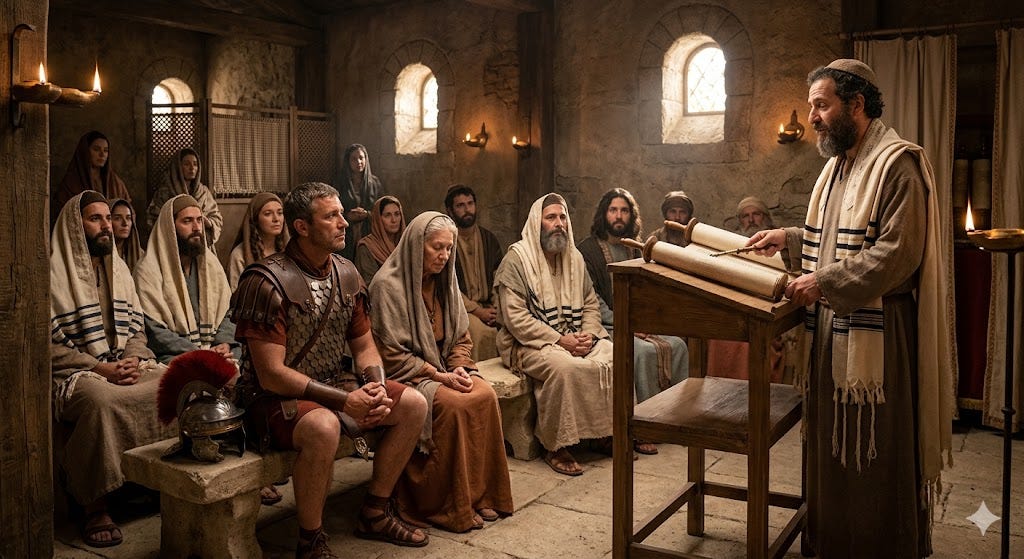
The synagogue was everywhere. Archaeologists have identified first-century synagogues in Galilee (Magdala, Gamla, Capernaum), in Judea (Masada, Herodium), and throughout the Diaspora (Delos, Ostia, and later all over the Roman Empire).2 There were, according to one rabbinic tradition, over four hundred synagogues in Jerusalem alone. Synagogues were not sacrificial. They had no altar. They had no priesthood in the Temple sense - instead, they were led by a “ruler of the synagogue” (archisynagogos) and an attendant (chazzan / huperetes) who managed the scrolls, and the adult male members of the community took turns reading and teaching. The center of the synagogue was not an altar but a reading stand, on which the Torah scroll was placed.
Two institutions. One people. Working together.
The Temple was the place of sacrifice - where sin was atoned for, where priests served, where the continual offerings kept the pattern of Israel’s covenant relationship with God unbroken. The synagogue was the place of Scripture - where the Word of God was read, where the community gathered to hear the Law and the Prophets, where teaching and prayer and the recitation of the faith happened every Sabbath.
And here is the thing almost no one tells Christians: both of these institutions made it into the Christian Church.
The Temple, as I showed you last time, is the root of Christian sacred architecture. Every Orthodox church is a structural descendant of the Jerusalem Temple: three zones, an altar for the Eucharistic sacrifice, a veil, a priesthood, the whole inheritance.
The synagogue is the root of the Christian liturgy of the Word. The first half of every Divine Liturgy - the readings, the Psalter, the intercessory prayers, the homily - is structurally the synagogue service. The Temple filled the building; the synagogue filled the service inside the building. Both, together, fulfilled in Christ.
This is also, incidentally, why the destruction of the Temple in 70 AD did not entirely destroy Judaism or Christianity. Judaism survived because it had already developed the synagogue as a complementary institution centered on the Word, and after 70 AD the synagogue became the primary vehicle for Jewish worship. Christianity survived because it had already absorbed both institutional patterns - the Word-centered synagogue and the sacrificial Temple - and had fulfilled the sacrificial function in Christ’s one offering, made present in the Eucharist. When the Temple fell, the Church had already become the Temple.
But that is getting ahead of ourselves. Let’s back up. What exactly happened in that synagogue service that Jesus attended every Sabbath?
What Did a First-Century Synagogue Service Actually Look Like?
I have to be careful here because the scholarly answer is “we know a lot, but not everything, and scholars disagree about some of the details.”
Our most detailed descriptions of synagogue liturgy come from the Mishnah (compiled around 200 AD) and the two Talmuds (compiled between roughly 400 and 500 AD). These rabbinic sources describe a highly developed liturgical system - fixed prayers, fixed numbers of benedictions, fixed reading cycles. But they were written 150 to 500 years after Christ. And in that gap, after the Temple was destroyed in 70 AD, Jewish worship was significantly reorganized. The rabbis standardized and formalized things that we assume had been more fluid in the first century. So when we read the Mishnah’s account of synagogue prayers, we are looking at a snapshot taken well after the service Jesus attended.
Scholars have had to triangulate. They work backwards from the Mishnah, comparing it with the New Testament’s own fragmentary glimpses, with pre-70 AD inscriptions and archaeological remains (the Theodotos inscription, the Magdala stone, the Gamla synagogue floor), with the Dead Sea Scrolls, and with references in Philo and Josephus. And in the last twenty or thirty years, archaeological discoveries have shifted the consensus considerably - the Magdala synagogue was excavated in 2009, and it has changed the picture of what first-century synagogues looked like.3
So I am going to tell you what the scholarly consensus says about the core structure, and I am going to do my best to flag honestly where the details remain uncertain. This is a case where being precise about what we know and what we don’t know is stronger than pretending to more certainty than we have.4
Here is what we can say with generally high confidence. The first-century synagogue service on a Sabbath morning had, at minimum, these elements:
The Shema. The central confession of Jewish monotheism, drawn from Deuteronomy 6:4-9, Deuteronomy 11:13-21, and Numbers 15:37-41. “Hear, O Israel: the Lord our God is one Lord.” This was recited by the community twice daily, morning and evening, and was the foundational statement of faith that defined Israel as Israel. By Jesus’s time it was already ancient. Every observant Jew said it. Jesus Himself quoted the Shema when asked what the greatest commandment was (Mark 12:29-30).
The Tefilah (also called the Amidah). Tefilah literally means “prayer,” and in this context means The Prayer - the central liturgical prayer of the synagogue service. By the later rabbinic period it would become fixed at eighteen benedictions (and is therefore also called the Shemoneh Esreh, “Eighteen”), but in Jesus’s time it is thought that the form was still fluid - scholars estimate it had roughly twelve to fourteen benedictions in the first century, and the exact wording was not yet standardized.5 What was fixed was the structure: a pattern of praise, petition, and thanksgiving, recited standing (amidah means “standing”), facing Jerusalem.
The readings from the Law and the Prophets. This was the heart of the synagogue service, and it is the part best attested in our sources. The Torah was read aloud in the community every Sabbath, cycling through the entire Pentateuch over a set period. The exact cycle in the first century is debated. Some scholars think it was a triennial cycle (three and a half years.) Others think it was already annual in some communities - but the practice of reading straight through the Torah, week by week, Sabbath by Sabbath, is firmly established. After the Torah reading came a reading from the Prophets (the Haftarah). This is what Jesus is doing in Luke 4. He stands up to read from Isaiah, which was the Prophets reading, after (we can infer from the structure of the service) the Torah reading had already happened.
A seat for teaching. After the readings, someone - usually a visitor invited by the ruler of the synagogue, or a respected member of the community - would sit down and offer a word of exhortation, teaching, or interpretation of what had just been read. This is exactly what Jesus does in Luke 4:20-21: He finishes reading, rolls up the scroll, hands it back to the attendant, sits down, and every eye in the synagogue is fixed on Him, waiting to hear what He will say. The posture was the signal. Readers stood. Teachers sat.
The Kedushah. This is the piece that will matter most for Article 5, so pay attention now. The Kedushah (Hebrew for “holiness” or “sanctification”) is a liturgical response drawn directly from the prophet Isaiah’s vision in Isaiah 6:3, where he sees the seraphim around the throne of God singing “Holy, holy, holy is the Lord of hosts; the whole earth is full of his glory.” By the Second Temple period, this seraphic song had been incorporated into synagogue worship as a congregational response - the people standing and joining the angels’ praise. The exact form of the Kedushah that we know from later Jewish liturgy developed over time, but the practice of liturgically joining the Isaiah 6 hymn is attested in Second Temple Jewish sources.6 Hold that thought. We will come back to it in Article 5 with some force.
The psalmody. The Psalms were Israel’s hymnbook. They were sung in the Temple by choirs of Levites. They were chanted and sung in the synagogue as part of the liturgical rhythm of the service. When Jesus and His disciples ended the Last Supper by singing “a hymn” before going out to the Mount of Olives (Matthew 26:30), they were almost certainly singing the Hallel psalms (Psalms 113-118), which was the established Jewish practice at Passover. The Psalter was the prayer book of ancient Judaism, and it was woven into every liturgical gathering.
Prayers for the community, the ruler, and the wider world. Synagogue prayer included intercessions for the people, for rulers, for the sick, for travelers, for the restoration of Israel. The specific forms varied, but the practice of corporate intercessory prayer was standard.
A blessing or dismissal. The service ended, as it began, with a blessing. The priestly blessing from Numbers 6:24-26 - “The Lord bless you and keep you; the Lord make His face shine upon you” - was ancient and widely used.
That is the core structure. Scripture readings, chanted Psalms, the Shema and the Tefilah, standing prayer, the Kedushah, a homily on the text, intercessions, a blessing.
Now watch this.
The Luke 4 Moment
I want to zoom in on the single best documented example of a first-century synagogue service in existence, because it is preserved in the New Testament and it shows you exactly what I am talking about.
Luke 4:16-21. (Go read it yourself: here.)
Let me walk you through it sentence by sentence, because every detail is evidence.
“And He came to Nazareth, where He had been brought up: and, as His custom was, He went into the synagogue on the Sabbath day.”
Two things already. First: “as His custom was.” This was His pattern. This was every Sabbath. Christ did not drop into synagogue that day on a whim - He went because He always went. Second: the synagogue. Not the Temple. Not a field meeting. Not an impromptu revival. The established weekly gathering of the local Jewish community in its dedicated worship space.
“And He stood up to read.”
He stood up. The posture is the signal. Readers stood in the synagogue. That detail tells you which part of the service we are in - we are in the Scripture reading portion, after the initial prayers, after the Shema, after the Tefilah. The service has been going for a while. We have arrived at the readings.
“And there was delivered unto Him the book of the prophet Esaias.”
The scroll of Isaiah. Delivered by the attendant - the chazzan - whose specific job was to manage the scrolls and hand them to the readers. This is a formal, choreographed moment. Someone is playing the role of scroll-bearer. Someone is playing the role of reader. Everyone knows what is happening.
The fact that Jesus is reading from Isaiah rather than the Torah tells us this is the Haftarah - the reading from the Prophets - which in the established pattern came after the Torah reading. The Torah reading has already happened. We are now in the prophetic portion of the Scripture cycle.7
“And when He had opened the book, He found the place where it was written, The Spirit of the Lord is upon me...”
He unrolls the scroll. He “finds the place.” Whether this was a pre-assigned reading for that particular Sabbath or whether Jesus chose His own passage is debated, but either way, He knew the scroll well enough to navigate it. This is not a novice improvising. This is a Jew who has been attending synagogue His whole life, who knows the scroll layout, who knows the reading cycle.
“And He closed the book, and He gave it again to the minister, and sat down.”
He finishes reading. He hands the scroll back to the attendant. And then He sits down, because, as I said a moment ago, readers stood and teachers sat. The posture signals the transition from reading to teaching.
“And the eyes of all them that were in the synagogue were fastened on Him.”
Everyone knows what is coming. They know the structure of the service. They know that after the reading comes the teaching. They are waiting for the sermon.
“And He began to say unto them, This day is this scripture fulfilled in your ears.”
The shortest sermon in history. And also the most scandalous. But look at the form of the moment, the liturgical choreography of it. Jesus has just performed the functions of the synagogue service exactly as any Jewish man of His time would have performed them. Reading standing. Handing back the scroll. Sitting to teach. Speaking to a congregation that knew exactly what to expect because this was exactly what happened every Sabbath in every synagogue in the Jewish world.
This is one of the best-documented first-century synagogue services we have.
And it is, structurally, the first half of the Orthodox Divine Liturgy.
Let me show you.
The Liturgy of the Word
If you walk into an Orthodox parish this Sunday, the service you will attend is called the Divine Liturgy. And it has two halves.
The first half is historically called the Liturgy of the Catechumens - because, as we will see in a moment, it was the portion of the service that catechumens (people preparing for baptism but not yet baptized) were permitted to attend. In modern usage it is also called the Liturgy of the Word, because its center of gravity is the reading and proclamation of Scripture.
The second half is called the Liturgy of the Faithful - because only the baptized, the communing members of the Body of Christ, were permitted to attend. Its center of gravity is the anaphora, the great Eucharistic Prayer we will examine in Article 5.
The first half - the Liturgy of the Catechumens - is what I want to walk through now. Because every element of it is an inheritance. Every element came from somewhere. And that somewhere is the synagogue.
The Opening Doxology. The Liturgy begins with the priest blessing the Kingdom of the Father, the Son, and the Holy Spirit. A blessing at the beginning. Just as the synagogue service began with a blessing. The priest will say “Blessed is the Kingdom of the Father, the Son, and the Holy Spirit. Now and ever and unto the ages of ages.” This is the clue that the Divine Liturgy has begun, it also signifies that this is a “Kingdom” event. i.e. an event taking place in the Kingdom of God.
The Great Litany. A long series of intercessory petitions, sung by the deacon and answered by the congregation with “Lord, have mercy.”
“For the peace from above and for the salvation of our souls, let us pray to the Lord.
For the peace of the whole world... For this holy house and for those who enter it with faith...
For travelers by land, sea, and air, for the sick and the suffering, for captives...”
The specific wording is Christian, but the form - corporate intercessory prayer, led by an appointed minister, with the congregation responding - is directly inherited from synagogue intercessory practice.
The Antiphons. Three sets of sung Psalm verses, interspersed with short hymns and responses. The Psalter is woven into the service as liturgical prayer. This is exactly what was happening in the synagogue. The Psalms were not decoration. They were the Church’s prayer book and hymn book, inherited from Israel, prayed by Christ Himself, and prayed by the Orthodox Church every Sunday morning. Those newly attending an Orthodox church may at first look for a separate hymnal. They won’t find one, because Christians have it embedded in the bible.
The Little Entrance. The deacon (or priest) takes the Gospel book off the altar, processes with it through the Royal Doors, around the church, and up to the altar again. The congregation stands. The priest declares: “Wisdom! Let us attend!” The Gospel book - Christ in the Scriptures - is being carried in procession to the reading stand.
If that sounds familiar, it should. In the synagogue, the Torah scroll was brought out from the ark where it was stored, carried in procession through the congregation, and placed on the reading stand. The entrance of the sacred text into the midst of the assembly. The pattern is the same. The text has changed from Torah to Gospel, but the movement - the procession, the reverence, the liturgical unveiling of the Word of God to the assembled community - is the synagogue pattern fulfilled.
The Trisagion. “Holy God, Holy Mighty, Holy Immortal, have mercy on us.” Sung three times, then with a doxology. This particular hymn, in this particular form, is a later Christian development. Tradition attributes it to a vision during an earthquake in Constantinople in the fifth century.8 But the instinct it expresses - the threefold “Holy, Holy, Holy” joining the Seraphim of Isaiah 6 - is drawn from the same Kedushah tradition that shaped first-century synagogue worship. The Isaiah 6 song runs through the whole bloodstream of Jewish and Christian liturgy. We will meet it again, in its most undiluted form, in the anaphora.
The Epistle Reading. A deacon or reader chants a passage from the New Testament epistles - Paul, Peter, John, James, Hebrews, Jude. This is read standing. The reader stands. The congregation stands.
The Alleluia and the Gospel Reading. After the Epistle, the congregation sings “Alleluia” (from the Hebrew hallelu-Yah, “praise the Lord”) while the Gospel book is prepared. The priest or deacon then reads the Gospel aloud, standing, at the ambo (the raised reading platform in front of the Royal Doors).
Let’s stop and take a pause.
What just happened?
A reader stood to read from the writings (the Epistles). Another reader stood to read from the Gospels. Both readings chanted or proclaimed aloud to the assembled community, standing in reverence. The Word of God, read in its fullness, week by week, Sunday by Sunday.
This is structurally identical to what was happening in Luke 4. In the synagogue, a reader stood to read from the Torah. Another stood to read from the Prophets. Both readings chanted to the assembled community. The Word of God, read in its fullness, week by week, Sabbath by Sabbath.
The Christian Church, from its earliest days, replaced “Torah and Prophets” with “Epistles and Gospels” - while preserving the exact liturgical structure that had carried the Torah and Prophets in the synagogue. Two readings. Standing posture. Chanted or solemnly proclaimed. Followed by a teaching.
The Homily. After the Gospel is read, the bishop or priest stands (or, more commonly in Orthodox practice, if it is the Bishop, he sits in the bishop’s chair as a representative of the apostles and Christ, if it is a priest, he stands) and delivers a homily on the readings, exhorting the people to live out what they have heard.
Jesus, in Luke 4, did exactly this. He finished reading from Isaiah, handed the scroll back, sat down, and taught. “This day is this scripture fulfilled in your ears.”
The posture of teaching. The exegetical application of the Scripture just read. The authoritative word spoken to the assembled community.
Same service. Two thousand years later. Fulfilled in Christ.
The Litany of Fervent Supplication and the Prayers for the Catechumens. After the homily, the deacon leads the congregation in further intercessory prayers - for the Church, for the bishops, for the civil authorities, for the sick, for travelers, for the departed. Then a specific set of prayers is offered for the catechumens - those preparing for baptism.
And this is where the Liturgy of the Catechumens reaches its structural hinge.
The Shift at the Dismissal
At the end of the prayers for the catechumens, the deacon cries out:
“Catechumens, depart! Catechumens, depart! All catechumens, depart! Let none of the catechumens remain!”
And then the famous ancient command:
“The doors! The doors!”
In the early Church, this was literal. Catechumens were physically dismissed from the service at this point. The doors of the church were closed. Only the baptized faithful remained. What was about to begin, the Liturgy of the Faithful, the Eucharistic offering, was for the baptized only. I have been told that in ancient times, sometimes you did not know if a catechumen was a Roman spy, so for the most sacred part of the service, they were dismissed.
In modern practice, catechumens are not always physically dismissed (though in some traditions they still are), but the deacon still cries out the ancient words. The structural moment is preserved, even where the physical practice has softened.
And this is the exact moment - the exact moment - when the first half of the Divine Liturgy ends and the second half begins.
It is also, not coincidentally, the exact moment when the synagogue service ends and the uniquely Christian part of the Liturgy begins.
Here is what I want you to take away. The first half of the Divine Liturgy - the Liturgy of the Catechumens - is the synagogue service fulfilled in Christ. The readings, the Psalmody, the intercessions, the homily. It is structurally open to anyone who comes to hear the Word of God, just as the synagogue was structurally open to God-fearers9 and interested Gentiles in the first century (Acts 13 records Paul preaching in synagogues to mixed audiences of Jews and “devout Gentiles” - likely God-fearers). The Liturgy of the Word is, in a real sense, a Jewish inheritance of Christian worship - the part of the service that the Apostles knew how to do before they ever met the risen Christ, because they had been doing it their whole lives.
The second half, the Liturgy of the Faithful, is something else. It does not have a direct synagogue parallel, because the synagogue was not sacrificial. But it has an even deeper root. The Liturgy of the Faithful is the fulfillment of Temple worship in Christ.
Remember what we established in Article 2. The Orthodox church building is architecturally the Jerusalem Temple fulfilled. Three zones. A veil. A sanctuary behind the veil. A priesthood. Vestments. Incense. Every element of Temple architecture, preserved and transfigured in the physical space of the Orthodox parish. That whole architectural claim from Article 2 would be meaningless - would be theatrical set dressing - if the worship performed inside that architecture were not itself sacrificial Temple worship fulfilled. The Holy of Holies exists because a sacrifice is offered there. The veil opens because the High Priest has passed through. The altar is the altar because the offering happens on it.
The Liturgy of the Faithful is what happens behind the iconostasis, at the altar, by the priesthood, in the fulfilled Holy of Holies. It is the Eucharist, the one sacrifice of Christ re-presented (not re-performed, re-presented) in every Liturgy, everywhere, among all nations. The Fathers read this as the fulfillment of Malachi’s prophecy: ”From the rising of the sun even to its setting, my name shall be great among the nations, and in every place incense shall be offered to my name, and a pure offering” Malachi 1:11. Not in Jerusalem only. Everywhere. Not among Israel only. Among the nations. A pure offering, made in every place, until the end of the age.
That is the Liturgy of the Faithful. And it is the second Jewish root of the Divine Liturgy, not the synagogue root, but the Temple root, fulfilled in the one sacrifice of Christ and extended across the world in the apostolic succession.
We will walk through the Anaphora itself in Article 5, piece by piece, and I will show you exactly how the Temple fulfillment is performed in the words, the gestures, and the architecture of the prayer. For now, the point to hold is this: the Divine Liturgy has two Jewish roots, not one. Synagogue on the one side. Temple on the other. The first half of the service inherits Israel’s weekly gathering for the Word. The second half fulfills Israel’s sacrificial offering in the Body and Blood of the risen Christ.
Put those two halves together, and what do you get?
Synagogue plus Temple, both fulfilled in Christ.
The Jewish inheritance of the Word, and the Jewish inheritance of the Altar. The ancient weekly service the Apostles had attended all their lives, joined to the ancient sacrificial offering they had all witnessed in Jerusalem, now fulfilled in the one sacrifice of Christ given them the night before He died. Both preserved. Both transfigured. Both still being prayed, every Sunday, in every Orthodox parish on earth.
That is the Divine Liturgy.
What the Earliest Christians Actually Did
Now here is where it gets really interesting, because we can actually watch this happen in the New Testament itself.
In the book of Acts, the earliest Christians are doing exactly what I am describing. They go to the synagogue. They attend the Jewish service. And then, separately, they gather in homes “to break bread” - Luke’s technical phrase for the Eucharist (Acts 2:46, Acts 20:7).
Two gatherings. The synagogue service, and the Eucharistic meal. Eventually, these two gatherings merged into a single Christian service, which is exactly the shape we have been walking through. The synagogue half (Liturgy of the Catechumens / Liturgy of the Word) became the first half of the Christian service. The Eucharistic half (Liturgy of the Faithful) became the second.
Initially, Jewish Christians attended synagogue on the sabbath and then met separately on Sunday to celebrate the Eucharist (Sunday because it was the day of the Lord’s resurrection.) By AD 80-90, Jewish Christians were being progressively pushed out of synagogues due to social hostility brought about by institutional Jewish resistance, not by Christian choice. This is unsurprising as the Jewish institution I’m referencing here consisted of the the very pharisaic rabbis who rejected Christ and called for his crucifixion.10 An additional motivator was likely the Birkat haMinim - the "curse against the heretics and nazarenes - a term that included christians"11 - which was added to the daily synagogue liturgy. The addition of this curse is traditionally associated with the rabbinic academy at Yavneh (Jamnia) under Rabban Gamaliel II. As Christians were pushed out, there would have been gradual need and desire to add the old service Christians were now barred from into the independent Christian service already being held on Sunday.
How long did this take? When exactly did the two services fuse into one? The evidence is fragmentary, but we can say with confidence that by the time Justin Martyr writes his First Apology in 155 AD, the document I walked you through in Article 1 - the fusion is complete. Justin describes a single Sunday morning service with both halves: readings and homily followed by Eucharistic Prayer and communion. The synagogue half and the Eucharistic half are already one liturgy, celebrated together, in Rome, fifty-five years after the death of the last Apostle.
Which means this fusion happened very early. Very, very early. The Apostles themselves lived to see it.
And it has not changed since.
The Pattern in Your Parish
I want to end by making this practical.
If you have never been to an Orthodox Divine Liturgy, and I suspect most of my readers have not, go. Not to convert you on the spot (though hey, I wouldn’t complain.) Go to see the pattern. Go to hear what I have been describing, with your own ears, in the flesh. Go and see if you don’t feel transported by something ancient, and even a little foreign.
You will hear intercessory prayers that are structurally the same prayers the synagogue prayed before the Temple fell. You will hear Psalms chanted as they were chanted in the Second Temple. You will watch a book of Scripture processed into the midst of the congregation as the Torah was processed in Magdala, Nazareth, and Pisidian Antioch. You will hear two readings stood for and chanted, one from the epistles and one from the Gospels, structurally identical to the Torah-and-Prophets pattern Jesus participated in on that Sabbath in Nazareth. You will hear a homily given from the place of teaching, following the Scripture readings, exhorting the hearers to live what they have just heard.
And then you will hear the deacon cry out, “The doors! The doors!” and you will be standing at the exact liturgical seam where the Jewish inheritance hands off to the apostolic Eucharist.
This is not a Byzantine innovation or a medieval development. This is not a quaint cultural holdover from the old country. This is the worship pattern Christ Himself attended every Sabbath of His earthly life, joined to the Eucharist He instituted the night before He died, preserved and taught by His Apostles, and handed on in unbroken succession to a parish down the street from you.
Lex orandi, lex credendi. The law of prayer is the law of belief.
The Apostles prayed this way because they believed this. Their disciples prayed this way because they believed this. Every generation of Orthodox Christians since has prayed this way because they believed this.
And if it matters what the first Christians believed, then it matters what the first Christians prayed.
And it is still being prayed.
Next week, we go deeper into the documents. Justin Martyr is not the earliest source we have for Christian worship - he is only the earliest pagan-facing source. There is an even older document, called the Didache, that some scholars date as early as the middle of the first century - which would make it older than parts of the New Testament itself. The Didache gives us a Eucharistic Prayer that is stunningly close to what Orthodox Christians still pray at every Divine Liturgy. We will read it together, side by side with the prayers used today, and you will see the fingerprints of the Apostles on both.
If you want to read that article when it drops, become a paid subscriber now. The series only works as a whole. The Apostles were there first. It is time we caught up.
Primary Sources
Every claim in this article can be verified against the documents themselves. Don’t take my word for any of it. Go read them.
Luke 4:16-30 - The best-documented first-century synagogue service in existence, preserved in the Gospel of Luke. Read it here.
Acts 13:13-52 - Paul’s experience of synagogue worship at Pisidian Antioch. Note especially verses 14-15, which describe “the reading of the Law and the Prophets” followed by an invitation to a “word of exhortation.” Read it here.
Acts 15:21 - James’s reference to the universal weekly reading of Moses in the synagogues of every city. Read it here.
Acts 3:1 - Peter and John observing the hour of the afternoon prayer (the ninth hour) at the Temple. Read it here.
Isaiah 6:1-8 - The seraphim’s “Holy, Holy, Holy” hymn that became the liturgical Kedushah in Jewish worship and the Sanctus in Christian worship. Read it here.
Justin Martyr, First Apology, chapters 65-67 (c. 155 AD) - The earliest extended Christian description of a combined Word-and-Eucharist Sunday service, showing the fusion of synagogue liturgy and apostolic Eucharist was already complete by the mid-second century. Read it here.
The Mishnah, Tractate Megillah and Tractate Berakhot - The earliest rabbinic descriptions of synagogue liturgy. Compiled around 200 AD, these tractates describe a more developed form of synagogue worship than existed in the first century, but they retain elements clearly rooted in earlier practice. English translations available in Jacob Neusner’s The Mishnah: A New Translation (Yale University Press) and in various online editions.
Philo of Alexandria, On the Contemplative Life and Embassy to Gaius - First-century Jewish witness to synagogue worship from the Diaspora. Available in the Loeb Classical Library and online at Early Jewish Writings.
Josephus, Against Apion 2.17 and Antiquities of the Jews 16.43 - First-century Jewish witness to the universal weekly practice of Scripture reading in synagogues. Available online at Sacred Texts.
A general resource for the curious: For readers who want to go deeper into the scholarly reconstruction of first-century synagogue worship, the archaeological excavation reports on the Magdala synagogue (2009) and the Gamla synagogue have significantly shaped the current consensus. The standard academic reference is Lee I. Levine’s The Ancient Synagogue: The First Thousand Years (Yale University Press, 2nd edition, 2005), which remains the gold standard. Also valuable is Anders Runesson, Donald Binder, and Birger Olsson’s The Ancient Synagogue from Its Origins to 200 CE: A Source Book (Brill, 2008), which collects the primary sources.
I want to be careful about the “reading cycle” claim because the evidence is fragmentary. What we know for sure for that time period is that the Torah was read in the synagogue each Sabbath, that the readings proceeded through the text in order over a fixed cycle, and that the Prophets reading (Haftarah) was paired with the Torah portion. Whether the cycle in Jesus’s time was triennial (about three and a half years) or annual, and whether Jesus’s Isaiah reading in Luke 4 was a pre-assigned Haftarah or a free selection, remain scholarly debates. The point is not settled. But the pattern of Torah-plus-Haftarah is firmly established.
The archaeological picture has been transformed in the last twenty-five years. The Magdala synagogue, excavated beginning in 2009, is a pre-70 AD synagogue with a stone reading stand carved with Temple imagery - it’s one of the most important first-century archaeological finds in Galilee, and it establishes beyond serious dispute that dedicated synagogue buildings existed in first-century Galilee. Older generations of scholars had speculated that “synagogue” in the first century might have meant just a gathering rather than a dedicated building; the archaeology has put that speculation to rest.
The Theodotos inscription is a Greek inscription discovered in Jerusalem in 1913, dating to some time before 70 AD. It was placed by a man named Theodotos, son of Vettenus, who describes himself as the builder of a synagogue “for the reading of the Law and the study of the commandments.” The inscription is one of the most important pieces of pre-70 AD archaeological evidence for first-century synagogue function.
This is a general principle I want my readers to understand and trust me on. When the evidence is uncertain, I will tell you it is uncertain. When scholars disagree, I will tell you they disagree. The argument of this whole series does not depend on forcing the evidence to say more than it says. It depends on what the evidence actually says being sufficient - which, as you will see, it is. Honesty about the limits of our knowledge is a strength, not a weakness, in an apologetic argument. Anyone who tells you that we know exactly what first-century synagogue liturgy looked like down to the wording is overselling. I am not going to oversell.
The dating of the Amidah’s development is contentious. What is certain: by the end of the first century AD, the number of benedictions had been fixed at eighteen (later expanded to nineteen with the addition of the Birkat haMinim, the “blessing against the heretics,” which was effectively a curse and which was aimed in part at Jewish Christians around 85-90 AD). What is less certain: exactly when the eighteen was fixed, and how fluid the wording was before that. Most scholars estimate twelve to fourteen benedictions in the mid-first century, with thematic stability but verbal fluidity. Paul Bradshaw’s The Search for the Origins of Christian Worship (Oxford, 2nd ed. 2002) is a careful treatment.
The Kedushah has three liturgical forms in Jewish tradition - the Kedushah recited during the repetition of the Amidah, the Kedushah d’Yotzer recited in the morning before the Shema, and the Kedushah d’Sidra recited at the end of the morning service. The developed forms of all three belong to the later rabbinic period, not the first century. But the practice of liturgically joining the angelic “Holy, holy, holy” of Isaiah 6 is attested in Second Temple Jewish sources, including the Dead Sea Scrolls (the Songs of the Sabbath Sacrifice from Qumran include extensive use of the seraphic hymn as a liturgical response). So the core practice - congregational participation in the angelic Kedushah - is pre-Christian. The specific wording of modern Kedushah is post-Christian. Again, we will come back to this in Article 5 with more force.
The ordering of Torah reading before Haftarah reading is attested in Mishnah Megillah 4:1-4, which, while compiled around 200 AD, clearly describes an established practice. The New Testament itself confirms the order implicitly: in Acts 13:15, after Paul and his companions enter the synagogue, it is “after the reading of the Law and the Prophets” that they are invited to speak. Law first, Prophets after. This is the pattern Jesus is participating in at Luke 4.
Yes, I know I am downplaying a hymn that Orthodox Christians have sung for fifteen hundred years, and that matters to me too. But honesty requires me to say clearly: the specific three-fold “Holy God, Holy Mighty, Holy Immortal” form of the Trisagion has a fifth-century Christian origin, not a first-century Jewish one. The instinct behind it - joining the angelic thrice-holy of Isaiah 6 - is much older. But the specific hymn is not a synagogue inheritance. The true synagogue inheritance of the Kedushah shows up in the Anaphora, as the Sanctus, which we will meet in Article 5.
God-fearers (Greek: phoboumenoi ton Theon or sebomenoi) were a specific group of Gentiles (non-Jews) who were deeply attracted to Judaism and the God of Israel but stopped short of becoming full converts. They abandoned pagan polytheism to worship the one God of Israel. They generally followed the moral and ethical laws of Judaism such as the prohibitions against idolatry, murder, and theft. They attended weekly synagogue services to hear the reading of the Torah and the Prophets. The primary barrier to full conversion for men was the requirement of circumcision. They also did not necessarily commit to all the ritual dietary laws (kosher) or the full ceremonial purity code.
And if you know your history, you know that current modern day Judaism is the religion of the pharisees. They are the ones who survived and reformulated Jewish worship after the fall of the temple in 70AD.
It went somewhat like this before it was censored in later versions: "For the apostates let there be no hope, and may the arrogant kingdom be swiftly uprooted in our days. Let the Nazarenes and the heretics perish in a moment, be blotted out of the book of life, and not be inscribed with the righteous."