

The Service that Remembers
A Walking Tour of a Single Sunday Morning, From the First Prayer to the Last, Naming the Pedigree of Every Movement

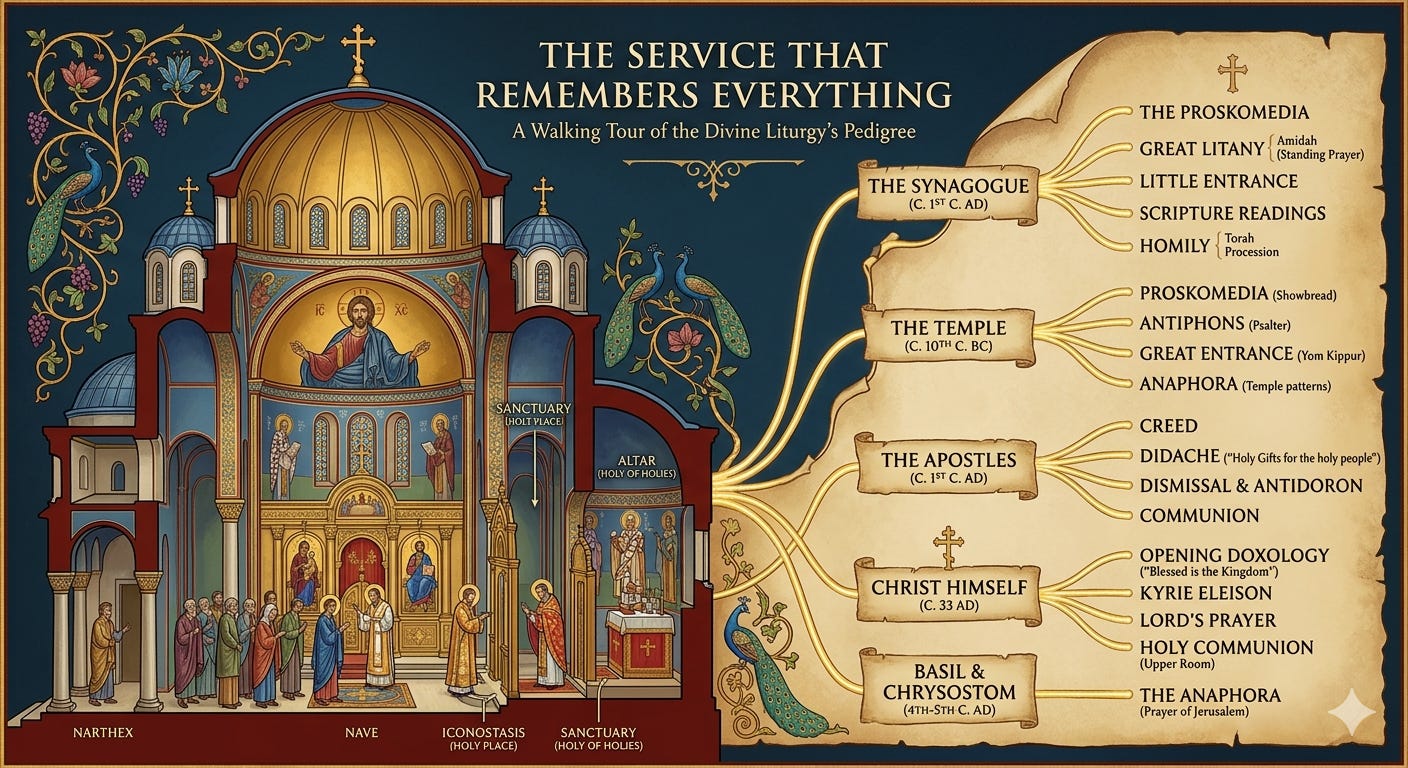
We’re going to walk through the current liturgy of St. John Chrysostom. This is a really big and important topic. I pray that I get this right. All errors here are mine and due to my particular human fallibility.
Picture this… (without the Mull River shuffle joke this time)
It’s Sunday morning. You are standing in an Orthodox parish somewhere in the world. It could be Denver, Austin, Toronto, Thessaloniki, Tripoli, or Addis Ababa. Could be a temporary space (maybe for a mission church) or a permanent domed cathedral (for an established parish). The specifics don’t matter.
You are standing with the general body of the faithful. Maybe it’s your first time attending a liturgy; maybe you are cradle Orthodox and already have it memorized. As you look around, you see that the priest is vested. There is a deacon at his side, also vested. The acolytes (adult male altar servers in plain black cassocks) and altar boys (younger boys wearing sticharion) are holding candles. The choir has begun to sing something in a mode that sounds like it’s from mythic history. The air smells like beeswax and incense.
I am going to attempt to walk through the entire service with you. From the first words to the last. And at every movement, I am going to try to stop and name the pedigree, and if I can explain a little bit. i.e.
This part is from the synagogue. This part is from the Temple. This part is from the Apostles. This part is from the Didache. This part is from Basil. This part is from Chrysostom. This part is from the Apostolic Constitutions. This part is from St. Cyril of Jerusalem. This part is from Isaiah. This part is from Christ Himself.
Six articles have led to this one. Six articles of patient documentary work - Justin Martyr in 155 AD, the Temple in your parish, the synagogue that became a church, the Didache that shouldn’t exist, the Anaphora and its eleven movements, the bishops through whom the liturgy came down.
Now we put it all together.
Now let’s start our walk with Christ and his Apostles as we engage in authentic traditional Christian worship.
Before the Beginning: The Proskomedia
The Divine Liturgy does not begin when you think it begins.
45 minutes before the priest opens the Royal Doors and you hear “Blessed is the Kingdom,” there is a quiet service happening in the sanctuary that most parishioners never see. It is called the Proskomedia - the service of preparation.1 The priest stands at a small table to the left of the altar called the Prothesis (the “setting forth” table). He has before him the loaves of prosphora - the offering bread, stamped with a specific seal, made and brought to the church by the faithful. And with a small liturgical spear2, he begins to cut. (The number of prosphora used depends on the tradition. In the Greek tradition, which I’m a part of, we typically use as many as we believe are needed based on the size of the congregation. My parish is large, and so it is not uncommon for us to use 9-10. (For the blessing of the Loaves for feast days, there are always 5- but it’s a different recipe. For very large congregations they may use multiples of five.)
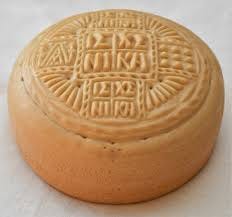
He cuts the central square out of the first loaf - the part that is stamped. This square has a name: it is called the Lamb. The priest intones as he cuts: “He was led as a sheep to the slaughter; and as a lamb without blemish, so opened He not His mouth.” Direct quotation from Isaiah 53:7 - the prophecy of the Suffering Servant, seven centuries before Christ.
The priest pierces the right side of the Lamb with the spear, reading the words of the Evangelist John describing the spear thrust at Calvary (John 19:34). He pours wine and water into the chalice, the same wine and water that flowed from Christ’s side. From the remaining four loaves, or the remaining portion of the large loaf from which the lamb was cut, he cuts small particles in honor of the Theotokos, the ranks of the saints, the living faithful of the parish, and the departed. Each particle is placed on the diskos - the paten - around the Lamb, in a specific arrangement that visually depicts the entire Church gathered around Christ: Christ in the center, His Mother to His right, the saints ranked in order, the living below, the departed below them.
When the priest is finished, the diskos looks like a map of the Church - every member of the Body accounted for, every commemoration named, every Christian past and present gathered around the Lamb.
Where does this come from?
The Proskomedia as a formal service took its current shape between the eighth and fourteenth centuries. But the pattern is much older than that. It is older than Christianity itself. Because what is the priest doing at the Prothesis? He is preparing the offering. He is cutting the bread. He is arranging the elements before the sacrifice.
That is the Tabernacle pattern. Leviticus 24:5-9: twelve loaves of bread, fresh every Sabbath, set in order on the Table of the Presence, consecrated to the Lord. In Article 2 of this series, we walked through how every Orthodox church on earth preserves the three-zone Temple architecture - the Outer Court, the Narthex, the Nave where the faithful stand, the Holy of Holies (the sanctuary behind the iconostasis, which is the Temple veil,) opened rather than abolished in Christ. The Proskomedia happens in that architecture. The priest stands in the Holy of Holies, at the Prothesis table, preparing the offering that will soon be carried to the Altar. The Proskomedia is the New Covenant version of the showbread - but now the twelve loaves have become one Lamb, and the particles arranged around Him are no longer the twelve tribes but the whole Body of Christ: saints, faithful, departed, the Theotokos who bore Him, all gathered around the One who gathers them.
This part is from the Temple.
And the Lamb itself - cut with the spear, pierced in the side, spoken over with the words of Isaiah 53 - this is direct apostolic theology. The earliest Christians called the Eucharist “the Lamb that was slain from the foundation of the world” (Revelation 13:8). The Apostle John saw Him. The Apostle Paul preached Him - “For even Christ our passover is sacrificed for us” (1 Corinthians 5:7). The Proskomedia takes the apostolic theology of the Lamb and enacts it ritually before the Liturgy begins.
This part is from the Apostles.
The First Cry: Blessed Is the Kingdom
The priest situated in front of the Altar, behind the Royal Doors, blesses the Gospel Book on the altar, and cries out:
“Blessed is the kingdom of the Father and the Son and the Holy Spirit, now and ever and to the ages of ages.”
The people answer: “Amen.”
That opening acclamation is already doing theology. It’s declaring this Liturgy as an event in the Kingdom of Heaven. It’s a Kingdom event.
Every other major Eucharistic liturgy - Roman, Ambrosian, Coptic - begins with “In the name of the Father” or a similar Trinitarian formula. The Byzantine liturgy is different. It does not open with the name of God as an invocation. It opens with the Kingdom of God as a proclamation. The Liturgy is not about what we are doing for God this morning. The Liturgy is about the Kingdom that is already breaking in upon us, and our entry into it.3
Where does this come from?
From Christ Himself. The first words of His public preaching in Mark 1:15: “The time is fulfilled, and the Kingdom of God is at hand: repent ye, and believe the Gospel.” The Orthodox Liturgy begins by announcing the exact message Christ began with. We are entering the Kingdom.
This part is from Christ Himself.
And the congregational “Amen” that answers? That is the oldest liturgical response in Christianity. The word is Hebrew. It is what Jewish worshippers shouted at the end of every synagogue prayer in the first century. It is what Paul assumes the Corinthians are shouting at the end of their Eucharistic prayers around 55 AD (1 Corinthians 14:16). It is the word that has never been translated out of Christian liturgy, in any language, in any century, anywhere on earth. You say it. The Coptic monks in Egypt say it. The Syriac Christians in Kerala say it. The Russian Orthodox in Alaska say it. It is the same word.4
This part is from the synagogue.
The Great Litany
A deacon steps out through a door in the iconostasis, faces the people, and begins to chant a long sequence of petitions. It is called the Great Litany or, in Greek, the Megalḗ Ektenḗ. Each petition is answered by the choir with “Lord, have mercy” - in Greek, Kyrie eleison. The deacons in the liturgy fulfill the role of angelic messengers. In most iconostases there are two deacons’ doors, one with the icon of Gabriel and one with the icon of Michael. The deacons often come out the door of Gabriel, in the role of heavenly messengers moving between heaven and earth, and they enter back into the holy of holies through the door of Michael the Archangel, the protector of heaven.
Deacon: In peace let us pray to the Lord.
People: Lord, have mercy.
Deacon: For the peace from above and for the salvation of our souls, let us pray to the Lord.
People: Lord, have mercy.
Deacon: For the peace of the whole world, for the stability of the holy churches of God, and for the unity of all, let us pray to the Lord.
People: Lord, have mercy.
And it continues. For travelers. For the sick. For the prisoners. For favorable weather. For the abundance of the fruits of the earth. For deliverance from all affliction, wrath, danger, and necessity. Petition after petition. Prayers for the whole world are brought before the altar.
Where does this come from?
From the synagogue. The Great Litany is the Christian form of the ancient Jewish Amidah - the “standing prayer” of eighteen (later nineteen) blessings that structured every synagogue service in the first century.5 In Article 3 of this series, I walked you through the full synagogue service that Jesus attended every Sabbath of His earthly life - the Shema, the Amidah, the Kedushah, the Torah and Haftarah readings, the homily, the intercessions, the fixed order of chanted prayer. The first half of the Divine Liturgy is that service, baptized into Christ.
The Amidah was a sequence of petitions covering every dimension of communal and personal need: for understanding, for forgiveness, for healing, for rain in its season, for the regathering of Israel, for peace. Jesus prayed the Amidah. Peter prayed the Amidah. Paul prayed the Amidah. When they began to gather as Christians, they did not stop praying sequences of petitions like the Amidah - they baptized the pattern into Christ. The Great Litany of the Divine Liturgy is what the Amidah became once the Messiah the Amidah had prayed for had arrived.
This part is from the synagogue.
And the response - Kyrie eleison - is older than the Christian Liturgy. It appears in Psalm 123:3 and throughout the Psalter. It is what the Canaanite woman cried out to Jesus in Matthew 15:22. It is what the ten lepers cried in Luke 17:13. It is what Bartimaeus cried in Mark 10:47. It is the cry of every person in the Gospels who encountered Christ in the flesh. The Church has never stopped crying it.
This part is from Christ Himself.
The Three Antiphons
After the Great Litany, the choir begins to sing three sets of Psalm verses called the Antiphons. Each is separated from the next by a short litany and a prayer from the priest.
The First Antiphon traditionally uses verses from Psalm 103 (“Bless the Lord, O my soul”). The Second Antiphon uses verses from Psalm 146 (“Praise the Lord, O my soul”). The Third Antiphon, on Sundays and feast days, uses the Beatitudes from Matthew 5 (“Blessed are the poor in spirit, for theirs is the Kingdom of Heaven”).
Between the Second and Third Antiphons, the choir sings the hymn “Only-begotten Son and Logos of God” - a sixth-century composition traditionally attributed to the Emperor Justinian, which compresses the entire Christological doctrine of Chalcedon into six lines of poetry.6
Where do the Antiphons come from?
The Psalter has been the prayer book of the people of God for three thousand years. David composed some of the psalms. The Levitical choirs sang them in the Temple. The synagogues of the Diaspora chanted them every Sabbath. Christ Himself quoted them from the cross - “My God, my God, why hast Thou forsaken me” is Psalm 22. The Apostles prayed them. The monks of the Egyptian desert in the third and fourth centuries structured their entire daily life around chanting the whole Psalter every week.
When you hear the choir at an Orthodox parish begin “Bless the Lord, O my soul,” you are hearing words that David may have composed, that the Temple choirs certainly sang, that Christ knew by heart, that the Apostles prayed, that the desert Fathers chanted in their caves, and that have been sung in Christian liturgy without a Sunday off for nearly twenty centuries.
This part is from the Temple. And this part is from the synagogue. And this part is from Christ Himself.
The Little Entrance
After the Third Antiphon, something shifts. The priest and deacon bow before the altar. The deacon takes up the Gospel Book. They circle the altar and exit through the north door of the iconostasis in solemn procession, led by altar servers carrying candles. They pause in the middle of the nave. The deacon raises the Gospel Book high and cries:
“Wisdom. Arise.”
And the choir sings (on most Sundays):
“Come, let us worship and bow before Christ. Save us, O Son of God, risen from the dead, to You we sing: Alleluia.”
This is the Little Entrance. The Gospel Book processes into the sanctuary through the Royal Doors.7
Where does this come from?
From the synagogue. Every first-century synagogue service included a solemn procession of the Torah scroll - the reader would bring the scroll from the ark, process it through the assembly so that the people could see and touch it, and carry it up to the bimah to read. The Torah procession was the visible sign of God’s Word entering the midst of His people. It is still practiced in synagogues today, every Sabbath.
The Little Entrance of the Divine Liturgy is the Christian form of the Torah procession. But now the Word is not carried on a scroll of law. The Word is carried on a book of Gospel. Because the Word became flesh and dwelt among us, and we beheld His glory (John 1:14). The Torah procession has been fulfilled in the Gospel procession. The scroll has become a book. The book is Christ.
This part is from the synagogue.
The Trisagion
After the Little Entrance, the choir chants what is arguably the most ancient hymn of the Christian Liturgy still in continuous use:
Holy God, Holy Mighty, Holy Immortal, have mercy on us.
In Greek: Hágios ho Theós, Hágios Ischyrós, Hágios Athánatos, eléison hēmâs. This is the Trisagion - the “thrice-holy” - chanted three times, with a doxology, then once more.
Where does this come from?
From Isaiah. Specifically from Isaiah 6:3 - the vision of the prophet in the Temple in the year that King Uzziah died, where he heard the seraphim crying “Holy, holy, holy, is the Lord of hosts; the whole earth is full of His glory.” The Trisagion is the Christian expansion of Isaiah’s angelic cry.
The hymn itself entered formal liturgical use in Constantinople in the fifth century, but its roots are much older. The Jewish synagogue had a prayer called the Kedushah - the “sanctification” - based on the same Isaiah 6 passage. Jews were praying the Kedushah in the first century. Christ prayed it. The Apostles prayed it. When Christians began to compose their own worship, they kept the Kedushah pattern and expanded it. The Trisagion is one of its forms.8
A precision note worth landing here - because Article 5 of this series walked through the Anaphora and named the Epinikios Hymnos (the Triumphal Hymn, the one that begins “Holy, holy, holy, Lord Sabaoth”) - you might wonder whether this Trisagion is the same hymn. It is not. The Trisagion is a fifth-century Constantinopolitan hymn that inherits the Kedushah pattern. The Epinikios Hymnos is the Anaphora’s direct quotation of Isaiah 6, inherited through a different channel from the Jerusalem liturgical tradition. Two different hymns, both descended from the same synagogue Kedushah, both descended from the same prophet Isaiah, both sung in every Divine Liturgy. The same root. Different branches.
This part is from Isaiah. And this part is from the synagogue.
The Scripture Readings
After the Trisagion, the choir chants the Prokeimenon - a short Psalm refrain announcing the day’s theme. Then the reader proclaims the Epistle - a reading from the New Testament letters or the Acts of the Apostles. Then the choir sings the Alleluia. Then the deacon, standing in the center of the nave, proclaims the Gospel.
When the Gospel is announced, the people respond: “Glory to You, O Lord, glory to You.” And at its conclusion: “Glory to You, O Lord, glory to You.”
Where does this come from?
Straight from the synagogue.9 The first-century synagogue service had two readings: one from the Torah (the Law), and one from the Prophets (the Haftarah). The people stood for the Torah reading and sat for the Haftarah. The reader identified the source. The people responded with acclamations. There was a prescribed cycle of readings covering the Torah over the course of a year.
The Christian Liturgy preserved the pattern exactly. Two readings. Specific cycle. Standing for the Gospel (as the synagogue stood for the Torah) - because the Gospel is the Torah fulfilled in Christ. The acclamations at the beginning and end are the direct Christianization of the synagogue responses. If you attended a synagogue this Sabbath and an Orthodox parish on Sunday morning, you would recognize the pattern immediately. One service sat down for the prophets and stood for the Law. The other sits down for the Apostle and stands for the Gospel. The same movement, the same posture, the same purpose.
This part is from the synagogue.
And what does Jesus Himself do in Luke 4:16-21? He stands up in the Nazareth synagogue. He is handed the scroll of the prophet Isaiah. He opens it and reads: “The Spirit of the Lord is upon me, because He hath anointed me to preach the Gospel...” Then He sits down and delivers the homily. That is a synagogue service. That is also the structure of every Divine Liturgy’s Liturgy of the Word. You stand for the reading. You sit for the homily. You do what Christ did.
This part is from Christ Himself.
The Homily
After the Gospel, the priest (or the bishop, if he is presiding) delivers the Homily. A sermon explaining the readings, applying them to the life of the Church, exhorting the faithful to the Christian life.
Where does this come from?
The synagogue, again. The homily was the regular feature of every first-century synagogue service following the readings. This is what Jesus did in Luke 4. This is what Paul does in Acts 13:14-16 when he is invited to speak “after the reading of the Law and the Prophets.” This is what every traveling rabbi did when he was visiting a new synagogue. The custom of following Scripture readings with a homily of application is as old as rabbinic Judaism and has been unbroken in Christian worship from the first generation.
This matches exactly what Article 1 of this series showed you in Justin Martyr’s First Apology. Writing in 155 AD, Justin described the Christian Liturgy to a pagan emperor: “When the reader has finished, he who presides instructs and exhorts to the imitation of these good things.”10 Justin saw it. The pattern was already fixed. It is still fixed. Scripture first, homily second, in that order, every Sunday, in every Orthodox parish, the way Christ did it in Nazareth and the way Paul did it in Pisidian Antioch and the way Justin watched it happen in Rome.
This part is from the synagogue.
The Pivot: From Synagogue to Temple
At this point in the service, something shifts. We have completed the Liturgy of the Word - the synagogue-derived portion of the Divine Liturgy, structured around the proclamation of Scripture. The readings, the homily, the Trisagion, the Antiphons - all of this descends from the Sabbath morning worship that Jesus attended every week of His earthly life.
Now we cross into the Liturgy of the Faithful - the Temple-derived portion of the Liturgy, structured around the offering of sacrifice. 11
In the ancient Church, this was a literal threshold. Everyone who was not baptized had to leave before the Liturgy of the Faithful began. The deacon would call out, in some form: “Catechumens, depart!” and “The doors, the door, let us be attentive.” The doors would close. The mysteries were for the faithful only.
Most Orthodox parishes today still include the litanies and the prayers for the catechumens at this point in the service, though the formal dismissal is rarely enforced. But the theological shift is the same as it was in the second century. We are leaving the synagogue. We are entering the Temple. We are about to offer the sacrifice.
The Cherubic Hymn and the Great Entrance
The choir begins to sing a hymn that, in every Orthodox parish, marks one of the most sacred moments of the entire service:
Let us, who mystically represent the Cherubim and who sing the thrice-holy hymn to the life-creating Trinity, now lay aside every worldly care.
This is the Cherubic Hymn.12 While the choir is singing, the priest and deacon go to the Prothesis table where the bread and wine are waiting. The priest lifts the diskos (with the Lamb and all the particles of the saints and faithful). The deacon lifts the chalice. They process out through the north door of the iconostasis, through the nave of the church, past the faithful, and back through the Royal Doors to the altar.
This is the Great Entrance.
The gifts that were prepared at the Proskomedia forty-five minutes ago now come through the nave, past the people, into the sanctuary. The choir finishes the hymn:
So that we may receive the King of all, Who is invisibly escorted by the angelic hosts. Alleluia. Alleluia. Alleluia.
Where does this come from?
From the Temple. Specifically, from the Day of Atonement.13 On Yom Kippur, the High Priest would process the blood of the sacrifice from the outer altar (where the animal had been slain) into the Holy of Holies to sprinkle it on the Mercy Seat. The procession from the place of preparation to the place of offering - that is the Temple pattern.
Article 2 of this series walked through the three-zone Temple architecture preserved in every Orthodox church. Article 3 showed you that the Liturgy of the Word descends from the synagogue, while the Liturgy of the Faithful descends from the Temple. The Great Entrance is the moment where that movement into the Temple becomes unmistakable. The bread and wine that have been prepared at the Prothesis (the “outer altar” of the Liturgy) are now carried into the sanctuary (the “Holy of Holies” of the Liturgy) for the offering of the sacrifice. The priest functions in the role of the High Priest. The deacon is his assistant. The altar servers carrying candles are the Levites, while also representing the presence of the heavenly hosts. The faithful who bow as the gifts pass are the people of Israel watching the procession.
The difference is that the High Priest is no longer a son of Aaron. The High Priest is Christ, and the priest at the altar is acting in persona Christi - in the person of Christ, the true and eternal High Priest after the order of Melchizedek (read Hebrews 7 on that). And the blood is no longer the blood of bulls and goats. The blood is the Blood of Christ Himself, the pure offering prophesied by Malachi 1:11 - the prophecy that Article 4 showed you is already being applied to the Eucharist in the first-century Didache, before anyone had written the word “liturgy” in any language.
This part is from the Temple.
The Creed
After the Great Entrance, after the Kiss of Peace between the clergy, the congregation chants the Nicene-Constantinopolitan Creed.14 The whole Creed. Every article. From “I believe in one God, Father Almighty, Creator of heaven and earth” through the articles on the Son, the Spirit, the Church, the resurrection of the dead, and the life of the age to come.
Where does this come from?
From the First Ecumenical Council at Nicaea in 325 AD. It was expanded at the First Council of Constantinople in 381 AD. The Creed was composed to defend the apostolic faith against the Arian heresy, which denied the full divinity of Christ. It is the shortest, most precise articulation of Christian theology the Church has ever produced.
But the content of the Creed is not a fourth-century invention. Every clause of the Nicene Creed can be traced to prior Christian baptismal creeds, which can be traced to the apostolic tradition, which can be traced to the teaching of Christ Himself. The Creed is what Peter confessed at Caesarea Philippi (Matthew 16:16): “Thou art the Christ, the Son of the Living God.” The Creed is what Paul summarized in 1 Corinthians 15:3-5. The Creed is what Ignatius of Antioch preached in 107 AD. The Creed is what Irenaeus defended in 180 AD.
The Council of Nicaea did not invent the content. The Council gave the content its most precise formal expression and declared it binding for the whole Church. The Creed is the apostolic faith, defined with imperial precision, chanted by the congregation at the climactic moment of every Divine Liturgy.
This part is from the Apostles.
The Anaphora
And then, at the very heart of the Liturgy, comes the prayer we spent all of Article 5 walking through.
The deacon cries: “Let us stand aright! Let us stand in awe! Let us be attentive, that we may present the Holy Offering in peace.” The choir answers: “A mercy of peace, a sacrifice of praise.” The priest begins: “The grace of our Lord Jesus Christ, and the love of God and Father, and the communion of the Holy Spirit, be with you all.”
And the Anaphora begins. Eleven movements, each one an inheritance. I will not walk them again here - Article 5 did that work. But I want you to remember what sits inside this prayer:
The Opening Dialogue is what Hippolytus of Rome records in his Apostolic Tradition around 215 AD, identical to what is prayed in every Orthodox parish today.
The Preface is the cosmic thanksgiving that takes the shape of the ancient Jewish berakhah - the blessing-prayer that names God as Creator and Redeemer.
The Pre-Sanctus builds the bridge from earth to heaven, naming the Cherubim and Seraphim who surround the throne.
The Epinikios Hymnos - the Triumphal Hymn, what the West calls the Sanctus - is the song the prophet Isaiah heard the seraphim singing in the Temple in the year that King Uzziah died.
The Post-Sanctus is the cosmic gift of the Father in giving His only-begotten Son for the life of the world.
The Institution Narrative is the direct quotation of the words of Christ at the Last Supper, in the exact form preserved in 1 Corinthians 11 by the Apostle Paul.
The Anamnesis is the remembrance of the Cross, the tomb, the Resurrection, the Ascension, the enthronement, and the second coming - a remembrance of the future Coming that is the sign that time itself is folding here.
The Epiclesis is the calling-down of the Holy Spirit upon the gifts - a movement present in every Eastern liturgy, descending through the Antiochene tradition to the apostolic prayer of Jerusalem.
The Intercessions are the prayers of the Church for the whole world, gathering the saints, the departed, the living, the hierarchs, the rulers, the suffering - ending with “Especially for our most holy, pure, blessed, and glorious Lady, the Theotokos and ever-virgin Mary” and the people’s response, the Áxion Estín - the hymn revealed, according to tradition, by the Archangel Gabriel to a monk on Mount Athos.15
The Doxology is the final glorification: “And grant that with one voice and one heart we may glorify and praise Your most honorable and majestic name, of the Father and the Son and the Holy Spirit, now and ever and to the ages of ages.”
And the people’s Amēn seals it.
This is the prayer that comes down from Jerusalem. Article 6 of this series walked through the chain - the Liturgy of St. James, attributed by the Church to the brother of the Lord and confirmed by St. Cyril of Jerusalem’s mid-fourth-century Mystagogical Catecheses to have been celebrated in essentially its received form at the Church of the Holy Sepulchre. From the Liturgy of St. James, the Antiochene tradition descended. Through the Antiochene tradition, Basil refined and theologically formed his Cappadocian recension. Through the Antiochene tradition, Chrysostom carried the prayer to Constantinople. From Constantinople, it spread to every Eastern Christian community under the sun. The chain has never been broken, and the Church confesses it with confidence: Through the prayers of our Father among the Saints, John Chrysostom, Archbishop of Constantinople...
When you stand in the Orthodox parish, and the priest begins this prayer, you are not witnessing a human composition. You are witnessing the prayer of the Church across two thousand years, on every continent, in every language, praying together now, in the timelessness of the Liturgy, through the one Spirit who makes the offering.
This part is from Jerusalem. This part is from the Apostles. This part is from Christ Himself.
The Lord’s Prayer
After the Anaphora, after the Holy Spirit has descended and the gifts have been changed, the deacon calls the faithful to prepare for communion. And then, together, the whole congregation prays:
Our Father, who art in heaven, hallowed be Thy name. Thy kingdom come, Thy will be done, on earth as it is in heaven. Give us this day our daily bread; and forgive us our trespasses, as we forgive those who trespass against us. And lead us not into temptation, but deliver us from evil.
The Lord’s Prayer. Prayed exactly as Christ gave it to His disciples. In Matthew 6:9-13. In Luke 11:2-4.
Where does this come from?
From Christ Himself. Directly. In His own words. The Our Father is the one prayer in the Christian Liturgy of which we can say - with zero uncertainty, zero scholarly hedge, zero textual ambiguity - this prayer is the prayer of Christ.
The Didache from the first century instructs Christians to pray the Our Father three times a day (Didache 8).16 The Apostles prayed it. The martyrs prayed it. The desert Fathers prayed it. Every Christian of every tradition on earth has prayed it continuously for two thousand years.
The Orthodox Liturgy places it here, directly before communion, because this is where Christ taught His disciples to pray for daily bread - and the daily bread, in the deepest sense, is about to be given.
This part is from Christ Himself.
“The holy Gifts for the holy people of God”
The priest lifts the consecrated Body of Christ from the diskos. He holds it over the altar. And he cries out:
The holy Gifts for the holy people of God.
In Greek: Tà Hágia toîs hagíois. The holy things, for the holy ones.
The people answer: One is Holy, one is Lord, Jesus Christ, to the glory of God the Father. Amen.
Where does this come from?
From the Didache. Directly. Chapter 10, verse 6. Written, at the latest, in the 90s AD - within living memory of the Apostles. Article 4 of this series spent its entire length walking through the Didache and showing its overlaps with the modern Divine Liturgy. This pre-Communion exchange is one of those overlaps, hiding in plain sight in chapter 10.
The Didache preserves a liturgical exchange that goes exactly like this: “If any one is holy, let him come; if any one is not, let him repent. Maranatha. Amen.” 17 That is the same invitation, the same call for self-examination, the same movement of prayer. The Orthodox Liturgy’s “Holy Gifts for the holy people of God” is the first-century Didache text refined into liturgical form. The Didache says “if anyone is holy.” The Liturgy answers: “One alone is Holy - Jesus Christ.” Christ alone is the source of the holiness we are about to receive.
The call came down from the first century. The response came up from the faithful Church.
This part is from the Didache. And this part is from the Apostles.
Holy Communion
The priest and deacons commune at the altar. Then the Royal Doors are opened, and the priest comes out to the people with the chalice. The deacon calls out: “With the fear of God, faith, and love, draw near.” The choir sings a Communion Hymn - most often a verse from the Psalms. The faithful approach the chalice with their arms crossed over their chest, receive on a spoon the Body and Blood of Christ together, and are blessed with the words:
The servant of God (Name) partakes of the Body and Blood of Christ for the remission of sins and life eternal.
Where does this come from?
From the Upper Room. The night He was betrayed, Christ took bread, gave thanks, broke it, gave it to His disciples, and said: “Take, eat, this is my body, which is broken for you for the remission of sins.” He took the cup, gave thanks, and said “Drink of it, all of you; this is my blood of the new covenant, which is shed for you and for many for the remission of sins.” This portion of the gospel story should be very familiar to every Christian, as it was the heart of the Christian worship service from the beginning.
That was the first Communion. Everything since has been a continuation of that meal.
The Apostles communed. They handed the meal to their disciples. Their disciples handed it to the next generation. The chain has never broken. Justin Martyr describes it in 155 AD. The Didache describes it in the first century. Ignatius of Antioch calls it “the medicine of immortality” in 107 AD.18 Cyril of Jerusalem teaches the newly baptized about it in 348 AD at the Holy Sepulchre.
The spoon is a later development - it was introduced in the Byzantine Church around the ninth century to make communion more practical for large congregations. But the meal itself, the substance of what is being received, the theological reality - that is as old as the Last Supper.
When you receive Holy Communion at an Orthodox parish, you are receiving what the Apostles received from Christ Himself in the Upper Room on the night before He died. Not an approximation. Not a symbol. It.
This part is from Christ Himself.
The Dismissal
After communion, after the thanksgiving prayers, after a final litany, the priest comes through the Royal Doors one last time. He stands before the icon of Christ and prays the Prayer Behind the Ambon - a blessing over the people that concludes the offering. Then he returns to the altar. The deacon cries:
“Let us depart in peace.”
And the priest gives the final dismissal, commemorating the intercessions of the Theotokos, the saints, the Apostles, the holy fathers, and the saint of the parish - ending with:
“Through the prayers of our holy fathers, Lord Jesus Christ our God, have mercy on us.”
The people cross themselves. The choir sings “Many Years” for the bishop. The faithful line up to receive a piece of blessed bread - the antidoron - from the priest’s hand as they leave.
It is over.
It will begin again next Sunday.
Where does this come from?
From everywhere we have been. The dismissal is the Church’s final act of parádosis - sending the faithful out with the blessing of all the saints who prayed this prayer before them. The antidoron is the remaining bread from the Proskomedia, not consecrated as the Eucharist but blessed and distributed to everyone including non-Orthodox visitors, so that no one leaves the Liturgy without receiving something from the offering.
The antidoron is particularly worth noticing. In the ancient Church, the Eucharist was offered by the whole community, and what remained after Communion - the bread that had not been consecrated, the remains of the offering - was distributed to the poor, to the catechumens, to the visitors, to anyone who had not yet been baptized into the full communion of the Church.19 The antidoron is that ancient practice still alive. A small gesture. A piece of blessed bread. A sign that the offering of the Church is for the whole world.
This part is from the Apostles.
What You Just Saw
Let’s take a step back and look at the whole shape of what we just walked through.
The Proskomedia - Temple pattern, apostolic theology.
The Opening Doxology - Christ’s own proclamation of the Kingdom.
The Great Litany - synagogue Amidah, baptized into Christ.
The Antiphons - Psalms of David, sung continuously for three thousand years.
The Little Entrance - the synagogue Torah procession, fulfilled in the Gospel.
The Trisagion - Isaiah’s vision of the seraphim, expanded into Christian doxology.
The Scripture Readings - the synagogue Torah-and-Prophets pattern, now Apostle-and-Gospel.
The Homily - the synagogue sermon, preached by Christ Himself in Nazareth.
The Cherubic Hymn and Great Entrance - the Temple procession on the Day of Atonement, now carrying the true Lamb.
The Creed - the apostolic faith, formalized at Nicaea and Constantinople.
The Anaphora - the prayer of Jerusalem, delivered through Basil and Chrysostom, descending from the Liturgy of St. James to the apostolic tradition itself.
The Lord’s Prayer - from the lips of Christ.
“The Holy Gifts for the holy people of God” - from the Didache, first century.
Holy Communion - from the Upper Room.
The Dismissal and Antidoron - from the Apostolic Church.
Every movement of the Liturgy is either (a) directly inherited from Jewish worship that Christ Himself participated in, (b) directly inherited from apostolic practice documented before the end of the first century, (c) directly drawn from the words of Christ preserved in the Gospels, or (d) a Byzantine formalization that elaborates, ornaments, or gives liturgical form to one of the above.
The Byzantine and medieval elaborations are not innovations in the sense of introducing new theological content. They are refinements, elaborations, and hymnographic developments that take inherited theological material and give it new poetic or liturgical form. The Áxion Estín is a tenth-century hymn, but Marian veneration is apostolic. The Cherubic Hymn is a sixth-century composition, but the theology of the earthly congregation joining the heavenly ranks is in the Sanctus tradition that goes back to the synagogue Kedushah and ultimately to Isaiah 6. The Trisagion is from the fifth century, but it is an expansion of Isaiah 6:3.
This is actually the same theological argument Article 6 made about Basil and Chrysostom - they did not invent the Liturgy; they received and refined an inheritance. The same principle applies to every Byzantine hymnographer and every liturgical development. Refinement of inheritance is itself a form of fidelity. Nothing was added to the Liturgy that contradicted or replaced the apostolic deposit. Likewise, nothing that was an apostolic inheritance has been removed or replaced. Things were added that adorned it.
Not a single movement was invented by the Reformers’ imagined “medieval corruptions” that supposedly had to be purged in the sixteenth century. (Besides, the Reformers were about reforming the roman catholic church, not the eastern orthodox church - of which they knew little.)
What This Means
For six articles, we have been building toward this. And the conclusion I want to offer is not triumphant. It is quiet.
If the Divine Liturgy really is what I have shown you - and I believe the documentary record is solid enough that you can verify these claims for yourself with the sources I have cited throughout the series - then something follows that matters for every Christian, of every tradition, on earth.
For my LDS readers: I have said it many times before, and I’ll say it again: the Great Apostasy did not happen. Or, more precisely, if it happened, it did not happen to the Church that has been praying this prayer continuously for two thousand years.20 The Liturgy you have just walked through is the prayer that was being prayed in Jerusalem within a generation of Pentecost. It is the prayer that the Apostles celebrated. It is still being prayed. The chain is unbroken and documentable. If you have been told that the apostolic Church fell away and required restoration, the Liturgy is the evidence that at least one branch of that Church (which Christ promised that the gates of hell could never prevail against) never fell away. The prayer is still here. The priesthood is still here. The Eucharist is still being offered on the altars of every Orthodox parish every Sunday morning.
This does not tell you what to do with that fact. But it tells you that the fact is real, and the fact is verifiable, and the fact deserves to be sat with honestly.
For other Christian readers: The apostolic Church was not simpler than this. It was not more improvisational than this. It was not more Bible-focused at the expense of sacramental worship. It was not closer to what you recognize as “New Testament Christianity” than what you have just seen. The apostolic Church was this. Sacramental. Liturgical. Priestly. Sacrificial. Rooted in the Temple and the synagogue. Offering the Eucharist as the fulfillment of the Old Testament pattern. Communing the baptized faithful with the Body and Blood of Christ.
If the Reformers were trying to recover apostolic Christianity, they were trying to recover this. And if they did not recover this, then the question becomes whether what they recovered is what Christ actually gave His Church on the night before He died.
I am not asking you to become Orthodox. I am asking you to read the sources. Justin Martyr. The Didache. Cyril of Jerusalem. The Apostolic Constitutions. Go see for yourself. The documents are not hidden. They have been available the whole time.
For everyone: The Divine Liturgy is not a museum piece. It is a living service, offered every Sunday, by a living Church, for the life of the world. It is not frozen in stone; it is not an irrelevant artifact of the past. It has absorbed local flavors, local languages, local music, local architecture - there is a Russian way of chanting and a Greek way of chanting and an Antiochian way and an Ethiopian way, and they are all different in their aesthetic texture and all identical in their theological and structural essence. The Liturgy breathes. The Liturgy sings. The Liturgy is being offered right now, somewhere on earth, as you read this sentence, because with the dawn on every meridian, the bells ring and another Sunday morning begins and another priest enters the sanctuary and another community gathers and another Eucharist is offered.
The prayer has never stopped.
It will not stop in our lifetimes.
It will not stop at all.
What Comes After This Series
This is Article 7. This is the end of The Liturgy Remembers.
I started this series because I am a convert from the Latter-day Saint (Mormon) tradition. I walked into an Orthodox parish for the first time a few years ago, not knowing what I was looking at. I felt something I could not explain, something ancient, something drawing me into a time and space I had never experienced before. A thing that not only drew me in, but also lifted me into a knowledge and experience of Christ and divine worship. I went home and started reading. What I found in the reading - and what I have tried to show you across these seven articles - is that what I had walked into was not a quaint medieval novelty, but the oldest continuously practiced Christian worship on earth, and it was older than I knew how to measure. I had repeated, powerful experiences with the Holy Spirit throughout my attendance at liturgy after liturgy without it being based on a raw elevation emotion or burning in my bosom. Yet partway through it, I came away with the deepest conviction of orthodoxy and the liturgy as truth; and FINALLY, I had both an intellectual and spiritual confirmation of the truth - something I had long desired. In the LDS tradition (or at least my experience within it), there was no emphasis on, nor expectation of, an intellectual confirmation or surety; in fact, during the time I grew up Mormon, such a thing was typically discouraged in favor of a purely emotional “confirmation.” As a person with high-functioning autism, having and relying on a purely emotional response was never going to work for me.
I wrote these articles for anyone who might be where I was. LDS readers who have questions about the Great Apostasy narrative or any other LDS historical issue and find themselves searching for the truth. PIMO’s Physically In, Mentally Out Mormons who don’t really know which way to go, only that they are tiring of living inauthentically and can’t stay where they are forever. I hope to help show them that there is a viable alternative to secular material atheism, that there is a church that delivers on the promises Mormonism makes but cannot (in my opinion) deliver on, and that leaving the LDS faith doesn’t mean that you need to give up on Christ.
Or maybe protestant readers who have suspected for years that there must be something more than what they have been given. Catholic readers who want to understand the Eastern inheritance they share. Orthodox readers who love the Liturgy and want to understand its depth and historical ties. Seekers who have no particular tradition but sense that Christianity in the simplified versions they have thus far encountered cannot be all there is.
I have tried to be scrupulously honest about the documentary evidence throughout. Where scholars disagree, I have named the disagreement. Where the Church’s tradition goes beyond what secular historians will confirm, I have named the gap and explained why I still trust the Church’s witness. Where both can be true at once, I have suggested the both/and without insisting on it.
If you have followed the series to the end, you have the documentary case. You have the sources. You have the sequence of intellectual propositions. The rest is not mine to give you. The rest is yours to do.
Find a parish. Visit. Listen.
Stand through the service and let the prayer wash over you. Do not try to follow along in a book for the first time. Just be present. Soak it all in. Let the incense fill the nave. Let the chanting do what chanting does. Watch the procession. Watch the Royal Doors open. Watch the deacons as heavenly messengers move between heaven and earth. Watch the priest come out with the chalice. Watch the people stream forward, arms crossed, to receive the gift of the Body and Blood of Christ.
You do not have to do anything the first time. You do not have to join anything. You do not have to decide anything. You just have to be there.
And then, if something in you stirs, go back the next Sunday, even if the initial foreignness was something you struggled with.
The Liturgy has been waiting for you the whole time.
The Apostles were there first.
It is time we caught up.
Primary Sources
As always, the historical claims in this article can be verified against the sources themselves. Do not take my word for any of it. Please come to a knowledge of the truth on your own.
St. Justin Martyr, First Apology 65-67 (c. 155 AD) - The earliest pagan-facing description of the Christian Liturgy. Every major structural element of the modern Divine Liturgy is visible. Read it at New Advent here.
The Didache (late 1st century) - The earliest Christian worship manual. Contains Eucharistic prayers, the instruction to pray the Our Father three times a day, the pre-Communion exchange that became the “Holy Gifts for the holy people of God” acclamation, and the citation of Malachi 1:11. Read it at New Advent here.
St. Cyril of Jerusalem, Mystagogical Catecheses (c. 347-348 AD) - The catechetical lectures delivered at the Church of the Holy Sepulchre walking new Christians through the structure of the Divine Liturgy. The fifth lecture describes the Anaphora in detail. Read it at New Advent here.
The Apostolic Constitutions, Book VIII (c. 375-380 AD) - The fourth-century compilation preserving an older stratum of the Antiochene liturgical tradition, including the Clementine Liturgy that is structurally the parent of the modern Divine Liturgies. Read it at New Advent here.
The Anaphora of St. James - The ancient Jerusalem liturgy from which the Antiochene family of liturgies (Basil, Chrysostom) descends. English text at New Advent here.
The Divine Liturgy of St. John Chrysostom (GOArch official text) - The modern English translation used in the Greek Orthodox Archdiocese of America. Print it out. Follow it during a service. Available at goarch.org.
Isaiah 6 - The prophet’s vision of the Lord enthroned with the seraphim singing “Holy, holy, holy.” The scriptural root of the Trisagion and the Triumphal Hymn. Read it here.
The Epistles of St. Ignatius of Antioch (c. 107 AD) - The earliest Christian martyr-bishop’s letters, written en route to his execution in Rome, describing the bishop-led Eucharistic assembly as the sole legitimate gathering of the Christian community. Read them at New Advent here.
All six previous articles in this series - Available at The Eighth Day / The Liturgy Remembers on Substack. Read them in order if you have not yet.
The Proskomedia is also called the Prothesis (from the Greek for “setting forth” or “presentation”), named after the small table at which it is performed. In Slavic usage it is sometimes called the Proskomide. It is a formal liturgical service with its own fixed prayers, but it is celebrated quietly before the main Liturgy and is rarely seen by the faithful unless they arrive early enough to catch it.
This liturgical instrument is called the Holy Lance in English, or in Greek λόγχη (lónkhē) - which is the Greek word used in John 19:34 for the spear that pierced Christ’s side at the Crucifixion. In Slavonic, it is called the kopie (копие). It is a small double-edged knife with a cross-shaped handle, used only at the Proskomedia and a few other moments in the Liturgy.
The spear represents the spear of Longinus (the centurion at the cross) that pierced Christ’s side at Calvary. When the priest, having cut the Lamb out of the prosphora, pierces the right side of the Lamb with the spear, he says aloud the words of the Evangelist John: “One of the soldiers pierced His side with a spear, and forthwith there came out blood and water” (John 19:34).
At that exact moment, the deacon pours wine and water into the chalice. The wine and water that flowed from Christ’s side are pictured in the wine and water that flow into the cup. The Crucifixion is being enacted ritually at the Prothesis table, in real time, at every Liturgy.
Longinus, the centurion at the Cross, later became a Christian martyr. The Orthodox Church remembers him as St. Longinus the Centurion (feast day October 16).
When you walk into an Orthodox parish and see that small cross-handled knife on the Prothesis table, it is not a kitchen utensil.
The theological weight of “Blessed is the Kingdom” as an opening acclamation was noted by St. Germanus of Constantinople in his eighth-century commentary On the Divine Liturgy. Germanus argues that the very first words of the Liturgy are doing trinitarian theology - proclaiming that the Kingdom is of the Father, and of the Son, and of the Holy Spirit - three persons, one Kingdom, one God. Every Liturgy begins with the Creed in compressed form, before the Creed proper is even chanted.
The word Amen is Hebrew, from the root meaning “to be firm, to be true.” It occurs throughout the Old Testament as a congregational affirmation (see 1 Chronicles 16:36, Nehemiah 8:6). The fact that it has never been translated in any liturgical tradition - the Coptic, the Syriac, the Armenian, the Ethiopic, the Latin, the Greek, the English, the Spanish, the Chinese, the Russian - is itself a remarkable piece of evidence for the continuity of Christian worship. The word is a direct link, phonetically preserved, from the synagogues of the first century to the Orthodox parish in your city this morning.
The relationship between the Christian Great Litany and the Jewish Amidah is complicated by the fact that our earliest full text of the Amidah dates to centuries after the first century - the Mishnah was compiled around 200 AD, and the exact wording of the first-century Amidah has to be reconstructed from scattered references. But the structural pattern is clear: a sequence of congregational petitions, each answered by a short response, covering communal and personal concerns in a fixed order. That structure is first-century Jewish practice, and it is preserved in the Christian Liturgy.
“Only-begotten Son and Logos of God” (Ho Monogenēs Hyiós) was composed in the sixth century and attributed by tradition to the Emperor Justinian I (527-565), who was also the builder of Hagia Sophia. Some scholars dispute the attribution, but the sixth-century dating is secure. The hymn is a compressed summary of Chalcedonian Christology - the doctrine that Christ is one Person in two natures, fully God and fully human, “without change, without confusion, without division, without separation.” When you sing this hymn, you are confessing the faith of the Council of Chalcedon in six lines of Byzantine poetry.
The Little Entrance is one of the oldest elements of the Liturgy, descending from the ancient practice of bringing the Gospel Book into the church at the start of the service. In the very early Church, the Gospel Book itself was kept in a separate place and brought into the liturgical space only when the service began. The procession preserves that pattern, now interpreted mystagogically as the entrance of Christ into the Church’s gathering.
The Trisagion as a discrete hymn with the words “Holy God, Holy Mighty, Holy Immortal” entered the Liturgy of Constantinople in the mid-fifth century. Traditional accounts attribute its revelation to a dramatic incident during an earthquake in 438 AD under the Patriarch Proclus, when a child was taken up to heaven and returned teaching the hymn. Whatever the historical truth of the account, the hymn’s textual roots in Isaiah 6 and in the synagogue Kedushah tradition are documented and older. For a fuller discussion, see Article 5 of this series, where I walked through the distinction between the Trisagion (this hymn) and the Epinikios Hymnos (the Sanctus in the Anaphora).
The synagogue structure of Torah-and-Prophets readings is documented in Luke 4:16-21 (Jesus reading Isaiah in the Nazareth synagogue) and Acts 13:14-16 (Paul invited to speak after the reading of the Law and the Prophets in the synagogue at Pisidian Antioch). Both passages describe a service structure that is unmistakably continuous with the Christian Liturgy of the Word.
St. Justin Martyr, First Apology 67: “When the reader has finished, he who presides instructs and exhorts to the imitation of these good things.” The homily is documented as a standard feature of the Christian Liturgy in 155 AD, and had been continuous from apostolic times before that. For the full context of Justin’s description, see Article 1 of this series.
The terminological distinction between the Liturgy of the Catechumens (or Liturgy of the Word) and the Liturgy of the Faithful (or Liturgy of the Eucharist) is ancient and structural. The first half of the service was open to everyone who was interested in Christianity. The second half was for the baptized only. In the ancient Church, this distinction was strictly enforced. It is less strictly enforced in modern practice, but the structural division still shapes the shape of the service.
The Cherubic Hymn (Greek Cheroubikon) was introduced into the Liturgy of Constantinople in 573 under the Emperor Justin II. It is a sixth-century composition. What the Cherubic Hymn replaced - a simpler hymn or a silent transition - is harder to document. But the theological content of the hymn, the identification of the earthly congregation with the heavenly ranks of Cherubim, is much older than the specific Byzantine hymn-text.
The identification of the Great Entrance with the High Priest’s procession on Yom Kippur is the classical patristic reading, developed in detail by St. Germanus of Constantinople in his eighth-century commentary and elaborated throughout the Byzantine liturgical commentary tradition. See Maximus the Confessor, Mystagogia, chapter 14, for the theological framework.
The Creed was added to the Liturgy at this point in the service around the late fifth or early sixth century in the East. Its placement directly before the Anaphora is deliberate: the faithful must confess the apostolic faith before they can offer the apostolic prayer. The Creed acts as a kind of gate. You cannot walk through the door of the Anaphora unless you confess what the Church confesses about the God to whom the Anaphora is offered.
The Áxion Estín is a two-part hymn. The second part - “More honorable than the Cherubim, and beyond compare more glorious than the Seraphim, without corruption you gave birth to God the Word. We magnify you, the true Theotokos” - is attributed to St. Cosmas the Hymnographer in the eighth century. The first part - “It is truly worthy to bless you, the Theotokos, the ever blessed and most pure and mother of our God” - is, according to Orthodox tradition, a hymn revealed by the Archangel Gabriel to an unknown monk on Mount Athos around 980 AD. Whether one accepts the tradition of angelic revelation or not, the hymn entered liturgical use in the late tenth century and has been sung at this point in the Anaphora ever since.
Didache 8.2-3: “Nor pray as the hypocrites, but as the Lord commanded in His Gospel, thus pray: Our Father, who art in heaven, hallowed be Thy name. Thy kingdom come. Thy will be done on earth as it is in heaven. Give us this day our daily bread...” - and the prayer continues verbatim. The Didache then instructs: “Thrice in the day thus pray.” First-century Christians were praying the Our Father three times a day.
Didache 10.6: “Let grace come, and let this world pass away. Hosanna to the Son of David. If any one is holy, let him come; if any one is not, let him repent. Maranatha. Amen.” The structural match with the Orthodox pre-Communion exchange (”The Holy Gifts for the holy people of God / One is Holy, one is Lord”) is unmistakable. For a full treatment of the Didache’s liturgical parallels with the modern Divine Liturgy, see Article 4 of this series.
St. Ignatius of Antioch, Epistle to the Ephesians 20: “breaking one and the same bread, which is the medicine of immortality, and the antidote to prevent us from dying, but which causes that we should live for ever in Jesus Christ.” Written around 107 AD, by the third bishop of Antioch (the See later occupied by John Chrysostom), en route to martyrdom in Rome. Ignatius is writing within the lifetime of men who had known the Apostles personally. What he describes is what Orthodox Christians still do.
The practice of distributing unconsecrated blessed bread (the antidoron, literally “instead of the gift”) to non-communicants and visitors is ancient. It preserves the early Church’s conviction that the Eucharist is the possession of the baptized and communing faithful, while ensuring that no one leaves the assembly empty-handed. Orthodox parishes still offer antidoron to everyone, including non-Orthodox visitors, at the end of every Liturgy. Take some. It is offered to you.
This is an important distinction to make. My read of history is that the extremely anti-catholic sentiment that was floating around in Joseph Smith’s day, which made Oliver and Parley believe that the “great and abominable church” was the Roman Catholic church, is also the same animus that fueled the idea of a Great and total Apostasy. i.e. in my opinion, the Great Apostasy narrative was aimed squarely at the Roman Catholic church. People at that time had little to no awareness of the Eastern Orthodox Church. It is not hard to see how people might make that charge against the Roman (Latin) Church, given all of the shenanigans they were getting up to in the Middle Ages. As far as I’m aware, however, none of the charges levied against the Latin church apply to the Eastern church.
One of the most helpful and complete things I have ever read. Thank you.
According to what I read online, you'd just provide a Google doc, give me the link, and I would post with your byline as a guest post on my Substack.