

The Prayer That Came Down From Jerusalem
Why the Two Greatest Liturgies in Christian History Bear the Names of Two Men Who May Not Have Been Their First Authors

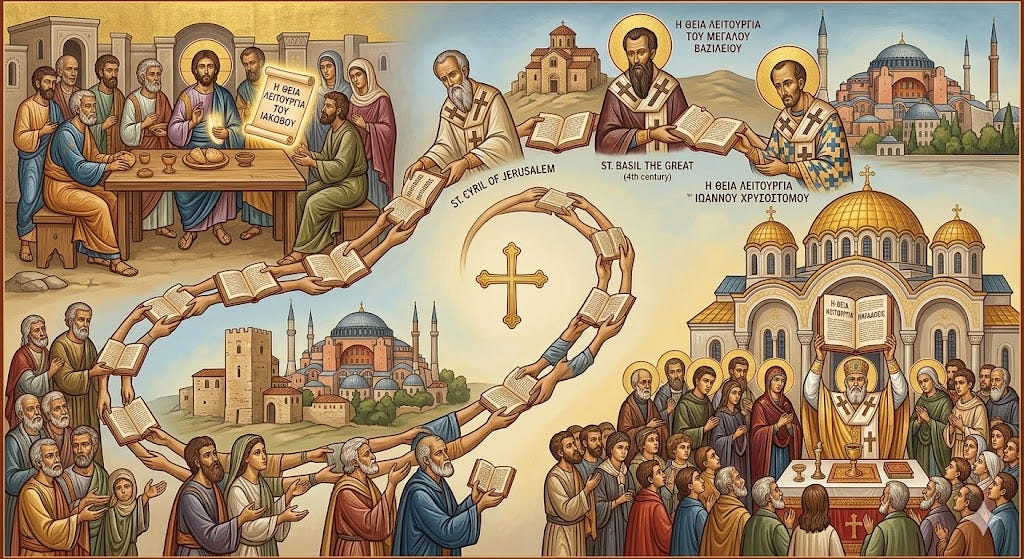
Imagine you walked into your grandmother’s kitchen, opened her recipe box, and pulled out a card titled “Grandma’s Chicken Soup.”
You make the soup. You eat the soup. The soup is delicious. Your kids ask where the recipe came from, and you say, “This is Grandma’s chicken soup.” And they grow up knowing it as Grandma’s chicken soup. Their kids will know it as Grandma’s chicken soup. Two hundred years from now, if your great-great-great-granddaughter is still making it, it will still be called Grandma’s chicken soup.
But here’s the thing.
Grandma did not invent chicken soup.
She got the recipe from her grandmother, who got it from a Polish neighbor in 1923, who got it from her mother in Galicia in 1880, who got it from the woman across the village whose mother-in-law made the best soup in three counties. The carrot-to-celery ratio is from the Polish neighbor. The pinch of dill is from a Lithuanian cousin who married in. The dumplings, technically, are from a different recipe entirely - your grandmother just always served them together because they go.
Grandma adapted. Grandma edited. Grandma standardized the version that her family ate every Friday night for forty years. Grandma’s name went on the card. The card became the family canon.
But Grandma did not invent chicken soup.
I want you to hold that image. Because what happened in Grandma’s kitchen, on a small scale could have been what happened in the Byzantine Church on a vast scale, with the two greatest Eucharistic prayers in all of Christian history.
Two Names on Two Liturgies
If you walk into any Greek Orthodox parish in the world this Sunday morning, you will hear the priest celebrate one of two liturgies. Most Sundays, it will be the Theía Leitourgía toû Hagíou Iōánnou toû Chrysostómou - the Divine Liturgy of St. John Chrysostom.1 On ten specific days each year - the five Sundays of Lent, Holy Thursday, Holy Saturday, Christmas Eve, the Eve of Theophany, and January 1 (Basil’s feast day) - the priest will celebrate the Theía Leitourgía toû Hagíou Basileíou toû Megálou - the Divine Liturgy of St. Basil the Great.
Two liturgies. Two saints’ names. Two prayer-texts that have been used continuously in the Greek Orthodox world for at least 1,500 years.
And here is the question almost no Orthodox layperson stops to ask:
Did Chrysostom and Basil actually write these liturgies?
The answer according to scholars is: mostly no.
And once you understand why the answer is “mostly no,” you will understand the heart of what this entire series has been arguing.
What Chrysostom and Basil may have actually done
Let’s introduce these two men because we need to feel the weight of their authority before we examine what their legacies.
St. Basil the Great (330-379 AD) was Bishop of Caesarea in Cappadocia (modern central Turkey). He was one of the three “Cappadocian Fathers” - the trio of theological giants (Basil, his brother Gregory of Nyssa, and their friend Gregory of Nazianzus) who, in the late fourth century, defended and articulated the Trinitarian theology that defines orthodox Christianity to this day.2
Basil wrote the foundational treatise On the Holy Spirit. He organized monastic life in the Eastern Church. He fed the poor of his city through an institution called the Basileiad that was, essentially, the world’s first hospital. He stood up to the Arian Emperor Valens to his face and refused to back down. When Valens’s prefect threatened him with confiscation, exile, torture, and death, Basil reportedly answered: “Confiscation? I have nothing. Exile? I am at home everywhere. Torture? My body is already broken. Death? It would be a kindness.” The prefect went back to the Emperor and said, “We have never spoken to a bishop like this before.” Basil replied: “Perhaps you have never yet had to deal with a bishop.”3
This is the man whose name is on the Liturgy, and he was an absolute Boss.
St. John Chrysostom (c. 347-407 AD) was Archbishop of Constantinople - which is to say, the Patriarch of the imperial capital itself, the most prominent ecclesiastical position in the Eastern Empire. He was called Chrysostomos - “Golden-Mouthed” because his preaching was so powerful that his sermons drew enormous crowds, were transcribed by stenographers as he spoke, and have been preserved in greater volume than the writings of almost any other Father. He was famous for his commentaries on Scripture, his ascetic personal life, and his refusal to flatter the imperial court. The Empress Eudoxia hated him because he denounced her vanity from the pulpit. She had him exiled. The people of Constantinople rioted. He was exiled again. He died on the road to his second exile, in 407, at age sixty.
This is the other man whose name is on the other Liturgy, also an absolute Boss.
Both of them are giants, titans and most importantly, Saints. Both of them are honored as among the “Three Holy Hierarchs” of the Eastern Church (along with Gregory of Nazianzus). Both of them shaped Eastern Christianity in ways that still ripple two thousand years later.
And according to scholars, ,neither of them invented the liturgy that bears his name.
The Basil Question
Let me start with Basil, because his case is more straightforward than John’s.
The scholarly consensus on Basil is this: he edited and reformed an existing liturgical tradition that was already being used in his diocese in Cappadocia. He did not compose a brand-new liturgy from scratch. The testimonies we have describe him shortening and reforming what already existed, not creating something out of nothing.
The earliest evidence comes from his own contemporaries. Gregory of Nazianzus, in his funeral oration for Basil delivered shortly after Basil’s death in 379, mentions that Basil produced “liturgical rules of prayer.”4 A treatise attributed to St. Proclus of Constantinople (mid-5th century) reports that Basil noticed people were getting tired of the length of the existing liturgy, so he shortened it. Notice the verb. He did not write a new one. He shortened the existing one. The Council of Trullo in 692 - one of the major councils of the early Church - explicitly recognized “the written liturgy of the archbishop of the Caesareans, St. Basil, whose renown has spread through the whole world.”
So Basil did real liturgical work. The Liturgy of St. Basil really does carry his theological fingerprints - particularly the dense Trinitarian language of the Anaphora, which sounds exactly like Basil’s On the Holy Spirit.5 When you read the Liturgy of St. Basil’s Anaphora and then read Basil’s theological treatises, the same voice is unmistakable. He really was involved in producing the prayer text.
But apparently what Basil did was receive an inheritance and refine it.
Where did the inheritance come from?
The scholarly best guess is that it came from the Liturgy of St. James, the ancient Eucharistic prayer of Jerusalem, which tradition (and good circumstantial evidence) attributes to James the brother of the Lord, the first Bishop of Jerusalem.6 The Liturgy of St. James was the mother liturgy of all the West Syrian / Antiochene family of liturgies. Basil’s diocese in Cappadocia used a local form of this Antiochene tradition. Basil shortened and refined that local form. The result is what we now call the Liturgy of St. Basil.
There is also a fascinating historical wrinkle. The version of the Liturgy of St. Basil that the Coptic Orthodox Church uses today is older than the version the Greek Orthodox Church uses.7 Both go back to a common ancestor that predates Basil himself. Some scholars think Basil may have actually brought the original prayer-form with him from Egypt (Basil traveled extensively in his early career and spent time in Alexandria around 357 AD). Others think the prayer-form was already circulating in both Egypt and Cappadocia and Basil’s contribution was the Cappadocian recension.
Whichever theory is right, the point holds. Basil did real work. But the work he did was editorial. He received a prayer that was already being prayed by other Christians in other places, refined it according to his theological priorities, standardized the form for use in his own diocese, and handed it on. His name went on the card. The liturgy became known as Basil’s liturgy. But Basil did not invent it.
The John Chrysostom Question
If Basil’s case is “edited an existing liturgy,” John Chrysostom’s case is more complicated - and the way the Orthodox Church herself answers it is more important than any modern scholarly reconstruction.
Let me start with what the Church confesses, and then I will tell you what modern academic scholarship adds, complicates, or contests.
What the Church confesses. The Orthodox Church has, for at least fifteen hundred years, taught that the Divine Liturgy of St. John Chrysostom is in fact the Liturgy of St. John Chrysostom. This is not a casual attribution. It is a confession the Church makes every time the priest opens the altar service book - which on the cover and in the title of the prayer-text says, in Greek, Ἡ Θεία Λειτουργία τοῦ ἐν Ἁγίοις Πατρὸς ἡμῶν Ἰωάννου τοῦ Χρυσοστόμου, “The Divine Liturgy of our Father among the Saints, John Chrysostom.” The Church says this in the title. The Church says it in the dismissal of every Liturgy (”Through the prayers of our Father among the Saints, John Chrysostom...”). The Church has said it in every Liturgy book printed in every Orthodox jurisdiction in every century since the liturgy began to be celebrated.
The Church’s confession is grounded in what was received from those who knew Chrysostom personally - his disciples, the bishops who succeeded him in Constantinople, the priests who served at Hagia Sophia, the chain of liturgical practice that came down through the centuries of the Byzantine Church. The living memory of the Church remembered who taught the Constantinopolitan Church to worship this way, and the Church wrote his name on the liturgy.
This is a serious witness. It is the kind of witness this entire series has been arguing we should take seriously - because lex orandi, lex credendi, and because the Church’s living memory of her own liturgical practice is a primary source of theological truth, not merely a sentimental label that needs to be validated by external academic authority.
What modern academic scholarship adds. Beginning in the nineteenth century, with the development of comparative liturgical studies as an academic discipline, scholars began reconstructing the manuscript history of the prayer-text we now call the Anaphora of St. John Chrysostom. The earliest surviving complete manuscript is the Barberini Codex, dated to the late eighth or early ninth century - roughly four centuries after Chrysostom’s death in 407. Working backwards from that manuscript, comparing it to other Eastern Christian liturgical texts, and tracing the development of various phrases and movements, modern scholars have argued that the prayer-text crystallized into its current form gradually over the centuries between Chrysostom’s death and the Barberini manuscript - and that the actual textual contribution of Chrysostom himself may be limited.
Some scholars go further. Encyclopædia Britannica states that “the evidence that he had anything to do with its composition is unconvincing.”8 The Wikipedia summary, citing a body of academic literature, describes Chrysostom’s connection as “a matter of debate among experts.” The standard scholarly reference, Father Robert Taft’s multi-volume A History of the Liturgy of St. John Chrysostom, documents in painstaking detail the extent to which the prayer-form developed after Chrysostom rather than with him.9
I want to acknowledge this scholarly opinion honestly. It is doing legitimate work. It is reconstructing manuscript history, identifying textual layers, and dating crystallizations of the prayer-form. The work is technical, careful, and worth respecting.
But - and this is the important part - the modern scholarly consensus and the Church’s confession are answering different questions, and only one of those questions is finally decisive for the argument of this series.
The scholars are asking: can we, working with eighth-century manuscripts and comparative textual analysis, prove that the specific words in front of us were composed by Chrysostom personally? That is a narrow question, and the honest scholarly answer is “probably not all of them, and we cannot tell which ones.”
The Church is asking: who did the Holy Spirit work through to give us this prayer in the form in which we have received it? That is a wider question, and the Church’s answer, testified by an unbroken liturgical tradition that begins in the immediate aftermath of Chrysostom’s episcopate, is St. John Chrysostom. Not because Chrysostom personally wrote every word, but because Chrysostom is the bishop through whom the Antiochene liturgical tradition came to Constantinople, became the dominant prayer-form of the imperial capital, and was handed down to the rest of the Eastern Christian world. The Church remembers him as the one through whom this prayer comes to us. The Church has never had any reason to revise that memory.
Where the conflict actually sits. When the modern scholarly consensus and the Church’s tradition appear to conflict, my own experience as a former Latter-day Saint who has done a great deal of historical investigation is that the Church’s tradition has a remarkable habit of being vindicated over time. The scholarly consensus of 1850 is not the scholarly consensus of 1920, which is not the scholarly consensus of 1960, which is not the scholarly consensus of today. The Church’s tradition does not work that way. It accumulates and preserves rather than overturning and revising. When the Magdala synagogue was excavated in 2009, traditional readings of first-century synagogue practice that secular scholars had been dismissing for a century were suddenly vindicated by the stones in the ground. When the Sahidic Coptic Basil manuscript was discovered in 1960, the scholarly story about Basil’s liturgical work had to be substantially revised in ways the tradition had never needed to worry about.
The pattern is real. New manuscripts are still being discovered. New textual analyses are still being published. The “consensus” of any given decade is provisional. The Church’s confession of who taught her to pray is not provisional. It is grounded in her own continuous memory of her own liturgical life, handed down with the utmost fidelity.
So when Britannica tells me that the evidence for Chrysostom’s authorship is unconvincing, I take the point. The evidence visible to a nineteenth- or twentieth-century manuscript scholar is what it is. But when the Church tells me, in every Liturgy of every Orthodox parish for fifteen hundred years, that this is the Liturgy of St. John Chrysostom - I trust the Church. The Church was there, these 20th century scholars were not. The Church received the prayer from Chrysostom’s own disciples. The Church has never lost the memory.
What scholars say Chrysostom actually did. Within the framework of the Church’s confession, the most likely historical picture is something like this. Chrysostom, having served as a deacon and priest in Antioch before becoming Archbishop of Constantinople in 398 AD, brought the Antiochene Eucharistic tradition with him to the imperial capital. He celebrated this prayer-form throughout his episcopate. He preached on its meaning in the homilies of his that have been preserved. He defended it against heretics. He taught his clergy and people to pray it. After his exile and death, his disciples and successors continued to celebrate this same prayer-form, eventually displacing the older Constantinopolitan use that had previously been dominant.
I want to suggest something to the reader at this point, because I think there is a way of reading the evidence that resolves the apparent tension between the Church’s confession and the scholarly investigation.
It is possible that both readings are true. It is possible that Chrysostom genuinely shaped, refined, and delivered this Liturgy to the Church at Constantinople, the seat of the Empire and the most prominent See in the Eastern Christian world, and that he stood on the shoulders of giants, building upon a tradition that was already ancient when he received it. It is possible that he was both a real contributor to the prayer’s final form and a faithful transmitter of an inheritance far older than himself. The Church’s confession that this is his Liturgy and the scholarly observation that the prayer descends from older sources need not be in conflict.
I am not asserting this resolution as historical fact. The scholarly debates are real and unsettled. But I am suggesting that parádosis - the act of receiving and handing on - is itself a contribution. To receive faithfully is itself a form of stewardship. To hand on faithfully is itself a form of creation. The prayer that comes down to us through Chrysostom can be both the apostolic prayer and Chrysostom’s prayer, in the same way that Grandma’s chicken soup can be both the inherited recipe and Grandma’s soup. There is no necessary contradiction. The Apostle Paul himself frames his own teaching about the Eucharist this way - “I have received of the Lord that which also I delivered unto you” (1 Corinthians 11:23). Receiving and delivering. Both real activities. Both holy.
That is what parádosis looks like at its best. And it offers a way of reading the historical evidence on which the scholarly investigation and the Church’s confession both stand together, rather than in opposition. The reader is free to decide whether that reading is persuasive. I find it persuasive. But that is my personal opinion.
His name is on the card. The Church confesses that the card is correct. The prayer is older than he is, and the prayer may also, in a real sense, be his. The Church is not wrong to honor him as the saint through whom this prayer came down to us.
The Liturgy of St. James and the Prayer of Jerusalem
There is one more piece of this story that I have not yet placed on the table, and it is arguably the most important piece of all. Because everything I have told you so far about Basil and Chrysostom - their reception of the Antiochene tradition, their refinement of inherited prayer-forms, their delivery of those prayers to the Eastern Christian world - traces back through one prior link in the chain.
That link is the Liturgy of St. James. Sometimes called the prayer of Jerusalem. And it is the source from which the entire Antiochene family of liturgies - including Basil and Chrysostom - descend.
Let me tell you what the Church confesses about this Liturgy, what scholars have established about it, and why both together build a serious case for apostolic authenticity.
What the Church confesses. The Liturgy of St. James is attributed to James the brother of the Lord - the first Bishop of Jerusalem, the man who presided over the Council of Jerusalem in Acts 15, the author of the New Testament Epistle of James, and the man whose martyrdom around 62 AD is recorded by Josephus and Hegesippus. The Church holds that this is the original Eucharistic prayer of the Jerusalem Church - the prayer of the Mother Church of all Christianity, the prayer prayed at the holy places where the events of the Gospel actually happened, the prayer that bears the name of the brother of the Lord himself. The Quinisext Council of 692 AD (of the Roman Catholic church) in Canon 32, formally honored this attribution - placing the Liturgy of St. James alongside Basil and Chrysostom as one of the three great apostolic Eucharistic prayers preserved by the Church.10
The Liturgy of St. James is still being prayed today. It is the principal Eucharistic prayer of the Syriac Orthodox Church, the Malankara Orthodox Syrian Church, the Maronite Church, and other West Syriac Christian communities. In the Eastern Orthodox Church, it is celebrated annually on the feast of St. James (October 23), and in some parishes in Jerusalem it is celebrated more regularly. If you ever get a chance to attend, do. You will be praying the prayer of the Mother Church.
What modern scholarship has established. The scholarly investigation has reached a position that, on the surface, looks like it complicates the Church’s confession. Most scholars date the received text of the Liturgy of St. James - the form preserved in our oldest manuscripts - to the late fourth or early fifth century. Some, following John Fenwick’s 1992 study, attribute its final compositional form to St. Cyril of Jerusalem around 370 AD.11 The earliest complete manuscript we possess, Vatican gr. 2282, dates to the late ninth or early tenth century - some 850 years after James the brother of the Lord was martyred.
So if you ask the narrow scholarly question - can we prove that James personally composed the prayer-text we now have? - the answer is no. The text we have shows fourth-century markers that postdates James himself by three centuries.
But here is where the conflict resolves. The same scholarly investigation that places the received text in the fourth century also places the underlying liturgical pattern in Jerusalem in apostolic or near-apostolic times. The Catholic Encyclopedia’s article on the Liturgy of Jerusalem states the conclusion bluntly: “We have, then, certain evidence that our St. James’s Liturgy is the original local rite of Jerusalem.” The internal evidence in the prayer text itself - the constant references to the holy places of Palestine, the prayer for “holy and glorious Sion, mother of all Churches,” the way the intercessions are structured around the Jerusalem Church - all of this reveals a prayer that was developed in Jerusalem, for Jerusalem, by the Jerusalem Church.
And we have direct documentary evidence from the mid-fourth century that confirms this. St. Cyril of Jerusalem - who became Bishop of Jerusalem around 350 AD - delivered a series of catechetical lectures to newly baptized Christians in the Church of the Holy Sepulchre itself. The lectures are called the Mystagogical Catecheses (literally “the teaching of the mysteries”), and in them Cyril walks his catechumens through the Eucharistic liturgy they have begun celebrating. He describes the Sursum corda dialogue. He describes the triumphal hymn. He describes the Epiclesis. He describes, in detail, the prayer-form that we now know as the Liturgy of St. James.12
The Mystagogical Catecheses are dated to around 347-348 AD. They describe the Eucharistic worship being celebrated in Jerusalem at the very site of the Resurrection. And the prayer Cyril is teaching his catechumens is structurally identical to the Liturgy of St. James.
This means the Liturgy of St. James, in essentially the form we now have it, was being prayed in Jerusalem - at the Holy Sepulchre - in the mid-fourth century. That is two and a half centuries earlier than the oldest surviving manuscript would suggest, if we were working from manuscripts alone.
And the prayer Cyril describes is itself a refinement of an older prayer. The Apostolic Constitutions, a Syrian compilation from around 370-380 AD, preserves what most scholars consider an older stratum of the same liturgical-family - simpler, less developed, more obviously close to the apostolic root. The trail keeps going back. Behind the Liturgy of St. James in Cyril’s mid-fourth-century Jerusalem stands an older Syrian-Antiochene rite. Behind that stands the apostolic liturgy of the earliest Jerusalem Church, the liturgy of James the brother of the Lord, the liturgy that was being celebrated in homes and house-churches in Jerusalem within years of the Resurrection itself.
The both/and applies here too. We can, if we wish, read the evidence as the Church has always confessed it: this is the Liturgy of St. James, the brother of the Lord, the first Bishop of Jerusalem, and the liturgical form he established for the Mother Church has been preserved and refined through the generations until it reaches us today. Or we can read the evidence the way some modern scholars do: this is a fourth-century Jerusalem composition that builds upon older apostolic patterns and bears James’s name as a matter of honoring the Jerusalem tradition he founded. Or we can suggest, again, that both readings are saying something true. The prayer is genuinely the prayer of Jerusalem. It does carry James’s apostolic signature in the sense that it is the prayer of his church. The fourth-century shaping is real. The apostolic root is also real. Both belong to the same liturgical inheritance.
Why this matters for the entire series. The Liturgy of St. James is the parent of the Liturgy of St. Basil. The Liturgy of St. Basil is the parent of the Liturgy of St. John Chrysostom. These are not separate liturgies invented by different Fathers in different centuries. They are successive refinements of one continuous Jerusalem liturgical tradition, handed down from the Mother Church of Jerusalem and it’s first jewish Christians of “the way” to the great See of Antioch, from Antioch to the Cappadocian churches that Basil reformed, from Basil’s reformed liturgy to the Antiochene tradition Chrysostom brought to Constantinople, from Chrysostom’s Constantinople to the entire Eastern Christian world.
When you stand in an Orthodox parish on Sunday morning and the priest begins the Anaphora, you are not praying a fourth-century Cappadocian invention or a fifth-century Constantinopolitan composition. You are participating in a refinement of the liturgy that was being performed at the Holy Sepulchre in the mid-fourth century. Which was a refinement of the liturgy that was being performed in the Jerusalem house-churches a generation earlier. Which was a refinement of the liturgy that James the brother of the Lord taught the first Christian community in Jerusalem after the Resurrection.
The chain runs all the way back. The Church confesses it. The scholarly investigation, at minimum, supports the plausibility of it. And when both honest sources of evidence point in the same direction, that is what authenticity looks like.
Why This Strengthens the Argument
If you have been reading this series carefully, you may be wondering whether what I just told you is a problem for the case I have been making.
The series has been arguing, article by article, that the Orthodox Divine Liturgy is not a medieval invention but the preservation of an apostolic inheritance. I have spent five articles showing you the documentary evidence: Justin Martyr in 155 AD, the Didache in the late first century, the synagogue inheritance of the Liturgy of the Word, the Temple inheritance of the Liturgy of the Faithful, the Anaphora’s eleven movements that converge synagogue and Temple and Christ.
And now I have told you something that may seem at first to complicate the case: the Liturgies of Basil and Chrysostom are not the personal compositions of Basil and Chrysostom. They were liturgies far older than the men who refined them. And those older prayers themselves descend from the Liturgy of St. James and the apostolic worship of some of the first christian communities in Jerusalem.
Doesn’t that weaken the argument? Doesn’t that suggest the Orthodox liturgical tradition is more cobbled-together and less unified than I have been claiming?
No. It does the exact opposite and here’s why.
If Basil and Chrysostom had each invented their respective liturgies from scratch, the case for apostolic continuity would be weaker, not stronger. It would mean that two specific fourth-century bishops sat down with blank scrolls and composed brand-new Eucharistic prayers, and the Orthodox Church has been using their personal compositions for the last 1,600 years. That would be an argument for Orthodoxy as the work of two creative theologians, not as the preservation of apostolic inheritance.
But what actually happened - what the Church confesses and what honest historical investigation supports - is something far more powerful. Two of the greatest theologians and bishops of the fourth century - Basil and Chrysostom, men who could have written anything they wanted, men who were brilliant enough and authoritative enough to compose new liturgies if they chose to - received the apostolic Eucharistic tradition that came down to them, shaped and refined it where refinement was needed, gave it their theological voice, taught it to their flocks, defended it against heresy at personal cost, and handed it on to the next generation of bishops who handed it on to the next, and so on, until it reaches us this Sunday morning.
The Church gave the liturgies their names because Chrysostom and Basil were the bishops through whom the apostolic liturgy came down to us in the form we now have it. They are not the liturgies inventors. But neither are they merely passive conduits. They are the liturgies guardians in the active, contributing, theologically formative sense - the named saints whose stewardship gave the apostolic liturgy the shape in which we now receive it. What they handed on was older than they were. And what they handed on was, in a real sense, theirs - because faithful reception and faithful delivery are themselves a contribution. They took an inheritance and made it the inheritance of generations to come. That is the work the Church honors when she names the liturgies after them.
This is why their names are on the liturgies. Not because they invented anything. Because they were the faithful curators through whom an apostolic inheritance was preserved.
The Eastern Christian instinct for naming liturgies is the opposite of the modern Western instinct for naming books. When we name a modern book, we name the author - the originator, the creator, the source. The name belongs to the person who made the thing. When the East named the liturgies, it named the guardian - the bishop who received the liturgy faithfully, preserved it, and handed it on to the next generation. The name belongs to the person who protected the inheritance.
This is the same instinct that produced the patristic principle: “We have received and we hand on.” The Apostle Paul names this explicitly in 1 Corinthians 11:23: “For I have received of the Lord that which also I delivered unto you.” Paul did not invent the Eucharist. He received it from the Lord and handed it on to the Corinthians. The Greek verb here is paralambánō - to receive what is handed down. The corresponding verb for handing it on is paradídōmi - to deliver, to transmit. From these two verbs comes the Greek noun parádosis - often translated as “Tradition.”
Tradition, in the Eastern Christian sense, is not something old that is preserved out of antiquarian sentiment. Tradition is the act of receiving and handing on the apostolic deposit. It is a verb before it is a noun. The whole Christian life, in the Orthodox understanding, is participation in this parádosis - this receiving and handing on of what was given by Christ to the Apostles, by the Apostles to their disciples, by their disciples to the next generation, and so on, in an unbroken chain.
Basil and Chrysostom are exemplars of this. Their names are on the liturgies because they show what faithful tradition looks like. Each of them received an inheritance, prayed it faithfully, refined it where it needed refinement, and handed it on. Each of them did the same thing the Apostles had done before them. Each of them did the same thing the bishops who came after them would do.
Their names are not signatures of authorship. They are signatures of fidelity.
The Pattern of the Series
I want to step back now and name what we have actually seen across this series, because Article 6 is the article where the pattern becomes visible as a whole.
In Article 1, I showed you Justin Martyr describing the Divine Liturgy in 155 AD - fifty-five years after the death of the last Apostle. He describes a service that already has all the structural elements of the modern Orthodox Liturgy. Justin did not invent that service. He was describing what was already being done in Rome and across the Empire. He received and reported.
In Article 2, I showed you that the architecture of every Orthodox church is a deliberate continuation of the Tabernacle and Temple blueprints God gave to Moses. The bishops and Christians of the second, third, and fourth centuries did not invent sacred Christian architecture. They received the Old Testament pattern and built it into their churches. They received and built.
In Article 3, I showed you that the first half of the Divine Liturgy is structurally the synagogue service that Jesus attended every Sabbath of His life, and the second half is the fulfillment of Temple sacrificial worship. The Apostles did not invent Christian worship, they received the Jewish liturgical inheritance, allowed Christ to fulfill it, and prayed it for the rest of their lives. They received and fulfilled.
In Article 4, I showed you that the Didache - possibly first-century, almost certainly within living memory of the Apostles - already contains Eucharistic prayers, Sunday gathering, the Eucharist as sacrifice, the explicit citation of Malachi 1:11, and the closed-communion discipline. The Didache’s author did not invent any of this. He was writing down what his community was already practicing. He received and recorded.
In Article 5, I showed you the Anaphora itself - the Great Eucharistic Prayer with its eleven movements - and demonstrated that its essential shape is older than every Christian tradition that uses it. Eastern, Western, Coptic, Armenian, Ethiopian, Syriac - they all have an Anaphora with the same basic structure. None of these traditions invented it. They all received it from a common apostolic source in the holy land.
And now in Article 6, I have shown you that the two greatest Anaphoras in the Orthodox tradition bear the names of two of the greatest bishops of the fourth century - and that the Church confesses these as their liturgies because they are the bishops through whom the apostolic prayer came down to the Eastern Christian world. I have also shown you that behind both Basil and Chrysostom stands the Liturgy of St. James - the prayer of Jerusalem itself, attributed by the Church to the brother of the Lord, and confirmed by the Mystagogical Catecheses of St. Cyril of Jerusalem to have been celebrated in essentially its received form at the Church of the Holy Sepulchre by the mid-fourth century. The Antiochene liturgical inheritance that Basil and Chrysostom received and handed on traces back, through every honest investigation we can do, to apostolic Jerusalem.
Do you see the pattern?
Nobody in this story is inventing anything.
Not Justin. Not the architects of the early churches. Not the Apostles. Not the author of the Didache. Not the bishops who shaped the Anaphora. Not Basil. Not Chrysostom. Not the editors of the Barberini manuscript in the eighth century. Not the Byzantine liturgists who standardized the liturgical texts we use today. Not the modern Greek Orthodox Archdiocese of America that publishes the English translation we have been quoting throughout this series.
At every link in the chain, what is happening is reception and transmission. What is not happening is invention.
This is the deepest claim of the entire series. The Orthodox Divine Liturgy is not the product of any individual mind. It is not the achievement of any single century. It is not the doctrine of any single Church Father. It is the cumulative, continuous, faithful preservation of what Christ gave the Apostles and what the Apostles handed to their disciples, what their disciples handed to the next generation, and what every generation since has handed forward.
When you stand in an Orthodox parish on Sunday morning and the choir begins the Anaphora, you are not participating in a service that anyone composed. You are participating in a service that has been handed down. And when the priest says the words of Christ - “Take, eat, this is My Body, which is broken for you for the remission of sins” - he is saying what every Orthodox priest has said, in every Liturgy, in every parish, on every continent, for nearly two thousand years.
The chain has not been broken.
A Word to My LDS Readers
You have heard the argument throughout this series that the Orthodox Church preserves an unbroken apostolic tradition. Article 6 puts a specific historical case on the table: the two greatest Eucharistic prayers in Orthodox use bear the names of fourth-century bishops, and the Church has confessed for fifteen hundred years that these are their prayers - that the prayer-form came down to us through them. The Church remembers her own liturgical history. She remembers who taught Constantinople to pray.
This is significant for the LDS account of Christian history because the LDS framework requires a break somewhere - a Great Apostasy in which the apostolic priesthood, authority, and ordinances/ (sacraments & holy services) were lost, eventually requiring restoration in 1830.
The Orthodox liturgical evidence does not show a break. It shows continuous transmission. Every Father from the second century to the eighth, every bishop who ever celebrated the Liturgy, every Eastern Christian community that ever came under the Byzantine sphere - they all received and handed on the same essential prayer. There is no point in the documentary record at which someone says, “The apostolic prayer has been lost, and I am introducing a new one to replace it.” There is no moment at which the Eucharistic offering stops being practiced. There is no break.
I am not arguing this to wound you. I am arguing it because I made the same investigation you may now be making, and the documentary evidence had to be looked at honestly. If there had been a Great and total Apostasy, it would have been a major event, and it should be visible in the historical record - someone, somewhere, would have noticed that the Eucharist had stopped being celebrated, or that the apostolic prayer had been corrupted beyond recognition, or that a new prayer-form had to be introduced to replace what had been lost. We do not see any of this. We see continuity. And this is the challenge with a Great Apostasy narrative: when you ask details about it, when, where, who, how, and why, there are no specific answers that can be pointed to in any historical record. Most times, there are no answers to the above questions. Why? because, in my opinion, it’s not history, it’s mythology.
The question this puts to LDS readers is not whether the apostolic tradition was preserved, but where it was preserved. The Orthodox Church claims that it was preserved in her, in the unbroken chain of bishops, in the unchanging Liturgy, in the prayer that has not stopped being prayed. The historical evidence at minimum supports the plausibility of this claim. Whether the claim is true, ultimately, is a question for prayer and discernment. But the claim is at least on the table, supported by exactly the kind of documentary evidence that any serious historical inquiry requires.
Sit with that. Read the sources I have cited. Ask whether the documentary picture matches the apostasy narrative you have been told. Decide for yourself.
A Word to My Protestant Readers
You have inherited a very complicated relationship with the early Church Fathers. The Reformers—Luther, Calvin, and Zwingli cherry-picked ruthlessly, subordinated the Fathers to their own limited and private interpretation of Scripture, openly mocked or dismissed them when the patristic consensus didn’t line up with sola fide (Luther), rejection of free will (Calvin), or their new sacramental minimalism (Zwingli). This wasn’t a humble submission to an apostolic inheritance. It was the same ego-driven impulse I unpacked in “Going Beyond the Mark”: peel away anything that smells to you like “corruption” until you’re left with whatever fits your own personal ideas and theologies.
I do believe, however, that they had a noble goal: they sought to prune away what they considered, from their renaissance perspectives13, medieval additions/corruptions to recover what they assumed was a "simpler, purer" Christianity of the apostolic age (even while discarding the views and writings of church leaders in that earlier age when they didn’t align with their own ideas.) Publicly, they stated a desire to bring the faithful back to the heart of the Gospel by removing what they saw as the "clutter" of history.
However, as we look closer at the historical record, we encounter a challenging question: Did the Reformers and the Apostles define "simpler" and "purer" in the same way? Was the assumption that there was a simpler, purer Christianity of the apostolic age (that fit their definitions) a correct assumption? Or was it erroneous?
We often equate "simplicity" with informality, more a reflection, perhaps, of our modern American/Western preferences. But the Patristic age tells a different story.
The historical record suggests that early Christian worship was deeply sacramental, liturgical, and priestly. This wasn't a lack of sophistication; it was a reflection of a Near Eastern inheritance that saw worship as a participation in the heavenly court.
Similarly, the Reformers sought purity through subtraction—by stripping away things that they themselves, 1500 years after the fact, felt were "man-made" (I think they either didn’t understand them or didn’t understand where they had come from. Anything that felt foreign to their European pre-enlightenment humanist culture was jettisoned.)
But for the Church Fathers, "purity" wasn't found in having less; it was found in the exactness of the Sacrifice. To them, the "purest" form of the faith was the faithful preservation of the Eucharist as the literal Body and Blood of Christ.
Consider the Anaphora (the Eucharistic prayer) we examined in Article 5. This wasn't a later invention or a "corruption"; it was the language of Basil the Great and John Chrysostom, passed down through them from the liturgy of Saint James, the brother of our Lord. It is sacramental, sacrificial, and priestly. If this was how the Apostles and their immediate successors prayed, it suggests a difficult irony: In their zeal to recover a "purer" Church by stripping away the Liturgy, sacraments, and other things they didn’t like, the Reformers may have inadvertently discarded the very "apostolic inheritance" that the early martyrs fought and died to protect.
I don't share this to make you defensive. I say it because the Liturgy of St. John Chrysostom is a living document sitting in front of all of us. We can examine its history and its theology. When we do, the answer provided by historical investigation strongly suggests that the Orthodox liturgical tradition is genuinely apostolic in both shape and content. (In a way that no other tradition can.)
This leaves us needing to ask and answer some vital questions.
If our goal is to follow the Apostles, where does the evidence lead?
Does it lead to Joseph Smith? Sidney Rigdon? John Wesley? Martin Luther? John Calvin? Ulrich Zwingli? John Nelson Darby? Alexander Campbell? Emmanuel Swedenborg? Ellen White? Johnathan Edwards? George Whitefield?
Is it possible that the Reformers did not restore the Church to its original "simple/pure" state, but rather shaped new religious movements to fit their own cultural milieu and personal beliefs? That is a hard thing to consider, and I know that it takes immense courage to even ask the question.
If you are looking for a deeper relationship with the Lord, if you are a seeker after truth, know that I have walked a path similar to what you may now be considering. The path leads to the Apostles. The Apostles lead directly to Christ. The Liturgy they prayed is not lost to time; it is still being prayed today. Truth is what it is, but that does not mean it is easy to accept. There is no shame in admitting that accepting the truth, particularly when it contradicts your own tradition, will require great sacrifice. 14
Find a parish. Visit. Listen.
What Article Seven Will Cover
We have come to the end of the historical and structural arguments of this series.
In Article 1, you saw what Christian worship looked like in 155 AD. In Article 2, you saw the Temple in your parish. In Article 3, you saw the synagogue that became a church. In Article 4, you saw the book that shouldn’t exist. In Article 5, you walked through the eleven movements of the Anaphora. In Article 6, you saw that even the named bishops on the great liturgies were guardians of an apostolic inheritance, that the chain runs back through the Liturgy of St. James to the apostolic liturgy of Jerusalem itself, and that the Church remembers all of this rightly when she names the liturgies in their honor.
In Article 7, the final article of this series, we are going to put it all together. We will walk into an Orthodox parish on a Sunday morning, and I will try to guide you through the structure of the Divine Liturgy, naming the pedigree of every single movement.
This part is from the synagogue. This part is from the Temple. This part is from the Apostles. This part is from the Didache. This part is from Basil. This part is from Chrysostom. This part is from the Apostolic Constitutions. This part is from St. Cyril of Jerusalem. This part is from Isaiah. This part is from Christ Himself.
By the end of Article 7, I do not think you will ever look at Christian worship the same way again. And I do not think you will ever sit in a service - any service, anywhere - without instinctively asking, where did this come from?
The Apostles were there first.
It is time we caught up.
Primary Sources
The historical claims in this article can be verified against the following sources. As always, do not take my word for any of it.
Encyclopædia Britannica, “Liturgy of Saint John Chrysostom” - The most accessible single statement of the scholarly consensus on Chrysostom’s actual relationship to the liturgy that bears his name. Read it here.
Catholic Encyclopedia, “Liturgy of Saint Basil” - The Catholic Encyclopedia’s article on the Basilian liturgy, with extensive discussion of authorship, dating, and the relationship to other ancient liturgies. Read it here.
St. Gregory of Nazianzus, Funeral Oration on St. Basil the Great (Oration 43, 379 AD) - The earliest direct testimony to Basil’s liturgical work, by his closest friend and theological collaborator. Read it here.
The Quinisext / Trullan Council (692 AD), Canon 32 - The seventh-century ecumenical recognition of the Liturgy of St. Basil as authentic patristic inheritance.
St. Basil the Great, On the Holy Spirit - The theological treatise whose Trinitarian language and sensibility is unmistakably present in the Anaphora that bears Basil’s name. Reading the treatise alongside the liturgy is the strongest internal evidence for Basil’s involvement in the Anaphora’s composition. Read it at New Advent here.
St. John Chrysostom, Homilies on Matthew, Homily 82, and Homilies on 1 Corinthians - Chrysostom’s own preached theology of the Eucharist, which provides the theological context for understanding what kind of liturgical tradition he represented and why his name became attached to the Antiochene anaphoral tradition. Read it at New Advent here.
The Anaphora of St. James - The ancient Jerusalem liturgy traditionally attributed to James the brother of the Lord, which most scholars identify as the parent of the Antiochene / West Syrian liturgical family that includes both Basil’s and Chrysostom’s anaphoras. English text available here.
St. Cyril of Jerusalem, Mystagogical Catecheses (c. 347-348 AD) - The five lectures delivered to newly baptized Christians at the Church of the Holy Sepulchre in Jerusalem, walking them through the meaning of the Mysteries they had just begun to celebrate. The fifth lecture describes the Eucharistic liturgy in detail and provides the earliest direct documentary evidence of the structure of the Liturgy of St. James being celebrated in Jerusalem in the mid-fourth century. Read it at New Advent here.
The Quinisext Council, Canon 32 (692 AD) - The seventh-century ecumenical council canon that names the Liturgies of St. James, St. Basil, and St. John Chrysostom together as authoritative apostolic witnesses to the Eucharistic tradition. Read the canons at New Advent here.
For readers who want to go deeper: The standard scholarly reference on the Liturgy of St. John Chrysostom is Robert F. Taft15, A History of the Liturgy of St. John Chrysostom (Pontifical Oriental Institute, multiple volumes from 1975 onward). Taft is a Catholic Jesuit and a member of the Society of Jesus, which means his scholarship is sober, rigorous, and not motivated by Orthodox apologetic concerns. His conclusions about the development of the prayer-text are accepted by Orthodox liturgical scholars as well. For Basil specifically, the best scholarly treatment in English is John Fenwick, The Anaphoras of St Basil and St James: An Investigation into Their Common Origin (Pontifical Oriental Institute, 1992). For a more accessible introduction to the entire field, see Hugh Wybrew, The Orthodox Liturgy: The Development of the Eucharistic Liturgy in the Byzantine Rite (SPCK, 1989).
A small note on the names. In Greek liturgical books, the Divine Liturgy of St. John Chrysostom is called Ἡ Θεία Λειτουργία τοῦ ἐν Ἁγίοις Πατρὸς ἡμῶν Ἰωάννου τοῦ Χρυσοστόμου - “The Divine Liturgy of our Father among the Saints, John Chrysostom.” The Liturgy of St. Basil has the equivalent formulation. The “among the Saints” (ἐν Ἁγίοις) is not a poetic flourish - it is the formal liturgical title given to a saint whose feast day is in the calendar and whose canonical authority the Church recognizes. In the Greek tradition, you do not say “Saint John” - you say “our Father among the Saints, John.”
For LDS readers - the “Cappadocian Fathers” (Basil, Gregory of Nyssa, Gregory of Nazianzus) are central to the development of Trinitarian theology in the late fourth century. They are the theologians whose work shaped the final form of the Nicene Creed at the First Council of Constantinople in 381 AD. Whether you accept Nicene Trinitarianism or not, these are the men who articulated it. Their authority in Eastern Christianity is approximately analogous to the way the LDS tradition treats Joseph Smith and Brigham Young - the foundational theological and ecclesiastical figures whose articulations shape what comes after.
The exchange between Basil and the prefect Modestus is preserved in Gregory of Nazianzus’s Funeral Oration on Basil (Oration 43.48-50). It is one of the great moments in patristic biography. I have given a slightly compressed version above; the full text is worth reading.
Gregory of Nazianzus, Oration 43.34, on Basil. The full Greek phrase Gregory uses describes Basil’s “ordering of prayers” or “arrangement of the liturgy” - the exact translation is debated, but the meaning is clear: Basil did liturgical work, and his closest friend, writing shortly after his death, knew about it.
The Anaphora of St. Basil is densely Trinitarian in a way that the Anaphora of St. John Chrysostom is not. It addresses the Father in long sequences of theological epithets that read like compressed versions of Basil’s On the Holy Spirit. If you have time and inclination, set Basil’s On the Holy Spirit alongside the Anaphora of St. Basil and read them together. The same voice is unmistakable. Whatever uncertainty exists about Chrysostom’s connection to “his” liturgy, Basil’s connection to “his” liturgy is much more textually visible.
The Liturgy of St. James is treated in detail in its own section below. For now, what is important is that it is the parent of the entire Antiochene liturgical family, and that even on the most rigorous scholarly dating, its essential structure is documented in fourth-century Jerusalem - which means the prayer-form Basil and Chrysostom inherited descends from a Eucharistic tradition rooted in the Mother Church of Jerusalem itself.
The 1960 discovery of a 7th-century Sahidic Coptic manuscript of the Anaphora of St. Basil dramatically reshaped scholarly understanding of the prayer’s history. The Coptic version is shorter, more sober, and theologically less developed than the Greek Byzantine version - which strongly suggests that the Coptic preserves an older form. The Greek version, by contrast, shows the influence of post-Nicene Trinitarian theology that did not exist in Basil’s earliest decades. So when you pray the Liturgy of St. Basil at a Greek Orthodox parish, you are praying a fourth-century Cappadocian recension of an even older Egyptian prayer that may go back to the third century or earlier.
I want to flag that quoting Encyclopædia Britannica as a primary source is unusual in a series like this. I am doing it deliberately. Britannica is a respected, mainstream, academic, non-religious reference work. When even Britannica - which has every reason to be neutral and no reason to take a particular ecclesiastical side - acknowledges that the evidence for Chrysostom’s authorship is “unconvincing,” that is significant. Orthodox apologists could be accused of motivated reasoning when they discuss the liturgy’s history. Britannica cannot.
I want to note something pastorally for Orthodox readers who may find this article uncomfortable. I am not trying to undermine the veneration of Saints Basil and Chrysostom. I am trying to clarify why the Church gave them the honor of having the liturgies named after them - and the answer, because they were faithful curators of an apostolic inheritance, is more theologically powerful than the answer because they invented these prayers. The Saints would have been horrified at the suggestion that they had created anything new. Their entire theological self-understanding was that they were preserving and handing on what had been given them. That is what makes them Saints. Not creativity. Fidelity.
Canon 32 of the Quinisext Council (also called the Council in Trullo, 692 AD) addresses the use of wine and water in the Eucharist, and in doing so cites the written testimony of the Liturgies of St. James, St. Basil, and St. John Chrysostom as authoritative apostolic witnesses. The full text of the Canon refers to “the divine apostle James, who was the brother, according to the flesh, of Christ our God, and who was the first to whom was entrusted the throne of the church of Jerusalem” - the council does not hedge or qualify the apostolic attribution. The Quinisext is recognized by the Eastern Orthodox Church as ecumenical in its disciplinary authority. Read Canon 32 here.
John R. K. Fenwick, The Anaphoras of St Basil and St James: An Investigation into Their Common Origin (Pontifical Oriental Institute / Orientalia Christiana Analecta 240, 1992). Fenwick’s careful textual analysis suggests that both anaphoras descend from a common earlier source that has been preserved most faithfully in the Egyptian recension of the Liturgy of St. Basil. His proposal that St. Cyril of Jerusalem may have been responsible for the final compositional form of the Liturgy of St. James is a scholarly hypothesis - well-defended but not universally accepted. What is universally accepted is that the Liturgy of St. James in something like its current form was being celebrated in Jerusalem by the mid-fourth century, which is precisely the conclusion that the Mystagogical Catecheses of St. Cyril of Jerusalem independently confirm.
The Mystagogical Catecheses (Greek: Mystagōgikaì Katēchḗseis) are a series of five lectures traditionally attributed to St. Cyril of Jerusalem and delivered to newly baptized Christians during Bright Week (the week after Pascha) at the Church of the Holy Sepulchre in Jerusalem, around 347-348 AD. They walk the new Christians through the meaning of the Mysteries (Sacraments) they have just begun to celebrate - Baptism, Chrismation, and Eucharist. The fifth lecture in particular describes the Eucharistic liturgy in detail, including the Sursum corda dialogue (”Let us lift up our hearts” / “We lift them up to the Lord”), the Sanctus, the Epiclesis, the Lord’s Prayer, and the communion of the faithful. The structure Cyril describes is unmistakably the structure we still pray today in the Liturgy of St. James, the Liturgy of St. Basil, and the Liturgy of St. John Chrysostom. Authorship of the Mystagogical Catecheses is debated among scholars - some attribute them to Cyril’s successor John of Jerusalem - but the dating to the mid-to-late fourth century in Jerusalem is secure regardless. Read the Mystagogical Catecheses at New Advent here.
One of those common Renaissance ideas was Ad Fontes, which we discussed in the aforementioned article (and which plants the seed of the Mormon great apostasy idea). I think it is important to note that this idea, and the ideas of the reformers, were their ideas. The ideas of fallible men, men of their times, looking at a now foreign and alien culture and interpreting it through their own sociocultural lens. None of them claimed to be prophets speaking for God. They spoke for themselves, supported and cheered on by secular authorities who had much to gain (politically and financially) from getting out from under the authority of the Roman Catholic church, and appropriating her property.
Heck, my first response to Christ calling me back to him was to flip him the bird. I was NOT happy. I was finally spiritually comfortable as a Buddhist. The cognitive dissonance I experienced most of my life was finally over. I was finally at peace spiritually. Coming back to Christ has been, in many ways, extremely difficult. I have paid for that decision dearly (my life has been like a country and western song), but I would do it over again because it’s what is true, and I cannot bear the thought of living in and dedicating my life to another falsehood. I can no longer live in a delusion of what is true.
Robert F. Taft (1932-2018) was an American Jesuit, Eastern liturgical scholar, and member of the Society of Jesus who taught at the Pontifical Oriental Institute in Rome for decades. He was the leading Western scholar of Byzantine liturgy in the second half of the twentieth century. His work is universally cited by both Catholic and Orthodox liturgical scholars. The fact that the Catholic Church chose him to chair the Pontifical Oriental Institute is itself significant - the Vatican wanted the foremost Eastern liturgical scholar in the world to be doing this work, even though his conclusions sometimes complicated narratives that would have been more convenient for the Roman Catholic side of various ecumenical disputes. That is good scholarship. I cite him because his judgment is trustworthy across confessional lines.