

The Cloud of Witnesses
A case for intercessory prayer

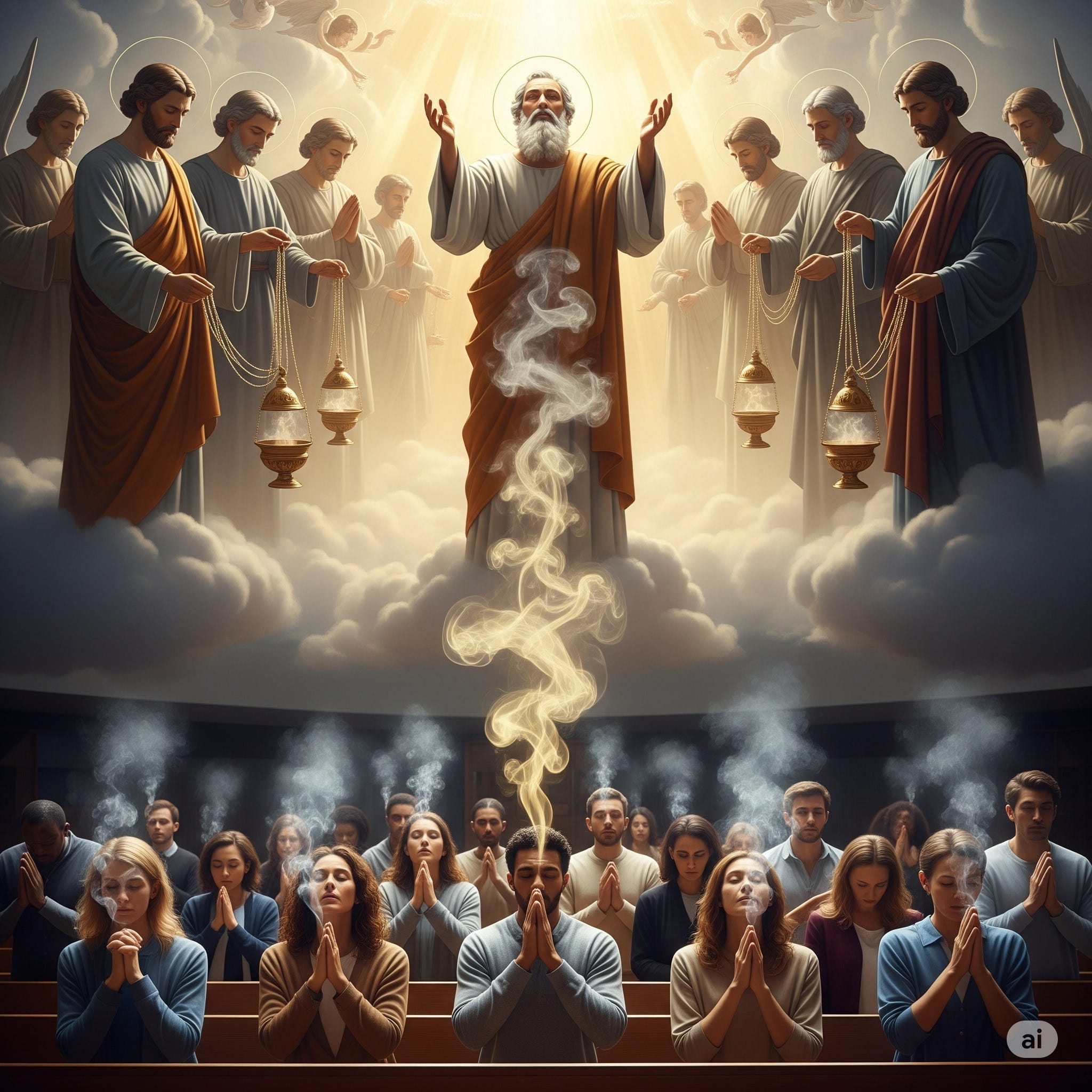
I have recently seen some instances of catechumens and others crossing the bridge from western protestant Christianity to Eastern Orthodoxy or Roman Catholicism who have struggled with the concept of intercessory prayer. Pre-existing conditioning with the concepts of sola-scriptura and a paradigm that views death as a hard barrier, inquirers often experience instinctive resistance, viewing the practice as a departure from what they understand as biblical practise.
However, when examined holistically, the invocation of the saints is not a late pagan corruption (I’ve spent the last couple episodes debunking some of these pagan corruption myths, this is no different.) Rather this practice is a highly sophisticated, deeply scriptural, and organically coherent extension of the New Testament understanding of the Body of Christ.
Once they can break through this mindset, however, a whole new world of understanding opens to them. I know this to be true as it aligns with my own experience.
On Substack a creator I follow recently posted the following note which spurred the revisiting of this issue:
My relationship with the saints has been somewhat awkward for me as I slowly shed my evangelical Protestant background to embrace Holy Orthodoxy.
However, today I bent my neck and kissed the holy relics of the Wonderworker St. John of Shanghai in San Francisco. Today I sang his Troparion with tears and celebrated his blessed feast. Today I truly realized the magnitude and reality of the saints. Today I remembered that our highest calling in our earthly lives is the acquisition of holiness in Christ our Lord. Today I realized how I have hardly even begun walking in this race! Lord have mercy, and pray for us, O wonderworker John!
I could really relate. Although my religious background was quite different I went through a very similar experience. I responded with:
When you finally have that realization of the reality and presence of the saints, it’s like a whole new universe opens up to you, things you’ve been learning start to click and fall into place and then you realize that you are just starting the journey, and how far you really have to go.
but! better late than never!
That sparked this post and as a result, this article is not meant as an apologetic or to convince anyone who is already dead set against this idea. It’s only to help those who are open to and wanting to accepting the idea understand the context of the practice and explore the support for it, as well as to put the arguments against it into proper context. I hope to base the context for this discussion primarily on the Bible since many coming to the church still retain the instinct and impulse that the Bible is the sole authority on divine teaching (the OP references coming from an evangelical protestant background, so this impulse is likely to be there. Some things take time to adjust to.)
I think that it is important to approach the topic from this perspective, demonstrating that this tradition is not only ancient and authentic, but is permissible and, in fact, a natural extension of core biblical truths.
One first immediate objection that I often see in online debates/discussions is that. This practice is not directly addressed in the bible, in contrast to what appear to be prohibitions against it.
Getting our Thinking Right
To understand this doctrine, we first need to overcome our own modern snobbery. Often we assume that ancient people, Christians included, were primitive, simplistic, or prone to superstitious thinking. As evidenced by the flawless deductive rigor of Euclid’s Elements, the formal logic of Aristotle's Prior Analytics, the staggering metacognition of Marcus Aurelius’s Meditations, and the algorithmic precision of Pāṇini’s Sanskrit grammar, large parts of the ancient world (particularly those handed down to us) operated at an elite level of intellectual astuteness that is rare even by modern standards.1 The reality is that the level of education and complex thinking may have been higher amongst the educated in antiquity than it is today where we are educated by one teacher to 30 students in a public education curriculum calibrated for the lowest common denominator.
“But it’s not in the Bible!” is a common rebuttal that I have heard many time. And in my mind I think that this is both true and false at the same time. It is true that the doctrine of intercession of the Saints is not plainly addressed simply and directly in scripture using the terms we would use today, but neither is the doctrine of the Trinity (the word trinity does not exist in the Bible at all) and virtually all Christians today are Trinitarians. In fact, we often use acceptance of the Trinity as a litmus test to determine whether or not one is a Christian. Like the Trinity, this is something that comes out of a comprehensive reading of scripture that pulls in clues and facts from many places order to formulate a comprehensive belief and practise that is well supported by scripture.2
This is a pattern of practice evident from the earliest days of the church. When the Early Church formulated its practices, it did not rely on wild speculation. They, like our scientists today, built robust philosophical and theological models based on collecting, understanding and structuring data - looking for patterns that would not otherwise be obvious.
The Orthodox understanding of the Communion of Saints functions precisely like this: it is a robust theological model that synthesizes numerous scriptural data points, a firm understanding of cultural context (which we will examine next,) and extra-biblical statements from Apostolic Fathers (those taught directly by the Apostles themselves) to bring it all together into a cohesive, non-contradictory whole.
This defense rests on three fundamental pillars:
