


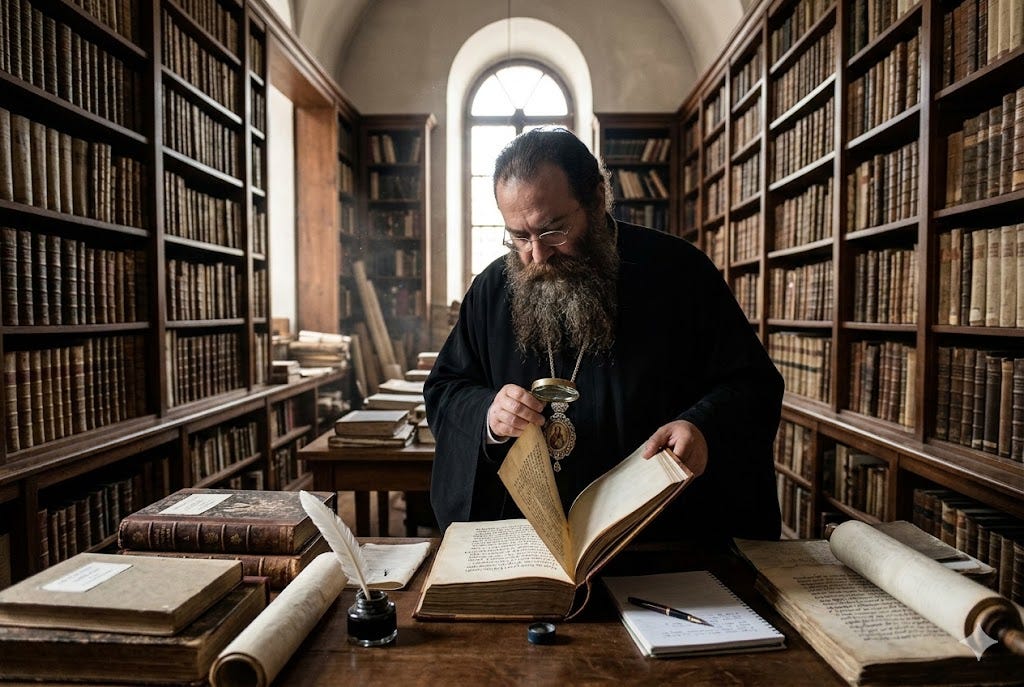
Picture this, nope not a small country farm, 1873 Constantinople. Now called Istanbul. But in 1873 it was still the seat of the Ecumenical Patriarchate of the Orthodox Church. A Greek Orthodox bishop named Philotheos Bryennios is working in the library of the Monastery of the Holy Sepulcher in the Greek quarter of the city.1 He is in his fourth decade. He has a beard you could shelter a small family in. He is a serious scholar - had studied in Germany, reads Greek the way most people read their own first language, knows the manuscripts and the Fathers cold.
He is pulling codices off shelves. Looking. Cataloging. The kind of patient, unglamorous work that academic libraries are full of at any given moment.
And at some point - we don’t know exactly which afternoon, which hour, but it happened - he pulls down a 1056 AD Byzantine codex. Opens it. Starts reading.
Inside are some things he already knows about. A letter attributed to Clement of Rome. A couple of Epistles of Barnabas. Standard patristic library material. Fine. Interesting. Nothing you’d call a sensation.
And then, tucked between these other documents, he turns a page and finds something that makes his hand stop moving across the parchment.
A title at the top of the page.
Διδαχὴ τῶν δώδεκα ἀποστόλων.
The Teaching of the Twelve Apostles.
What Bishop Bryennios is holding in his hands is a document that the Christian Church has not seen in roughly fourteen hundred years. It is mentioned by name in Eusebius, in Athanasius, in Clement of Alexandria - the greatest Fathers of the fourth century knew this book existed, knew it was very old, and some of them even thought it belonged in the New Testament canon. But the text itself had vanished. Lost. Gone. Nobody in the Western Church had laid eyes on it since the early Middle Ages. It existed only as a rumor. A ghost in the footnotes of people more famous than itself.
And Bishop Bryennios just pulled it off a shelf.
He does what any careful scholar does. He closes the book. He goes home. He takes a breath. He comes back. He reads it again. Then he sits on the discovery for ten years (I am not making this up - ten years - because he wants to make sure he has it right), and in 1883 he publishes it.
The world promptly loses its mind.
Catholic scholars, Protestant scholars, Orthodox scholars, secular scholars, all of them - they have in their hands a document that, depending on how you date it, might be older than some of the books of the New Testament. A first-century Christian handbook. A manual for baptism, fasting, prayer, Eucharist, and community life, written by somebody, for somebody, in the generation of the Apostles themselves or the generation right after.
The document has a short, formal title, but in the almost 150 years since its rediscovery it has come to be known by a single Greek word.
The Didache (pronounced did-ah-KAY, or, if you are getting fancy, did-ah-KHAY - it rhymes with “okay” and it means “teaching”).2
And when Orthodox Christians read it - I mean really read it, slowly, with the Divine Liturgy in their memory - something strange happens.
They recognize the prayers.
Not vaguely. Not in spirit. Not structurally.
Word for word.
Let me show you what I mean.
What We Actually Have
Let me establish what we are dealing with before we get to the payoff, because you deserve to know how strong the evidence actually is.
The Didache is a short document - sixteen brief chapters, maybe four thousand words in English translation. It has four parts:
The Two Ways (chapters 1-6): A moral catechism based on the Jewish “two ways” teaching tradition - the way of life versus the way of death - re-framed for Christian use. This is the part that gets used to prepare catechumens for baptism.
The Liturgical Section (chapters 7-10): Instructions for baptism, fasting, the Lord’s Prayer (prayed three times daily), and the Eucharist.
The Community Section (chapters 11-15): How to receive traveling prophets and apostles, how to appoint bishops and deacons, how to hold Sunday worship.
The Eschatological Section (chapter 16): Watch for the coming of the Lord.
The document is anonymous. It calls itself “The Lord’s Teaching Through the Twelve Apostles to the Nations” - which is not a claim to have been written by the Twelve, but a claim to be preserving what they taught. It is written in Greek. It almost certainly emerged from a Jewish-Christian community in Syria or possibly Palestine or Egypt.
And here is the thing that matters most: it describes Christian worship.
Not abstract theology. Not apologetic. Not a gospel narrative. Christian worship. How to baptize. How to pray. How to give thanks over the bread and the cup. What to do on the Lord’s Day. Which prayers to use.
This is the oldest surviving Christian worship manual we have.
And the question is - how old is it, really?
The Dating Fight
Scholarly dating of the Didache has ranged, at the extremes, from about 40 AD to about 150 AD.3 That is a genuinely wide range that is still debated.
Let me walk you through where the consensus is.
The early end of the range (50-70 AD). A significant minority of serious scholars, Jean-Paul Audet being the classic example, Alan Garrow and others more recently, argue that the Didache is pre-70 AD. Some of them think it may be older than parts of the New Testament. Their arguments are structural: the church organization the Didache describes (itinerant apostles, prophets, and teachers with only rudimentary local bishops and deacons) looks earlier than what we see in Paul’s Pastoral Epistles or in Ignatius of Antioch. Its liturgical instructions presume no institution narrative in the Eucharistic prayer, no “on the night he was betrayed, he took bread...” which is the kind of simplicity that many scholars believe reflects a very early stage of development. Its Jewish character is deep enough to suggest a community still in close conversation with Jewish worship, which fits better with pre-70 AD conditions than with the late first century after the break with the synagogue hardened.
The middle of the range (80-100 AD). Most serious scholars land here. Michael Holmes, editor of the standard Loeb Classical Library edition of the Apostolic Fathers, writes that while the Didache “may have been put into its present form as late as 150, though a date considerably closer to the end of the first century seems more probable.“4 This is the consensus comfort zone. Late first century. Roughly contemporary with the Gospel of John. Older than 2 Peter. Older than Jude. Older than Revelation.
The late end of the range (100-150 AD). A small group of scholars argues for a second-century date, usually citing the relative sophistication of some passages or the possibility that the author knew the Gospel of Matthew. Even these scholars, though, generally acknowledge that the Didache is preserving much older material, Jewish-Christian prayers and teachings that go back substantially earlier than the date of the final redaction.
Here is the important takeaway. Even the latest plausible dating of the Didache places it within living memory of the Apostles. And the most plausible dating places it in the late first century - composed by someone who could have shaken hands with people who shook hands with the Twelve.
But the dating of the final text is not really the most important question. The most important question is: how old are the prayers inside it?
Because the prayers inside a liturgical manual are almost never newly-composed at the time of writing. Liturgical manuals preserve prayers. They write down what is already being prayed. Which means the prayers in the Didache are older than the Didache itself.
How much older? We cannot know exactly. But the scholarly consensus is that the Eucharistic prayers in chapters 9-10 reflect very early Jewish-Christian practice, quite possibly going back to the apostolic period itself. Jewish liturgical scholars have shown that the prayers in Didache 10 are a direct Christian adaptation of the birkat ha-mazon, the Jewish grace after meals.5 Same structure. Same movements. Same grammatical patterns. Christianized in content - but Jewish in its bones.
Which means what we are reading, when we read Didache 9-10, is something very close to the actual Eucharistic prayers used by the apostolic generation itself.
Let me show you what they say.
Didache 9 - The Prayers Over the Cup and the Bread
Here is the text of Didache 9, in a standard English translation.6 I have formatted it to make the structure visible.
Now concerning the Eucharist, give thanks this way.
First, concerning the cup:
We thank you, our Father, for the holy vine of David your servant, which you made known to us through Jesus your Servant; to you be the glory forever.
And concerning the broken bread:
We thank you, our Father, for the life and knowledge which you made known to us through Jesus your Servant; to you be the glory forever.
Even as this broken bread was scattered over the hills, and was gathered together and became one, so let your Church be gathered together from the ends of the earth into your kingdom; for yours is the glory and the power through Jesus Christ forever.
But let no one eat or drink of your Eucharist unless they have been baptized into the name of the Lord; for concerning this also the Lord has said, “Give not that which is holy unto dogs.”
Read that again. Slowly. Out loud if you can.
I want you to notice four things about what you just read.
It is a thanksgiving. The word Eucharist (Greek eucharistia) literally means “thanksgiving.” And the prayers are, precisely and structurally, prayers of thanksgiving. We thank you, our Father. Twice. Over the cup. Over the bread. This is the theological shape of the Eucharistic action itself. Christ gave thanks before He broke the bread, Paul says Christ “took bread, and when he had given thanks, he brake it” (1 Corinthians 11:24). The Didache is preserving, at the earliest possible documentary level, the most ancient Christian name for this act. Thanksgiving. Eucharist.
It is addressed to the Father. “We thank you, our Father.” Not to Jesus directly. Not to the Holy Spirit. To the Father, through Jesus His Servant (Greek pais, which can mean “servant” or “child”). This is what the scholars call the “through Christ” structure of early Eucharistic prayer - we pray to the Father, through the Son, in the Spirit. The trinitarian grammar is already there in the earliest known text.
The image of the scattered grain. Even as this broken bread was scattered over the hills, and was gathered together and became one, so let your Church be gathered together from the ends of the earth into your kingdom. Stop and sit with that image. The bread was once scattered - individual grains of wheat, grown on different hillsides - and has been gathered into a single loaf. And that gathering of grain into bread is a sign of something else: the Church, scattered across the earth, being gathered into one through the Eucharist. It is an ecclesiology built into the prayer. You are what you eat. The Church becomes one body by eating the one bread.
And this is the one that should stop you cold. “Let no one eat or drink of your Eucharist unless they have been baptized into the name of the Lord.”
The Didache, in the first century or close to it, is drawing a line around the Eucharistic table that Orthodoxy still draws today.
Closed communion. Not a cultural quirk. Not a medieval development. Not a Byzantine innovation. Not a late piece of gatekeeping dreamed up to keep people out. It was there from the beginning. The baptized alone ate and drank. Every other Christian who showed up was welcome to hear the readings, welcome to hear the homily, welcome to pray - but the Eucharist was for those who had passed through the waters.7
If you have ever been to an Orthodox parish and been told you could not receive communion because you were not Orthodox, and you felt hurt by that, I understand. I really do. But I want you to understand what is actually happening. The Orthodox Church is not being rude to you. The Orthodox Church is doing what the Didache - The teachings of the 12 apostles - told the Church to do in the first century. The instruction has not changed. The Church has not moved. It is doing the same thing it was told to do by the Apostles themselves.
Now let me show you chapter 10.
Didache 10 - The Prayer After Communion
But after you are filled, give thanks this way:
We thank you, holy Father, for your holy name which you caused to tabernacle in our hearts, and for the knowledge and faith and immortality which you made known to us through Jesus your Servant; to you be the glory forever.
You, Master Almighty, created all things for your name’s sake; you gave food and drink to men for enjoyment, that they might give thanks to you; but to us you freely gave spiritual food and drink and life eternal through your Servant.
Before all things we thank you that you are mighty; to you be the glory forever.
Remember, Lord, your Church, to deliver it from all evil and to make it perfect in your love, and gather it together from the four winds, sanctified for your kingdom which you have prepared for it; for yours is the power and the glory forever.
Let grace come, and let this world pass away. Hosanna to the Son of David! If anyone is holy, let him come; if anyone is not, let him repent. Maranatha. Amen.
Maranatha is an Aramaic word. It means “Our Lord, come!” It is preserved here, in the Greek text of the Didache, untranslated - the same way Paul preserves it untranslated in 1 Corinthians 16:22. Maranatha. The prayer for the return of Christ.
That one word is doing enormous historical work. The author of the Didache, writing in Greek, feels the need to preserve the original Aramaic. Which means this prayer was so ancient, so deeply rooted in the apostolic community, that even in a Greek-speaking context it was still prayed in the original Aramaic of the earliest Jewish-Christian Church in Jerusalem.
This is what the Twelve prayed.
Not might have prayed. Not probably prayed. Prayed. In the Upper Room. In the Temple courts. In the homes where they broke bread daily. The Aramaic word that the author of the Didache preserves untranslated is the same word the Apostles shouted in their own language when they longed for their Lord to return.
What Your Orthodox Parish Is Praying This Sunday
I want to show you what happens when you hold the Didache’s prayers up against the prayers of the modern Orthodox Divine Liturgy.
Before I do, a technical caveat. The two Eucharistic prayers in Didache 9-10 are not the direct literary ancestors of any one modern anaphora. The modern Orthodox Divine Liturgy - whether the Liturgy of St. John Chrysostom or the Liturgy of St. Basil, which we will examine in Article 6 - uses a longer, more developed form of Eucharistic prayer that includes the words of institution (”on the night He was betrayed...”) that the Didache does not include.8 So the claim I want to make is not “modern Orthodox prayers are cut-and-pasted from the Didache.”
The claim I am making is something different, and in some ways more profound. The claim is that the Didache and the modern Orthodox Divine Liturgy share a common shape, a common vocabulary, and in several places common specific language - because both of them are drawing on the same apostolic stream of liturgical practice.
Let me show you what I mean. I am going to pick four specific places where the overlap is striking.
Overlap 1: “To you be the glory forever.”
The Didache’s Eucharistic prayers keep returning to a specific doxological9 refrain - “to you be the glory forever.” It appears four times in Didache 9-10. It is the constant downbeat of the thanksgiving.
Walk into an Orthodox parish today. Listen to any Divine Liturgy. At the end of virtually every priestly prayer, you will hear some version of the doxology: “For Yours is the glory, Father, Son, and Holy Spirit, now and ever, and unto the ages of ages. Amen.” This is not a medieval invention or a Byzantine flourish. This is the exact doxological shape of the Didache’s Eucharistic prayer, still being prayed at every Divine Liturgy in the world, almost two thousand years later.
Overlap 2: “Remember, Lord, Your Church.”
Didache 10: “Remember, Lord, your Church, to deliver it from all evil, and to make it perfect in your love, and gather it together from the four winds.”
Open the Liturgy of St. John Chrysostom. In the Anaphora - the Great Eucharistic Prayer that we will examine in detail in Article 5 - the priest prays: “Again we offer unto You this reasonable service, for the whole world, for the Holy Catholic and Apostolic Church... Remember, O Lord, every Bishop of the Orthodox... Remember, O Lord, this city in which we dwell, and every city and countryside... Remember, O Lord, those who travel...”
The same verb. “Remember, Lord.” The same object. The Church. The same movement of prayer - gathering up the whole Body of Christ and setting it before the Father. The Didache’s remember is preserved, elaborated, made universal, but unmistakably the same prayer.
Overlap 3: “Gather Your Church.”
Didache 9: “Let your Church be gathered together from the ends of the earth into your kingdom.”
Didache 10: “Gather it together from the four winds, sanctified for your kingdom which you have prepared for it.”
Liturgy of St. Basil: “...that all of us who share in the one Bread and the one Cup may be united to one another in the communion of the one Holy Spirit, and that none of us may partake of the holy Body and Blood of Your Christ unto judgment or condemnation.” The prayer for unity in the Eucharist, for the gathering of the Church into one body through the one bread. Same theological vision. Same liturgical request.
Overlap 4: The Invitation and the Response.
Didache 10 ends with an extraordinary exchange: “Let grace come, and let this world pass away. Hosanna to the Son of David! If anyone is holy, let him come; if anyone is not, let him repent. Maranatha. Amen.”
The pattern is a public invitation to communion, if anyone is holy, let him come, followed by a congregational Hosanna and an eschatological cry: Maranatha, our Lord come.
Now listen to what happens in every Orthodox Divine Liturgy at the moment of communion. The priest lifts the holy gifts and cries out: “The Holy Gifts for the holy people of God!” The congregation responds: “One is Holy, One is Lord, Jesus Christ, to the glory of God the Father. Amen.” And before communion the congregation sings: “Blessed is he who comes in the name of the Lord... Hosanna in the highest!”
The public invitation, the call for holiness, the response of faith, the Hosanna, the cry for the coming of the Lord. It is the shape of Didache 10, scaled up and liturgically elaborated. But the shape is the same. The ancient structure holds.
Four overlaps. There are more. These are enough to make the point.
Didache 14 - The Hinge
Now I want to show you the verse that Article 3 was setting up.
In Article 3 (go read it, if you haven’t already - it contains the setup for everything I am about to say), I made the claim that the Liturgy of the Faithful is the fulfillment of Temple sacrificial worship in Christ. I told you that the Fathers read Malachi 1:11 as the key prophecy of this fulfillment: “From the rising of the sun even to its setting, my name shall be great among the nations, and in every place incense shall be offered to my name, and a pure offering.”
I promised that Article 5 would develop this claim in detail. But I want to show you, right now, that this reading of Malachi is not a later invention of the Fathers. It is not a fourth-century development. It is there in the Didache.
Here is Didache chapter 14, in full. It is only a few sentences long.
On the Lord’s day of the Lord, come together, break bread, and give thanks, after confessing your transgressions, that your sacrifice may be pure.
But let no one who has a quarrel with his companion join with you until they are reconciled, that your sacrifice may not be defiled.
For this is what the Lord has said: “In every place and time offer me a pure sacrifice, for I am a great King, says the Lord, and my name is wonderful among the nations.”
Stop. You should probably read that again.
The Didache - possibly first-century, almost certainly within living memory of the Apostles - is doing four things in these three sentences that change everything.
It is giving instructions for Sunday worship. “On the Lord’s day of the Lord, come together.” The weekly pattern is already fixed. Sunday gathering. Not Saturday synagogue. Not a Passover-only annual Eucharist. Every Sunday, the Church gathers. This is the pattern that Justin Martyr describes fifty to a hundred years later, and here it is already assumed.
It is calling the Eucharist a sacrifice. “That your sacrifice may be pure... that your sacrifice may not be defiled.” The word is thysia. It is the technical Greek word for a Temple sacrifice. The Didache is calling the Sunday Eucharistic gathering a sacrifice. In the first century. In a Christian document. Before there was a Vatican, before there was a Pope, before there were any of the medieval developments that Protestant polemics often blame for “inventing” the idea of the Eucharist as sacrifice. It is there, at the earliest possible documentary level, in the earliest surviving Christian liturgical manual.
It is requiring confession before communion. “After confessing your transgressions, that your sacrifice may be pure.” Communion is preceded by confession. Personal reconciliation is required first - “let no one who has a quarrel with his companion join with you until they are reconciled.” This is the ancient Christian discipline. It is still the Orthodox discipline today. Confession before communion. Reconciliation before approaching the altar. The instruction has not changed.
The Didache is explicitly citing Malachi 1:11 as the scriptural warrant for calling the Eucharist a sacrifice.
“For this is what the Lord has said: In every place and time offer me a pure sacrifice, for I am a great King, says the Lord, and my name is wonderful among the nations.”
The author of the Didache, writing down the practices of his community, has already worked out the Malachi 1:11 reading of the Eucharist that the Fathers would later develop in vast theological detail, indicating (at least to me) that this thread of thought predated any future patristic exegesis.
This is not a later invention, nor is this is a medieval Roman Catholic sacramental overreach. It is right there. In the oldest surviving Christian worship manual we have. The Eucharist is the pure offering prophesied by Malachi, made in every place, among the nations, fulfilling the Temple sacrificial system in Christ.
Which means the claim I made in Article 3 - that the Liturgy of the Faithful is the fulfillment of Temple worship - is not my claim. It is not an Orthodox claim. It is not a patristic claim. It is a first-century Christian claim, preserved in the earliest document of Christian worship we possess.
Lex orandi, lex credendi. The law of prayer is the law of belief.
The first Christians prayed this way because they believed this. They believed the Eucharist was the pure offering of Malachi, the fulfillment of Temple sacrifice, made in every place, among the nations, through the Body and Blood of Christ. And they are still praying this way, every Sunday, in every Orthodox parish on earth.
The Didache stands as a witness
What This Means
I want to close by naming what the Didache does and does not do, because this is a case where over claiming would weaken the argument.
The Didache does not give us a complete liturgy. It gives us prayers and instructions, but not a full order of service. We do not have a moment-by-moment script for what happened in Didache-era Sunday worship.
The Didache does not give us the institution narrative. The words “This is my body... this is my blood” are not in the Didache’s Eucharistic prayer. This is a real feature of the text and scholars argue about why - possibly because the institution narrative was so central that it went without saying, possibly because Didache 9-10 is an Agape meal blessing with the Eucharist proper happening separately, possibly because the institution narrative had not yet been fixed in the exact form that later liturgies would use. The honest answer is that we are not sure.
The Didache does not solve every question about early Christian worship. There are things it assumes that we wish it had explained, things it leaves out that we wish it had included, and ambiguities in the Greek that scholars will still be arguing about in another hundred and fifty years.
But what the Didache does give us is enormous. It gives us - within living memory of the Apostles - a document that shows us:
A Christian community already meeting on Sunday rather than Saturday
Already calling its central rite Eucharist (thanksgiving)
Already praying structured Eucharistic prayers that share specific language with the modern Orthodox Divine Liturgy
Already restricting communion to the baptized
Already requiring confession before communion
Already calling the Eucharist a sacrifice
Already citing Malachi 1:11 as the prophetic warrant for that sacrificial reading
Already praying “Maranatha” in Aramaic, the language of the Twelve
Every one of these elements is still present in the Orthodox Divine Liturgy.
If you want to argue that Orthodox Christianity is a medieval development, a Byzantine accretion, a late distortion of some simpler earlier Christianity, you have to explain not only everything in the past 3 articles, but the Didache itself. You have to explain why the oldest Christian worship manual we possess looks like a shorter, simpler version of what is happening in an Orthodox parish down the street from you.
I am not sure it can be explained. I am not sure it has been explained by anyone, ever, in any sustained apologetic against Orthodox liturgical claims. The Didache is there. It is an embarrassment to every idea of Christian worship that says the apostolic Church was simpler, more Protestant, more Mormon, more improvisational, less sacramental than what later traditions developed. The apostolic Church was already doing what Orthodox Christians do now.
The apostolic Church was offering the Eucharist. The apostolic Church was restricting it to the baptized. The apostolic Church was confessing sin before communion. The apostolic Church was calling the Eucharist a sacrifice. The apostolic Church was reading Malachi 1:11 as a prophecy of that sacrifice.
The Apostles were there first.
It is time we caught up.
Next week we go deeper into the prayer itself. In Article 5, we will examine the Anaphora - the Great Eucharistic Prayer that sits at the heart of every Orthodox Divine Liturgy. We will see how the Anaphora fulfills the Kedushah of the Jewish synagogue, how it sings the Sanctus that Isaiah heard the seraphim singing in the Temple in the year that King Uzziah died, how it re-presents the one sacrifice of Christ on Calvary, and how it performs the Temple fulfillment that the Didache was already pointing toward. If you thought the Didache was a sensation, wait until we examine the Anaphora.
Become a paid subscriber if you haven’t already. The series only works as a whole. And the Anaphora is where all the roads meet.
Primary Sources
The Didache is short enough that you can read it yourself in one sitting. Please do. Don’t take my word for any of this.
The Didache, full text (Roberts-Donaldson translation) - One of the most commonly cited public-domain English translations. Read the full text at New Advent here.
The Didache, full text (Charles H. Hoole translation) - An alternate early English translation. Read it at Early Christian Writings here.
The Didache, full text (Kirsopp Lake translation from the Loeb Classical Library) - The scholarly standard English edition. Read it at Early Christian Writings here.
Malachi 1:11 - The prophecy of a pure offering made in every place among the nations, cited in Didache 14. Read it here.
1 Corinthians 11:23-26 - Paul’s account of the institution of the Eucharist, including the “gave thanks” (eucharistesas) verb that gives the Eucharist its name. Read it here.
1 Corinthians 16:22 - Paul’s preservation of the Aramaic Maranatha prayer. Read it here.
Eusebius, Ecclesiastical History, Book 3, chapter 25 - Eusebius’s fourth-century catalogue of Christian writings, which mentions “the so-called Teachings of the Apostles“ - one of the patristic references that confirmed the Didache had existed long before its rediscovery in 1873. Read it here.
Athanasius, 39th Festal Letter (367 AD) - Athanasius recommends the Didache as useful reading for catechumens, confirming its continued circulation in the fourth-century Church. Read it here.
For readers who want to go deeper: The standard English-language critical edition of the Apostolic Fathers, including the Didache with introduction and notes, is Michael W. Holmes, The Apostolic Fathers: Greek Texts and English Translations (Baker Academic, 3rd edition, 2007). For the scholarly debates around dating and composition, Huub van de Sandt and David Flusser’s The Didache: Its Jewish Sources and its Place in Early Judaism and Christianity (Fortress Press, 2002) is the most thorough single-volume treatment. For the Jewish liturgical background - particularly the parallels between Didache 10 and the birkat ha-mazon - please see Enrico Mazza’s The Origins of the Eucharistic Prayer (Liturgical Press, 1995)
The monastery library at the Holy Sepulchre in Constantinople was (and is) a metochion - a daughter institution - of the Patriarchate of Jerusalem. Bishop Bryennios (sometimes spelled Bryennius) was the Metropolitan of Serres in 1873 when he made the discovery, and later became Metropolitan of Nicomedia. He died in 1917. The codex itself is now known as the Codex Hierosolymitanus and was moved after its discovery to the library of the Patriarchate of Jerusalem.
The pronunciation did-ah-KAY is the common anglicization. The Greek is Διδαχή (didakhē), with the accent on the final syllable. If you want to be strict about it, the third syllable is actually a chi (χ), which is pronounced like the ch in Scottish “loch” or German “Bach” - so it is more precisely did-ah-KHAY. If you say did-ah-KAY at your next dinner party, nobody will correct you. If you say did-ah-KHAY, the one classics major at the table will nod approvingly. Your call.
The dating history of the Didache is itself a fascinating scholarly detective story. When it was first published in 1883, the dominant scholarly view placed it in the second or third century. Over the next century, as scholars studied the text more carefully and better understood its relationship to Jewish liturgical sources and to the earliest strata of Christian tradition, the dating consensus moved progressively earlier. Jean-Paul Audet’s La Didachè: Instructions des Apôtres (1958) was a watershed - Audet argued for a date of 50-70 AD, which was radical at the time and is now a respectable minority view. Today, most scholars are comfortable somewhere in the late first century, though reasonable people can and do disagree.
Michael W. Holmes, The Apostolic Fathers: Greek Texts and English Translations, 3rd ed. (Baker Academic, 2007), pp. 337-338. Italics mine. Holmes is the standard English-language critical editor of the Apostolic Fathers and his judgment carries considerable weight in the field.
The birkat ha-mazon is the Jewish grace after meals - a three-part blessing thanking God for food, for the land of Israel, and asking for the restoration of Jerusalem. Jewish liturgical scholars have demonstrated, in painstaking detail, that the prayer structure in Didache 10 is a direct Christian adaptation of this Jewish table grace. The best single treatment is Enrico Mazza, The Origins of the Eucharistic Prayer (Liturgical Press, 1995), chapter 2. Mazza is a Catholic liturgical scholar but his analysis is technical and sober, not apologetic.
The translation I am using here is a lightly-modernized version of the Roberts-Donaldson translation from the Ante-Nicene Fathers. It is not copyrighted and you can verify the entire text against New Advent if you want to check my work. For those who want to go deeper, Kirsopp Lake’s Loeb Classical Library translation (available at Early Christian Writings) is considered the scholarly standard.
I know this is a hard pill for Protestant readers who are used to open communion. And I want to be clear that I am not writing this to make you feel bad (although admittedly I’ve never shied away from doing so.) I am writing to show you what the actual ancient Christian practice was. If the Didache tells us, in the first century, that only the baptized ate and drank at the Eucharist, then any modern Christian tradition that practices open communion (including the LDS church) is departing from apostolic practice, not returning to it. That is worth sitting with. It does not mean your tradition is wicked or that Orthodox Christians hate you. It means that on this specific point, the Orthodox Church is doing what the Didache said to do, and your tradition is doing something different. Which of us is closer to what the Apostles actually taught? That is a question worth asking honestly if you are brave enough to ask it.
The absence of the institution narrative in Didache 9-10 is one of the most discussed features of the text. Some scholars (Crossan, Riggs) argue that Didache 9-10 is an Agape meal blessing, not a proper Eucharistic prayer, and that the Eucharist itself happened separately. Others argue that the institution narrative was so central that it was considered unnecessary to write down in a community that knew it by heart. Still others argue that the Didache reflects an early stage of liturgical development before the institution narrative was universally included in the Eucharistic Prayer. What is striking is that the Syrian liturgy known as the Holy Qurbana of Addai and Mari - still in use in the Assyrian Church of the East today - also lacks the institution narrative. The Roman Catholic Church, remarkably, recognized the validity of this ancient Syrian liturgy’s Eucharist in 2001. Which means that the pattern we see in the Didache - a Eucharistic prayer without the institution narrative - may be preserved intact in one of the oldest continuously-used liturgies on earth. That is a separate article, but it is worth noting.
A doxology is a short liturgical formula of praise to God, typically used in Christian worship services