


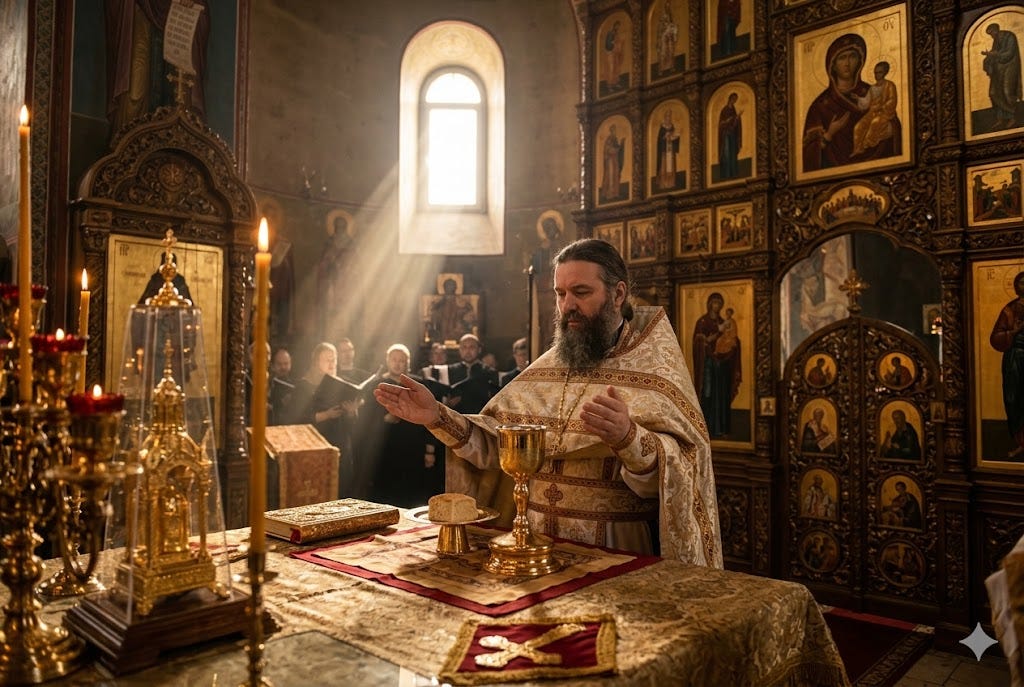
Please note, this is article 5 in a 6 part series. It is somewhat important that you read them in sequence.
I want to start with a confession. This is the article I have been most afraid to write. Not because the argument is hard - by this point in the series, four articles in, the argument is mostly built. Article 1 showed you that the early Church was already doing the Divine Liturgy by 155 AD. Article 2 showed you that the architecture of every Orthodox parish is the Jerusalem Temple fulfilled in Christ. Article 3 showed you that the first half of the Liturgy is the synagogue service Jesus attended every Sabbath of His life, and that the second half - the part we are about to walk into - is the fulfillment of Temple sacrificial worship. Article 4 showed you that all of this is documented in the Didache - a manual older than parts of the New Testament, including the explicit reading of Malachi 1:11 as the prophecy of the Eucharistic sacrifice.
So the argument is laid. The framework is built. What is left is to walk you into the room itself. And that is what scares me, because the room I am about to walk you into is the most sacred space in Christian worship, and I am not an ordained priest, I’m not even a seminarian, so I’m trying to tread extremely carefully, because I don’t fully feel qualified to write this, despite copious amounts of checking materials, conferring with AI assistants, etc.
This is the prayer the priest prays at the altar. The prayer the Seraphim sing. The prayer the Apostles handed down. The prayer that calls bread and wine and turns them, by the descent of the Holy Spirit, into the Body and Blood of the Risen Christ.
It is called the Anaphora.
And to write about the Anaphora is to attempt to describe, in human words, the prayer that joins heaven to earth.
I am going to do my best. I am going to try to be precise. I am going to be very careful. I am going to keep my hands open and my voice quiet, the way you should when you walk into a holy place. And I am going to ask, before we begin, that you read this article slowly. Not because the argument is complicated - though it is - but because what we are walking into deserves slow reading.1
Any errors in this document are mine and due to my own human limitations.
Let’s -a- go. (like from mario kart)
What the Word Means
The Greek word anaphora (ἀναφορά) comes from the verb anapherō, which means “to carry up” or “to offer up” or “to bring up.” It is the same root from which we get the English word “metaphor” (literally “carrying across”). Ana means “up.” Pherō means “to bear” or “to carry.”
The Anaphora, then, is the carrying up.
It is the offering. The prayer that lifts the bread and wine, and with them, the whole Church, and with the Church, the whole world, up to God the Father, through God the Son, in God the Holy Spirit.
Every ancient Christian liturgy on earth has an Anaphora. The Roman Mass has one (called the Eucharistic Prayer in modern English). The Coptic Liturgy has one. The Armenian Liturgy has one. The Ethiopian Liturgy has one. The Syriac Liturgy has one. The Maronite Liturgy has one. The various Byzantine Liturgies have several (we will examine the major two in Article 6). Every single one of these traditions, now separated from each other by centuries and continents and the theological controversies that shattered communion between them, all retain an Anaphora at the center of their Eucharistic worship.2
And every one of these Anaphoras has the same essential shape.
This is not a coincidence. It is evidence. The shape of the Anaphora goes back to the apostolic period, before any of these traditions had separated from each other. They all preserved the same prayer because they all received the same prayer. From the same Apostles. Who received it from the same Christ.
I want you to sit with that for a second. There is no other prayer in the world that has this property. The Anaphora is, structurally, theologically, liturgically, the most cross-traditional prayer in Christian history. Eastern and Western, Greek and Latin and Syriac and Ge’ez (Ethiopian) and Coptic and Armenian. All of them, doing the same thing, in the same order, with the same essential words.
That is what the apostolic deposit looks like when it is preserved across two thousand years.
The Eleven Movements
The Byzantine Anaphora - the one prayed in every Greek, Russian, Romanian, Serbian, Bulgarian, Antiochian, and other Orthodox parish on earth - has eleven distinct movements.3 I am going to name all eleven now, briefly, so you have a map of where we are going. Then we will walk through each one. I have included the Greek terms where possible.
The Opening Dialogue/The Eisodos - sometimes referred to as the Prooímion (Προοίμιον.) “The grace of our Lord Jesus Christ...”
The Próphasis/Preface - “It is meet and right...”
The Pre-Sanctus/Eulogētikḗ - The transition into the angelic hymn, the prayer leading to the triumphal hymn
The Epinikios - The triumphal hymn. “Holy, Holy, Holy...”
The Post-Sanctus/Prayer of Thanksgiving - The remembrance of God’s saving acts
The Institution Narrative (Words of Institution) or Sýstasis - “Take, eat... Drink ye all of it...”
The Anamnesis - “Remembering, therefore...”
The Epiclesis/Epíklēsis- The calling down of the Holy Spirit
The Intercessions/Diptycha - “Remember, O Lord...”
The Doxology/Doxología - “And grant us with one mouth and one heart to glorify...”
The Great Amen - The congregation’s response sealing the prayer
Eleven movements. Each one doing specific theological work. Each one inheriting specific elements from synagogue, Temple, Apostles, or all three. Each one preserved across two thousand years and across every ancient Christian tradition.
Let’s walk through them.
Movement One: The Opening Dialogue / The Eisodos
The Anaphora begins with a dialogue between the priest and the people.
Priest: The grace of our Lord Jesus Christ, and the love of God the Father, and the communion of the Holy Spirit be with you all.
People: And with your spirit.
Priest: Let us lift up our hearts.
People: We lift them up unto the Lord.
Priest: Let us give thanks unto the Lord.
People: It is meet and right. (my parish uses a slightly different translation that says it is proper and right.)
You have already heard part of this. The opening blessing is taken almost word-for-word from 2 Corinthians 13:14 - the apostolic benediction Paul wrote to the Corinthian church around 56 AD. The Christian liturgy did not invent this opening. It received it from Paul.
But the rest of the dialogue is even older than Paul.
“Lift up your hearts.” In Latin: Sursum corda. This is the most ancient surviving liturgical formula in Christian history. It is attested in Hippolytus of Rome’s Apostolic Tradition (around 215 AD), which is the earliest detailed description of a Christian liturgical service we have. It is identical in every Christian tradition - Eastern, Western, Coptic, Armenian, Ethiopian, Syriac, Maronite. Every. Single. One.
Which means Sursum corda must be older than any of these traditions had separated from each other. It must be apostolic.4
And what is it doing?
It is calling the congregation out of this world.
Lift up your hearts. Not your eyes. Not your hands. Your hearts. The center of your being. The seat of your will. The place where you actually live. Lift them up. Lift them out of the city outside. Lift them out of your job, your worries, your relationships, your phone, your bank account, your children, your marriage, your fears about the future and your regrets about the past. Lift them up unto the Lord.
Because what is about to happen cannot happen at the level of your everyday consciousness. What is about to happen is that the priest is going to step into the place of the High Priest, the bread and wine on the altar are going to become the Body and Blood of Christ, and the entire assembly is going to be carried up - anaphora, carried up - into the heavenly throne room where the Seraphim are singing. You cannot do that with your heart still doom scrolling on your phone. Lift up your hearts.
The people respond: We lift them up unto the Lord. This is not a formality. It is a vow. The congregation is committing actively and verbally to be present for what is about to happen.
And then: Let us give thanks unto the Lord. Eucharistesomen. Let us eucharist. The verb form of the noun. The prayer is named for what it is doing.
It is meet [proper] and right. The people agree. The thanksgiving begins.
Movement Two: The Preface / Próphasis
The priest now begins the great prayer of thanksgiving.
It is proper and right to hymn You, to bless You, to praise You, to give thanks to You, and to worship You in every place of Your dominion. For You, O God, are ineffable, inconceivable, invisible, incomprehensible, existing forever, forever the same, You and Your only-begotten Son and Your Holy Spirit. You brought us out of nothing into being, and when we had fallen away, You raised us up again. You left nothing undone until you had led us up to heaven and granted us Your Kingdom, which is to come.
Quoted From the the liturgy of St. John Chrysostom on the Greek Orthodox Archdiocese of America’s website, you can read it yourself here:
Stop and listen to what just happened.
This is thanksgiving on the cosmic scale. The priest is not thanking God for nice weather. The priest is thanking God for creation (you brought us out of nonexistence into being), for salvation (when we had fallen, you raised us up again), and for eschatology (you brought us up to heaven and granted us your Kingdom which is to come).
The whole of salvation history, compressed into three clauses. Past, present, future. Created, fallen, redeemed, glorified.
This is the architecture of all Eucharistic prayer. The Eucharist is not just a meal of remembrance. It is a recapitulation a calling-back of the entire arc of God’s saving action so that the offering about to be made participates in all of it. The bread and wine on the altar are not isolated objects. They are about to become the focal point of the entire cosmic drama.
You can hear, in this Preface, the structure of the Jewish berakhah - the blessing-prayer that names God as Creator, as Redeemer, as the Holy One of Israel. Article 4 showed you the birkat ha-mazon, the Jewish grace after meals, with its three-part structure of blessing for creation, blessing for the land, and prayer for restoration. The Anaphora’s Preface is the Christian fulfillment of that pattern. Same structure. Same theological architecture. Filled with Christ.
Movement Three: The Eulogētikḗ or Pre-Sanctus
The Preface flows directly into the Pre-Sanctus, which is the transition into the angelic hymn:
We thank You also for this Liturgy, which You have deigned to receive from our hands, even though thousands of archangels and tens of thousands of angels stand around You, the Cherubim and Seraphim, six-winged, many-eyed, soaring aloft upon their wings,
singing the triumphal hymn, exclaiming, proclaiming, and saying: Singing the triumphal hymn, exclaiming, proclaiming, and saying…
The priest is now naming what is happening in the heavenly places at this exact moment.
The earthly assembly is not alone. The earthly assembly is being joined - is already joined, is in fact already singing with - the angelic hosts who stand around the throne of God. The Liturgy on earth is not a separate event from the Liturgy in heaven. They are the same Liturgy, one performed in time and the other in eternity, and at this moment in the prayer they converge.
Soaring with their wings. That is a direct allusion to Isaiah 6:2 - the Seraphim Isaiah saw, who “each had six wings; with twain he covered his face, and with twain he covered his feet, and with twain he did fly.”
Many-eyed. That is an allusion to Ezekiel 1:18 - the four living creatures Ezekiel saw, whose rings were “full of eyes round about.” And to Revelation 4:8 - the four living creatures John saw around the throne, who were “full of eyes within.”
The Anaphora is now doing something extraordinary. It is naming, by their biblical descriptions, the angelic beings who are present in the room. Not metaphorically present. Liturgically present. The Pre-Sanctus is the priest saying, in effect: we are about to sing with them. They are here. They are singing. We are joining their song.
And what is the song?
Movement Four: The Epinikios (Ἐπινίκιος’) - the triumphal hymn, aka the Sanctus
The congregation now sings the most ancient and universal hymn in the entire Christian liturgical tradition.
Holy, Holy, Holy, Lord of Sabaoth (Lord of the Angelic Hosts)!
Heaven and earth are filled with Your glory!
Hosanna in the highest!
Blessed is He who comes in the name of the Lord!
Hosanna in the highest!
This is the Epinikios. And I want to take my time with this one, because it is the moment in the Liturgy where every thread of this entire series ties together.
The first half of the Sanctus - Holy, Holy, Holy, Lord of Sabaoth! Heaven and earth are full of Your glory! - is taken directly from Isaiah 6:3. It is the song the prophet Isaiah heard the seraphim singing in the Temple in the year that King Uzziah died. ⁵
The second half - Hosanna in the highest! Blessed is He who comes in the name of the Lord! - is from Psalm 118:26 and from the crowds’ acclamation as Christ entered Jerusalem on Palm Sunday in Matthew 21:9.
And here is what I want you to see.
The Epinikios is not a Christian invention. It is an inheritance.
The Jewish synagogue prayer called the Kedushah (Hebrew for “holiness” or “sanctification”) combines exactly the same Isaiah 6:3 hymn with a verse from Ezekiel 3:12 - “Blessed be the glory of the LORD from his place.” The Kedushah is the moment in synagogue worship when the congregation joins the angelic praise of God. The community stands. They sing the seraphic hymn. They join the worship of heaven.
The Christian Epinikios is doing the same thing. With one critical change. The second half of the Epinikios is no longer Ezekiel’s “Blessed be the glory of the LORD from his place.” It is the crowd’s “Blessed is He who comes in the name of the Lord.” The blessing is no longer of an abstract glory. It is of a Person. The One who comes.
And the One who comes - the One whose coming the crowd was acclaiming when they sang this in Jerusalem on Palm Sunday - is Christ.
The Christian Epinikios has taken the Jewish Kedushah and Christified it. The angelic hymn of Isaiah 6 still calls the congregation into the worship of heaven. But the second half of the hymn now identifies, by name, the One whose coming makes that worship possible. The He who comes in the name of the Lord is the One whose Body and Blood are about to be made present on the altar. The Epinikios is announcing His arrival.
In Article 3, I told you that the Liturgy of the Word inherits the synagogue service, and the Liturgy of the Faithful fulfills the Temple. The Epinikios is both at once. It is the synagogue’s Kedushah, drawn from the prophet’s Temple vision in Isaiah 6, sung by the congregation joining the angels’ eternal song around the throne of God, identifying by name the Christ whose body is about to be offered as the pure offering Malachi prophesied. Synagogue, Temple, Christ. All three. Converging in one hymn.
The hymn that is now being sung this very Sunday morning, in every Orthodox parish on earth, by congregations who may not even realize what they are doing.
They are joining the seraphim. They are praying the Kedushah of their elder brothers in the synagogue. They are standing in the Temple where Isaiah stood. And they are welcoming Christ, the One who comes in the name of the Lord, into the bread and wine on the altar in front of them.
Lex orandi, lex credendi. The law of prayer is the law of belief.
The Christian Epinikios has been sung continuously, by every ancient Christian tradition on earth, for at least 1,800 years - and probably longer. It is referenced in Clement of Rome’s letter to the Corinthians (around 95 AD), in Ignatius of Antioch’s letter to the Ephesians (around 107 AD), in Tertullian (early 200s), and is a fixed element of every surviving fourth-century liturgical text. The Epinikios did not develop late. The Epinikios is the prayer of the apostolic Church.
Which means that when you stand in an Orthodox parish on Sunday morning and hear the choir begin “Holy, Holy, Holy, Lord of Sabaoth!” - you are hearing the song the Apostles sang. You are hearing the song their Jewish ancestors sang in the synagogues of Galilee and Judea. You are hearing the song Isaiah heard the seraphim sing in the Temple in the year that King Uzziah died.5 And you are hearing the song that has not stopped being sung, in some place on earth, every Sunday for two thousand years.
The hymn does not break. The hymn cannot break. The hymn is the song of the angelic worship of God in heaven, and that worship has been continuous from before time and will be continuous beyond time.
The Liturgy is letting you join it.
Movement Five: The Post-Epinikios / Post-Sanctus
After the Epinikios, the Anaphora continues with what is called the Post-Epinikios - the priest’s prayer that picks up the thanksgiving and carries it into the remembrance of Christ’s saving work.
Together with these blessed powers, Master, Who loves mankind, we also exclaim and say: Holy are You and most holy, You and Your only-begotten Son and Your Holy Spirit. Holy are You and most holy, and sublime is Your glory. You so loved Your world that You gave Your only-begotten Son so that everyone who believes in Him should not perish, but have eternal life. When He had come and fulfilled for our sake the entire plan of salvation, on the night in which He was delivered up, or rather when He delivered Himself up for the life of the world, He took bread in His holy, pure, and blameless hands, and, giving thanks and blessing, He hallowed and broke it, and gave it to His holy disciples and apostles, saying:
Let’s take notice of what just happened.
The priest moved from the general praise of God to the specific moment of the Last Supper. The Anaphora is now doing what every ancient Eucharistic prayer does at this point: it is narrating the institution of the Eucharist itself.
You can hear the verbatim quotation of John 3:16 - “You so loved Your world that You gave Your only-begotten Son...” The prayer is weaving Scripture into itself. Not as proof-texts. As prayer. The Word of God is being prayed back to God in the Liturgy.
And then the prayer arrives at the moment of the Last Supper itself.
Movement Six: The Sýstasis or Words of Institution
The priest now speaks the words of Christ Himself.
Take, eat. This is my Body which is broken for you for the remission of sins.
Likewise, after partaking of the supper, He took the cup, saying,
Amen.
Drink of this, all of you; this is My Blood of the new covenant, which is shed for you and for many for the remission of sins.
Amen.
This is what is called the Words of Institution or the Institution Narrative. It is the priest, speaking in the person of Christ, repeating the words Christ Himself spoke at the Last Supper.
The four Gospel and Pauline accounts of these words (Matthew 26:26-28, Mark 14:22-24, Luke 22:19-20, and 1 Corinthians 11:23-25) are conflated into the liturgical form. The Anaphora is not quoting one Gospel. It is praying what Christ said. The narrative is being re-presented not as historical reportage but as living liturgical action.
A small word about Eastern and Western theology here, because it matters.6
In Western Roman Catholic theology, particularly after the medieval period, the Institution Narrative came to be understood as the moment of consecration - the precise instant at which the bread and wine become the Body and Blood of Christ. The priest speaks the words of Christ, and at that moment the change happens.
Eastern Orthodox theology has historically located the moment of consecration later in the prayer - at the Epíklēsis, when the Holy Spirit is called down upon the gifts. The Institution Narrative establishes what is about to happen and by whose authority, but the change itself happens by the Spirit, in response to the Church’s prayer.
Both traditions agree that the bread and wine become the Body and Blood of Christ. They differ on the precise when and how of the change. The Eastern emphasis on the Epíklēsis preserves something the Didache already showed us in Article 4: that the Eucharistic prayer is fundamentally an act of the whole Church, not a magical formula spoken by an individual priest. The change happens because the Holy Spirit responds to the Church’s offering.
For now, what matters is that the priest has just spoken the words of Christ. The bread and wine on the altar are no longer being merely held. They are being identified. The priest has just announced what they are about to become.
Movement Seven: The Anámnēsis
After the Institution Narrative comes one of the most theologically dense moments in all of Christian liturgy.
Remembering, therefore, this saving commandment and all that has been done for us: the Cross, the Tomb, the Resurrection on the third day, the Ascension into heaven, the Sitting at the right hand, and the second and glorious Coming again - Yours of Your own we offer to You, on behalf of all and for all.
The Greek word for “remembering” here is Anámnēsis - the same word Christ used at the Last Supper when He said “Do this in remembrance of Me” (Luke 22:19). And anámnēsis in this context does not mean what English speakers usually mean by “remembrance.” (suck it Ulrich Zwingli!) It does not mean thinking about something that happened in the past.
It means making something present.
In Hebrew thought, when a community remembers a saving event - the Passover, the Exodus, the giving of the Law - it does not merely recall it intellectually. The community enters the event. It becomes present to it. The past saving act becomes liturgically present in the now.
That is what is happening here. The priest is naming, in sequence, every saving event of Christ - the Cross, the Tomb, the Resurrection, the Ascension, the Sitting, and the second Coming - and re-presenting them, all of them, as present realities in this Liturgy at this moment.
Notice the verb tense on the second Coming. “Remembering... the second and glorious Coming again.” You can only “remember” something that has happened. But the Anaphora remembers Christ’s future coming. Because in the Liturgy, time is folded. The Coming has happened, is happening, will happen, and we are present to all of it at once.
And then, having made all of this present, the priest offers it. “Yours of Your own we offer to You, on behalf of all and for all.”
This is the line that breaks the question of who is offering and who is receiving.
The bread and wine on the altar - the prosphora the people brought, the wine pressed from grapes God grew in soil God created, watered by rain God sent - all of it is Yours of Your own. The Church is not bringing God anything that did not first come from Him. We offer back to God what He first gave us. On behalf of all and for all.
This is why the Eucharist is a sacrifice and not a payment. It is not us giving God something to pacify Him. It is us returning to God His own gifts, transformed by His own action, on behalf of His own world. The whole movement is grace.
The congregation responds with one of the most ancient hymns in the liturgy:
We praise You, we bless You, we thank You, O Lord, and we pray to You, our God.
And now the prayer arrives at its center.
Movement Eight: The Epíklēsis
The priest extends his hands over the bread and wine. The deacon stands in attendance. The congregation has fallen silent.
The Epiclesis is about to happen.
Once again we offer to You this spiritual worship without the shedding of blood, and we beseech and pray and entreat You: Send down Your Holy Spirit upon us and upon the gifts here presented,
And make this bread the precious Body of Your Christ.
Amen.
And that which is in this cup, the precious Blood of Your Christ.
Amen.
Changing them by Your Holy Spirit.
Amen. Amen. Amen.
The Greek word Epíklēsis/epiclesis (ἐπίκλησις) means “calling upon” or “invocation.” This is the moment in the Anaphora when the Church asks the Father to send the Holy Spirit, upon the bread and the wine and upon the people.
Notice that. Upon us and upon these gifts. The Spirit is invoked not only on the elements but on the Church. The same descent of the Spirit that sanctifies the bread and wine sanctifies the people who will receive them. The Eucharist is not changing one set of objects in isolation. It is changing the whole Body of Christ. The bread becomes His Body. The wine becomes His Blood. The Church becomes what she eats.
And the priest says, changing them by Your Holy Spirit.
The Greek word translated “changing” here is metabolō - the same root from which we get the English word metabolism. It means a thorough transformation. The bread is no longer bread. The wine is no longer wine. They are now, by the descent of the Holy Spirit, the precious Body and the precious Blood of the Risen Christ.
This is the moment. This is what the Liturgy has been building toward. This is what the Sursum corda was preparing us for. This is what the Epinikios was announcing. This is what Christ Himself instituted in the Upper Room and what He commanded His Apostles to do until His coming again.
And let me be precise about the theology, because precision matters here.7
Orthodox theology does not claim to explain what happens at the Epíklēsis. It does not provide a metaphysical mechanism. The Western Catholic Church developed the doctrine of transubstantiation using Aristotelian categories of substance and accidents. Orthodox theology has historically declined to provide such an explanation. We use the word metabolē - change - and we let it stand. The bread and wine become the Body and Blood. How this happens is mystery. That it happens is faith.
But what Orthodoxy has always affirmed - from the earliest centuries to today - is that the change is real. The bread is not a symbol of the Body. The bread becomes the Body. The wine is not a memorial of the Blood. The wine becomes the Blood. This is what the Fathers taught. This is what the liturgies pray. This is what every ancient Christian tradition - Eastern and Western, Greek and Latin and Coptic and Syriac and Armenian and Ethiopian - has held without exception, until the sixteenth century, when certain men we call the Reformers introduced, for the first time in Christian history, the idea that the Eucharist might be merely symbolic.8
The Anaphora cannot be read in any other way. The Eucharistic prayer of the apostolic Church, attested in the Didache, in Justin Martyr, in Ignatius, in every patristic source we have, treats the bread and wine after the Epíklēsis as the actual Body and Blood. The priest does not pray “Father, help us to think of this bread as your Son’s body.” The priest prays “Make this bread the precious Body of Your Christ.” That’s not symbolism or a memorial, that’s consecration.
Movement Nine: The Intercessions / Diptycha
The bread and wine on the altar are now the Body and Blood of Christ. And the prayer that follows takes the most extraordinary turn in the whole Liturgy.
The Church now intercedes. With the Body and Blood of Christ on the altar in front of her, the Church begins to pray for the world.
So that they may be for those who partake of them for vigilance of soul, remission of sins, communion of Your Holy Spirit, fullness of the Kingdom of Heaven, boldness before You, not for judgment or condemnation. Again, we offer You this spiritual worship for those who have reposed in the faith: forefathers, fathers, patriarchs, prophets, apostles, preachers, evangelists, martyrs, confessors, ascetics, and for every righteous spirit made perfect in faith,
The Church remembers her dead. Not as people who are gone. As people who are alive - who are with Christ - who are participating, even now, in the same Liturgy from the other side of the threshold.
Especially for our most holy, pure, blessed, and glorious Lady, the Theotokos and ever-virgin Mary.
The Church names the Mother of God. She is the first and greatest of those who said yes to Christ. Her fiat - “let it be done to me according to your word” (Luke 1:38) - made the Incarnation possible. The whole liturgy now pauses to honor her.
The choir sings the Axion Estin - one of the most ancient Marian hymns in Christianity:
It is truly meet to bless you, O Theotokos, ever-blessed and most pure and the Mother of our God. More honorable than the Cherubim and beyond compare more glorious than the Seraphim, who without corruption gave birth to God the Word - true Theotokos, we magnify you.
And then the priest continues the intercessions:
Again we beseech You, Lord, Remember all Orthodox bishops who rightly teach the word of Your truth, the presbyterate, the diaconate in Christ, and every priestly and monastic order. Again we offer You this spiritual worship for the whole world, for the holy, catholic, and apostolic Church, and for those living pure and reverent lives. For civil authorities and our armed forces, grant that they may govern in peace, Lord, so that in their tranquility we, too, may live calm and serene lives, in all piety and virtue.
Remember, Lord, this city in which we live, and every city and land, and the faithful who live in them. Remember, Lord, those who travel by land, sea, and air; the sick; the suffering; the captives; and their salvation. Remember those who bear fruit and do good works in Your holy churches and those who are mindful of the poor, and upon us all send forth Your mercies.
This is the “Lord, Remember” that I showed you in Article 4 - the prayer pattern that goes back to Didache 10. Now you see what it has become. The Church, with the consecrated Body and Blood on the altar, now lifts up by name every category of human being she can think of and intercedes for them. The bishops. The cities. The travelers. The sick. The captives. The poor.
The Eucharist is not a private devotion. The Eucharist is the prayer of the whole Church for the whole world. The Church does not eat this meal for herself. She eats it on behalf of all and for all. The intercessions are the proof. The bread on the altar is being offered for everyone.
Movement Ten: The Doxología
The intercessions conclude with the priest singing aloud:
And grant that with one voice and one heart we may glorify and praise Your most honorable and majestic name, of the Father and of the Son and of the Holy Spirit, now and forever and to the ages of ages.
The Anaphora resolves into doxology. Glory to the Father, Son, and Holy Spirit, now and forever. The same doxological structure we saw in Didache 9-10 in Article 4 - “to you be the glory forever” - preserved here, two thousand years later, as the closing movement of the great Eucharistic prayer.
Movement Eleven: The Great Amen
And then the people respond.
Amen.
This single word is the seal of the entire Anaphora. It is the people’s affirmation that everything the priest has just prayed - the thanksgiving, the Epinikios (triumphal hymn), the Institution Narrative (Sýstasis), the Anámnēsis, the Epíklēsis, the Diptycha intercessions, the doxology - all of it has been prayed with them and on their behalf.
In some Orthodox traditions, the people sing this Amen three times, or with elaborate musical setting, because the moment is so weighty. This is the Great Amen. It is the moment when the priest’s prayer becomes the Church’s prayer. The ancient liturgical instinct was that no Eucharistic prayer is valid without the people’s Amen. The Anaphora is not the priest’s private offering. It is the offering of the entire Body of Christ, with the priest praying as their leader and representative.
The Amen is the Church saying: yes. Let it be so. This is our prayer. This is our offering. This is our Body and Blood.
And the Anaphora is complete.
What Just Happened
I want to step back from the prayer for a moment and look at what just happened, because if you have followed the Anaphora through all eleven movements, you may need help seeing it whole.
What just happened is the apostolic Christian Church re-presenting the one sacrifice of Christ on Calvary, offered to the Father, by the descent of the Holy Spirit, on behalf of the entire world, in fulfillment of the Temple sacrificial system, with the saints and angels of heaven joining in.
Every thread of this series ties together in this prayer.
The synagogue inheritance is here, in the berakhah structure of the Preface, in the Kedushah that became the Epinikios, in the Remember, Lord intercessions, in the doxological refrains.
The Temple inheritance is here, in the priestly offering, in the sacrificial language (“this reasonable and bloodless worship,” “Yours of Your own we offer to You”), in the language of pure offering echoing Malachi 1:11, in the architectural placement behind the iconostasis where the Holy of Holies has always been.
The apostolic inheritance is here, in the Institution Narrative repeating the words of Christ Himself, in the “this is My Body... this is My Blood” commanded at the Last Supper, in the entire theological architecture of thanksgiving-and-offering that we saw already documented in the Didache by the late first century.
The Christ Himself is here, present in the bread and wine, the One who was prophesied by Malachi as the pure offering, the One whose coming the triumphal hymn announces, the One whose Body and Blood are being offered on the altar in front of you.
The Anaphora is not a service Orthodox Christians perform. The Anaphora is the place where the Church goes to meet Christ. Or more precisely, it is the place where Christ comes to meet the Church, having opened the way through the veil with the sacrifice of His own flesh, having summoned the Holy Spirit to consecrate the gifts, having made present in time the one sacrifice He offered once for all in eternity.
And this prayer - this exact prayer, in essentially this exact form - has been prayed continuously, every Sunday, in every Orthodox parish in the world, for at least 1,600 years.9 The shape of it is older. The triumphal hymn is apostolic. The Sursum corda is apostolic. The Epiclesis is apostolic. The intercessions are apostolic. The doxology is apostolic.
The Apostles prayed this. Their disciples prayed this. Every generation since has prayed this.
It is still being prayed.
A Word to My LDS Readers (I’ll be nice)
I want to pause here and address you directly, because some of what I have walked through so far may sound kind of familiar to you, and most of it will sound like nothing you have ever encountered, and the combination is disorienting (I know.)
The covenant character of Eucharistic worship - the way the Liturgy preserves continuity with ancient Israel, the way it understands sacred space and sacred service, the way it treats certain rites as matters of holy boundary rather than open access - much of this will resonate with patterns you know from the LDS tradition.
The specific theology - the descent of the Holy Spirit transforming bread and wine into the actual Body and Blood of Christ, the consecration performed by an unbroken apostolic priesthood, the Trinitarian dogma that the Holy Spirit is God in the same nature as the Father and the Son - some of this is genuinely new ground, and I am not going to pretend otherwise.
What I will ask you to consider is this. The pattern of weekly sacred ordinance, performed by a recognized priesthood, in a sacred space marked off from ordinary access, with strict eligibility requirements for participation, with covenental language and remembrance of saving acts - this pattern is not LDS in origin. It is apostolic. The Orthodox Church has been doing it, in essentially the same form, for two thousand years. The Didache documented it in the late first century. Justin Martyr documented it by 155 AD. The Anaphora I just walked you through is the prayer that has been the center of that practice for at least sixteen centuries.
If the LDS tradition is right that there was a great apostasy, then the Orthodox Church should not exist. There should be a clean break between the apostolic Church and what came after. But the documentary record does not show a break. It shows continuity. It shows the Apostles doing this, their disciples doing this, the next generation doing this, every generation since doing this. There is no point in the chain where someone introduces new doctrine, no moment of apostasy, no break in the prayer.
I am not asking you to convert in the next ten minutes. I am asking you to look at the evidence. The Anaphora is the evidence. Lex orandi, lex credendi.
Does any of this look even remotely like an LDS sacrament service? Not in my 40+ years of LDS experience. I know you were told that the original church was lost and that we don’t know what the first Christians believed or how they worshiped, but that’s just not true. If you want to know what the Apostles believed, look at what they prayed. They prayed this. They handed it to their disciples. It has not stopped being prayed. The most difficult thing to admit to yourself (at least it was for me) will be the realization that, there was no “great apostasy,” that the original church was not lost or taken from the earth and that there was no break in priesthood authority.
A Word to My Protestant Readers
The Anaphora I just walked you through asserts things that most Protestant traditions have long abandoned and no longer assert. It treats the bread and wine as actually becoming the Body and Blood of Christ. It treats the priest as standing in the apostolic succession with authority to consecrate. It treats the saints in heaven as alive and praying with us. It treats the Eucharist as a sacrifice. It treats Mary as the Theotokos and offers her honor. It treats the prayers and intercessions of the Church as efficacious for the living and the dead.
I know some of this will be hard. I know that for many of you, the Reformation taught you that all of this was medieval Roman Catholic accretion that Luther, Calvin and Zwingli and the other Reformers stripped away to recover the simple gospel of the apostolic Church.
What I want you to consider is that the Reformers were not stripping away medieval Roman accretion. They were stripping away apostolic Christianity itself. The things they removed - the priesthood, the sacrifice, the real presence, the intercession of the saints, the sacramental view of the Church - were not invented in the middle ages. They are documented in the late first century. They are in the Didache. They are in Justin Martyr. They are in Ignatius and Irenaeus and Cyril and Chrysostom and Basil. They are in every ancient Christian tradition that survived from the apostolic age.
If the apostolic Church believed and prayed all of this, and the documentary evidence says it did, then any Christian tradition that does not believe and pray all of this has departed from the true apostolic Church somewhere along the line.
I am not saying this to wound you. I am saying it because I love you, and because I made the same journey you may be considering, and because I owe you the honest truth. The Anaphora is not a Roman Catholic prayer that the Orthodox happen to share. It is the prayer of the apostolic Church, preserved in the Orthodox East, that the Roman West also preserved (with later developments), and that the Reformers eventually threw out with the bathwater.
The question is not whether to follow the Reformers. Men who were not prophets, and did not claim to be. Sinners, like you and me, no matter how well intentioned, who followed their own ideas and had their own motivations. The question is whether the Reformers were right.
Read the Didache. Read Justin Martyr. Read Ignatius. Read the Anaphora. And then ask yourself, honestly, whether the church the Reformers tried to recover looks anything like the church the documents actually show us.
Looking forward to Article Six
We have walked through the Anaphora. We have seen its eleven movements. We have seen how it gathers up every thread of the entire series - synagogue, Temple, Apostles, Christ - into a single prayer that has been prayed continuously for at least sixteen centuries.
Article 6 will examine the two greatest editors of that prayer.
In the late fourth and early fifth centuries, two of the most important bishops and theologians in Christian history shaped the form of the Anaphora that the Orthodox Church still uses today. Their names are John Chrysostom, Archbishop of Constantinople, and Basil the Great, Archbishop of Caesarea. We will see, with documentary evidence, that neither of them invented the liturgies that bear their names. They were editors. The liturgies were already there. They received them, refined them, standardized them, and handed them on. Which is exactly what the Apostles told them to do.
The fact that we call these prayers “the Liturgy of St. John Chrysostom” and “the Liturgy of St. Basil” is, in some sense, a courtesy. They might more accurately be called “the apostolic liturgies as edited by John Chrysostom and Basil the Great.” But the point is that these editors were not inventors. They were curators of an inheritance.
If you have stayed with me this far, you already know what is coming. The pattern of the entire series - we did not invent this, we received this - is going to play out one more time, in the lives of two specific historical figures whose names are still spoken at every Orthodox Liturgy in the world.
Subscribe so you don’t miss it.
The Apostles were there first. It is time we caught up, the hour is late, and it’s time to get off the fence.
Primary Sources
The Anaphora is too important to take anyone’s word for. Read the texts yourself.
The Anaphora of St. John Chrysostom - The most commonly used Eucharistic prayer in the Orthodox Church today. The full English text is available at numerous Orthodox parish websites. The Greek Orthodox Archdiocese of America hosts a clean version here. All of the quotes in this article from the liturgy are from the English translation of St. John Chrysostom’s liturgy as provided by the Greek Orthodox Archdiocese of America.
The Anaphora of St. Basil the Great - Used on specific liturgical days throughout the Orthodox year, especially during Lent. Longer and more theologically expansive than Chrysostom’s. Available in English here.
Isaiah 6:1-8 - The prophet’s vision of God enthroned with Seraphim singing the Holy, Holy, Holy. The biblical root of the Sanctus. Read it here.
Matthew 26:26-28, Mark 14:22-24, Luke 22:19-20, 1 Corinthians 11:23-26 - The four New Testament accounts of Christ’s Institution of the Eucharist at the Last Supper. Matthew, Mark, Luke, 1 Corinthians.
2 Corinthians 13:14 - The apostolic benediction that became the opening of the Anaphora. Read it here.
Malachi 1:11 - The prophecy of the pure offering, foundational to the Eucharistic-as-sacrifice theology of the Anaphora. Read it here.
Hebrews 9-10 - The New Testament’s most extended theological argument for Christ’s once-for-all sacrifice as the fulfillment of Temple worship. The theological ground beneath the Anaphora. Read Hebrews 9 and Hebrews 10.
St. Cyril of Jerusalem, Catechetical Lectures, Lectures 19-23 (around 350 AD) - The earliest extended patristic explanation of the Divine Liturgy aimed at newly-baptized Christians. Cyril walks through the Anaphora step by step, explaining what each movement means. Indispensable for understanding how the fourth-century Church understood the prayer it was praying. Read it at New Advent here.
St. John Chrysostom, Homilies on Matthew, Homily 82 and St. John Chrysostom, Homilies on Hebrews - Chrysostom’s own theological exposition of the Eucharist and its sacrificial character. Available at New Advent here.
St. Basil the Great, On the Holy Spirit - Basil’s definitive fourth-century treatment of the divinity and work of the Holy Spirit, including the Spirit’s role in the consecration of the Eucharist. The theological foundation of the Epiclesis. Read it at New Advent here.
The Didache, chapters 9-10 and 14 - The first-century document we examined in Article 4, attesting to the apostolic Eucharistic prayer pattern. Read the full text here.
For readers who want to go deeper: The standard scholarly treatment of the Anaphora’s history and structure is Robert F. Taft, The Byzantine Rite: A Short History (Liturgical Press, 1992) and his more technical multi-volume A History of the Liturgy of St. John Chrysostom (Pontifical Oriental Institute). Hugh Wybrew, The Orthodox Liturgy: The Development of the Eucharistic Liturgy in the Byzantine Rite (SPCK, 1989) is more accessible. For the patristic theology of the Eucharist, see Johannes Quasten’s Patrology volumes I-III, which collect the relevant patristic texts with introductions.
I want to acknowledge openly: there is a tension between writing a careful, slow article about the Anaphora and writing in the conversational, sometimes-funny voice that I sometimes use. I am not going to resolve that tension. The voice will quiet down in the parts that walk through the prayer itself. It should - because the prayer demands that. But I am still going to be me. If a parenthetical aside lands in the middle of a discussion of the Sanctus, that is just the cost of being who I am. I would rather be honest in voice than perform a reverence that does not belong to me.
A small technical clarification. The Anaphora is the central prayer of every ancient Christian Eucharistic liturgy, but the full Eucharistic prayer in the Roman Mass is sometimes called the “Canon” rather than the “Anaphora.” The terminology varies by tradition. The structural reality is the same. Every ancient Christian Eucharistic celebration has a long, thanksgiving-shaped prayer with the same essential movements: thanksgiving, Sanctus, Institution Narrative, anamnesis, epiclesis, intercessions, doxology. The names differ. The thing is the same.
The number eleven is a scholarly convention. Different liturgical historians divide the prayer slightly differently - some count nine, some count twelve, some count thirteen. The eleven I am using here follow the West Syrian / Byzantine pattern as it crystallized by around 400 AD. The point is not the number. The point is the structure.
The earliest documentary evidence of Sursum corda is in Hippolytus of Rome’s Apostolic Tradition, traditionally dated around 215 AD - though contemporary scholarship has questioned both Hippolytus’s authorship and the early dating, with some scholars now arguing the document is a fourth-century composite. Even on the most skeptical scholarly view, however, Sursum corda is fourth-century at the latest, and its presence in every separated ancient Christian tradition strongly suggests an origin earlier than the divisions between those traditions - which means before 451 AD at the very latest, and almost certainly considerably earlier.
For LDS readers - the year that King Uzziah died is traditionally calculated to about 740 BC. Isaiah 6 is one of the most famous prophetic call narratives in the Old Testament. The Seraphim’s hymn that the prophet hears is the same hymn that the Christian congregation sings at the Epinikios, two and a half millennia later, in every Orthodox parish on earth. The continuity from Temple worship to Christian liturgy runs straight through this verse.
The Eastern-Western theological difference about the moment of consecration is one of the genuine substantive disagreements between Orthodox and Roman Catholic eucharistic theology. It is not a difference about whether the bread and wine become the Body and Blood. Both traditions agree that they do. It is a difference about when and how. The Western emphasis on the Words of Institution as the consecratory moment came to dominance in the medieval period and was reinforced by Scholastic theology. The Eastern emphasis on the Epiclesis is older, in the sense that the early Eucharistic prayers (including the Didache and the early West Syrian anaphoras) all have epicletic moments, while the formal doctrine of “consecration at the words of institution” is a later development. This is one of the real theological differences I noted in Why I Chose Orthodoxy Over Rome - and it is part of why the Orthodox Church has resisted certain Western developments that it sees as departures from the apostolic pattern.
The vocabulary of the Eucharistic change is its own scholarly minefield. Eastern Orthodoxy uses the Greek words metabolē (change), metousiosis (a Byzantine Greek loan word of the Latin transsubstantiation, controversial within Orthodoxy), and historically also metaballō and metarrhythmizō (rearrange). The general Orthodox preference is to affirm the change as real while declining to specify the metaphysical mechanism. Roman Catholic theology, particularly after the Council of Trent (1545-1563), specifies the change as transubstantiation using Aristotelian categories. Protestant theology splits in many directions: Lutheran sacramental union (real presence “in, with, and under” the bread and wine), Reformed memorialism (Zwingli) or spiritual presence (Calvin), Anglican comprehensiveness (multiple positions held within the same communion). The Orthodox position is closest to the patristic consensus: the change is real, the mechanism is mystery.
This is a strong claim and I want to defend it honestly. The Reformed and Zwinglian traditions of the sixteenth century introduced for the first time in Christian history the doctrine that the Eucharist might be merely a memorial, with no real presence of Christ in the elements. Earlier Christian theologians had debated how the change happened, and what categories best described it - but none, prior to Zwingli, had taught that the bread and wine remain ordinary bread and wine. The Lutheran position (sacramental union, real presence) and the Anglican position (varied) maintained some form of real presence. The Calvinist tradition affirmed a “spiritual presence” that is harder to categorize. But Zwinglian memorialism - the dominant view in many modern Protestant and Evangelical traditions, and even in Mormonism - is a sixteenth-century invention with absolutely no precedent in apostolic, patristic, medieval, or Reformation-era Christianity prior to Zwingli himself. Anyone who tells you that “the early Church believed the Eucharist was just a symbol” is not telling you the truth. The early Church believed nothing of the kind.
The text of the Anaphora of St. John Chrysostom that we have today is preserved in the Barberini manuscript of the late eighth century, and the structure has been remarkably stable since then. The shape of the prayer, however, is older. The basic Antiochene/West Syrian anaphoral structure I have walked through here was already in place by the late fourth century, when Chrysostom was Archbishop of Antioch (and later Constantinople). The Sanctus and Sursum corda and Epiclesis are older still. So when I say “at least 1,600 years,” I am being conservative. The full prayer has been continuously prayed in essentially this form since the fourth century. The major elements - the structural skeleton, the Jewish-Christian inheritances, the theological architecture - are apostolic.