

Terminology

This page provides an overview of some Orthodox terminology that LDS readers may not be familiar with. I try to keep the descriptions at the conceptual level, but it’s important to note that many books have been written on each one of these topics, and my presentation here glosses over many details and technicalities.
Apologetics
Apologetics does not mean to apologize. When we engage in LDS apologetics or Catholic apologetics, we are not apologizing for those beliefs. The term is derived from the Greek word "apologia," which means "a speech in defense."
Apologetics is the systematic, reasoned defense of a particular doctrine, belief, or religious faith. It is the discipline of defending or proving the truth of religious doctrines through systematic argumentation and discourse. In Christian theology, for instance, apologetics is the study of the defense and justification of Christianity against objections.
Throughout history, many religious traditions have developed their own corpus of apologetics to rationalize and advocate for their beliefs while rebutting skepticism, criticisms, or competing ideologies.
Apostolic Succession
The theological doctrine that the spiritual authority and ministry given by Jesus to his original twelve Apostles has been passed down in an unbroken line to the present day.
It’s essentially your priesthood line of authority, and it explains how the priesthood authority of the Apostles is understood to be passed down directly from the original Apostles to modern-day Bishops and clergy.
This “chain” is believed to trace back to the Apostles, who laid hands on their own successors (the first bishops), who in turn laid hands on the next generation, and so on. It’s seen as a spiritual “chain of custody” for the Church’s authority.
How It Is Transmitted
The physical act of transmitting this authority is the “laying on of hands” (also known as episcopal consecration or ordination).
When a new bishop is to be made, several other bishops (at least 3) who are already in the line of succession lay their hands on his head and pray, passing on the “apostolic deposit.”
Why It Is Considered Important
Apostolic succession is not just a historical “nice to have.” It is the very guarantee of the Church’s legitimacy and power. It is believed to ensure:
Doctrinal Authority: The unbroken line guarantees that the Church’s teaching is the same “Apostolic” faith that Christ gave, protected from fundamental error.
Sacramental Validity: This authority is what gives bishops and the priests they ordain the power to perform valid sacraments (especially the Eucharist/Communion and absolution of sins).
Those churches that splinter from an apostolic church are not considered to have apostolic succession, as it takes at least three apostolic bishops to ordain a new bishop. Also, you are arguably only an apostolic bishop as long as you have not fallen into heresy. That means that even if you have a denomination that an apostolic bishop started, he alone could not pass on that priesthood authority to anyone else.
In an LDS frame, this would have been why a priesthood restoration would have necessitated all three of Peter, James, and John passing on “the priesthood.” If only one or two of them had appeared to do it, it would have been invalid. As a counter-argument, they would have had to ordain not only Joseph Smith and Oliver Cowdery, but also one more for apostolic succession within the LDS church beyond themselves to be valid.
Christology
The branch of Christian theology that focuses on the study and understanding of the person, nature, and role of Jesus Christ within the context of the Christian faith. It explores questions related to Christ's divinity and humanity, His relationship with God the Father, His redemptive work, and His significance in Christian doctrine and practice. Christology delves into the mysteries of the Incarnation, the Atonement, and the nature of Christ as both fully God and fully human, seeking to articulate the profound truths central to Christian belief regarding Jesus Christ.
Deification - Theosis (Orthodox), Exaltation (LDS)
Deification, known by LDS as Exaltation, is the process of making man divine. It’s also referred to as divinization, apotheosis, or theosis. It refers to the idea that human beings can become more like God and is very much the purpose of human life, both for Orthodox and LDS.
Ecumenical Council
Typically, it refers to a meeting of the bishops of the whole early church. For the LDS, the first presidency and quorum of the twelve are the equivalent to the orthodox bishops. Any meeting where all of the LDS apostles meet together to decide theological issues for the church could be considered a form of ecumenical council.
Eschatology
Eschatology is a branch of theology that is concerned with the final events in the history of the world or of humankind. This includes concepts such as death, judgment, and the ultimate destiny of the soul and of humankind. It often involves beliefs concerning the end of the world, the resurrection of the dead, or the Last Judgment. The term originates from the Greek word “eskhatos” which means "last."
Ecclesiology
This is the study of the Church itself—its nature, its authority, its structure, and its role in salvation. This is a massive topic in any LDS-Orthodox dialogue.
Eucharist (or Holy Communion)
Also called by Mormons “The Sacrament.” Unlike Mormons, however, the Orthodox believe in the “Real Presence” of Christ in the bread and wine, which is fundamentally different from the symbolic, memorial-only nature of the LDS Sacrament.
The Real Presence of Christ in the Eucharist is not the same thing as Transubstantiation - a roman catholic doctrine.
Filioque
Latin for "and the Son.” The Filioque controversy revolves around the question of whether the Holy Spirit proceeds from the Father alone or from both the Father and the Son (as added in the Roman Catholic version of the Nicene Creed in 1024 AD.) This is important because it greatly affects the understanding of the Trinity (the Godhead.)
The original Nicene Creed of 381 AD, states that the Holy Spirit "proceeds from the Father," emphasizing the Father as the source or cause of the Holy Spirit's procession. This was agreed to by all branches of the church at the council of Nicaea. "Filioque" (meaning "and the Son") was added to the Roman Catholic version of the Nicene Creed, to assert that the Holy Spirit also proceeds from the Son (Jesus Christ).
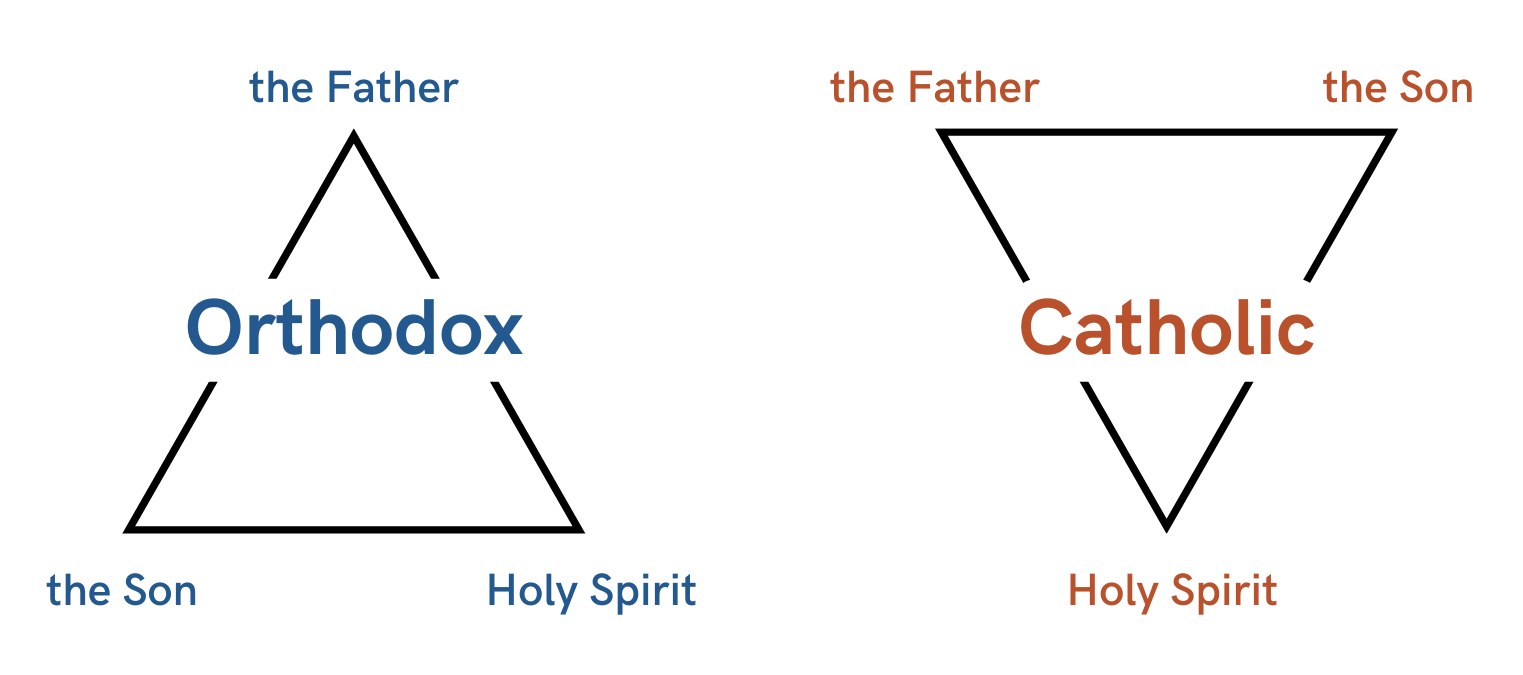
The Eastern Orthodox Church strongly objected to this addition, considering it a theological innovation and deviation from the original Nicene Creed. The Eastern Orthodox position is that the Holy Spirit proceeds from the Father alone, and any modification to the creed should only be made through an ecumenical council, not unilaterally by one branch of the Church.
The Filioque controversy became one of the contributing factors to the Great Schism of 1054, which led to the formal separation of the Eastern Orthodox Church and the Roman Catholic Church. To this day, the Filioque clause remains a significant theological difference between these two Christian traditions.
Holy Tradition
For Orthodoxy, Holy Tradition is the fullness of the faith passed down (of which Holy Scripture is the highest part), preserved by the Holy Spirit within the Church. It’s impossible to understand Orthodoxy without this. It’s important to note that not all of the teachings of Christ and the Apostles are found in Scripture. Some have been passed down orally or documented outside of scripture, but there are indications of this in scripture.
“Therefore, brethren, stand fast, and hold the traditions which ye have been taught, whether by word, or our epistle.” (KJV)
2 Thessalonians 2:15
This verse is a cornerstone for discussions on tradition, as Paul explicitly places teaching delivered “by word” (orally) on par with teaching delivered “by our epistle” (in writing).
2 Timothy
2 Timothy is an urgent plea for Timothy to guard the doctrine he received. The relevant verses here emphasize the oral transmission:
2 Timothy 1:13: “Hold fast the form of sound words, which thou hast heard of me, in faith and love which is in Christ Jesus.”
2 Timothy 2:2: “And the things that thou hast heard of me among many witnesses, the same commit thou to faithful men, who shall be able to teach others also.”
Holy Tradition is differentiated from Tradition or Customs, which are malleable and man-made. Only the former is binding on the Church. The latter are subject to change.
Liturgy (Divine Liturgy)
This is the central, foundational worship service of the Orthodox Church. It is far more than a “sacrament meeting” or a concert + TED Talk, and is considered a participation in the worship of heaven.
Mysteries
The Mysteries are also known as Sacraments. The LDS language would be Ordinances (A term derived from the radical reformer Ulrich Zwingli and a mark of Mormonism’s protestant inheritance). In Orthodoxy, there are seven sacraments:
Baptism
Chrismation (aka confirmation to protestants - gift of the holy spirit.)
The Eucharist (LDS - The Sacrament)
Confession
Marriage
Unction (Anointing of the Sick) - Similar in purpose to an LDS healing blessing.
Ordination - Ordination of clergy and the passing on of apostolic priesthood authority.
Patristic / Patristic Fathers
Refers to the early Church Fathers, also known as the Patristic Fathers or simply the Fathers of the Church. These were influential Christian theologians, bishops, and scholars of the early centuries of Christianity, typically from the first to the eighth century AD. Their writings and teachings are highly regarded within Orthodox Christian tradition. The Patristic Fathers played a crucial role in shaping Christian theology, doctrine, and spirituality during the formative years of the Christian Church.
Here is a list of 10 important early Church Fathers (the list is not definitive or exhaustive):
St. Ignatius of Antioch (c. 35-108 AD)
St. Clement of Rome (c. 35-99 AD)
St. Polycarp of Smyrna (c. 69-155 AD)
St. Justin Martyr (c. 100-165 AD)
St. Irenaeus of Lyons (c. 130-202 AD)
Origen of Alexandria (c. 184-253 AD)
Tertullian (c. 155-240 AD)
St. Cyprian of Carthage (c. 200-258 AD)
St. Athanasius of Alexandria (c. 296-373 AD)
St. John Chrysostom (c. 349-407 AD)
It should be noted that while many of the Patristic Fathers are canonized as Saints, it is widely recognized that not everything that every Father taught was always accurate and accepted by the church. In the early centuries of the Church, there were points of doctrine that were not fully settled, understood, or agreed upon, and it was common for different people to hold different views. It took a number of church councils over centuries to get answers to many of these theological and doctrinal questions.
i.e. Just because a Patristic Father said something, does not make it Gospel. We look at the general consensus of the Fathers, the decisions of future councils, and alignment with apostolic teachings. With guidance and confirmation by the Holy Spirit.
Phronema
A Greek term that refers to one’s mindset, spiritual disposition, or way of thinking that shapes one's beliefs, attitudes, and moral reasoning. It encompasses practical wisdom, understanding, and principles that guide actions and decisions.
A great book that delves into and discusses Phronema in detail is “Thinking Orthodox. Understanding and Acquiring the Orthodox Christian Mind”
Pneumatology
This is the branch of theology focused on the Holy Spirit. The Filioque mentioned previously is fundamentally a pneumatological issue.
Sola Scriptura
"Sola Scriptura" is a Latin phrase that means "Scripture alone." It is a primarily Protestant theological principle used since the Reformation. The essence of "Sola Scriptura" is the belief that the Scriptures are the sole and ultimate authority for matters of faith, doctrine, and practice.
I have replaced the term Bible with Scripture, as LDS have additional scriptures and a partially open canon. Protestants reading this would read “the Bible” in it’s place.
Key points regarding include:
Authority of Scripture: It asserts that Scripture, defined as the Bible for protestants, is the supreme and infallible authority, surpassing all other sources of authority, including tradition, church councils, or ecclesiastical leaders.
Access to Scripture: emphasizes that Scriptures should be accessible to all believers in their native languages, rather than being restricted to the clergy or scholars.
Personal Interpretation: individual believers are encouraged to read and interpret scripture for themselves, relying on the guidance of the Holy Spirit.
Rejection of Extra-Biblical Traditions: rejects the idea that non-canonical writings, traditions or teachings should hold equal or higher authority than scripture.
A great video discussing Sola Scriptura can be found here:
Soteriology
The branch of theology that deals with the study of salvation. It focuses on the doctrines and beliefs related to the process of salvation, including the nature of salvation, the means by which it is attained, and its significance in religious contexts. Soteriology explores questions about how individuals are saved, from what they are saved, and what salvation means for their spiritual or eternal destiny.
The Trinity
There have been large books and series of books dealing with this topic so at most I’ll keep it to a high level description.
The Trinity (or Holy Trinity): This is the classical (historic Christian) belief of one God in three co-equal, co-eternal, and uncreated Persons (Father, Son, and Holy Spirit)—”one essence (ousia) in three hypostases.” Contrary to popular mythology this does not come from Greek Philosophy, despite using philosophical terms. Neither was it invented by Constantine at Nicae.
The core of Trinitarian theology is to explain how God can be both One and Three. Early Christians struggled with this, using biblical terms that were often confusing or imprecise - thereby allowing definitions that were heretical. The term hypostasis was famously clarified by a group of theologians known as the Cappadocian Fathers (like St. Basil the Great) to resolve this.
They established the foundational formula of Orthodox Christianity: God is One Ousia (Essence) in Three Hypostases (Persons).
Ousia (οὐσία): This is the Essence, Substance, or Nature of God. It is the “what” of God. It’s the shared, single, indivisible divine nature—all the attributes that make God God (omnipotence, omniscience, etc.)
Hypostasis (ὑπόστασις): This is the Person. It is the “who” of God. It refers to the distinct, individual subsistence of the Father, the Son, and the Holy Spirit.
So, the Father, Son, and Holy Spirit are not three separate gods. They are three distinct hypostases (Persons) who all share the identical, single ousia (Essence/Nature). Now the eastern fathers mean something a little different here than perhaps the Roman Catholics do in the West. You can think of Ousia as a nature, like Human nature for example. And a Hypostasis as an individual. So if we were talking about Peter, James and John we would say there are three Hypostasis (persons) that share a single nature - human nature. So 3 hypostasis and one Ousia.
Mormon’s might look at this and say, hey that’s what we believe. But it’s not really, we don’t believe that the Father has a body. We don’t believe that he used to be a mortal man. Mormons and Orthodox christians have very different underlying metaphysics and very different anthropologies.
The best discussion I’ve seen on this is a lecture series by Dr. Nathan Jacobs. You need to pay for it, but he goes through some of this stuff on his podcast, The Nathan Jacobs Podcast.
A Simple Analogy (with a major warning):
Think of three humans: Peter, James, and John.
Their shared “what” (their ousia) is “humanity” or “human nature.”
Each one—Peter, James, and John—is a distinct “who” (a hypostasis or person).
The Warning: This analogy breaks down because Peter, James, and John are three separate beings with three separate wills. The three Hypostases of the Trinity are one God, with one divine will and one divine nature, existing eternally as three distinct Persons.
The Hypostatic Union
The term was also crucial for defining who Jesus is. This is known as the Hypostatic Union, which was formally adopted at the Council of Chalcedon (451 AD).
The doctrine states that in the one hypostasis (Person) of Jesus Christ, two distinct natures are united:
A perfect and complete divine nature
A perfect and complete human nature
These two natures are united in his single Person “without confusion, without change, without division, without separation.”
In short, Jesus isn’t two people (a divine person and a human person) sharing a body. He is one Person (hypostasis) who is simultaneously fully God and fully Man.
In traditional christianity and orthodoxy you may hear Jesus called the God-Man. This is a reference to this concept.
Theophany
A theophany is a visible, tangible, or otherwise sensible manifestation of deity to human beings. The word comes from the Ancient Greek theopháneia, which literally means “appearance of a god” (from theos, “god,” and phainein, “to show” or “to appear”).
While this term can technically be applied to any religion, it is most commonly used in a theological context to describe appearances of God in the Bible. These are temporary and sudden encounters where God’s presence is perceived by the external human senses.
Key Characteristics
Sensible: It is not just an idea, dream, or internal vision. It involves senses like sight or hearing (e.g., seeing a form, hearing a voice).
Tangible: The manifestation takes on an observable form, such as a person, an angel, a natural element, or a powerful event.
Temporary: Unlike an incarnation (like that of Jesus Christ, which is considered a permanent union of God and man), a theophany is a temporary event for a specific purpose.
Common Examples from the Bible
Old Testament:
The Burning Bush: God appears to Moses in a bush that burns but is not consumed (Exodus 3).
Mount Sinai: God descends on the mountain in thunder, lightning, smoke, and fire to give the Ten Commandments (Exodus 19).
Pillar of Cloud and Fire: God leads the Israelites through the wilderness as a pillar of cloud by day and a pillar of fire by night (Exodus 13).
Abraham’s Visitors: God appears to Abraham in the form of three “men” (Genesis 18).
Jacob’s Wrestling Match: Jacob wrestles with a “man” who he later identifies as God (Genesis 32).
New Testament:
The Baptism of Jesus: The heavens open, the Holy Spirit descends like a dove, and a voice from heaven speaks (Matthew 3).
The Transfiguration: Jesus’s appearance is radiantly transformed, and he speaks with Moses and Elijah (Matthew 17).
Mormonism:
Joseph Smith’s first vision would be an example of both a Theophany and a Christophany.
A related term is Christophany, which specifically refers to an appearance of Christ, particularly pre-incarnate appearances in the Old Testament.
Theology
Theology is the study of God and religious beliefs. It is a broad field that encompasses many different topics, such as the nature of God, the relationship between God and humanity, and the meaning of life. Theology is often studied in academic settings, but it can also be studied independently or in informal groups.
Theological discussions can help us to understand and appreciate the gospel of Jesus Christ. It also helps us to defend our faith against those who would attack it.
Here is a simple analogy that may help you to understand theology:
Imagine that you are looking at a mountain. You can see its size and shape, but you cannot see what is inside of it. Theology is like a flashlight that allows you to see inside of the mountain. It helps you to understand the mountain's composition, its history, and its purpose.
Just as a flashlight is helpful for understanding a mountain, theology is helpful for understanding God. It helps us to understand God's nature, his relationship with humanity, and his plan for our lives.