


We interrupt out regularly scheduled programming to diverge into another topic that I am quite opinionated on, and that’s Math Education for kids. Please bear with me.
I recently came across the following math blog. Which struck a nerve you could say. I read it b/c I’m a BSG nerd (both of the original series I watched as a child, and of the remake done in the early 2000’s.)
https://mathwithbaddrawings.com/2023/12/18/the-battlestar-galactica-theory-of-math-education/

TLDR on the originating article
This is an article about the history of math education.
It discusses the ongoing debate about whether math education should emphasize rote memorization or conceptual understanding.
The author argues that both sides of this debate share a common assumption: that math education shapes the way we think.
However, the author questions this assumption and suggests that perhaps math education should simply be about math.
For the purposes of this discussion, I’m going to refer to the Rote Memorization method as the Cylon method (i.e. the intelligent robots from BSG) and the “Conceptual understanding” method (i.e. the Common Core method) as the Human method.
Why I Care
If you’ve been keeping up, you have probably figured out that I’m a very opinionated person. I happen to have strong opinions on this topic:
Because I’m Asian
Because I’ve lived through it with my two sons
Because my academic background is heavily based on math and engineering
There seems to be a lack of critical thinking on approach to the subject.
Math really does shape the way you think. If you want to produce people who have critical thinking skills, they need to have solid math skills, along with some solid skills in expository essay writing (which is why math and English are the two most important subjects.)
Math makes minds.
I’ve long operated on this same principle. Vital to a free and thriving intellect—and thus, to a free and thriving society—is great mathematical thinking, whatever that is. - Mathwithbaddrawing.com by Ben Orlin
My perspective is coming from that of a “Tiger Dad”…..
Just so you understand. I’m very much a traditional Asian parent with many traditional Asian parent expectations, values, and standards. I’m what you could call a “Tiger Dad.” This term comes from a book published in 2011 by Amy Chau a “Tiger Mom.” Her book can be found at the link below.
Battle Hymn of the Tiger Mother: https://amzn.to/3Xx6ol1
TLDR - What the heck is a Tiger Dad?
A "Tiger Mom/Dad/Parent" refers to a strict and demanding parenting style typically associated with Asian mothers, although it can be found across cultures. This term gained popularity from Amy Chua's 2011 memoir "Battle Hymn of the Tiger Mother," in which she detailed her strict parenting approach.
Key characteristics of a Tiger Mom/Parent:
High expectations for academic achievement: “Tiger” Parents push their children to excel in school, often setting stringent standards and requiring long hours of study and practice. The acceptable minimum grade for my boys was 92%. Not because I always felt that that was achievable in every instance, but because I knew that if they shot for 92%, they’d at least hit 86% (the minimum cut-off for an A where we lived.) I followed that up with the motto, “There ain’t nothing wrong with 100%.) In order to attempt to mitigate instilling a sense of perfectionism (of which I am 100% guilty of being a perfectionist.) I would also tell them it’s totally ok to make mistakes when the time to perform is not critical. i.e., if you get a lower grade on a pop quiz, that’s ok as long as you learn from it and shore up what you didn’t get correct so that when a midterm or final comes around, you can ace it.
(A related Asian parent joke is - your kid comes home with a grade of 99%, and instead of congratulating them, your first reaction is to ask, “What happened to the 1%? - Let’s find and fix the 1%.)
Emphasis on extracurricular activities: They encourage their children to participate in high-status activities like music and/or sports to enhance their resumes and future prospects. Both my kids played instruments (Classical Guitar and Violin); one did gymnastics and played football, while the other took Kung Fu. The rationale is that music training builds perseverance, enhances cognitive development, and hence, educational achievement (some pregnant Asian mamas will even play classical music and hold an earbud or speaker to their belly.), brings a sense of cultural appreciation and sophistication, and helps to build character. For sports, our rationale was to build confidence and healthy lifestyles and provide a physical outlet for the stresses and pressures of a Tiger Parent regime - (and nothing builds confidence in a boy like fighting skills and weight lifting to put on muscle mass and great endurance.) I was also impressed by the values/ethics of football coaches in the American South - and I was not disappointed. Faith, Family, Football, learning to “grind it out” if you hit obstacles, “to get back up if you are down,” and to “never quit” even when you are behind in a game and are likely to lose. Invaluable skills to cultivate in young people.
Limited social life and playtime: Tiger Parents prioritize academic pursuits over leisure activities, believing that free time detracts from achieving success. I agree with the sentiment that too much free time leads to kids getting into trouble or developing bad habits. All playtime activities were based on a reward system. Each boy had a daily chart with things they had to do and check off to get that day’s reward such as playing video games, watching TV, candy, etc. There were also weekly rewards for successfully completing a week where every day was completed successfully. If there is one thing I wish in hindsight I’d done better, it was in the daily/weekly rewards. A reward/goal and objective tied to each outcome you want to drive. You can’t be all stick; there needs to be a juicy carrot hung out there too. For one son, it was a very expensive electric guitar (then guitar pedals, loop stations, etc), for the other, a likewise expensive electric violin. I’d suggest keeping the rewards a little more modest. The guitar was $1000 all said and done, the violin was $1300. The loop station was $500. I probably could have done better at this part of the “program” by having more rewards that were less expensive. (The $ value doesn’t always equate in the child’s mind to the magnitude of the reward.)
Strict discipline: Tiger Parents often employ strict rules and punishments to ensure their children comply with their expectations. I established very clear boundaries that, when crossed, resulted in greater punishments. For example, one rule was no TV or video games during the week, and as soon as you came home from school it was homework first and play second. This didn’t always work. The initial punishment was grounding off video games and TV for a week. By the time this rule was violated the 3rd time, I had upped the ante and set the grounding off of video games to 1 year. I don’t think they believed me, but they found out; the next time I caught them playing video games before completing their homework, I took the Nintendo away for an entire year. Honestly, I felt horrible doing it and wished I could take it back (maybe make it only a month or three), but I had already said it, and if I wanted them to take me at my word, I had to stick to my word, too.
Western reactions and Criticisms of the Tiger parent approach
Westerners1 often look at Asian parenting styles with something akin to discomfort and even horror. I have heard many Western women comment that they believe it is excessive to the point of being cruel. If you are from a Western culture, you are welcome to those reactions, and on some level, you may even be correct.
But let me let you in on a little secret, just to save you potential embarrassment in the future. If you were to voice such an objection to Asian parents in person, you’d likely be met with half smiles of politeness (which in Chinese culture means that we are politely disagreeing with you while thinking that you are full of crap). Meanwhile, the conversation judgment and assessment going on in the Asian brain basically boils down to:
Westerners are weak parents - too permissive, too indulgent, that’s why their kids go bad. If you are objecting, you are probably a bad parent, and your children will be failures.
Westerners have no ambition (with the built-in implication that you are lazy)
This method of parenting arguably does produce high-achieving children. (Asians are the most successful immigrant group in basically every country.)
Critics complain that this kind of parenting also has potential drawbacks, such as increased anxiety and stress, decreased self-esteem, and strained parent-child relationships. The approach has sparked debate about the balance between pushing children to succeed and nurturing their well-being.
Many of these complaints are warranted. Any approach needs to be tailored to a child's personality —the “softer” a child’s personality, i.e., the more they are a people pleaser type of person, the more cautious you need to be about creating anxiety, and the more you need to use a reward/goal-based approach. - But your reaction can be itself a reward. In this case, where a child will work to please you, try a “pull” based approach where incentives - and your reaction to their success help create self-motivation for success. You will also have to help them learn to do things for their own sense of fulfillment and pleasure, so make sure you help them learn to celebrate their successes. Here are some of my responses to those accusations:
My opinion is that concerns about self-confidence are a non sequitur, particularly in the Western imagination of what creates real self-confidence. When the whole anti-bullying movement got started in the 90’s, the common approach was to shield children from any criticism or failure. Participation badges, hyper-vigilance for bullying, and “safe spaces.” IMO - all of those are complete nonsense. Confidence comes from competence - the knowledge that a kid has that they have a set of skills that can match or dominate the best competition anywhere they go. And for teenage boys, strength, fitness, speed, and the ability to hold their own in a fight. Here’s my unvarnished opinion on the matter….
If you try to protect your child to the point where they never encounter any of the ugliness that is part of the real world, you are setting them up to fail at life in the real world. You are training them for a world that doesn’t actually exist, which means you, as a parent, are derelict in your duties and are doing your children a massive disservice that you all (parents and children) will pay for for the rest of your lives. The real world is not a Disney princess fantasy, and so childhood shouldn’t be either. Your job as a parent is to help them learn to cope with, work through, and overcome life’s challenges and ugliness without falling apart in the face of it. That creates weak snowflakes, and I think in the last 20 years we’ve seen enough evidence of this in the outcomes of this wrong-headed philosophy that has produced generations of fragile people who are not equipped to deal with reality.
The nature of your relationship at the end of the day (when your child is an adult and your parenting job is effectively over) is going to be largely dependent on your ability to effectively balance the carrot and the stick. Depending on the child, you may need more of one than the other. The important thing is to try to be consistent in your approach and don’t let moments of personal frustration or anger determine how you -as the adult - act. Be measured, be reasonable, strike a balance that will keep children motivated. Also, remain flexible if you think you need to adjust your approach. Children grow up and change as they do - so we need to keep pace.
IMO, the typical old-school FOB2 Asian parent response to this (at least my father’s) would be to just not care about it. I can hear my father’s voice saying something like: "Our job is to be parents, not our children’s friends. It’s our job to form them (or beat them) into useful members of society.” Being that one of the motivators for every Asian parent is to make the next generation better than the past or current generations (better usually means more financially successful), and that tends to end up being the end that justifies the means. Most westerners will look at this as cruel, but it’s not. The older generations still have fresh memories of friends and/or family who starved to death or didn’t have safe/sanitary places to live. In Asia, east, west, south, and north - this was and remains a very real concern. Almost every family has a story of so-and-so they knew who starved to death or died due to malnutrition. My family has those same stories, but ours are primarily due to the actions of communists.
While I am sympathetic to the “old school” Chinese mentality of a parent’s job and goals, I have grown up long enough in Western society and done a fair bit of climbing the corporate ladder myself to realize that money and financial success often bring at least as many problems as they solve, and it doesn’t necessarily bring happiness, which is true.
That’s why I’ve titled this article the Taming the Tiger and Releasing the Dragon. In Chinese thought, the Tiger is strong, ferocious, and brave, often rushing to attack or act but without wisdom or thought. The Dragon is strong and wise, and symbolizes change, growth, and the pursuit of higher aspirations.
Getting your thinking right
No goal can be achieved if your thinking is marred by delusions. So, in this article I’ll address what I believe are myths and ways of looking at thing that are unhelpful to it goal.
The Myth of Fairness
The concept of fairness is a comforting illusion based on emotionally driven thinking. It’s human nature to yearn for a world where everyone is happy and gets what they want, and the scales of justice remain perfectly balanced. However, reality paints a very different picture. Life is inherently unfair. We are all born into different circumstances, with varying advantages, disadvantages, talents, and opportunities. This will never change and can never be changed. Trying to force equal outcomes at this level is impossible and unethical.
Any time there is a desirable limited resource (like a college spot at Harvard or the best seats at a football game.), there will be competition to obtain it. As a result, nothing will be fair, and the winners will be those who are best prepared to claim the opportunity. The fairest system you can have is a meritocracy where the opportunity is open for all to attempt.
Obsessing over fairness breeds resentment and hinders personal growth. It fosters a victim mentality, where individuals attribute their lack of success to external forces beyond their control. Instead of focusing on their own actions and taking responsibility for their outcomes, they become consumed by perceived injustices.
A focus on fairness also stifles ambition and innovation. It encourages an entitlement mindset, where individuals believe they are owed specific outcomes regardless of their efforts. This discourages them from striving for excellence and taking risks, as they expect rewards to be handed to them without earning them.
Ultimately, a relentless pursuit of fairness is a self-defeating endeavor. It prevents individuals from adapting to the realities of life and taking control of their own destinies. By embracing the inherent unfairness of the world and focusing on their own actions, individuals can unlock their true potential and achieve success on their own terms.
My Grandmother - who lived through the Great Depression, used to say:
Nothing in life is free. That’s not how the world works, and you should be skeptical of anyone offering to give you something for free - especially. a politician - because they certainly aren’t going to pay for it out of their own pocket, they are just going to reach into your back pocket to pay for it. Don’t let a politician bribe you with your own money!
You want something? Go work for it and make it happen!
The Myth of the Magical Childhood
I’ve never bought into the approach that childhood is supposed to be a magical, Disney-fairy-tale time in your life. If you do that, your child will be directionless, spoiled, and not at all prepared to capitalize on opportunities that arise in their lives. When it comes time to compete for a desired college spot or get a job they want, they will be unprepared for success and will lose to someone who is prepared. Remember, their competition is not the children in North America; it’s the kids who are working their butts off all around the world, from Africa to Asia, the Middle East, Eastern Europe and Russia. It’s a global economy, and that means there is global competition. The belief in the “sanctity” of childhood is an ultimately destructive notion that I believe is partly based on overindulgence and even a degree of apathy, or at least ignorance as to the level of preparation children these days will need to have.
What I learned from my traditional Asian Father was that childhood is the time to get beaten into shape so that you can come out a useful, productive member of society who can support his/her own family and give their children more opportunities than they had to make the next generation more successful than the first. Traditional Asian parents often care *very* *very* much about having a next generation and making the next generation better (wealthier, more successful, higher status) than they are.
Asians don’t understand this fairy tale disney approach to parening, even to the degree that Asian comedians make fun of it (see the YT video below.)
One objection that I can imagine American parents having is, “isn’t this asking for too much sacrifice from children?” My response would be that they will either sacrifice willingly now for 10-20 years, or they will have sacrifice imposed on them for the rest of their life, and they won’t have the lifestyle they want and cannot capitalize on future opportunities that come their way.
One challenge with this approach is that you can only teach your kids to be what you are and, ultimately, to achieve what you have achieved as a human being. If you want to teach your children to be kind adults, you must be a kind and empathetic adult. If you want to teach them to be overachievers, you must be an overachiever. Kids care more about what you do than what you say. They will learn much more from your example as you live up to the values and principles you articulate.
Spankings / Discipline
Discipline is a natural part of life. If you don’t discipline your children, the world will eventually discipline them, and when that happens, it’s likely to be more painful and impactful to their lives than if you (as the parent) had imposed some discipline on them while they were young. Case in point. Both my slightly younger brother and I were spanked (with a thick leather belt) fairly often by my father. By today’s standards, it would probably be characterized as beatings. Our other two younger brothers received virtually no corporal discipline (due to objections from my mother, who got custody of them after my parents divorced), and there are stark differences in outcomes. For those of us who received spankings, we have become relatively successful in life. We have had our share of struggles (everyone does), but we have also achieved above-average life outcomes. Our two brothers who did not get spanked: one ended up living on the streets for a while, using a lot of drugs, and the other almost ended up in juvenile detention - I had to rescue him and raise him from the ages of 12 to 17. He left my home, pursued post-secondary education, and ultimately built a large family, securing employment that enables him to support himself and his children.
To be clear, there is a line between punishment and abuse. If you are acting out of emotion (anger, frustration), then whatever you do is not a punishment or correction, and if you hit, it’s going to be abuse. If you approach it level-headed with the intention of setting a boundary that should never be crossed, then you can administer a correction or punishment that is relative to the boundary.
I’m not advocating for just any form of corporal discipline, and I’m not advocating for it to be the go-to method of discipline or even the punishment of last resort (sometimes there are much better things you can do that teach the lesson you are trying to teach). Here are my principles when it comes to discipline:
For young boys, there is no difference between fear and respect. They are the same thing. It’s not until they get older that they learn the difference, so don’t be afraid of them being afraid of you if they knowingly do wrong.
Always keep any punishment or correction proportional. I’ve seen many kids who went astray and got into trouble or did nothing with their lives because they didn’t have any boundaries or corrections when they should have. Other people sometimes looked at my parenting methods as crazy, but their kids are still living in their basements, or turned into druggies, or went to prison, etc. No one who has met my children as adults has ever questioned my approach. In fact, they often ask me how I produced such excellent young men.
A parent’s job is to create decent human beings who become productive members of society and can support themselves and their families in the future, and to make the next generation better than the previous one. Your job is not to be your child’s friend.
Consequences Must Be Proportional and Related to the Infraction
Discipline should align with the behavior and aim to teach, rather than punish.
Logical consequences (cause→ effect) are more effective than arbitrary punishments.
Excessive or disproportionate punishments (e.g., public shaming, slapping in the face, or humiliation for minor offenses) are counterproductive and potentially abusive.
Physical punishment should always be reserved as a last resort, if used at all. It should never be the go-to “solution” because the appropriate solution should depend on the infraction and the lesson you are trying to teach.
Structure and Clarity Prevent the Need for Punishment
Children need clear rules, expectations, and predefined consequences.
Rewards and punishments should be laid out beforehand, not improvised in anger after the fact.
This creates predictability, fairness, and trust in parental authority.
Follow-Through is Non-Negotiable
If a boundary is set, it must be enforced, regardless of whether you want to or not. If you don’t want to enforce a boundary by administering a punishment, then don’t have the boundary or choose a different punishment. What boundaries you choose and how you enforce them is totally within your control. Failure to follow through with articulated punishments teaches:
The boundary is meaningless.
The parent lacks integrity.
The child can manipulate or ignore authority.
Any of the above can result in a child who lacks respect and is willing to cross any boundary you set. When you attempt to enforce one, they will escalate their behavior, leaving you unprepared to deal with it. If they “win,” you will lose all control over them, particularly when they become teenagers.
Discipline fails if not backed by consistent parental action.
I’ve seen many kids who went astray and got into trouble or did nothing with their lives because they didn’t have any boundaries or corrections when they should have. There were have been people who looked at my parenting methods as crazy, but their kids are still living in their basements, turned into druggies, or went to prison. No one who meets my children today looks at me as if I am or was a crazy parent. Many ask me how I did it.
Physical Discipline is Situational, Not Ideological
Ideological positions such as “never use physical punishment” are unrealistic and deeply naive. Even worse nonsense like “never punishing a child” (yes there are some nutcases who advocate for this - they obviously don’t have children) might make you feel good as a parent, but will be utterly disasterous for your child.
Viral or popular parenting trends that sound good often do not work. You need to find what works, regardless of whether it sounds appealing. Parenting is not about being nice; you are not there to be your child’s friend. You are there to prepare them for the world they will face as adults. That requires resilience that can only be obtained through hardship. So, don’t try to protect them from everything.
In the mid-to-late 1990s, a pop parenting fad emerged that emphasized “quality time, over quantity time.” This is complete and utter horse-shit. My initial reaction at the time I heard this was that this was an attractive mantra for parents who both worked or worked multiple jobs, assuaging their guilt by telling them that they just needed to make sure that the time they spent with their kids was “quality time,” even if it was infrequent or nonexistent.. This nonsense was preached by parenting “gurus”/psychologists promoting their books and making money on speaking engagements and TV spots. I immediately discarded it as marketing trash - that’s all it ever was, and unfortunately for the kids, it’s completely and utter nonsense. Your kids care that you are there, that you are present and available - even if you aren’t interacting, your physical presence is reassuring and enjoyable (as long as you have a good relationship with them.)
You can’t predict when quality moments will happen — they arise spontaneously and organically. Without time together, you miss the spontaneous, unplanned moments that build real bonds or opportunities to teach important principles.
Children interpret love through presence, not performance — showing up consistently matters more than orchestrating perfect outings or conversations.
Quality requires a foundation of quantity — deep connection and trust aren’t built in curated snippets; they’re forged through shared life, repetition, and simply being present.
Spanking (IMO) is better applied in early years when cognitive reasoning is undeveloped (roughly from 3 to 8), but must always be measured and purposeful.
Once a child is old enough to reason, dialogue and logical consequences are preferable. I refrained from spanking my children after the age of 8.
Discipline Without Emotional Connection is Hollow
Spending quality time with your children is extremely important. It’s also important to create shared memories and be emotionally available. Both are critical to establishing parental authority, and for establishing yourself as a role model your children will look up to and want to follow.
A child is more likely to respect and learn from a parent with whom they feel a connection.
Discipline without involvement is likely to lead to resentment or emotional detachment.
Discipline Requires Parental Self-Discipline
You must embody the discipline you expect from your children.
Children test boundaries constantly; parents must remain firm, consistent, and emotionally controlled.
Reacting emotionally or inconsistently undermines authority and confuses the child.
Avoid Punishment for Unclear or Non-Communicated Rules
It’s unfair to punish a child for crossing a line they didn’t know existed.
Expectations should be clear and repeated. Surprising them with punishment teaches fear, not understanding.
Not All Discipline Works for Every Child
There’s no one-size-fits-all method. Children differ in temperament, sensitivity, and response.
Effective parenting adapts to meet the needs of each child while maintaining core boundaries.
Depending on the issue and the child, any kind of spanking may not be effective. A spanking is usually over quickly, and the sting fades pretty rapidly. It’s unlikely to leave a lasting impression. Depending on the child, grounding or removing something they love and value for an extended period is likely to have a greater impact on them.
If you do Spank, it should be below the belt and theatrical.
My father used a belt on us, and when he hit us, he hit relatively hard (at least in my estimation at the time).
If you are going to spank, whether it’s with your hand, a belt, or a wooden spoon (the latter two were my parents’ go-tos). Due to point #3 in the previous principle, if I were going to give a spanking, I wanted it to make a lasting impression. There are only two ways you can do that. A. make it more painful, B. make it scarier via theatrics. I think if you are an adult and you are spanking a child, it’s already too easy to hit them too hard. This is particularly true if you are emotionally charged or if you are spanking them with an object. If you are opting for option A, to make it more painful, you will easily cross over the line between a punishment and a beating (which may result in leaving bruises, welts, or swelling. This is illegal in many places, even if spanking with a belt is itself legal.) I always considered any risk of actual injury to be an unacceptable risk, so I strongly prefer option B: to make spankings scary rather than painful. I usually spanked with my hand or a soft leather belt. But in each case, I’d huff and puff and get a low booming voice, puff my chest out, stand tall, and make myself look as intimidating as possible. With a belt, I’d fold it in half and snap it a few times. With my hands, I’d clap them together in as loud a clap as possible, maybe slapping my hand on a table or wall to make a loud boom. Then, when I administered the spanking, I would do so only with enough force for it to seem real (leave a little bit of a sting) and not a joke.
The first time I did this with my older son, I was pretty nervous and didn’t smack his but very hard at all. After I was done administering the spanking, he actually laughed at me and said, “I thought that was really going to hurt, but I didn’t feel anything really, so it’s not so bad.” I had the distinct impression that he felt the spanking was so ridiculous that it made the infraction he was being punished for worth it. I promptly whipped his pants back down, pulled him over my knee and gave him a solid spank that stung his butt and my hand.
Parenting is Strategic, Not Reactive
Emotional outbursts or punishment done in frustration do more harm than good.
Parenting must be deliberate, principled, and grounded in values, rather than emotional reactions.
Examples
In a conversation about spanking, my daughter-in-law relayed to me that she was spanked by her Dad when she asked her mom to make sausages for dinner, and there were still some leftover pieces of meat in the pan in the fridge. The reason she was given was that she was wasting food. (For context, her family comes from a poor country, and they are poor people who struggle every day to make ends meet.) So, her father is angry because she was not respecting the value of the meat (which is expensive for them). In my estimation, her father spanked her because he was angry, which is a no-no for me. If you are emotional, take a break and do something else. Never discipline in anger.
In my opinion, this is not a good application of physical punishment. What lesson is she learning by getting spanked for wasting meat? (Nothing, only that wasting meat makes Dad angry. There is no connection to the principle that meat is expensive and therefore valuable.) Also, it’s not proportional to the issue. In her telling all she did was ask for more meat instead of eating what had already been cooked. I don’t think punishing a child for asking for something is reasonable. But let’s pretend that she asked for sausages, her mother made them, and instead of eating them, she wasted them by throwing them away or feeding them to the dog. Instead, my approach would have been to make her eat vegetarian for a week, or maybe two, depending on how much she likes to eat meat. Being forced to fast from meat should, in her mind, have the effect of increasing its value. This is the reason why her father became angry with her in the first place.
The Myth of the Smart Kid
There seems to be a popular and, sadly, unchallenged belief that a person is either smart enough to do math or isn’t and that these capabilities are fixed. I’m here to tell you that they are not.
This view of Children and intelligence is wrongheaded on so many levels. It undermines parents' efforts to help their kids excel and becomes a self-limiting belief. While I recognize that biological IQ differences between people exist, I also believe that the brain is highly elastic and can be taught and trained to achieve a great deal with the right support system and belief structure, regardless of innate IQ. The following is from an interview with a Psychologist researcher Caroline Dweck on mentalities and success.
DWECK: So I gave 10-year-olds problems that were slightly too hard for them. Some of them reacted in a shockingly positive way. They said things like, I love a challenge, or, you know, I was hoping this would be informative. They understood that their abilities could be developed. They had what I call a growth mindset. But other students felt it was tragic, catastrophic. From their more fixed mindset perspective, their intelligence had been up for judgment, and they failed. And in study after study, they have run from difficulty.
RAZ: First of all, can you explain this concept of a growth mindset?
DWECK: Well, let's start with a fixed mindset, which is the idea that your talents and abilities are just fixed. It's the idea that some people have a lot and some people have less, and that's the way it's always going to be. A growth mindset is the idea that talents and abilities can be further developed through hard work, good strategies, and asking for help and input from others. It's not that everyone's the same, but everyone can grow their abilities.
RAZ: So, what kind of thing can nudge a kid into one mindset or another?
DWECK: We have studied a lot of things now that create a growth or a fixed mindset in kids. The first thing we studied was the praise that adults give to children. And we found - contrary to popular wisdom - that when you praise intelligence, it backfires. It puts kids into a fixed mindset and right away, they don't want a challenging task. But if the adult praises the child's process, the effort or strategy, and ties it to the learning they've done or the success they've achieved then we're putting kids into more of a growth mindset.
RAZ: OK. So, like, when a parent or a teacher says to a kid, you know, you're so smart or you're so talented, that is actually not a good thing? But if we say to kids, hey, that was a really great effort, you know, you're improving, that's - like, just that small change in language can actually change how a kid thinks about him or herself?
DWECK: Yes. Just saying, I like those strategies, and you improved, or that was really hard, you stuck to it and you mastered it - just tying that process to their progress, their learning, their outcome teaches them they can grow their skills in that way.
Should We Stop Telling Kids They're Smart?
Some might think it must be easy for you, Lee, and your kids. You're Asian, you’re born smart. What Hogwash and tripe, and what an attempt to diminish the success and work of my family. Please don’t. Also, I know plenty of dumb Asian people.
Just because you are Asian doesn’t mean you are born with an IQ of 150 and pop out of the womb, ready to tackle Differential Calculus and write computer code. That’s ridiculous— yet Caucasian friends and teachers have always looked to my kids to help them tackle technology and math-related issues. When my youngest son was an LDS missionary, his mission president gave him the role of “technology support missionary” for the whole mission.
IQ exists on a bell curve, and when any child is born, the odds are that they are right in the middle of that curve. You have an 86% chance of your child having an IQ above 85. And that you can definitely work that! Seventy percent of all people born will have an IQ between 85 and 120. The average IQ in America is 98 as of 2022.
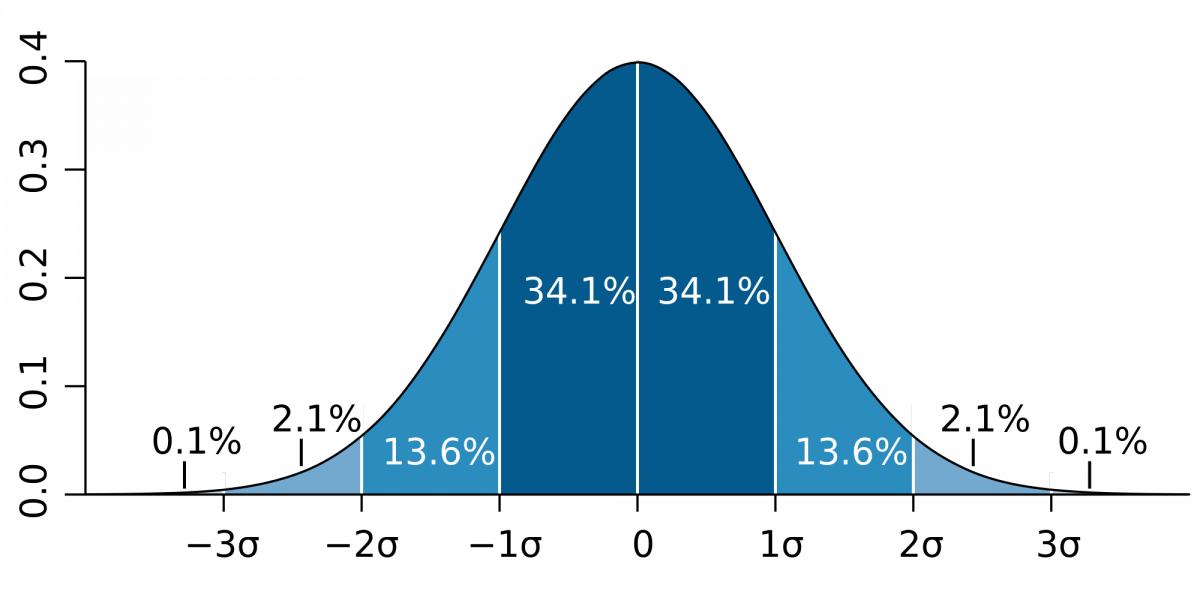
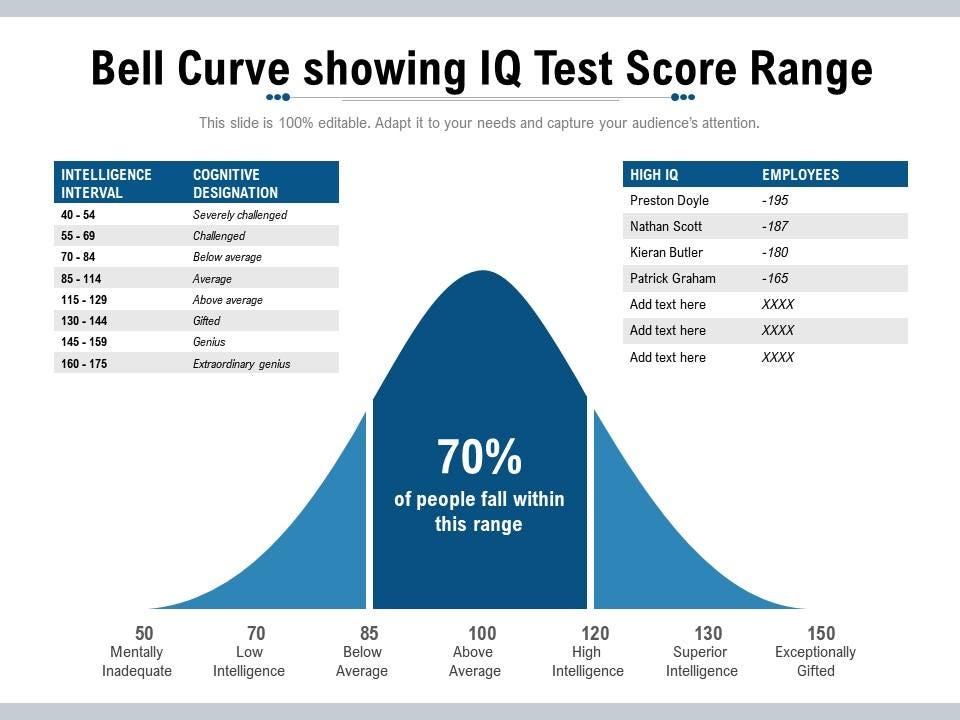
Instead of wondering if you or your child are smart enough to excel in math, I would suggest that you are asking the wrong question. I would instead approach it the following way, which I think is much more realistic and orients parents and children towards a growth mindset.
How do you train a child of average intelligence to get above-average academic results?
It’s not about being Smart, it’s about Working Hard
One lesson I learned with my kids is not to tell them they are Smart3 when they accomplish a goal of excellent grades/marks. If you tell a bright kid how smart they are, they will always rely upon innate “smarts” instead of learning to work to get results. Then, when they fail at something, it will be a hit to their self-esteem, which has, up until then, centered around their self-belief in their natural intelligence. They will interpret failure as meaning that they must not be smart after all, which will destroy their self-image and confidence, leading them to second-guess themselves in the future. Studies also show this leads to a fear of failure due to it being a personal, internalized failure. This also results in a fear of trying new things - leading to an inability to take risks.
Students can internalize a deep and nameless sense of intellectual inferiority.
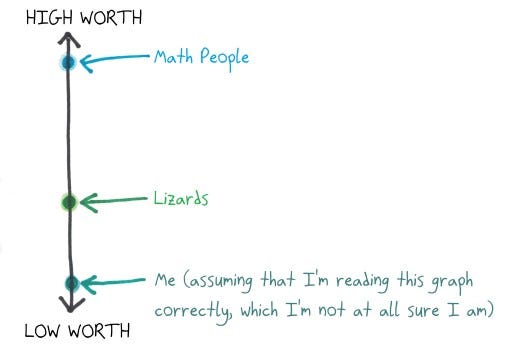
And so I didn't ever want to go out of my comfort zone and try things that I might not succeed at. For example, my elementary school wanted to send me to the citywide spelling bee, but I thought, wait a minute, I'm already a winner here; why should I go there and become a loser? So, I restricted my world just to things I was sure I could do well at. https://www.npr.org/transcripts/483126798
Stanford University psychologist Carol S. Dweck, PhD, discovered a simple but groundbreaking idea: the power of mindset. In this brilliant book, she shows how success in school, work, sports, the arts, and almost every area of human endeavor can dramatically influence how we think about our talents and abilities. People with a fixed mindset - those who believe that abilities are fixed - are less likely to flourish than those with a growth mindset - those who believe that abilities can be developed - Mindset - the New Psychology of Success by Carol S.Sweck, PhD. (For those who need an appeal to authority to believe me. - which is a logical fallacy fyi.)
Instead, I suggest that when you congratulate your child for success, attribute it to correct thinking and hard work. That way, if they fail, it won’t be because of some natural deficiency in intelligence that they can’t do anything about; it will be because they thought about the problem incorrectly, didn’t fully understand the requirements and expectations, or didn’t work hard enough. All are things that they can quickly be shown how to remedy on their own, and that are much less likely to be internalized.
"Whether you think you can, or you think you can't - you're absolutely right."
Henry Ford.
Advanced Preparation - How you get As for children of average intelligence.
If you want your child to get an A on a subject in school, they need to have been exposed to it and have some degree of competence before seeing it in the classroom. In that case, classroom instruction becomes an exercise in rounding the corners and filling in the gaps.
Asian parents are incredibly obsessive about academic performance (and upward social mobility) - it’s a core cultural value born out of hundreds or thousands of years of generations of people living in abject poverty, often on the very margins of life and death. In many ancient Asian societies, education has been seen as one of the only avenues out of poverty and to raise social status.
Asian parents will readily put their money where their mouth is and make sacrifices to ensure their children get as many advantages in this area as they can realistically afford. That’s an expectation of you as a parent. You must do everything possible and make multiple sacrifices to fulfill this mission. (Which was a mission you accepted when you had a child.) In China, many, many kids are tutored at home - not just on material that is currently being taught that they are struggling with, but for topics that the child will see in the classroom later on.
What is your job? When does it start and where does it end?
This is largely my opinion based on my upbringing and experience as an Asian minded parent. I think this question is almost an eternal one - and one that plays out based on how well you’ve done your job.
Your job is to make your children better people and more successful than you or any previous generation of your family. That means preparing them to operate in the real world. Teaching them resilience, persistence ,and the ability to move over, around or through obstacles.
It starts the day your spouse becomes pregnant or you decide to bring a child into your life. If you have done your job properly, the bulk of this should begin to wind down in the middle teen years.
In the early years you are going to be laying down, verbally, through example, and as reflected in your goals/objects and in how you build structure into childrearing a number of operating “first principles and values” that your children should adopting. You want them to internalize these principles and values because they will form the framework/scaffolding that they live the rest of their lives by. In my experience, as a parent, you can start backing off of the “parenting structure and compliance enforcement” part of the job - around the age of 15-18. Depending your personal assessment of your children’s maturity.
WHen you do, your kids are going to begin to make mistakes. Your role then transfers into one where you help them understand how and why they made those mistakes, what led to them, what the outcomes are or are likely to be, and then how to correct them. You want this time in their lives to be one where they learn to stand on their own and begin to experience some of the consequences of transgressing the first principles and values. There is no teacher like experience. This is the age to make mistakes because once they hit 18-20, the time when they can make big mistakes is basically over. As an adult, the consequences become larger and some can stick with you for many years.
By 18-20, you should have transitioned into more of an advisory role, that trusted wise elder that a young person can come to for advice, to assist with decision making and to help solve problems. After 18, you have effectively 0 control over their lives anyways. It’s time to enjoy the fruits of your labors.
A Personal Story About Priorities and Values
Before our children were born, my wife and I decided that my wife would stay home with them and get them going on the academic basics until they went to school. As a result, we made many financial sacrifices: we lived in not-so-great rental properties, I took the bus to/from work/school every day instead of driving, and we couldn’t afford to go out much, etc. When we bought our first home almost a decade later, it was so small that my description of it was, “It’s a hallway with doors.” That was difficult for me b/c all my peers were buying fancy cars and large homes in the suburbs. My car was a 1990s-era plastic car (GM Saturn) with a rusted-out bottom and a trunk that wouldn’t close, which I couldn’t afford to insure.
My wife taught my sons at home, and my oldest could read by age 3. When he first started reading full sentences, I, of course, bragged about it at work. One of my co-workers ascribed it to the “fact” that we were “lucky4” to have my wife at home but that he and his wife couldn’t afford to do that. I took him at his word - everyone’s situation is different. However, a few months later, that same co-worker came in boasting about the phenomenal home theatre system he had just bought. It was state of the art and then some and was indeed something to be envied. And it cost him about $25K. I didn’t say anything, but my initial thought was - “of course, you can’t have your wife stay home with your kids - your lifestyle is more important.” From my Asian cultural perspective, my co-worker’s priorities were entirely upside down. And admittedly, I did judge him - in my eyes, he was violating his responsibilities as a parent.
So, to pull all of this together, if you want your kids to have a jump start on their school material, it means that you should be obsessed with academic performance and find a way for your child to have a tutor, parent, or grandparent at home to home-school them while they are going to public/private school. Then, when that child sees some “new” material in class, they should already know it and just need to “perfect” it the way the teacher wants. When they bring home homework and quizzes, you may need to help shore up areas of academic weakness in understanding or skill - and guide and teach them. - but not do it for them - so they can get the “right answer” on their own. Or at least know how to work towards it.
My Experience with My Kids and Math
I have two boys. In Elementary school (approximately grades 3-7), they struggled with Math. For one of my sons, math was his lowest grade. This was concerning and alarming to me. On top of it, they both found math confusing and boring, to the degree that one day, they came home and said that one thing that is guaranteed to make an Asian father’s brain explode.
“I hate math. Why do I have to learn this? I’m never going to use it in real life anyway!”
I was aghast for multiple reasons. Sirens and red flashing lights were going off in my head. I took them aside and explained that conventional thinking like that - which likely came from their friend’s uneducated blue-collar parents, would undoubtedly lead to undesirable life outcomes. At that time, we lived in a low-income area. It was not a wealthy area. There were lots of issues with poverty.) If you think the same way everyone else around you does, you’ll have the same life outcomes they have.
Indeed, you’ll never/rarely use math beyond arithmetic in your daily life if you work at McDonald’s, or you are the Garbage man, or if you dig ditches for a living (not that there is anything inherently wrong with those jobs - it all depends on what you want out of life). You will absolutely use math if you work in a higher-paying profession, i.e., if you work in the stock market, if you want to be a programmer (and then I gave them examples of how I used math daily to solve real problems,) or if you want to be a doctor or a pilot, there is math (Most med schools require at least 1-2 math prerequisites, which may include calculus, statistics, and biostatistics.) Pilots should understand Geometry and Trig.
Or perhaps you wanted to do something in physics (like being a rocket scientist or an astronaut) or engineering. Today, there are job postings with salaries of 1 million for those with deep expertise in Artificial Intelligence (something deeply tied to math and statistics.) All those professions have sophisticated math components. My one son at the time wanted to be a Neurosurgeon, and the other one to fly Helicopters - So I tied back the need for math to both of those things.
This led back to an ongoing discussion about different lifestyles and life outcomes. I would compare and contrast and connect mediocre/conventional thinking to mediocre/conventional life outcomes and success thinking to successful outcomes. I then made sure that they had friends and regular contact with people in different socio-economic groups growing up so that they could see the results for themselves.
I would ask them age-relevant questions like when a new Nintendo was about to come out, “Do you want to sacrifice and save for a new Nintendo for months, or do you want to buy and play it the day it comes out?” If they said they could wait, then I’d ask them how they would feel if all their friends had the new Nintendo and the cool new games at school and they could only hear about it and watch it. And if their friends asked if they had the Nintendo, how would they feel if they had to say no?
“If you want to go out to eat, do you want to get a sandwich or go for Sushi?” (my kids were Sushi monsters and not so excited about sandwiches.) Once they selected the lifestyle they wanted, I connected that to the actual outcomes of what lifestyle they would have if they had average thinking and therefore got average results.
A Good Response from Another Reader
One commenter on the original article wrote the following which I think puts it nicely.
The post is interesting but I think that the conclusion that traditional mathematics education (focused on [rote] learning the basics, on mastering the standard algorithms, etc.) [that supposedly] has the goal of, as you say, “inculcat[ing] discipline and diligence”, in order to avoid “breed[ing] a feckless generation that was forever confusing true with false, right with wrong”, is a total strawman, and a bit of a failure on the ideological Turing test (that is, a traditionalist might say this is caricaturing their beliefs).
In my experience, a traditionalist in terms of mathematics education (a position I am sympathetic to) would probably rather frame their position in terms of the mathematics themselves instead of a presumed impact on broader society, and say that competency in doing mathematics is what creates motivation for students (in other words, being able to do things encourages students to persist), that procedural and conceptual understanding are not in opposition but instead feed into each other, so mastering procedures can foster understanding, and recall Paul Kirschner’s distinction between the epistemology and pedagogy of a field: a novice’s way of learning is different from an expert’s, so it’s probably impossible to “create a society of mini-professors”. Learning must go through steps instead of jumping directly to doing what experts do.
My Opinionated Response and thoughts about K-12 math/thinking education.
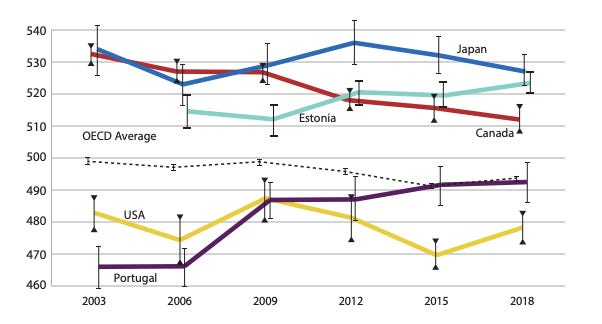
If turning away from rote learning to the “teaching to understand” works, why are our national Math scores so poor? Why are Asian scores using traditional approaches focusing on “rote” learning so much higher? China, Singapore, Macao, Hong Kong, Taiwan, Japan, and South Korea round out the top 7. And have long been at the top of international assessments. The US is ranked 26th (below average compared to other economically developed nations.5) This post from the same blog that inspired this article is funny.. (and satirical.)
https://mathwithbaddrawings.com/2020/02/19/uncommon-core-standards/
As a parent of two boys whose elementary school textbooks in Canada featured the “Teaching to Understand by Figuring out the Rules Yourself or guesstimating" “common core method” of asking 8-10 year-olds to think about it “critically,” I think this method is stupid and doesn’t work, particularly when trying to teach children the fundamentals of arithmetic and algebra. But maybe I’m wrong. I’m not a math PhD; I’m a computer science Grad. My job isn’t to philosophize about Math; it’s to use Math to solve problems.
Every day, my kids came home completely baffled by their math homework and poor Math grades. I was horrified. They needed daily help with their homework b/c the teacher’s direction and, the directions/methodologies documented in the textbook were nonsensical6. So we’d sit down together and open the textbooks, and I’d look at the chapter they were in, what it was attempting to teach them, and how. It didn’t take long before I chucked the textbook aside in disgust and taught them myself. (Which I did for years – every day after school reteaching what their math teacher should have taught.)
The textbook instructions were, even to me (a college graduate with a B.Sc. from the Department of Math and Computer Science), inane, puzzling, nonsensical, and done in such a way that wild guessing was the result, and of course, if they guessed wrong, they were marked accordingly. The textbook was less than useless. I personally believe all “Common Core” math textbooks belong at the bottom of the rubbish heap. My Sister-in-Law, a self-ascribed Tiger Mom, has the same opinion and also retaught Math to her children at home.
Eventually, I took my kids to Kumon (pure Asian - Japanese - rote math learning and an Asian parent’s secret superpower.) The Kumon instructor started them back on strengthening core fundamentals (several grades back.) In math, skills build on each other, so if you have poor fundamental skills, you will struggle with everything else that comes after.
Wait! What’s Kumon?
Kumon is a supplemental learning program focused primarily on math and reading skills. (I don’t think their Reading program is very good fyi.) It's characterized by:
Self-Learning: Students progress through a carefully designed, worksheet-based curriculum at their own pace. The goal is to develop independent learning skills and the ability to tackle new material without direct instruction.
Individualized Instruction: Each student's program is tailored to their current abilities, ensuring they're challenged but not overwhelmed. Instructors provide guidance and support, but the progression between different math concepts is gradual and done in a natural and intuitive way, allowing Kids to largely figure things out on their own. (Although sometimes they did need some direction.)
Daily Practice: Kumon typically involves short, daily practice sessions at home or in a Kumon center. This consistent practice reinforces learning and builds discipline.
Long-Term Goals: Kumon aims to help students advance beyond their current grade level and develop a lifelong love of learning. It emphasizes building foundational skills and critical thinking abilities.
Starting Kumon
Because they were already so far behind, I instituted a stringent and purposely ambitious “double Kumon” regiment. Most non-Asian kids at Kumon aimed to do a couple of math booklets per week. Each booklet has ten pages of math problems. The standard for my kids was a couple of booklets a day, which doubled in the summer. I’m sure they hated my guts, but I was terrified at how far behind they already were. When evaluating progress, I never considered their competition as being local kids in the area or even in the country of Canada. I always assumed that My kid’s future competition was the thousands of kids in Asia going to school 7 days a week for 12-16 hours a day.
In the end, not only did their math skills become much stronger, they began to excel and learned to persevere through work that they might consider mundane, repetitive, and boring. All skills that later in life have served them well - esp. since I suspected that one of my boys has ADHD, so this provided valuable coping skills and taught self-discipline. At one point, I hated my own standards because I had to mark all those darned booklets, and the Kumon Center had a very particular way of marking and tallying those marks. In addition, while marking the booklets, I’d look for commonalities in errors or issues so I could point those out to the Kumon instructor later so that focus could be put on strengthening problem areas. For E.G., at one point, I noticed that my child made many more errors when the number 7 was involved, which led to going back and doing booklets to drill on the 7-times tables. Sometimes, I’d have the boys redo entire sections I thought were important but for which they still demonstrated a lack of mastery. Not to be mean, but b/c I knew that one day, they’d hit advanced math and must have the foundations firmly in their grasp. (There were some math classes in University where I struggled b/c my foundations were not solid, and I had to go back and reteach myself that material to make it through. I didn’t want that to happen to them b/c it could put them behind their peers.)
My Children’s Outcomes
As a result, my boys excelled in math to the degree that both went from having Math as their worst subject (and most hated) to having Math as their best subject (and being pleased about the outcome of their efforts.)
They weren’t necessarily happy about having to do Kumon – but with an Asian father demanding that no grade be less than 92%, they were pleased with the outcomes and became much more confident in their math skills.
Fast-forward to today—one boy has a B.Sc. in Statistics and Data Science and works with a startup, creating an AI-based stock market trading platform. The other boy has a Bachelor’s degree in Economics and is finishing his MBA at a highly-ranked college program in the US.
My kids got the outcomes they did because they had an Asian (Tiger-Dad) father with enough of a background in Math to be helpful, recognized its importance, and did anything and everything he could to help them excel, including reteaching them their math at home in ways they could understand.
I sometimes think about the other kids in their class who did poorly in math, found it confusing, and, as a result, hated it and felt that anything Math-based was not for them because they weren’t smart enough. I also sympathized with their parents, who likely did not have the Math background I did and could not teach them math at home. Some of these kids are now working in coal mines or low-paying jobs b/c they never achieved the aptitude required to get into a good University and never thought that Science or Engineering was something they could be successful at.
I know this b/c some of them are still friends with my boys. In today’s Canadian Economy under Justin Turdeau, they are getting crushed and most want to leave Canada. If only they had an excellent Math education and could have been encouraged to become Engineers, Computer Scientists, etc. They would have more options and greater mobility.
And no, you will not successfully retrain all of today’s coal miners to be Coders (that’s ridiculous. Computer science is heavily based on math, and some folks are undoubtedly coal miners because they flunked Math.)
My Thoughts on Rote vs. Understanding Methods of Teaching Math
I understand the desire to teach kids how to use math to think for themselves, but in my opinion, that should wait until High School and be applied through teaching how to solve math problems or through a physics class.
Despite over a decade of the “Thinking Skills” / “Human understanding” method, kids are still graduating or going to University or College without the ability to think critically. It hasn’t helped. Instead, the only thing that has happened is that math competency in North America continues to decline. (some of the graphs below include the results of COVID lockdowns, but the first one does not.)
Common Core was officially introduced in 2010, but where my kids went to school, they had implemented the “learn math by thinking about it on your own” methodology starting in the 1990’s. Since its introduction in 2010, national scores have generally declined or stayed flat until the pandemic, when they fell off a cliff.
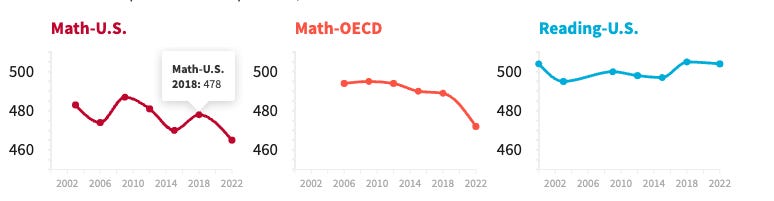
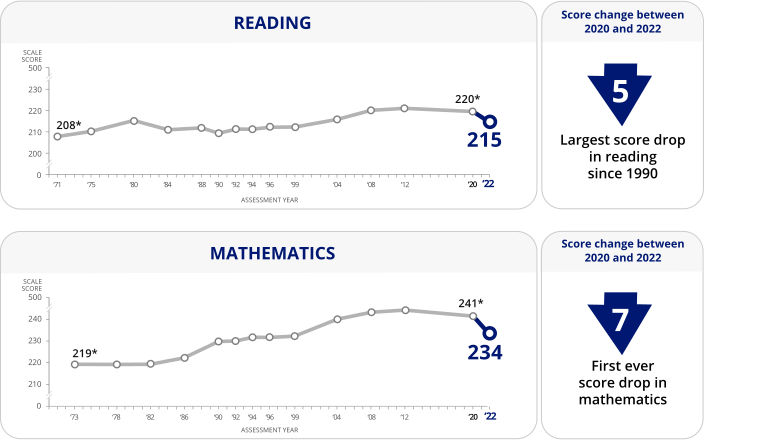
You can’t expect to teach children how to build a house of math-based critical thinking when they are mystified about how to pour the foundation and cannot construct a mental framework to help them approach solving the problem. That is what Math is supposed to help them develop. i.e. it’s the result of math education.
Arguably, critical thinking skills are all about identifying key drivers and first principles and then using those, along with related data, to reason through building a framework that allows you to efficiently address a problem in a way that leads to the desired outcomes or to project likely outcomes. But this presupposes that you know how to do that.
I think this learn math by understanding it yourself approach was something dreamed up by math PhDs who know the subject matter so well that they’ve forgotten what it takes to learn it and develop those skills. Their brains have already been shaped by their math experience to the degree that they no longer understand the process by which that transformation happened. Human children don’t create PhD-level math critical thinking skills ex-nihlo - they first need to build a foundation. That foundation then helps them make the scaffolding needed to assemble frameworks for thinking critically. This doesn’t happen at a single point in math education. i.e. you don’t get to algebra, and then suddenly you magically start to think mathematically; this occurs gradually over time as you learn advanced math and have to apply it to real-world problems.
The approach matters for Students and Parents, and that is what drives educational outcomes. The critical thinking skills emerge as they learn enough math and math “rules/properties/structures” to structure their thinking. Critical Thinking, in my opinion, is an emergent result of effective math education, and the only way to do that with kids (and adults) is to teach a solid foundation in calculation by doing it over and over again. The transition from rules-based learning to understanding and critical thinking then emerges when applying math to real-world problems (i.e., math word problems and physics.) Trying to jump directly to critical thinking without laying the foundation puts the cart before the horse.
You cannot just give people a canvas of ambiguity and say, go think critically, identify the key drivers and first principles, and figure it out without first building sufficient skills or mental scaffolding to make such an attempt possible. It’s an exercise in futility that ends in confusion, reduced self-esteem, and a belief that they are not smart enough to do it – which is hugely limiting when children are trying to author their future.
<tangential diatribe - sorry in advance - skip to the closing tag if you want to bypass my opinions on “regressive” progressive ideologies.>
If the goal is to teach critical thinking, and help our kids obtain it - we need to get our own thinking right - and we need to clean up the college. IMO, we first need to fire all of the “soft sciences” professors at our colleges who are brainwashing our kids with the ant-intellectual/anti-success “progressive” religious dogmas of identity/gender, intersectionality, marxism, post-modernism, and critical race theory. They obviously cannot teach skills (critical thinking) they don’t have, as evidenced by the appalling student demonstrations of 2024. That’s a failure of education, and if we continue, we’ll be doing future generations a massive disservice and be looking at the destruction of our County.
Personally, I view all of those ideologies as failure philosophies. No philosophy built on envy, hatred, or resentment-based victimhood blame-shifting (i.e., it’s not your fault. It’s the fault of those “oppressors” - over there.) can produce personal success in life. Only critical thinking and a sense of extreme ownership, coupled with a crazy work ethic, and a belief that it can be done and overcome, can ever produce success. Of course, playing the victim is much easier and perhaps more emotionally satisfying than the alternative.
This is IMO, partly why the rich get richer and the poor get poorer. The primary difference between a wealthy person and a poor person (ultimately) is the 6 inches of grey matter between your ears. It’s how you think.
Ever wonder why Asians are the most successful minorities in America? Not b/c we have “white privilege.” Not b/c we are all geniuses. When our ancestors arrived here, they were very discriminated against (something that continues even today. Under affirmative action, the most discriminated against group at Elite American schools were Asians - our kids needed SAT scores on average 140 points higher than white students and 450 points higher than African American students just to be competitive. Did you see Asian parents out protesting and burning down businesses? No! Because societal perception of us matters for upward mobility! We have a concept of ‘saving face’ related to social status. We aren’t and don’t want to be seen as troublemakers. We keep our heads down, work hard, and keep our noses clean!)
Our ancestors arrived here as poor or destitute, uneducated laborers and indentured servants. My father came to North America with a total of $200. Many were poor peasants fleeing war. Asians became the most successful group because we take responsibility, we rarely complain, we don’t worry about what Tom, Dick, and Harry are doing, and we don’t wait for things to be given to us. Thousands of years of Imperial rule mean that we expect things to be unfair, and we work around it by being the best we can be and going out and claiming/earning it7. If unbalanced/unfair access to opportunity exists in one area, we create opportunities in another or think about how to improve our odds. We make sacrifices to develop and provide privileges and advantages for our children instead of waiting for someone else to hand them to us or give us permission. (it’s always easier to beg for forgiveness than to ask for permission - particularly from an incumbent.) And we have an almost insane obsession with academic and career success. It’s a result of our history, values, expectations, and culture that are passed along within our families.
Since all these failure dogma proponents seem to be overly concerned with privileges, so let’s talk about them….. Where do these supposed “privileges come from? and how they are obtained?”
All privileges need to be earned (that was one of my principles of parenting.) There is a price to pay for each and every one of them, and if you have some, it’s because someone paid the price for it so that you could have it. Complaining about other people’s privileges is just envy and unhelpful- it only builds resentment. Those who complain about privileges not only want to do away with your advantages, but they want to take them for themselves and use them to become the “oppressors.” Those philosophies are based on envy, bitterness, hate, and resentment. No culture or society based on such principles can survive or thrive b/c they are - at their core, defeatist. Criticism and theft alone have never resulted in building something new; they only result in destroying or appropriating something someone else created. That is the definition of “ill-gotten gains.”
“Privilege” is built on the labors of your ancestors over time through their hard work, smart work, and sacrifice. We create them to hand them over to our children so they will have an advantage over others. Aww, is it unfair? Maybe, but that’s the entire point. If you don’t like it, build your own advantages for your children (or move to the wonderful utopia of North Korea - a country led by a mythical superhero who rides unicorns.) My ancestors started with nothing. It sucks, but you need to start somewhere, and you might as well start with yourself. Culture and society exist to build, protect, and perpetuate those advantages. That’s how countries, societies, and peoples become successful and powerful - and the successful and powerful are then afforded the ability to provide wealth, freedoms, and luxuries to their citizens, people, children, etc.
Any philosophy that attributes success solely to ‘ill-gotten-gains’ is based on envy and resentment, and is ultimately defeatist and can never be successful. If you have this mindset, it will be impossible for you to teach your children to succeed without destroying meritocracy and instilling a tyrannical dictatorship with yourself at the top.
</end diatribe>
Warning - This is not a how-to Guide
If you have kids struggling academically, you may be tempted to try to whisk your kids off to Kumon, but I wouldn’t necessarily try to do that right away or try to copy me. I’m not saying this because I don’t want you or your child to be successful.
Warning - copy me at your own risk.
By following or replicating any recommendations below, you agree to take full responsibility and accountability for the outcomes. I am not responsible for your outcomes. This information is based solely on my opinions and my experience.
I do not/cannot guarantee any outcomes - in fact, I discourage all readers from trying to follow my methodologies. (This is secret Chinese juju.)
I’m saying this because if you try to go from a conventional lassie-faire Canadian/American approach to parenting and then immediately attempt to implement a Tiger Parent approach including a stringent homework/study regimen - you will most likely fail. (particularly if your spouse is not onboard.)
Part of the reason we were successful (and it’s really my children who were successful—they were the ones who put in the majority of the work) is that a highly structured, goal- and rewards-based approach (earn all your privileges) always exited in our home from the time they were born. And such an approach is based on my cultural values. Some of which I may be so ingrained that I have neglected to identify and articulate them.
Almost everything in our household had to be independently earned. So, when it came to adding structure and things like Kumon, everyone was already normalized to this environment. We also had a lot of discussions on goals and values. I primarily drove these parenting efforts based on what my children identified to me as their desired life outcomes - so it was a program structure based on their identified goals.
I was, however, very careful in shaping those goals. I took action, shaped perceptions, formed associations (i.e. conventional-thinking→conventional results), and using a socratic method structured questions in such a way as to elicit responses and outcomes that I wanted then to come up with on their own. I also ensured that I allowed the boys to identify the rewards and motivators that would work best for them.
If you go down this road, be prepared to sacrifice and suffer for it
remember - nothing in life is free. It needs to be earned.
If you want to try to start on a similar path, my recommendations are below:
You need your Spouse’s full support. This won’t work if your spouse sabotages you. Step one is getting your spouse 110% on board and agreeing on an approach, standards and expectations. Don’t attempt to rely on your spouse to drive/lead this effort in any way. This will be 100% on you.
Discuss different lifestyles and life outcomes with your children and what it takes to achieve them. Illustrate the differences for them in ways they can understand. Talk about who they need to be as individuals (in terms of personal qualities) to make that a reality. (things like hard work, determination, people skills, networking, etc.) Don’t tell them that they need to have or develop characteristics that aren’t achievable or changeable. I.E. if your child wants success in a particular area don’t say, “Only rich Asian people can do that.” particularly if you are not rich and your child is not Asian. They cannot change their race/ethnicity. That’s the same as telling them what they are trying to achieve is impossible. Don’t be a dream stealer!
Start with how to think about things properly and how to gain the right personal qualities necessary.
Focus on personal growth - challenge them to step outside their comfort zones. I remember once while out to eat that my nephew wanted something in particular (I forget what it was but I think it was a particularly expensive dish that would be ordered just for him) while we were all out eating at his favorite restaurant. At that time, his future career goal was to be a famous Chef. So his tiger-mom told him he could have it, if he could go, find and talk to the owner or the head Chef and get a tour of the kitchen along with advice on how to become a head Chef and the things he’d need to learn and do. He did it.
Here is another maxim to instill in them: “You will never achieve a level of personal success greater than your level of personal growth.”
Help your child define success so that when you speak to them about success, you both understand what that means. For many Asians, success is often Money and Status, but that shouldn’t be all. It can be Money and Status, but it should also include spiritual, family, and lifestyle dimensions that don’t solely depend on Money.
Help your child author their future. Help them build a dream or vision board, That’s a great family activity! Help them define objectives that are short-term, near term and long-term - all the way into adulthood looks like for them so that they have an ultimate objective to work towards. Short and Near term may give you ideas for rewards and other motivators. Dr. Jordan Peterson also has a Self Authoring program that he has designed that combines principles from psychology as well as future goal setting and planning. I have not used it personally but it may be helpful if you don’t know how to proceed.
Don’t steal their dream. If anything, encourage them to think bigger!
Don’t confuse a job/career or profession with identity. I never let my kids say things like “I’m going to be a neurosurgeon when I grow up.” And I certainly would never let them hear me say that to someone else. If they said something like that, I’d always corrected them and rephrase it as, “When you grow up you are going to be <child’s name>, who is a <list of personal qualities> kind of person, and you are going to support yourself and your family, and achieve your life goals by practicing medicine as a neurosurgeon.” A job is not an identity. A job does not make you who you are. A job is something you do. It’s a mistake to tie your identity to a specific job for very similar reasons that telling Kids they are Smart is a mistake. What you want to be when you grow up should be determined by the personal qualities they want to have, not a job/profession.
Most kids have no idea “what they want to be when they grow up.” That’s ok. Anything they choose now, they are likely to change their mind on later. If your child has a true passion for something, go with that regardless of my criteria below. Having a passion is rare and they are more likely to be successful if they have a passion for something. If they don’t, then just work with them to identify and pick something that fits the criteria I provide below it’s likely to change numerous times before they get to College. If it changes, just roll with it as long as it leads to an achievable change in plans. The most important thing is to have a worthy goal and to teach children how to think about those goals properly.
Below is my criteria for steering children towards a future “profession.”
It should support their stated future lifestyle goals. Instead of thinking about “What do I want to do to make money?” (or more conventionally, “What do I want to be when I grow up?) and then living with the resulting lifestyle, The better question is “How do you want to live when you grow up?” and then fit the future income-generating activity to that.
Have a strong preference for owning a business versus being an employee. Employees only ever get paid what the business believes they are worth. If you want to build wealth, you need to be the one who owns the business. Any business creation process depends on a network of people for skills, promotion, and investment. So you, will have to become an expert at that and teach your children how to network. You should probably attempt to do that yourself so you have some idea of how to guide them. It can be done but it is extremely difficult and takes an absurd amount of work - which is why so few people do it. Just be aware that there is a difference between being self-employed and owning a business. Self employment relies on your own efforts to generate income where you are trading your time for money (just like a job). A business can generate income without you and can scale and duplicate efforts regardless of your time commitment (at least long-term.)
As soon as you can identify the kind of person your child needs to be to be successful as how they have defined it (in terms of personal growth qualities.) You need to start transforming yourself into that person. You cannot teach them to be someone you are not, and the challenges and issues you have to overcome will likely be the same for them, so you will be well positioned to help them.
Identify mentors - I’m a big believer in the adage of finding someone who has achieved what you want to achieve, find out what they did to get it, and then duplicating them. You will want to find mentors that can help you and your child achieve their goals. That may require networking - but often successful Adults will be willing to help children that ask. Just make sure you vet that person and form a relationship with that person and their family and that you trust them. Then try to arrange a way for your child to communicate with that person for mentoring, advice and guidance in a way that you can monitor.
Instill a sense of faith and a relationship with Christ. Whether you are religious or not, having a sense of faith in a higher power is helpful in times of struggle or lack of confidence. Some people may think this is a crutch, but I prefer to see it as a strength. It takes a much bigger person to take a leap of faith and, when necessary, engage in trustful surrender to God than it does just to attempt to go it alone and base all your efforts on your own ego. It’s also beneficial for a Child to feel like someone is always in their corner, and will always love them no-matter-what, whether you the parent is around or not.
Let your children know this is a process and a journey, not a destination. There will be lots of other people on similar paths, and that’s ok, life is about the Journey. Enjoy the journey and stop occasionally to smell the roses. I suggest dissuading them from comparing themselves to their peers. Instead, the benchmark should be progress toward their goals on the timetable required. Too much comparing with others will bring on extra anxiety and stress. The principle should be that they are working on improving themselves daily, that they are constantly pushing to be a better version of themselves instead of comparing themselves to other people who are farther down that road or appear to have already “arrived.” Especially comparing themselves to false images or perceptions of other people. Therefore, I would choose not to provide my child with a smartphone and certainly not allow them on social media (particularly if that child is a young girl or woman.) The social pressures are too great, and it’s not a battle you want them to have to fight while doing everything else.
Begin translating their existing privileges into goal/reward-based objectives. Define what they need to do to achieve them and make a daily/weekly checklist-style chart where they can see what they need to do and track their progress every day. This may be difficult if your children have never had to earn their privileges. What are privileges? TV, Computer, Phone, Games, treats, etc. Any time you get resistance doing this, tie it back to the outcomes they have identified they want. I suggest doing this when you introduce a new privilege so that you don’t have to fight historical attitudes and entitlements about old ones. Then, phase out older/existing privileges and renew and reintroduce them later under the new paradigm.
Start setting minimum standards for achievement. At first, allow them to set those standards - allow them to be lower than you’d like as long as everyone feels they are achievable. Once achieved, discuss with your child the principle that if they shoot for the Stars and work like mad to get there, they will at least land on the moon. Once they understand that, aim the goals higher so that the objective you want them to hit is about 80% of what you aim for.
Just setting standards can make a huge difference. I have a “nephew” - my cousin’s son, who came to visit me for the first time with his dad and we got on the subject of academic achievement. He asserted that his grades were “really good” and I asked him to define “good.” He told me mostly B’s with few C’s. I reiterated the principle of who his competition really was and that success is based on being prepared for when an opportunity arrives, then restated what I believe to be the acceptable minimum standards, and then reiterated my motto “There ain’t nothing wrong with 100%.” That seemed to be enough as he went home with his dad and started getting straight A’s within a few months. He was just a young man who needed to change his perspective and know what was acceptable and what was not. He graduated with a 4.0 from high-school and is now at the Royal Military College in Canada training to become an aerospace engineering officer!
Help them find and establish positions of leadership. Whether this is in a volunteer capacity or not doesn’t matter. They should have at least some experience being in a position of responsibility.
Take them with you to personal growth events. I used to attend courses from a company called Peak Potentials. (who are now out of business sadly.) They used to have classes called “The Millionaire Mind” and “Enlightened Warrior Training Camp” which I thought were great. I spent thousands on those and took my kid with me. They were primarily around how to get your thinking correct.
While things like this are great, they tend to attract groupies. They are also only valuable to the degree that you apply them and take action. Often I’d see the same crowd spending thousands of dollars they don’t have to go to event after event and never actually getting anywhere. Going to an event is easy. Application is hard. Don’t keep spending money on stuff like this unless you are actually using it and applying it in your life. At some point, you need to make it happen and move on. Great places to start, not great places to stay and end up. And the field of “personal growth” mentoring can be a huge scam so look for teachers who walk the walk and have the success you are looking for. Personally, I have very good things to say about Satyen Raja, but I think he only mentors business leaders these days and charges 6 figures to do so, but his events are good and I know very wealthy people who attend them. He taught significant parts of the Enlightened Warrior Training Camp I attended which I found very helpful - and at one point life-changing.
Let your kids know they have your and your spouse’s/partner’s full support. Then back that up with your time and money.
I told both my kids up front and very plainly that I would do whatever was necessary to support them in achieving their goals and that as long as they were putting in the work, they shouldn’t worry about the cost or money because that was Dad’s problem, and that was a Dad’s job.
My attitude was if they were going to work hard, focus, make sacrifices, and think long-term, I would have to do the same thing. If you are going to talk the talk, you are going to have to walk the walk.
I worked like a demon to make sure I could deliver on that promise - which became quite challenging when they both decided they wanted to go to the most expensive - and best - private school in our city for middle school and high school.) More sacrifices were required, and a lot of grinding it out on the part of the parents. I even worked two jobs at one point. Both of which were full-time. I had my regular job and then worked another full time equivalent job evenings and weekends. Thankfully, Popo the boy’s maternal grandmother - born in Hong Kong) also assisted.
When it comes to rewards, you need to deliver. One of my kids identified a reward for months of completing Kumon and advancing to a specific level as a Nintendo Wii the Christmas it came out. They earned it, but the Wii was extremely hard to come by that year. It was sold out everywhere, so I ended up sleeping on the sidewalk out front of a Best Buy overnight in the Canadian -30C winter (while getting snowed on) so that I could deliver on my end of the bargain.
If you say something, you must follow through. Otherwise, your children will not respect or trust you - which is essential if you want to obtain results. (They may not believe in themselves at some point, so it’s super important that they believe in you, in your direction, and that you’ve got their back. They may love you, but will not trust or respect you if you can’t keep your word, hold them accountable, and follow through on your promises. This is extremely important for modeling and building self-trust, integrity, and reliance within your children.
When my mother was angry, she used to tell us (myself and my brothers) that she would count to 3, and then punishment would follow. When she got to 2, instead of 3 coming next, it was 2 1/2, 2 3/4, 2 7/8, 2 8/8 - and she rarely followed through even if she got to 3. As a result, we didn’t trust or respect her when she spoke, but all she had to say was, “I’m going to discuss this with your father when he gets home,” we would shape up immediately b/c my father didn’t play games; if my father said something - that was how it would be. He set the standards and expectations, and we were all held to them b/c he also held himself to them. (And for us, the punishment was a whipping with a thick, crusty, stiff, leather belt on our bare backsides.) We knew that, and as a result, we listened when he spoke.
When it comes to discipline, I prefer to use the takeaway (of privileges or reduction of awards) versus escalating directly to physical punishment like my father would.
Be Flexible and Fair. If your kids did a lot of work but missed something minor (say, on a daily checklist), let it go. Don’t be Stalin. You can speak about it, but celebrate your successes with them. If they violated a standard, a reward can be reduced instead of eliminated, with the remainder provided when the situation is rectified. One parental goal is to keep your kids motivated. Use both the Carrot and the Stick, but be judicious about it. You must tailor your approach to each child separately.
Celebrate successes - the better you are at celebrating successes with your child, and teaching them how to do that as well, the more motivated they will be to work hard towards future goals. Celebrating success doesn’t just have to be material rewards - it can be games, fun, effusive verbal praise and celebration.
Thoughts on K-12 Education
If I were creating an educational curriculum, I’d drop parts of the curriculum irrelevant to success in the 21st century, like my kid’s month-long unit on Ancient Egypt. Instead, I’d replace that with a class or units on the philosophy of logic (deductive and inductive logic and the theory of knowledge,) first principles reasoning8, and logical fallacies and how to spot and avoid them. Identifying and Understanding key drivers and first principles are highly valued skills in the business world – which is why companies like McKinsey with the McKinsey method exist. And why execs spend hundreds of thousands on consulting fees.
I mean, ancient Egypt is fascinating, don’t get me wrong, but I don’t feel it helps equip kids to succeed in today’s world. If interested in that subject, one can study it in detail in anthropology/archaeology classes at University or in a high school elective class.
If I were the education minister in Canada (or the US), I’d send all the Math textbooks to the rubbish heap. Then, I’d buy the Kumon company and make it a mandatory part of the K-12 curriculum for all kids. I’d also Digitize it and provide AI-reviewed analytics to help teachers identify areas for improvement and reinforcement.
Then, I’d tie that math learning into electronics, robotics, and computer science classes so that kids can apply what they are learning in Math in a fun and hands-on way that also gives them tools to be creative with technology. It also allows them to see how math directly relates to the real world. I’d also make High School Physics mandatory. Physics is excellent for teaching kids how reality functions according to mathematical rules and principles. They would also learn that Reality is objective and not subjective (something sorely lacking today as people live increasingly in fantasy worlds of their own construction.)
We’re missing one thing, however, and that’s English. How does English relate to critical thinking skills beyond effective communication? I think one practice you learn in high school English is very important to developing critical thinking skills: Expository Essay writing.
What is an expository essay?
An expository essay is a type of writing that aims to inform, explain, or describe a topic. It presents facts and ideas clearly, concisely, and in an organized way. The goal is to provide an objective and balanced view of a subject, relying on evidence, examples, and logical reasoning to support the writer's claims. Expository essays should avoid personal opinions or biases, focusing instead on providing accurate and relevant information to the reader.
Writing an expository essay necessitates the use of several critical thinking skills, making it an invaluable tool for developing these abilities:
Analysis and Synthesis of information and data: To write an effective essay, one must break down complex topics into smaller, manageable parts (analysis) and then combine these parts to create a coherent whole (synthesis). This process enhances the ability to understand and organize information.
Evaluation and Interpretation: When researching and gathering information for an essay, writers must assess the credibility and relevance of sources. They must also interpret data and evidence, drawing logical conclusions based on their analysis.
Logical Reasoning: A well-structured argument requires clear and logical reasoning. Writers must present their points in a logical sequence, supporting each claim with evidence and addressing potential counterarguments while walking the reader through their thought process.
Communication and Clarity: Expository writing demands clear and concise communication. Writers should express their ideas in a way that the reader easily understands. This involves choosing appropriate language, using proper grammar, and organizing thoughts effectively.
Objectivity and Fairness: Maintaining an objective stance is crucial in expository writing. By presenting information without bias or personal opinions, writers learn to consider multiple perspectives, answer reader objections, and avoid making hasty judgments.
I’m trying to be kind, and as diplomatic as I can be without being directly offensive. WHen I say Westerners - my father and his side of the family would just generalize and stereotype all north americans under the title “White People.” Doing so, i believe, served two purposes. One it created distance between Asians and non-asians. Two, it helped reinforce the notion Asians culture is superior - which is a very commonly held, but almost always unstated assumption.
F.O.B - Fresh off the boat. The first generation to land/live here from the “old country.”
Yeah, Right, lucky is not the word I would have used. Any time someone wants to write off your accomplishments and minimize them b/c they could or would not do what’s required to achieve those same things - it’s called “lucky.”
https://www.edweek.org/leadership/u-s-teenagers-decline-in-global-test-of-math-but-hold-steady-in-reading-science/2023/12#:~:text=Some%20620%2C000%20students%20in%2038,science%2C%20and%2026th%20in%20math.
They were non-sensical to someone who graduated with a B.Sc. from a University’s Department of Math and Computer Science. If I couldn’t make heads or tails of it - how the hell would an eight-year-old figure it out? What about the other parents who had no university education in Math beyond what they did in High School decades ago? They’d be completely screwed!
A meritocracy IMO is one of the best things about America and why we have been successful as a country. When you destroy that, it’s game over. Failure philosophies based on envy and resentment can only get their people ahead by destroying meritocracy and stealing the achievements of other.