
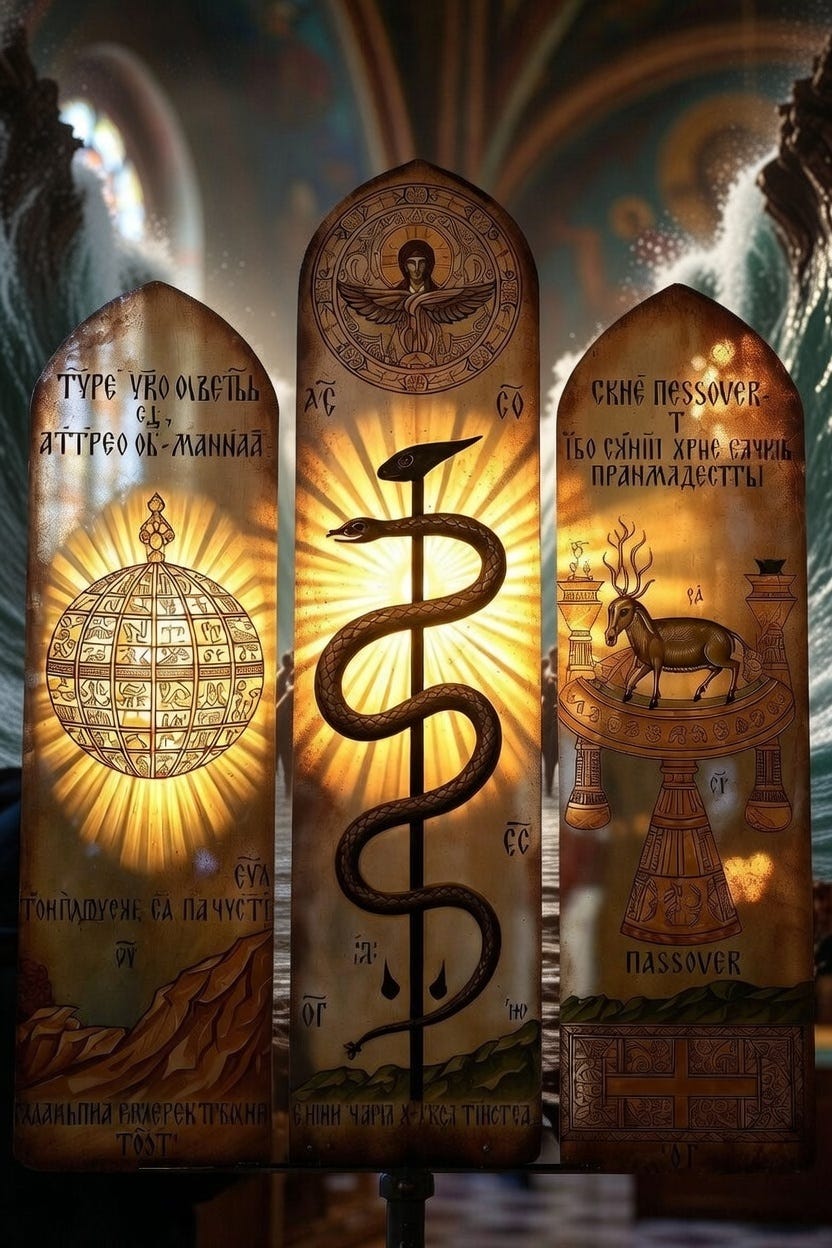
Shadows That Became Flesh
Orthodox keys that unlock true Christian understandings of Scripture
Imagine the chaos of the Red Sea: waves towering like judgment, Pharaoh’s chariots thundering behind, and a ragtag nation of slaves marching straight into the abyss on dry ground. The waters part, death swallows the oppressors, and Israel emerges alive on the other side, free, thanks to a divine miracle. Here’s the lightbulb moment: this wasn’t just a rescue op for ancient Semitic wanderers who found themselves trapped and enslaved by an evil empire. No, it’s part of a blueprint for something eternal. When those waves crashed back, drowning evil, did you see the font of Holy Baptism? Sin and the old man buried in water, the new man rising to life in Christ? If not, you’re reading Scripture with the lights off.
The Old Testament isn’t a dusty history book or a collection of moral fables. It’s a divine mosaic, every tile a shadow cast by the Light of the World. Typology, God-ordained prefigurations, prove it. Persons, events, rituals: all planted by the Spirit to point to Christ, His Church, and the sacraments.
Here’s the unyielding truth: only the Orthodox Church, the one holy catholic and apostolic Church founded by Christ through His Apostles, holds the key to unlocking it all.
Typology isn’t optional poetry; it’s the proof that God was always whispering the Gospel, from the beginning. Ignore it, and you miss Christ Himself. But grasp it in Orthodoxy, and the shadows become flesh.
What Is Typology? Secret Orthodox Keys to Scripture
Typology is no mere interpretive trick, no clever allegory spun by human fancy. It is the divine economy at work: historical realities in the Old Testament, sovereignly ordained by God to foreshadow the mysteries of the New. As St. Irenaeus of Lyons declared with apostolic fire: “For the law was a pedagogue to bring us unto Christ, that we might be justified by faith” (Against Heresies, drawing from Galatians 3:24). The Holy Spirit didn’t scatter hints haphazardly; He embedded them as seeds that bloom only in the soil of the true Church.
Consider the Apostles themselves. St. Paul, in 1 Corinthians 10:1-4, thunders: “Our fathers were all under the cloud, and all passed through the sea; and were all baptized unto Moses in the cloud and in the sea; and did all eat the same spiritual meat; and did all drink the same spiritual drink: for they drank of that spiritual Rock that followed them: and that Rock was Christ.” This isn’t a metaphor; it’s divine pedagogy, proving the Old prefigures the New. St. Cyril of Jerusalem echoes this in his Catechetical Lectures: “The Old Testament is a sketch, the New the full picture; the Law is shadow, the Gospel the reality.”
The Fathers wield typology as a hammer against error. St. Athanasius the Great, defender of the Godhead, insists in *On the Incarnation*: “The Scriptures proclaim Christ from beginning to end.” St. Basil the Great, in his Hexaemeron, sees creation itself typifying the sacraments: the waters of Genesis prefiguring the waters of regeneration. Why? Because God is not capricious, He prepares His people step by step for the fullness in Christ.
Now, contrast this with the heresies that splintered from the Church. Some, in their zeal for “sola scriptura,” spiritualize away the sacramental reality—turning baptism into a mere symbol, the Eucharist into a memorial snack. They drain the types of their power, leaving shadows without substance. Latins, meanwhile, add layers foreign to the Fathers: papal infallibility, immaculate conception—innovations that distort the pure fulfillment found in Orthodoxy. As St. Gregory of Nyssa warns in his Life of Moses: “One must not remain in the shadows but advance to the truth they signify.”
Only in the Orthodox Church do these types find unbroken continuity. Our Liturgy breathes them: the Theotokos as the burning bush unconsumed, the altar as the true tabernacle.
“What was prefigured at that time in the flame of the bush was openly manifested in the mystery of the Virgin… Just as on the mountain the bush burned but was not consumed, so also the Virgin gave birth to the light and was not corrupted.”- St. Gregory of Nyssa - On the Birth of Christ (aka In diem natalem Christi) circa approx. 370-380AD.
Depart from her, and you grope in partial light. Typology demands the whole Church—the sacraments administered by apostolic bishops, the faith once delivered to the saints (Jude 1:3). Anything less is diminution, a tragic veering from the path. Do you see it yet? The Spirit wrote the Old to reveal the New, but only in Orthodoxy do we read without blinders.
The Exodus Example
Dive into Exodus, and typology erupts like manna from heaven. Moses stands as a radiant type of Christ the Deliverer—flawed yet chosen, leading captives to freedom. The burning bush? St. Gregory of Nyssa in The Life of Moses reiterates, “The bush that burned yet was not consumed prefigures the Virgin who bore the fire of divinity without corruption.” The Theotokos, ever-virgin, holds God Incarnate. Moses’s staff strikes the rock, water gushes for the thirsty (Exodus 17:6). St. Paul identifies it: “That Rock was Christ.” The Cross strikes death, and living water flows—the font, the sacraments, eternal life.
The Red Sea crossing is this typology’s most visual jewel. Israel, enslaved in Egypt (Egypt here represents sin and an existence in sin, their enslavement, sin’s tyranny), passes through waters from death to life. Pharaoh’s army drowns in the waters, and the old oppressors are buried as are our sins in the waters of baptism. St. John Chrysostom preaches with fierce clarity in his Homilies on Romans: “The Red Sea was a type of baptism; as they passed through the water, so we pass through the font, drowning the Pharaoh of our sins.” Not allegory, brothers—divine foreshadowing. The cloud leading them? The Holy Spirit overshadowing the waters. The dry ground? The path to resurrection.
St. Cyril of Jerusalem drives it home: “You descend into the water bearing your sins, but the invocation of grace seals your soul... You come up a new man” (Catechetical Lectures). This is part of the Spirit’s instruction manual for salvation. In Orthodoxy, we live it: triple immersion, chrismation sealing the gift. Protestants reduce baptism to obedience without regeneration—a heresy that ignores the type. Catholics baptize infants validly, but delayed confirmations are alien to the original, undivided Church.
Every separation from Orthodoxy leaves the reader half-blind. Why? Because the types demand sacramental fulfillment in the true Body of Christ. Miss that, and Exodus becomes a nice story, not the Gospel in embryo. But in the Church, it thunders: Christ is here, delivering now.
But the most devastating and beautiful types—the Manna that prefigures the true Bread from Heaven, the Passover lamb slain for the life of the world, and Joshua’s crossing into the Promised Land, how these point unmistakably to the Eucharist and the Orthodox altar—are behind the paywall. If you stop here, you will have seen shadows. Subscribe now, and step into the light that has never been extinguished. Don’t leave the fullness of Christ on the table.
I left a tradition that claimed a new revelation but missed the ancient types and misunderstood small details like Christ’s exclamation from the Cross, “Why hast thou forsaken me?” Failing to recover truly lost divine plain and precious things with 19th century protestant speculations. A true prophet possessing legitimate revelation should be able to recover these details.
Don’t make the same mistake. Upgrade today—eternity is not a spectator sport.
Diving Deeper into the Mysteries: Manna, the Serpent, the Promised Land, and the Paschal Lamb
Now we plunge deeper, where the types blaze with sacramental fire. The manna in the wilderness (Exodus 16): bread from heaven, sustaining Israel, yet perishable. St. Cyril of Jerusalem proclaims in his Catechetical Lectures: “The bread that came down from heaven was a type; now the true Bread is given in the mystery of the Eucharist.” Christ Himself declares, “I am the living bread which came down from heaven” (John 6:51). In Orthodoxy, this finds reality: not symbol, not transubstantiation’s philosophical overlay, but the very Body and Blood through the epiclesis of the Spirit. Protestants call it remembrance—draining the type of power, reducing heaven’s gift to a cracker or loaf of bread. Heresy. The Fathers knew: manna pointed to divine communion, uniting us to God.
The brazen serpent in Numbers 21, lifted up by Moses, healed those bitten. Ever wonder why a bronze serpent? Isn’t the serpent an image of evil? Why Bronze? The serpent echoes the ancient enemy—the devil in Genesis 3, who brought sin and death (also understood as sickness and death) into the world through deception. Yet here, God commands Moses to fashion one and raise it high, so that gazing upon it brings healing. St. Cyril of Alexandria thunders in his Commentary on John: the serpent represents sin itself, the curse we bear, but elevated on the pole, it becomes the antidote. Christ, sinless, takes on the likeness of sinful flesh (Romans 8:3), becoming “sin for us” (2 Corinthians 5:21) on the tree of the Cross. He who knew no sin hangs there like the serpent—accursed (Galatians 3:13)—to conquer the sting of death. In Orthodoxy, this is a sacramental mystery: we venerate the Cross not as an idol, but as the weapon that slays the dragon, healing our wounds through confession and the Eucharist.
And why bronze? The metal itself has layers of meaning. Bronze (an alloy of copper, as the Hebrew nehoshet suggests) was the material of the tabernacle’s altar of sacrifice (Exodus 27), symbolizing judgment and atonement—enduring, unyielding, forged in fire. Bronze, as an alloy, is stronger than pure copper, much more resistant to corrosion, and far more valuable because of its tin content. While copper was abundant in the Sinai Peninsula and the Levant, tin was incredibly rare. In the time of the Exodus, tin often had to be traded from as far away as modern-day Afghanistan, Turkey, or even Cornwall (UK). This made bronze a high-status material. When the biblical texts describe the construction of the Tabernacle—mentioning bronze for the “brazen” altar, the basins, and the sockets—they are describing a material that was technologically advanced and valuable for its time.
I, the author (Lee), might see an analogy in this alloy an echo of the two natures of Christ, fully Man and fully God. There’s even a divine wordplay: nahash (serpent) sounds like nehoshet (bronze). St. Gregory Palamas touches on the concept of endurance in his homilies, seeing bronze as a type of Christ’s incorruptible humanity (bronze is far more resistant to corrosion than copper), shining yet strong enough to bear divine fire without consumption. In Orthodox iconography and hymnody—like the services for the Exaltation of the Cross—we honor this: the serpent of brass prefigures the Wood that gleams with glory, unconsumed by death. It’s not arbitrary, love; it’s the Spirit’s brushstrokes, painting salvation from Eden’s fall to Calvary’s triumph.
Christ owns this imagery: “As Moses lifted up the serpent in the wilderness, even so must the Son of man be lifted up” (John 3:14). St. Athanasius thunders: “The Cross is the sign of victory over death.” In Orthodoxy, we venerate the Cross—not as an idol, but as the tree of life fulfilling the type. This is tied to confession: the serpent’s bite (sin) is healed by looking up in faith. The sacrament restores, as the Fathers taught, not Sola Fide “faith alone that skips repentance.
Now, the full blossoming of this Type in the Exodus arc: Moses (who in Christ’s time represents the Mosaic Law) brings Israel to the edge of the Promised Land but cannot himself enter (Deuteronomy 34). Only Joshua can cross them over (Joshua 3). St. Irenaeus hammers this point home: “Moses, the Law, could not save; Joshua, whose name is rendered in Greek as Jesus, leads to inheritance.” Christ’s Hebrew name? Joshua (Yeshua). The Law tutors and instructs but cannot justify or save (Galatians 3:24); only Christ, the new Joshua, conquers death, leading us into the promised land of our heavenly rest (Hebrews 4). Scripture rams the point home: “The law was given by Moses, but grace and truth came by Jesus Christ” (John 1:17). Orthodoxy lives this—no legalism, no antinomianism, but synergistic ascent.
The Paschal Lamb
Finally, the Passover lamb. Many Protestants view this as evidence for penal substitutionary atonement theory. But first, what was the Passover sacrifice used for, and why was it necessary? A pure, spotless lamb, slain, its blood painted on doorposts. Specifically, the lamb’s blood had to be painted on the doorposts. Why? To save people from death (Exodus 12). It was the blood of the lamb that saved the people from death. Christ is “our passover... sacrificed for us” (1 Corinthians 5:7). St. John Chrysostom preaches: “The lamb was a shadow; the reality is the Lamb of God.”
Christ is the true Passover Lamb, slain not to appease an angry God hellbent on judgment, justice, and satisfaction, but to deliver us from the bondage of death and sin, just as the lamb’s blood marked the doors in Exodus, sparing Israel from the destroyer. St. John Chrysostom proclaims in his Paschal Homily: “Christ, our Passover, has been sacrificed for us!” This isn’t a judicial transaction swapping sin for mercy; it’s divine conquest and healing through reconciliation. The Crucifixion saves us by shattering the power of death. In the Harrowing of Hell (no longer taught in the West), Christ descends into Hades, binds the devil, and rises victorious, trampling down death by his death. We are freed not through punishment diverted, but through union with Him who destroys our enemies.
Therefore, Orthodox atonement? not some Latin-derived legalistic punishment/ransom narrative, but Victory over death and the recapitulation of creation (St. Irenaeus). God punishing Himself in substitutionary wrath? Hogwash. The Fathers instead see a ransom from corruption and death, and the healing of all creation. The Cross conquers Hell, Resurrection tramples death. In the Eucharist, we partake of the slain yet risen Lamb through his blood. His blood isn’t painted on our doorposts; his blood is painted on our souls. His flesh is not mere food, but together with the blood, a vessel for divine grace, which, when consumed, transforms us from the inside out. It’s not a mere symbol, and it never was; it’s a divine sacramental mystery.
These are but a taste
Other types we have not covered that foreshadow Christ and deepen our understanding of his mission and accomplishments. We will cover these in a future Part 2.
Jonah in the belly of the great fish (Jonah 1–2)
Joseph in Egypt (Genesis 37–50)
The sacrifice of Isaac (Genesis 22)
Noah and the Flood (Genesis 6–9)
Melchizedek, king of Salem (Genesis 14:18–20)
The Tree of Life in Eden (Genesis 2–3)
Lee’s Parting Aside
This continuity, largely forgotten in the West, indicates to me that the Orthodox Church alone is “the pillar and ground of the truth” (1 Timothy 3:15). Every heresy ignores, misunderstands, or subtracts from it. Protestants, and their derivatives, empty the sacraments of any real power, making them symbolic only. But here, the types become flesh.


