


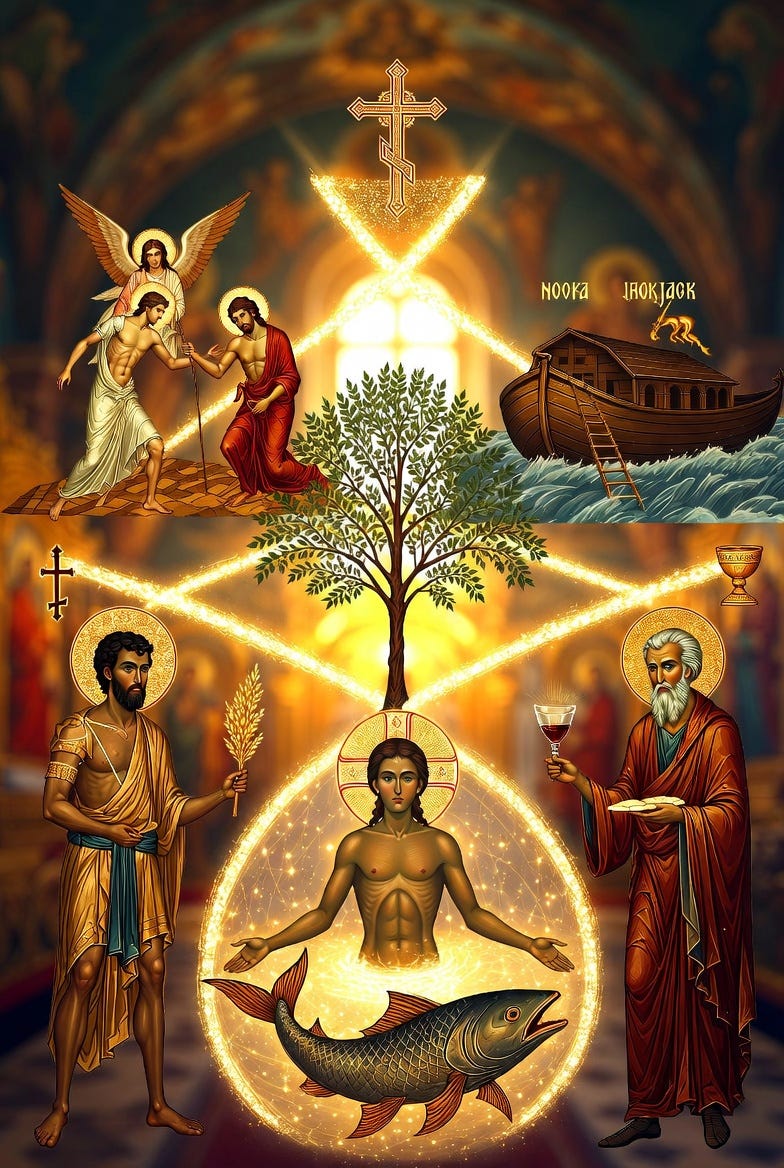
In the sacred tapestry of Holy Scripture, the Old Testament is not a collection of interpreted history, isolated tales, or moral lessons, but a divine symphony orchestrated by the Holy Spirit. These ancient narratives are seeds—foreshadowings planted by God Himself, awaiting the fullness of time when Christ would make them bloom into eternal truth. The Holy Fathers of the Church, and Christians, from the earliest centuries, beheld these typologies not as human inventions or clever allegories, but as God’s deliberate pedagogy (a method of teaching): shadows cast forward, finding their substance only in the incarnate Logos and His Body, the Church.
St. Irenaeus of Lyons, that great second-century defender of the faith against heresies, teaches us in Against Heresies (Book V, Chapter 19) that Christ is the “recapitulation” of all things—the One who sums up and fulfills the entire human story. St. Cyril of Jerusalem, in his Catechetical Lectures (Lecture 13), urges the faithful to see the Old Testament as a schoolmaster leading to Christ. St. John Chrysostom, the golden-mouthed preacher of the fourth century, echoes this in his homilies, proclaiming that every shadow in the Law and Prophets points to the radiant reality of the Gospel. And St. Gregory of Nyssa, in his mystical writings like The Life of Moses, reveals how these types elevate our souls toward theosis—our divine union with God.
These typologies are not intellectual exercises; they are living mysteries, woven into our hymns, icons, and sacraments. In the Orthodox Church alone, they find their unbroken fulfillment, without the subtractions of minimalism or the additions of innovation.
In the first article in this series, we explored some of my favorites, but those are far from the only types in the scriptures. Below, we will cover additional types that prefigure Christ, so that we can see them as the earliest Christians did.
Sadly, you’ve reached the end of the free preview. What follows is reserved for those who hunger for the deeper mysteries. The hidden manna that the world rushes past, but the Church has guarded and savored for two thousand years.
If the typologies we explored in part 1—the manna as prefiguring the Eucharist, the bronze serpent lifted up as Christ exalted on the Cross (John 3:14–15), the Exodus through the parted Red Sea as our passage through the waters of Baptism (1 Corinthians 10:1–4), and the Passover lamb whose blood shields us from death stirred something in your soul, remember: these are not mere historical curiosities or clever parallels. They are living revelations, breathed by the Holy Spirit through the Prophets and fulfilled in the Person of our Lord Jesus Christ.
The Fathers call us to go further. St. Basil the Great, in his treatise On the Holy Spirit, reminds us that treasures of divine wisdom are not scattered carelessly on the surface but hidden, awaiting those who seek with humility and perseverance: “Truth is always a quarry hard to hunt, and therefore we must look everywhere for its tracks.” St. John Chrysostom, that tireless preacher of the depths, urges the faithful not to stop at the outer court but to press into the Holy of Holies: “The Scriptures are not to be read superficially... but with great attention, for in them are hidden the treasures of wisdom and knowledge.”
Behind this paywall, I share what the free portion only hints at:
Patristic explanations of 7 typologies, drawn from the homilies and writings of the earliest Fathers (St. Irenaeus, St. Cyril of Jerusalem, St. John Chrysostom, and others)
This is not content for the casual browser. This is nourishment for the pilgrim who senses that Orthodoxy is not a museum of old ideas but a living ark carrying us through the floodwaters of this age to the promised land of union with God.
If your heart is kindled, if you long to taste more of the hidden manna that sustains the saints, then please consider becoming a paid subscriber to unlock this content today. Your support doesn’t just unlock words on a screen; it sustains this work.
The deeper mysteries await. Will you step through the veil?
