

No, Christmas Isn't Pagan
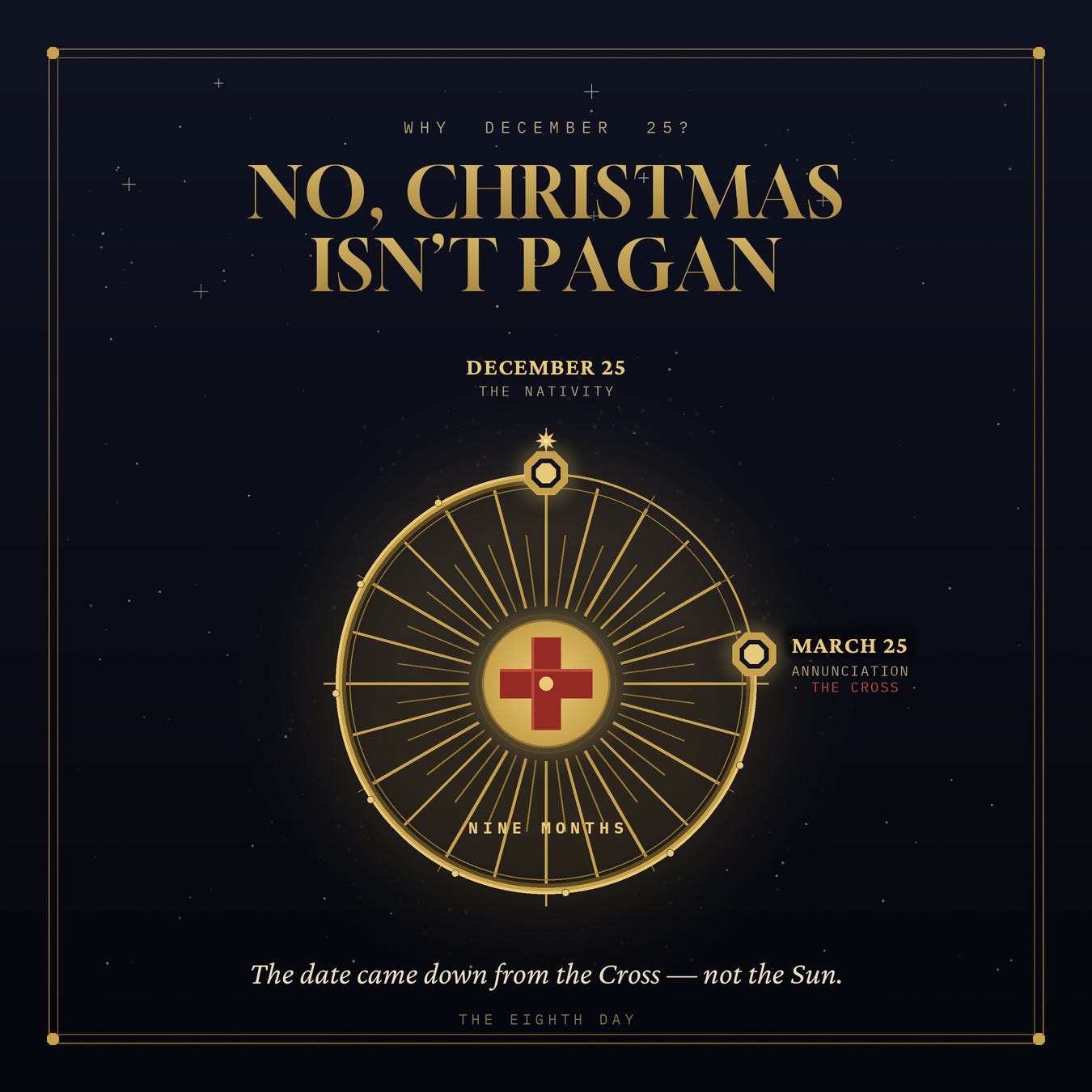
Christians Calculated December 25 From the Cross — Not the Sun. The Pagan-Origin Story Rests on a Single Marginal Note From the 12th Century.

<sets down eggnog>
You know the guy. Every family has one. It’s the second day of Christmas, the wrapping paper is still on the floor, somebody’s auntie is asking if anyone wants more ham, and from the corner of the couch, between bites of shortbread, he clears his throat.
“You DO know … Christmas is just a stolen pagan holiday, right? December 25th was the birthday of the Sun god. Saturnalia. Mithras. Constantine made the whole thing up to keep the pagans happy. It’s not even in the Bible.”
And everyone kind of nods, because it sounds like the sort of thing that’s probably true, it has that delicious flavor of forbidden knowledge, the History-Channel-at-2 am feeling, the sense that you’ve peeked behind the curtain and seen the gears. It’s a great story. It has a villain, a cover-up, and a smug little payoff.
It’s also almost entirely false, and — like its cousin, the “Constantine paganized the Sabbath”1 myth I took apart in an earlier piece — it’s a relatively recent invention dressed up as ancient history. So pour yourself some more of whatever you’re drinking, because we’re going to do something the couch-guy never does: check. We’re going to trace exactly how the Church arrived at December 25, dig into the strange and beautiful date of the Annunciation, and then take every single pagan-origin theory, Sol Invictus, Saturnalia, Mithras, the whole crew — and put each one in the ground, one at a time.
I was raised Latter-day Saint (LDS aka Mormon.) I want to be clear that what we are about to dig into is not formal LDS/Mormon Sunday school teaching. In fact I’ve never heard anyone preach this from the pulpit at all. But I do think that the belief of some of these myths are fairly widespread in the LDS world, because I have heard them repeated quite a lot over the years from various LDS people I know/knew (mostly my mother) for it to stick.
What did I hear? That December 25 had nothing to do with the real Jesus and everything to do with pagan compromise — and that the real date was some time in early April.2 So believe me: as someone who was formerly LDS, I get the appeal. It’s completely inline with the great apostasy type narrative. I just heard this again recently and decided to scrutinized this position instead of accepting it at face value.
First, let’s be Honest: the Bible Gives us no Dates
Let’s concede the couch-guy his one true point and get it out of the way, because it costs us nothing.
The Gospels do not tell us when Jesus was born. Not the day, not the month, not even the season. Luke mentions shepherds in the fields (Luke 2:8), which people love to wield as proof — “see, no shepherd would be out in December!” — but that argument is much weaker than it sounds. Bethlehem winters are mild, flocks were often kept outdoors, and more importantly, it’s beside the point. Nobody seriously thinks December 25 was arrived at by meteorology.3
In fact, the earliest Christians weren’t celebrating Jesus’ birthday at all. Around the year 200, Clement of Alexandria runs through a whole menu of proposed dates that various Christian groups had floated, May 20, April 20 or 21, others, and December 25 isn’t even on his list.
His contemporary Origen openly mocked the idea of celebrating birthdays as a pagan, vainglorious habit fit for Pharaohs and Herods, not Christians. (Hence a good reason for why early christians were not celebrating his birthday.)
I find this is highly ironic. Even if we granted, which we most certainly do not, that Dec 25th was chosen for pagan reasons; celebrating the Nativity, every year would be considered more pagan by early christian standards than the date it falls on. Let that sink in. Better point that finger somewhere else couch man!
For the first two centuries, the question of when Jesus was born simply wasn’t a priority. The cross was the priority. The empty tomb was the priority. Everyday christians weren't terribly concerned with when he was born.
Hold onto that: December 25 didn’t start as a guess about the weather on the night of the Nativity. It started as the answer to a math problem — and the math began at the cross.
How Christians Actually Got to December 25
Here is the chain of reasoning. It will feel alien to modern minds, which is exactly why no one borrowing a pagan party would ever have invented it.
The ancient principle of Wholeness. There was a deep conviction in the Jewish world, preserved in the Talmud, that the great turning points of salvation cluster on the same dates, that God’s work has a deliberate symmetry. The Babylonian Talmud records a second-century debate in which Rabbi Eliezer holds that the world was created in the month of Nisan, the patriarchs were born in Nisan, and in Nisan the world will be redeemed.4 Early Christians inherited a version of this instinct in a specific form: the idea that a great prophet enters and leaves the world in perfect wholeness. That he dies on the very same date he was conceived. No loose ends. No fractional life. A complete circle.
The date of the cross. Around 200 A.D., Tertullian of Carthage, working in the Latin West, reported a calculation that the 14th of Nisan, the day of the Crucifixion in John’s Gospel, fell on March 25 in the Roman solar calendar.5 Hold that date.
The date of creation. Around 221, the Christian historian Sextus Julius Africanus did something independent. In his world-chronicle, he fixed the moment of the Incarnation, the conception of Christ, not His birth, to March 25, the spring equinox, which he also held to be the very date of the creation of the world. The new creation begins on the anniversary of the first one. The new Adam is conceived on the day the cosmos was made.6
Do the arithmetic. If Christ was conceived on March 25 (the new creation / the Annunciation) and if, by that ancient principle of wholeness, the date of His conception equals the date of His death (March 25, the cross) — then count forward a normal nine-month pregnancy from conception, and you land, inevitably, on December 25.
Conception and crucifixion on one date; birth nine months later. That’s it. That’s the entire machine. It runs on Passover, Genesis, and a theology of cosmic symmetry, and there is not a single sundial or sun-god anywhere in the gears.
And here’s the part that should end the argument of pagan accretion itself: the East ran the same calculation and got a different answer, which proves it was a calculation.
Greek-speaking Christians worked from their own calendar, placing the Passion on the 14th of the spring month Artemisios, which corresponds to April 6 for us: same logic, same wholeness principle. April 6 conception, plus nine months, equals January 6.
January 6 is, to this day, the date the Armenian Church celebrates Christmas, and the root of Epiphany everywhere else.7 Two halves of the Christian world, working independently, produced two different dates by the same internal method. That is the fingerprint of a computation. You do not get that pattern from copying a pagan festival. You get it from doing the homework two different ways.
By around 200–235 AD, Hippolytus of Rome appears to have already drawn the December 25 conclusion explicitly. Two centuries later, Augustine spells the whole thing out and does it poetically. Christ, he writes, is held to have been conceived on March 25, the same day He suffered, so that the womb of the Virgin corresponds to the new grave in which no one had ever been laid; and He was born, according to tradition, on December 25.8 The conception and the death share a date; the womb and the tomb rhyme. That is not the theology of a man rebranding a solstice barbecue.
The Annunciation
March 25th keeps showing up in the calculation. Why March 25? It’s worth pausing at this point, because the date of the Annunciation is key to the entire calculation.
March 25 sits at the convergence of four lines, all of which the early Church found compelling:
It was the spring equinox in the Julian calendar. The hinge of the year, the moment in the year when light begins to win over darkness. For those seeing equinox and instantly jumping to Paganism, I would remind you that pagans didn't have a monopoly on the calendar and that even if some pagan festivals / holy dates also landed on the spring equinox, that would be, perhaps, an interesting correlation, but that's all it is. Repeat after me: "correlation does not equal causation?” There is a lot more work that you would have to do to show causation. I want to put this notion to bed clearly, so let's do that, shall we? Let's look at correlation vs causation to illustrate the absurdity of conflating the two.
Every summer, two things climb together like clockwork: ice cream sales and shark attacks. Chart them side by side, and they rise in perfect, sinister lockstep. The correlation is undeniable. So, applying couch-guy logic with full rigor, we are forced to conclude one of two things: either ice cream summons sharks, or sharks give people a sudden craving for Rocky Road. Either way, lock up the Mister Softee truck. It’s a menace; we should ban ice cream from anywhere near beaches. Obviously, this example illustrates that conflating correlation with causation produces totally absurd results.Or — or — maybe both spike in summer, because summer is when people swim where the sharks are and because it's hot outside, when people also buy ice cream. There is a great big flaming common denominator up in the sky that is a driver to both of them. Nobody copied anybody. The “connection” was the weather the entire time.
And that is exactly what’s happening with the equinox. Pagans clustered their festivals around the solstices and equinoxes for the very same reason the Christian conception of the Nativity math lands near one: because the turning of the sun is a real, visible, universal event that everyone experiences but nobody owns. The sky runs the same program for everybody: Roman, Christian, Norse, you, me, the shark, and those buying ice cream. Two groups arriving at the same season by completely different roads isn’t plagiarism; it’s a shared sky. To get from “they’re near the same date” to “one stole from the other,” you have to actually show your work, and nobody peddling the pagan theory ever does.
It was the computed date of the Passion. Tertullian dates the crucifixion to March 25.
It was the traditional date of the creation of the world. Africanus’s first day, when God said let there be light. And by the ancient Jewish prophetic principle of wholeness, it was therefore the date of the conception of Christ, the Word made flesh, the Light entering the world He had made, on the anniversary of the day He made it.
Sit with that for a second. On the Christian reckoning, the same date carries the first day of creation, the conception of the Redeemer, and the death that redeems all men. The beginning of the cosmos, the beginning of the Incarnation, and the climax of salvation, all folded onto a single square of the calendar. The Feast of the Annunciation, the day the angel Gabriel comes to Mary (Luke 1:26–38), got formalized as a liturgical celebration later, but the date was already there, fixed by this computation centuries before the feast had a name. 9
There’s even a second, Scripture-based route to the same place, and it’s worth knowing because my Protestant readers will likely find it easier to accept.
Luke tells us John the Baptist’s father, the priest Zechariah, was serving in the Temple when the angel announced John’s conception (Luke 1).
Luke then says Gabriel came to Mary in the sixth month of Elizabeth’s pregnancy, so the conception of Christ falls roughly six months after the conception of John.
Run the calendar calculations, and you get John conceived in late September (his birth still celebrated June 24), and Christ conceived in late March, and born in late December.10
Some saw further evidence in John the Baptist’s own words: “He must increase, but I must decrease” (John 3:30.) - John born at the summer solstice, as the days begin to shorten; Christ born at the winter solstice, as the light begins to grow. The Fathers noticed. But, of course, they noticed.
Yes, There’s Sun Symbolism, but it’s Ours, Not Theirs
Now, the couch-guy will pounce here. “AHA — you admit it’s about the solstice! The growing light! The sun! Gotcha! The fathers are thinking like Pagans!”
No. And the distinction here is the whole ballgame.
Christians absolutely did see meaning in Christ being born as the natural sun turns and the days lengthen. They said so, out loud, constantly. The prophet Malachi had called the Messiah the “Sun of Righteousness,” rising “with healing in his wings” (Malachi 4:2). John’s Gospel opens with the light shining in the darkness, the darkness unable to overcome it (John 1:5). Ambrose of Milan called Christ the true Sun, the one who outshines and outlasts the dying gods of the old order.
But look carefully at what that move actually is. The Fathers are not bowing to the sun — they are conquering it. They are taking the most universal natural symbol there is, the returning light, and saying: you pagans have been worshiping the shadow; here is the substance. The sun in the sky is a created thing, a lamp God hung on the fourth day; Genesis says God set the lights in the heavens "for signs, and for seasons" — the sun is assigned a sign-making, time-marking function by God from day four (Genesis 1:14), and both Jews and Christians acknowledged and respected that.
Christ is the uncreated Light, it was always dimly pointing toward. Augustine put it bluntly to his congregation: "Do not worship the sun, worship the One who made the sun.” This is not capitulation to paganism; it is the boldest possible act of reclamation in the other direction. The claim that the cosmos itself, sun and solstice and all, was Christian propaganda all along, and the pagans just hadn’t read the memo.
And, the date came first, by computation. The fit with the solstice was received as confirmation, a providential wink from a God who arranges His calendar with poetry, not as the cause of the date. The math gave them December 25. The sun just happened to be standing in exactly the right place to make the point for them.
Now Let’s Bury the Pagan Theories, One at a Time
This is the part you came for. The “Christmas is pagan” claim isn’t one argument; it’s a shotgun blast of them, and the people who love them fire them in rotation, retreating to the next as each one fails… So let’s be systematic. Here is, as best I can assemble it, the complete arsenal. Watch them fall.
1. “December 25 was the birthday of Sol Invictus, the Unconquered Sun” (Aurelian, 274 A.D.). This is the one with an actual scholarly pedigree, so it gets the most attention. And it collapses on the dates. The claim that the emperor Aurelian established a December 25 sun-festival in 274 turns out to be a phantom: it appears on no coin, in no inscription, and in none of the ancient biographies of Aurelian. Our single earliest source placing a festival of Natalis Invicti on December 25 is the Chronograph of 354, and that very same document contains the earliest explicit record of Christians keeping Christ’s Nativity on December 25. In other words, the first time we can prove anyone held a December 25 sun-feast is also the first time we can prove Christians held Christmas, same century, same document. There is no demonstrable pagan precedent at all. The Roman religion scholar Steven Hijmans, who has studied this more closely than almost anyone, concludes there’s simply no evidence of a December 25 Sol festival before the mid-fourth century — and raises the genuinely likely possibility that the pagan feast was a reaction to the Christian one, not its source. William Tighe argues the same: that Aurelian’s heirs (or Julian the Apostate) planted a sun-festival on December 25 precisely to give pagans a counter-attraction to a date Christians had already claimed. Read that twice. The borrowing may run exactly backwards from what the couch-guy thinks. We may have been the ones they were copying.
2. The 12th-century marginal note (the only “smoking gun” — and it’s a dud). Here’s the dirty secret of this whole debate: there is exactly one ancient-ish text that actually claims the Church deliberately set Christmas on a pagan sun-date. It is a marginal gloss scribbled on a manuscript of the Syriac writer Dionysius bar-Salibi, who died in 1171. That’s the twelfth century. That’s a thousand-plus years after the events it claims to explain — the historiographical equivalent of a sticky-note on a modern paperback “explaining” the motives of the Roman Senate.11 The entire scholarly “borrowing” hypothesis, when you trace it to its textual root, rests on this one late, anonymous annotation. Everything else is inference. A note from the 1100s cannot tell you what a bishop in the 200s was thinking.
3. Saturnalia. People throw this one around constantly, and it’s the easiest to dismantle, because you only have to look at a calendar. Saturnalia ran from December 17 to 23. It ends two days before Christmas. It was a raucous festival of role-reversal, gambling, and gift-giving in honor of Saturn, and it has no birth-of-a-god theme, no nativity, and crucially, no December 25. You cannot have stolen a holiday by scheduling yours on a day the other holiday isn’t even being held. (Some Christmas customs may echo Saturnalian gift-giving, more on trappings below, but the date and the feast simply aren’t Saturnalia.)
4. Mithras “born December 25 of a virgin.” This is the internet’s favorite, and it is pure fabrication. Go look at what the actual Mithraic monuments and inscriptions say, because we have them. Mithras was not born of a virgin and was not born on December 25. Mithras was born from a rock, the petra genetrix, emerging fully grown, often with a torch and a knife, while shepherds (sometimes) look on. The ancient poet Commodian literally calls him “born from a rock.” The leading modern scholar of the cult, Manfred Clauss, flatly calls Mithras “the rock-born god.” Another Mithraic specialist, Alvar, states that there is no evidence of any kind, not even a hint, that December 25 or any winter day mattered in the Mithraic calendar. The “Mithras born December 25” claim is a confusion: late Mithraists identified their god with Sol, and so the (post-Christian) Sol date got retroactively pinned onto Mithras by modern writers who didn’t check.12
5. Horus, Attis, Tammuz, Dionysus — and the “16 crucified saviors” carnival. Once Mithras fails, the couch-guy reaches for a parade of other gods, all supposedly “born December 25 of a virgin.” None of them check out either — there’s no ancient evidence for a December 25 nativity for any of them. What’s worth knowing is the pedigree of these claims, because it’s embarrassing. They don’t come from historians. They trace through the 2007 internet film Zeitgeist, which lifted them almost wholesale from the self-published Jesus-mythicist writer “Acharya S” (D.M. Murdock), who in turn drew on Kersey Graves’s 1875 book The World’s Sixteen Crucified Saviors — a work of Victorian esoterica so unreliable that even committed atheist historians disown it. The historian Tim O’Neill, an atheist who runs a whole blog debunking bad history about Christianity, dismantles this lineage piece by piece. When the atheists are telling you your anti-Christian argument is garbage, the argument is garbage.13
6. Hislop’s Two Babylons (Christmas = Nimrod, Tammuz, Babylon). This is the granddaddy of the Protestant-fundamentalist version. Alexander Hislop’s 1853 claim that Christmas is a secret continuation of Babylonian sun-worship, complete with his trademark “this word sounds like that word, therefore they’re the same” method. I dismantled Hislop’s etymological malpractice at length in the Constantine piece (the man thought “Easter” was “Ishtar”), so I won’t relitigate it here. Just know that no serious historian of any faith or none has taken The Two Babylons seriously in over a century. It is the Da Vinci Code of the 1850s.
7. Yule, the Christmas tree, and the Germanic stuff (the honest concession). Some of the trappings of the modern celebrations of Christmas, as it spread north into Germanic and Norse Europe many centuries later, genuinely do have folk or pagan roots, or at least pagan-adjacent ones. The Christmas tree, the Yule log, certain feasting customs: these are late, regional accretions, picked up long after the date was set in the Mediterranean world. And we even know the Roman Catholic Church sometimes did this deliberately: around 601, Pope Gregory the Great wrote to a missionary in Britain advising him not to smash the pagan temples but to repurpose them, and to let old festival days be kept as Christian feasts. But notice the date, 601, and notice what’s being repurposed: customs and buildings, centuries after December 25 was already fixed by computation in North Africa and Rome.14 Confusing the tinsel with the timing is a category error. The date of Christmas is Mediterranean, computational, and third-century. The tree is northern, folk, and medieval. Both things can be true. Granting the second does nothing whatsoever to the first.
8. “Even the scholars and the encyclopedias admit it’s pagan.” People love to quote an old Catholic Encyclopedia or a confident 19th-century professor saying Christmas was lifted from Sol Invictus, as if that settles it — see, even the Christians admit it! But this is citing a contested hypothesis as if it were a confession. The pagan-borrowing theory was given its scholarly form by Hermann Usener in 1889 (building on the 18th-century writer Paul Jablonski), and it became the fashionable academic consensus for a good chunk of the twentieth century, which is why it filtered into encyclopedias and pulpits alike. But “fashionable academic consensus of 1900” is not the same thing as “true,” and the consensus has since been seriously dismantled by scholars like Thomas Talley, Hijmans, and Susan Roll. An encyclopedia repeating the best guess of its era is reporting scholarship, not surrendering the faith.
9. “Constantine invented it / Nicaea changed the calendar to fit the sun.” The catch-all. But the December 25 date demonstrably predates Constantine: the Donatist Christians of North Africa kept Christmas on December 25 but refused to celebrate Epiphany, and since the Donatists split off in 312 and then froze their practices in amber, their December 25 observance points to a North African tradition already in place before Constantine had any influence.15 And the related claim that the Council of Nicaea “adjusted the calendar” to align Christmas with the solstice is simply science fiction: the Julian calendar Julius Caesar installed in 45 B.C. ran untouched until the Gregorian reform of 1582. Nicaea didn’t move a single day. (For the full takedown of the “Constantine corrupted everything” genre, see the Constantine piece — this is just another limb of the same beast.)
So there’s the whole arsenal: Sol Invictus, the bar-Salibi gloss, Saturnalia, Mithras, the mythicist menagerie, Hislop, the Yule trappings, the “encyclopedias admit it” move, and the Constantine catch-all. Every. Single. One. Either chronologically impossible, evidentially empty, or quietly conceding the only point that matters. The couch-guy is firing blanks, and he’s firing them in a circle.
Why the Myth Won’t Die
So if it’s this hollow, and it is, why does it have such a grip? Why does it come back every December like clockwork, more reliable than the snow?
Because, as my anthropology professors would say, the myth was never really about December 25 and it was never about truth. It’s a boundary marker — the same charter-myth machinery I keep running into in this whole project. For the Protestant restorationist (and for my old Latter-day Saint world), “the Catholics paganized Christmas” is a load-bearing wall: it lets you treat the entire historic, liturgical, sacramental Church as a compromised counterfeit, so that walking away from it — rejecting its feasts, its calendar, its accumulated wisdom — feels like purity rather than loss. And for LDS, if you let go of this myth, you have to contend with the reality that early Christian history is not corrupted or counterfeit. The thought that it's authentic and valid may be enough for many people to trigger destruction as they have to eventually admit that the Great Apostasy narrative they've accepted as the foundational raison détre, is just as fraudulent as this myth. And if the Great Apostasy is a fake, there is no reason for Mormonism to exist at all - and the First Vision must, by extension, be fraudulent.
For the secular skeptic, the myth scratches a different itch: it confirms the comfortable modern assumption that all religion is just recycled superstition, that there’s nothing under the tinsel but older tinsel. That reality can be distilled down to plain old secular materialism. Two opposite tribes, the fundamentalist and the village atheist, holding hands over the same mythical history, for exactly opposite reasons. The closer you actually are to the ancient Church, the louder you have to insist it was a fraud to justify your existence. The narcissism of small differences, wearing a Santa hat.
And there is something achingly American in the deepest version of it; the conviction that I, armed with a meme and a hunch, can stand in judgment over twenty centuries of saints and scholars and councils, and pronounce the whole inheritance corrupt. That every generation before me was duped, and I alone have seen clearly. We call it skepticism. It is, more often, just pride in a paper crown.
“The date isn’t in the Bible, therefore it’s a pagan corruption” pulls the same move as the Great Apostasy story. Take a real gap in the explicit record, fill it with a conspiracy, and use the conspiracy to justify the break. But the gap, examined, isn’t a conspiracy at all. It’s a community of believers doing careful, prayerful, scripturally-rooted math; concluding that the Light of the World entered His creation on the day He first said let there be light, and was born nine months later as the sun itself turned back toward us in the dark.16
That’s not a pagan accident. That’s the most Christian thing imaginable.
So this year, when the couch-guy clears his throat, be kind, pass him the shortbread, and then, if he’s actually curious, walk him through the math. Tell him the date didn’t come down from the sun. It came down from the cross. And I’d encourage you, as always, to verify every word of it yourself: the sources are below. Go read Augustine on the womb and the tomb. Go count the nine months. Go check whether Aurelian’s festival shows up on a single coin.
It doesn’t. But the empty tomb shows up everywhere, even, if you know how to read it, in the date of the cradle.
Primary & Scholarly Sources
Clement of Alexandria, Stromata 1.21 (c. 200) — the menu of proposed birth-dates; December 25 absent. New Advent
Tertullian, Adversus Iudaeos (Against the Jews) 8 (c. 200) — the 14 Nisan / March 25 crucifixion calculation. New Advent
Sextus Julius Africanus, Chronographiae (c. 221) — the Incarnation/conception fixed to March 25, equated with the creation of the world. (Surviving fragments; ed. Wallraff/Adler, De Gruyter, 2007.)
Hippolytus of Rome, Commentary on Daniel 4.23 (c. 204–235) — early reference to the December 25 Nativity; see T.C. Schmidt, “Calculating December 25 as the Birth of Jesus in Hippolytus,” Vigiliae Christianae 69 (2015).
Augustine, On the Trinity 4.5 (c. 399–419) — the conception-equals-Passion (March 25) and December 25 birth; the womb/tomb parallel. New Advent
Anonymous, On Solstices and Equinoxes (4th c. North Africa) — the explicit equinox/solstice computation for John and Jesus.
The Chronograph of 354 (Philocalian Calendar) — earliest record of both the December 25 Nativity (Depositio Martyrum) and the Natalis Invicti.
Babylonian Talmud, Rosh Hashanah 10b–11a — Rabbi Eliezer on creation, the patriarchs, and redemption in Nisan (the sacred-symmetry principle).
Andrew McGowan, “How December 25 Became Christmas,” Bible Review (2002) / Biblical Archaeology Society. BAS
Steven Hijmans, “Sol Invictus, the Winter Solstice, and the Origins of Christmas” (Mouseion, 2003) and “Usener’s Christmas” — no evidence of a December 25 Sol festival before the mid-4th century.
William J. Tighe, “Calculating Christmas,” Touchstone (December 2003) — the calculation hypothesis; the pagan feast as a reaction to the Christian one.
Thomas J. Talley, The Origins of the Liturgical Year (2nd ed., 1991); Susan K. Roll, Toward the Origins of Christmas — the standard scholarly treatments dismantling the borrowing theory.
On Mithras: Manfred Clauss, The Roman Cult of Mithras; and Tim O’Neill, “Pagan Christmas” / “The Great Myths 2: Christmas, Mithras and Paganism,” History for Atheists. historyforatheists.com
Scripture: Luke 1:5–38; Luke 2:8; Malachi 4:2; John 1:5; John 3:30 — linked above to the LDS friendly churchofjesuschrist.org (their website.)
If this helped you see the receipts, send it to the couch-guy in your life. He’s not a bad guy. He’s just been handed a sticky note from the 12th century and told it was the truth. If he doubles down, he's shoring up that boundary wall because he won't be able to survive if it collapses.
This is a companion to my earlier piece on the “Constantine moved the Sabbath / paganized the Church” myth — same family, same machinery, same 16th–19th-century origins masquerading as ancient fact. If you haven’t read it, the short version is: the “early Christianity was secretly pagan” narrative is overwhelmingly a product of post-Reformation polemics and Enlightenment skepticism, not of the historical record. (I’d link it here, but we both know I’ll forget to update the link. Future Lee: fix this.)
Latter-day Saint tradition generally does not officially pontificate on the actual date of the incarnation. But I have heard some leadership talks and even general conference talks where speakers have speculated on the date being in early April. I’m not here to argue that date. I raise it because the impulse behind it (to compute the sacred date from scripture and revelation rather than inherit it from “apostate” Rome) is exactly the impulse the ancient Church was already acting on. Curiously, the Eastern Christian computation also landed on April 6 — but for the Passion (and hence, by their reckoning, the conception), with the birth falling on January 6. Make of that convergence what you will; I find it interesting.
The “shepherds couldn’t be out in December” argument is doubly broken. First, the Judean lowlands around Bethlehem are temperate, and there are rabbinic references to flocks kept outdoors much of the year. Second, and this is the part people miss, it doesn’t matter, because December 25 was never a claim about the literal meteorological birthday. It’s a liturgical date reached by computation. Even if Jesus was historically born in, say, March, that would tell you nothing about whether December 25 is “pagan.” It isn’t. The two questions are completely independent.
b. Rosh Hashanah 10b–11a. The principle that great events recur on the same sacred dates (and the related early-Christian notion that a prophet dies on the date of his conception — the “integral age” or aetas integra) is the conceptual engine of the whole calculation. It’s a thoroughly Jewish mode of reasoning about sacred time, which is precisely why it points away from pagan borrowing and toward the Church’s Second-Temple roots.
Tertullian, Adversus Iudaeos 8. The Latin tradition of a March 25 crucifixion may ultimately derive from the apocryphal Acts of Pilate; it was picked up by Tertullian, read by Augustine, and disseminated across the West. Honest caveat: Tertullian himself reports the March 25 Passion date and does the calendrical spadework, but doesn’t explicitly assign a birth date — the December 25 conclusion is drawn by the cumulative tradition that builds on these blocks.
Africanus’s original Chronographiae survives only in fragments, so we don’t have him saying “December 25” in so many words — what we have is his fixing of the conception / Incarnation to March 25 (= the creation date, Anno Mundi 5501 = 1 B.C.), from which a December 25 birth follows by simple arithmetic. T.C. Schmidt has argued that Hippolytus, Africanus’s contemporary, drew the December 25 conclusion explicitly. The honest scholarly state of play: specialists still debate the exact mechanism — whether the conception date was computed first and the birth derived, or vice versa, and how early the explicit December 25 crystallized. But note carefully: that entire debate happens inside the Christian-computation framework. Even the scholars who critique the popular “calculation” reconstruction are arguing about which piece of Christian math came first — not about whether the date was lifted from a pagan cult. On the pagan question, the serious literature is close to unanimous in the negative.
Epiphanius of Salamis records the April 6 conception/Passion linkage in the East; the Armenian Apostolic Church still keeps Christmas on January 6 today. Two independent regional computations (West: March 25 → December 25; East: April 6 → January 6) yielding two different results from the same method is, to my mind, the single most decisive piece of evidence in the whole debate. Borrowing produces convergence on the borrowed date. Computation produces this parallel, slightly off, method-driven result. The pattern itself is a strong indication that paganism had nothing to do with it.
Augustine, On the Trinity 4.5 (the same theme appears in his Sermon 202 for the Epiphany season). The “womb of the Virgin... corresponds to the new grave” line is one of the most beautiful sentences in patristic literature, and it only makes sense if the conception and the death share a date, which is the whole principle of the calculation.
The date of March 25 (fixed by the third-century computation) considerably predates the formal liturgical Feast of the Annunciation, which develops and spreads later (and which the Council in Trullo in 692 already treats as established). This is a useful general principle when reading liturgical history: a commemorated date is often much older than the official feast that eventually enshrines it. The feast is the monument; the date is the bedrock under it.
This Luke 1 route is ancient, but the attempt to pin Zechariah’s priestly service (the “division of Abijah,” Luke 1:5) to a specific calendar week, usually late September, near the Day of Atonement, involves some inference and isn’t airtight. It’s a corroborating line of reasoning, not an independent proof. The load-bearing computation is the conception-equals-death one. But the “He must increase, I must decrease” solstitial symmetry between John (summer solstice) and Jesus (winter solstice) is too elegant for the Fathers to have missed, and they didn’t.
The note is a scholion — a marginal annotation — on a manuscript of Dionysius (Jacob) bar-Salibi, a Syriac bishop who died in 1171. The gloss claims the Fathers shifted the Nativity from January 6 to December 25 to coincide with the pagan sun-feast. It is the earliest text anyone has ever produced that asserts a deliberate pagan motive — and it is a throwaway medieval marginal note written roughly nine hundred years after the period it purports to explain, with no cited source. When this is the foundation stone of a theory, the theory is built on sand. (For the citation trail, see Talley, Origins of the Liturgical Year, pp. 101–102.)
The relevant scholarship is unambiguous: Manfred Clauss (The Roman Cult of Mithras) and the Mithraic specialist Roger Beck/Jaime Alvar tradition find no December 25 — indeed no birthday of any kind — in any Mithraic source. Mithras is the rock-born god (petra genetrix); the iconography is everywhere — a figure emerging from stone, not a virgin’s womb. The “December 25 birthday” is a back-formation from the (post-Christian) Sol Invictus date, glued onto Mithras by people conflating the two because late Mithraists associated their god with the Sun. Roman Mithraism, incidentally, only rose to prominence in the empire in the late first through fourth centuries — after Christianity was already a going concern, which makes “Christianity copied Mithras” chronologically awkward quite apart from the lack of evidence.
The lineage is worth naming because it’s so often laundered into respectability: Kersey Graves, The World’s Sixteen Crucified Saviors (1875) → D.M. Murdock writing as “Acharya S,” The Christ Conspiracy (1999) and Suns of God → the 2007 viral film Zeitgeist, which is where most people actually absorbed it. Not one of these is a work of credentialed history, and they recycle each other’s unsourced assertions. The most satisfying refutations come not from apologists but from secular historians. Tim O’Neill of History for Atheists is an atheist who spends his time correcting exactly this kind of anti-Christian pseudo-scholarship, and he’s merciless about it. If your argument against Christianity is too sloppy for the atheists, you may want a new argument.
Gregory the Great’s letter to Mellitus (601 A.D.), preserved in Bede’s Ecclesiastical History, is the clearest evidence we have of the Church deliberately Christianizing pagan sites and seasonal customs — and notice it’s a policy for missionary frontier situations (Anglo-Saxon Britain), dated to around 601, fully three to four centuries after December 25 was already established by computation in the Mediterranean heartland. So yes: some northern Christmas furniture (trees, logs, certain feasting habits) has folk or pagan ancestry, absorbed as the faith moved north. That’s a real and interesting fact about the holiday’s cultural development. It says precisely nothing about the origin of the date, which was settled long before and far to the south. Keep the two questions apart, and the whole confusion dissolves.
Augustine notes that the Donatists kept the December 25 Nativity but rejected the January 6 Epiphany as a novelty. Because the Donatist schism crystallized in 312 and the sect then clung rigidly to the practices it had at the moment of separation, their December 25 observance is strong evidence that the date was already rooted in North African Christianity before Constantine — exactly the period the “Constantine invented it” theory needs to be empty, and isn’t.
For the LDS reader following along: I’m not asking you to trade April 6 for December 25 here; that’s a separate conversation. I’m asking you to notice that the reasoning behind December 25 is not pagan compromise but the very thing your tradition prizes: searching the scriptures, reckoning sacred time, and trusting that God orders the calendar of salvation with intention. Whatever you conclude about the day itself, the story you may have been told about why the rest of Christianity keeps December 25, that it’s a smuggled-in sun-cult, turns out not to survive contact with the documents. And once you notice that, you might start wondering what else in the “great apostasy” file deserves a second look.
Thank you so much for this information! And so well-written.